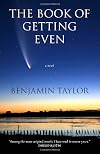
The Book of Getting Even: A Novel
by Benjamin Taylor
On This Page
Description
The son of a rabbi and a budding astronomer, Gabriel Geismer is struggling on his way from youth to manhood in the 1970s when he falls in love with the esteemed and beguiling Hundert family, different in every way from his own. But the Hunderts also embody a complex and far from ideal dynamic. A funny, robust novel, rich in the enduring values endemic to powerful fiction - the exploration of what is hidden, unexpectedness and the authorial skill of laying bare the fundamentals of life.Tags
Recommendations










































Member Reviews
Benjamin Taylor is a writer in full control of the tools available to a practitioner of the language arts. His prose is elegant, his language intoxicating; the stories he tells are rich in detail, full of import, and of intricate disposition. His techniques have been assembled over a lifetime of reading: Nabokov, Bellow, Hemingway, Cather, Isherwood, Woolf. From these and others he has learned unconventional dialog, the trick of presenting action by catalog, the appropriation of history and science, psychology and religion, all of which he brings to bear in the creation of “fully fleshed and blooded” characters. It seems possible to descend from the “L” to a corner in Chicago and encounter Gabriel Geismar from Taylor’s latest show more novel, “The Book of Getting Even,” walking slowly past, musing over the material composition of the cosmos:
It was simultaneously dawning on the three or four best cosmological minds: the multiverse, universes budding from one another, a profusion of universes without beginning or end, our own the merest upstart in the myriad. Universes without beginning or end — this bright idea, with its reintroduction of eternity, infinite regress and infinite progress, universes forever abounding, whispered to Gabriel that perhaps he hadn’t come so far from Terpsichore Street after all since, soberly considered, he was only putting eternal Nature where the eternal God of Abraham, Isaac, and Jacob used to be.” (Pgs. 85-86)
One might even chance upon the magical puppeteer from “Tales Out of School” who, on one’s way home in the afternoon, might approach with his spelling board and introduce himself:
“Old? He was older than old. With a neck as skinny as a cart shaft; and bug-eyes, signifying pathos; and nowhere the trace of a smile.
“Who are you, mister?” Felix asked at the corner of Post Office and Twelfth. He in particular, and Galveston in general, were interested to know.
The ancient of days said nothing, unbuckling his grip instead and taking from it a little board furnished with the letters of the alphabet. S-c-h-m-u-l-o-w-i-c-z, he spelled, pointing to each letter in turn. I—a-m—S-c-h-m-u-l-o-w-i-c-z.” (Pgs. 121-122)
Taylor’s characters are made for a particular time and place, but they embody what persists in human experience, regardless of context: the pain of youth, the pleasure of tenderness, the bewitching impulse to create. In this last he is as much a student as he is a teacher. Every sentence is expertly wrought, designed to wake the brain, combining, as the best writing does, meaning with music and artifice with import. From such language he builds authentic albeit imagined worlds wherein satisfying, sometimes painful, dramas unfold, proving that in contemporary literature one finds, even on a single page, the artful, the imaginative, the credible and the fantastic.
— Carlin M. Wragg, Editor, Open Loop Press show less
It was simultaneously dawning on the three or four best cosmological minds: the multiverse, universes budding from one another, a profusion of universes without beginning or end, our own the merest upstart in the myriad. Universes without beginning or end — this bright idea, with its reintroduction of eternity, infinite regress and infinite progress, universes forever abounding, whispered to Gabriel that perhaps he hadn’t come so far from Terpsichore Street after all since, soberly considered, he was only putting eternal Nature where the eternal God of Abraham, Isaac, and Jacob used to be.” (Pgs. 85-86)
One might even chance upon the magical puppeteer from “Tales Out of School” who, on one’s way home in the afternoon, might approach with his spelling board and introduce himself:
“Old? He was older than old. With a neck as skinny as a cart shaft; and bug-eyes, signifying pathos; and nowhere the trace of a smile.
“Who are you, mister?” Felix asked at the corner of Post Office and Twelfth. He in particular, and Galveston in general, were interested to know.
The ancient of days said nothing, unbuckling his grip instead and taking from it a little board furnished with the letters of the alphabet. S-c-h-m-u-l-o-w-i-c-z, he spelled, pointing to each letter in turn. I—a-m—S-c-h-m-u-l-o-w-i-c-z.” (Pgs. 121-122)
Taylor’s characters are made for a particular time and place, but they embody what persists in human experience, regardless of context: the pain of youth, the pleasure of tenderness, the bewitching impulse to create. In this last he is as much a student as he is a teacher. Every sentence is expertly wrought, designed to wake the brain, combining, as the best writing does, meaning with music and artifice with import. From such language he builds authentic albeit imagined worlds wherein satisfying, sometimes painful, dramas unfold, proving that in contemporary literature one finds, even on a single page, the artful, the imaginative, the credible and the fantastic.
— Carlin M. Wragg, Editor, Open Loop Press show less
I read many different types of books and pride my self on finishing any book that I start, for the first time in 12 years, this was actually difficult. It was as though I was allowed to smell the cake, but never taste. The outline and premiss of the story seemed well thought out and would have led to an excellent book if 10 years of a mans life wasn't squeezed into 176 pages.
 This review was written for LibraryThing Early Reviewers.
"The Book of Getting Even" is a fast moving novel of amazing depth and character. It's one of those books that just moves along very rapidly that one feels breathless just reading it. But packed in there is a coming-of-age story, a bittersweet love story, a story of redemption and growth and self-discovery.
The story is essentially a love triangle set in the 1970s. Our hero, Gabriel Geismar meets twins Daniel and Marghie Hundert; he falls for Danny, and Marghie falls for him. Gabe, as it turns out, falls even more deeply in love with the Hundert parents, Grisha and Lilo, than with their son. The Hundert family is brilliantly evoked in a few deft words that allow us to glimpse much of what is not spoken aloud.
Taylor is a gifted show more storyteller and provides a novel that provides some wonderful glimpses of the human soul. show less
The story is essentially a love triangle set in the 1970s. Our hero, Gabriel Geismar meets twins Daniel and Marghie Hundert; he falls for Danny, and Marghie falls for him. Gabe, as it turns out, falls even more deeply in love with the Hundert parents, Grisha and Lilo, than with their son. The Hundert family is brilliantly evoked in a few deft words that allow us to glimpse much of what is not spoken aloud.
Taylor is a gifted show more storyteller and provides a novel that provides some wonderful glimpses of the human soul. show less
This review was written for LibraryThing Early Reviewers.This book is less a novel than a novella written in broad strokes. The narrative is divided into five chapters and can be easily read in one sitting. I use the words broad strokes above intentionally as this book appears to me to be a written form of an impressionist painting in that Taylor does not delve into details often, if at all in this work. The story of a man's interest and then integration in his chosen family is well-told but does not have the pull that a larger novel would have provided. Taylor has a straight forward writing style that I appreciate but does leave me wanting more. He told a nice story but it could have been so much more.
This review was written for LibraryThing Early Reviewers.'The Book of Getting Even' is a very enjoyable, very quick read. Set in the 1970's, it is the story of Gabriel, the only son of a rabbi from New Orleans and an aspiring astronomer. At college, Gabriel meets, and becomes attached to the Hundert twins and their family, which is nothing like his own. Gabriel is gay and falls for Danny Hundert, but Marghie Hundert falls for Gabriel. Gabriel idolizes the twins' father, a famous physicist. Over the course of a decade or so, the three mature and attempt to find their own identities. A some times funny, other times tender and heart-warming coming-of-age story.
This review was written for LibraryThing Early Reviewers.The author's intent and purpose of the book is summarized at the end and this is the book's major flaw. The book might have been more successful had this intent been woven in through out the book instead of placed as an ending summary. Also, some expository writing on movies that is superflous. The voice changes from narrative to expository and weakens the book.
I've tried to read this book three times, and both times I just can't get past the first chapter. The initial anecdote is so unappealing that I just don't care about any of the characters and I don't trust the author to take it somewhere better.
Maybe I'll pick it up again someday, because I have a hard time not finishing books, but barring the unexpected, I would definitely not recommend this book.
Maybe I'll pick it up again someday, because I have a hard time not finishing books, but barring the unexpected, I would definitely not recommend this book.
This review was written for LibraryThing Early Reviewers.Members
- Recently Added By
Author Information
15+ Works 503 Members
Awards and Honors
Awards
Notable Lists
Classifications
Statistics
- Members
- 70
- Popularity
- 447,580
- Reviews
- 9
- Rating
- (2.69)
- Languages
- English, Spanish
- Media
- Paper, Ebook
- ISBNs
- 4
- ASINs
- 1