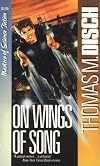
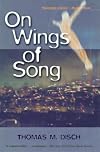
On Wings of Song
by Thomas M. Disch
On This Page
Description
In a disturbing vision of the future, Daniel Weinreb leaves behind the repression and censorship of the Midwest to pursue a career in New York, despite the famine and poverty of the overpopulated East Coast.Tags
Recommendations





















Member Reviews
Every time I reread this, there's more in it. Right now it feels especially timely in its approach to the Midwestern-fascism aspect, where the oppression is messier and less centralized and more contiguous with US history than in a lot of other dystopian fiction. But there's so much else going on. I love the imagery and the dark humor, you can tell that the writer loves everyone in it even if he also can't stand them, and out of all his novels I think it works the best overall as a novel.
I wrote some annotations for it here, if you're into that kind of thing: http://www.errorbar.net/nits/On_Wings_of_Song
I wrote some annotations for it here, if you're into that kind of thing: http://www.errorbar.net/nits/On_Wings_of_Song
I gave up on this one the first time around, but came back to it after a break of several months. It still took me quite a while to make it through, but I am glad I did and plan to seek out Disch's other novels.
The book provides an interesting juxtaposition of the surreal, the mundane, the profound and the profane. I never particularly warmed to the protagonist Daniel Weinreb. But I am kind of a sucker for stories that take as a given the transcendental nature of artistic expression. I didn't really enjoy the first two thirds of the book, but was kind of blown away by the last third.
This is a book where people pay a price for everything they do. It certainly has interesting things to say about the prospective future of the United show more States, things that feel if any thing more relevant today than they might have in 1979. show less
The book provides an interesting juxtaposition of the surreal, the mundane, the profound and the profane. I never particularly warmed to the protagonist Daniel Weinreb. But I am kind of a sucker for stories that take as a given the transcendental nature of artistic expression. I didn't really enjoy the first two thirds of the book, but was kind of blown away by the last third.
This is a book where people pay a price for everything they do. It certainly has interesting things to say about the prospective future of the United show more States, things that feel if any thing more relevant today than they might have in 1979. show less
(Original Review, 1980-07-27)
A paperback edition of Thomas Disch's "On Wings of Song" has come out, just in time to miss the Hugo balloting deadline. Although most of the novels that get nominated seem to be available in hardback, few seem to hit the mass markets in time for the voting. The shorter categories are even more inaccessible, particularly the nominees that appear in hardback anthologies like Orbit that are only bought by libraries. Is it any wonder then, that so few votes get cast? It's just an example of the fine scientific attitude of not deciding unless all the data is in.
Be that as it may, "On Wings of Song" is a well-written novel with a minimal amount of science fiction in it. It's set in a near-future America that is show more slowly going down the tubes. The Eastern cities are largely in ruins, energy supplies are so tight that when terrorists blow up the Alaska pipeline the country is plunged into darkness, industry, agriculture, everything is down. The only unfamiliar element in the picture is that astral projection is regularly possible. By plugging into this machine and singing with sufficient soul, one's mind can leave the body and fly about the world at will. The singing is a necessary, though never really justified condition; if you are tone-deaf or emotionless you'll never make it.
The protagonist is raised in Iowa, a state that is so fearful of the religious implications of flying that it has banned the sale of flying equipment and even frowns upon music in general. Naturally it becomes his life's ambition to fly. He lacks real musical talent, however, and so the book becomes story of his steady degradation in search of his goal. Only when he reaches the very bottom, by becoming a concubine of a castrati’s opera singer, does he come close to taking off.
The reason why this is only barely science fiction is that the flying part of it is hardly touched on. Any transcendent experience could be substituted for it and the plot would work out much the same. Aside from an increase in religious fanaticism in Iowa, no social implications of it are mentioned. People in New York refer to it as casually as if it were a new kind of drink. Disch could be saying that it'll be business as usual in spite of such changes, but I think that he just isn't interested in what is basically a ridiculous premise. Instead he takes a cynic's delight in describing the decay of the country and the humiliation of his characters. The writing is funny and clever enough to pull you through the book, but it leaves a bad aftertaste.
PS. I'm against the idea of rating books we describe in this BBS:
a) because people's tastes differ so much that the ratings
will be meaningless and
b) because you're trying to quantify something, namely the
quality of a book, that is not really quantifiable.
If a description here and a few minutes standing in the Coop or wherever reading the first couple of pages isn't enough, tough.
[2018 EDIT: This review was written at the time as I was running my own personal BBS server. Much of the language of this and other reviews written in 1980 reflect a very particular kind of language: what I call now in retrospect a “BBS language”.] show less
A paperback edition of Thomas Disch's "On Wings of Song" has come out, just in time to miss the Hugo balloting deadline. Although most of the novels that get nominated seem to be available in hardback, few seem to hit the mass markets in time for the voting. The shorter categories are even more inaccessible, particularly the nominees that appear in hardback anthologies like Orbit that are only bought by libraries. Is it any wonder then, that so few votes get cast? It's just an example of the fine scientific attitude of not deciding unless all the data is in.
Be that as it may, "On Wings of Song" is a well-written novel with a minimal amount of science fiction in it. It's set in a near-future America that is show more slowly going down the tubes. The Eastern cities are largely in ruins, energy supplies are so tight that when terrorists blow up the Alaska pipeline the country is plunged into darkness, industry, agriculture, everything is down. The only unfamiliar element in the picture is that astral projection is regularly possible. By plugging into this machine and singing with sufficient soul, one's mind can leave the body and fly about the world at will. The singing is a necessary, though never really justified condition; if you are tone-deaf or emotionless you'll never make it.
The protagonist is raised in Iowa, a state that is so fearful of the religious implications of flying that it has banned the sale of flying equipment and even frowns upon music in general. Naturally it becomes his life's ambition to fly. He lacks real musical talent, however, and so the book becomes story of his steady degradation in search of his goal. Only when he reaches the very bottom, by becoming a concubine of a castrati’s opera singer, does he come close to taking off.
The reason why this is only barely science fiction is that the flying part of it is hardly touched on. Any transcendent experience could be substituted for it and the plot would work out much the same. Aside from an increase in religious fanaticism in Iowa, no social implications of it are mentioned. People in New York refer to it as casually as if it were a new kind of drink. Disch could be saying that it'll be business as usual in spite of such changes, but I think that he just isn't interested in what is basically a ridiculous premise. Instead he takes a cynic's delight in describing the decay of the country and the humiliation of his characters. The writing is funny and clever enough to pull you through the book, but it leaves a bad aftertaste.
PS. I'm against the idea of rating books we describe in this BBS:
a) because people's tastes differ so much that the ratings
will be meaningless and
b) because you're trying to quantify something, namely the
quality of a book, that is not really quantifiable.
If a description here and a few minutes standing in the Coop or wherever reading the first couple of pages isn't enough, tough.
[2018 EDIT: This review was written at the time as I was running my own personal BBS server. Much of the language of this and other reviews written in 1980 reflect a very particular kind of language: what I call now in retrospect a “BBS language”.] show less
One of those books that can make you ache with something resembling what the main character faces. Provides a gloriously poignant story that can transform us by showing us the true meaning of the word "empathy."
Dystopian vision of a Bible-Belt police state America. The economy has collapsed—with millions fleeing their bodies as 'angels' set free by music. We follow Daniel's struggle to find his song (and love). Heady mix of 70's social and political satire with SF's weakness of ideas over high quality writing.
I read this book years ago and remember nothing about it except the intensity with which I hated it, especially given the title, which sounded like it would be a beautiful uplifting story! I was mad at Disch for years over this and never read anything else by him.
An odd but well-written alternative future novel in which food shortages and civil unrest have split America, and people have learnt how to leave their bodies and fly as fairies when they sing with enough intensity.
Members
- Recently Added By
Lists

Harold Bloom - The Western Canon: D. The Chaotic Age
833 works; 24 members

David Pringle's Science Fiction: The 100 Best Novels
101 works; 9 members

Books Read in 2024
4,727 works; 128 members
Author Information

165+ Works 8,128 Members
Thomas Disch was a popular & prolific poet, playwright, essayist, & novelist. He is the author of many works of science fiction & the poetry collections "Dark verses & Light" & "Yes, Let's: New & Selected Poems". (Publisher Provided) Thomas M. Disch was born in Des Moines, Iowa on February 2, 1940. He dropped out of the architecture program at show more Cooper Union, and then left New York University after he sold a short story entitled The Double Timer. His first novel, The Genocides, was published in 1965. His other novels include The House That Fear Built, 334, The M.D., The Priest, The Word of God: Or, Holy Writ Rewritten, and Clara Reeve written under the pseudonym Leonie Hargreave. He won several awards including the 1969 Ditmar Award for Camp Concentration, the O. Henry Award in 1975 for Getting into Death and in 1977 for Xmas, the 1980 John W. Campbell, Jr. Memorial Award for On Wings of Song, and the 1981 British Science Fiction Award for The Brave Little Toaster: A Bedtime Story for Small Appliances. He was also wrote poetry, opera librettos, plays, and criticism of theater, films and art. His collections of poetry include Here I Am, There You Are, Where Are We; The Dark Old House; Yes, Let's: New and Selected Poetry; and Dark Verses and Light. He won the 1999 biennial Michael Braude Award for Light Poetry for A Child's Garden of Grammar, the Locus and Hugo Awards for 1999 for The Dreams Our Stuff is Made Of: How Science Fiction Conquered the World, and the Puschcart Prize for The First Annual Performance Art Festival at Slaughter Rock Battlefield. His criticism appeared in several publications including The Nation, The New York Daily News, and The New York Sun. In 1987, he wrote a script for the television series Miami Vice. He shot himself on July 4, 2008 at the age of 68. (Bowker Author Biography) show less
Some Editions
Awards and Honors
Awards
Series
Belongs to Publisher Series
Common Knowledge
- Canonical title
- On Wings of Song
- Original title
- On Wings of Song
- Alternate titles
- 歌の翼に
- Original publication date
- 1979
- People/Characters
- Daniel Weinraub
- Important places
- Iowa, USA; New York, USA; Manhattan, New York, New York, USA
- Dedication
- For Charles Naylor
- First words
- When he was five Daniel Weinreb's mother disappeared.
- Quotations*
- Glaube ist eine Art von selektiver Blindheit.
- Last words
- (Click to show. Warning: May contain spoilers.)"I pledge allegiance," she declared, with her voice breaking and tears in her eyes, "to the flag of the United States of America, and to the republic for which it stands, one nation under God, indivisible, with liberty and justice for all."
- Blurbers
- Ellison, Harlan
- Original language*
- Englisch
*Some information comes from Common Knowledge in other languages. Click "Edit" for more information.
Classifications
Statistics
- Members
- 559
- Popularity
- 53,077
- Reviews
- 10
- Rating
- (3.68)
- Languages
- 6 — English, French, German, Japanese, Polish, Spanish
- Media
- Paper, Ebook
- ISBNs
- 14
- ASINs
- 7