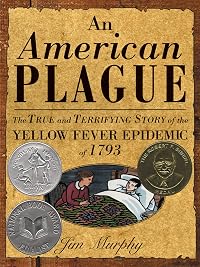
An American Plague: The True and Terrifying Story of the Yellow Fever Epidemic of 1793
by Jim Murphy
On This Page
Description
It's 1793, and there's an invisible killer roaming the streets of Philadelphia. The city's residents are fleeing in fear. This killer has a name--yellow fever--but everything else about it is a mystery. Its cause is unknown and there is no cure. This powerful dramatic account by award-winning author Jim Murphy traces the devastating course of the epidemic. An American Plague offers a fascinating glimpse into the conditions in American cities at the time of our nation's birth while drawing show more thought-provoking parallels to modern-day epidemics. show lessTags
Recommendations





Member Recommendations
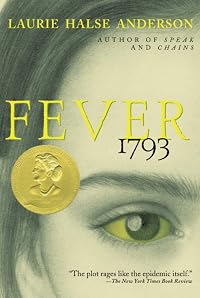
BookshelfMonstrosity While Fever is fiction and An American Plague is nonfiction, both are utterly compelling accounts of the yellow fever epidemic that ravaged Colonial Philadelphia. Rich details, based on extensive research, highlight the previously neglected care-giving role of African-Americans.
Also recommended by bogreader
20
Member Reviews
An American Plague, written by Jim Murphy, presents the “True and Terrifying Story of the Yellow Fever Epidemic of 1793”. Murphy’s writing style is thorough and detailed without being sensationalistic about a very serious topic. He begins with a map of Philadelphia in 1793, and uses illustrations and other images throughout the book to enhance each chapter. Murphy’s book is divided into eleven chapters and ends with his sources, acknowledgments, a “note about illustrations” and an index. The book is organized chronologically, beginning with August, 1793, and ending with modern accounts of yellow fever and the efforts to stop it. Each chapter begins with a quote from a primary source of the time, and Murphy’s rich language show more helps bring the story to life.
Murphy tells what would seem to be an impossible story. In just a few weeks’ time, the citizens of Philadelphia, capitol of the newly formed United States and home of President Washington and his wife, fell victim to the yellow fever. The disease did not discriminate, like other deadly plagues throughout history, and poor and rich alike died within days. The background information provided in the first chapter lets the reader get into the story as if living at the time; Murphy’s overview of the role of the French in the American Revolution as well as the medical knowledge of the time set the stage for later events. These details give the reader a sense of what conflicts and contrasts existed in Philadelphia at this time. Dr. Benjamin Rush is a major player in the dramatic tale of the disease, and a controversial one at that. Murphy writes about Rush’s treatment of patients, and the technique of bleeding which he employed, which was not without its detractors. Rush was the first to put a name to the sickness spreading throughout the city: yellow fever. Murphy writes, “Putting the name yellow fever to the illness was not to be done lightly. Yellow fever was one of the most vicious diseases in the world and could create panic anywhere”. And it did create panic, resulting in thousands fleeing the city within one week of Rush’s declaration. What followed is described in poignant detail by Murphy; houses and businesses abandoned, a fledgling government in crisis, and families torn apart. Luxurious homes were turned into hospitals, markets ceased selling goods for the farmers would not venture into town, and the seams of civilization unraveled. Murphy writes, “The crime rate went up, and there was rioting…Apothecary shops were broken into and medicines stolen; food was taken from the few farmer’s wagons to appear in town…Tenants, made jobless by the fever, ran out of rent money and were turned out of their homes”.
When it seemed as if it couldn’t get any worse, colder weather started to move in and the death toll began to fall. At the end of October, President Washington returned to the city after fleeing to safety months before. By November, there were hardly any accounts of the fever in the city of Philadelphia, and, “The city filled up again and took on its normal, preplague pace. The markets bustled with activity; the taverns and coffeehouses buzzed with conversation; the federal, state, and local governments took up the business they had left off in September’.
Murphy’s book is indeed a “true and terrifying story”. It is almost hard to believe that something like that could happen so quickly and affect so many people. I found his style of writing to be very effective and very moving. I was particularly interested in the role of the Free African Society in helping people through the outbreak of the fever. I want to learn more about the history of this organization past this one event. I also want to read more about the coffeehouses of the era, and how many women owned and ran these establishments. In my opinion, Jim Murphy’s book is a well written and thorough account of the yellow fever in 1793, and I highly recommend it. show less
Murphy tells what would seem to be an impossible story. In just a few weeks’ time, the citizens of Philadelphia, capitol of the newly formed United States and home of President Washington and his wife, fell victim to the yellow fever. The disease did not discriminate, like other deadly plagues throughout history, and poor and rich alike died within days. The background information provided in the first chapter lets the reader get into the story as if living at the time; Murphy’s overview of the role of the French in the American Revolution as well as the medical knowledge of the time set the stage for later events. These details give the reader a sense of what conflicts and contrasts existed in Philadelphia at this time. Dr. Benjamin Rush is a major player in the dramatic tale of the disease, and a controversial one at that. Murphy writes about Rush’s treatment of patients, and the technique of bleeding which he employed, which was not without its detractors. Rush was the first to put a name to the sickness spreading throughout the city: yellow fever. Murphy writes, “Putting the name yellow fever to the illness was not to be done lightly. Yellow fever was one of the most vicious diseases in the world and could create panic anywhere”. And it did create panic, resulting in thousands fleeing the city within one week of Rush’s declaration. What followed is described in poignant detail by Murphy; houses and businesses abandoned, a fledgling government in crisis, and families torn apart. Luxurious homes were turned into hospitals, markets ceased selling goods for the farmers would not venture into town, and the seams of civilization unraveled. Murphy writes, “The crime rate went up, and there was rioting…Apothecary shops were broken into and medicines stolen; food was taken from the few farmer’s wagons to appear in town…Tenants, made jobless by the fever, ran out of rent money and were turned out of their homes”.
When it seemed as if it couldn’t get any worse, colder weather started to move in and the death toll began to fall. At the end of October, President Washington returned to the city after fleeing to safety months before. By November, there were hardly any accounts of the fever in the city of Philadelphia, and, “The city filled up again and took on its normal, preplague pace. The markets bustled with activity; the taverns and coffeehouses buzzed with conversation; the federal, state, and local governments took up the business they had left off in September’.
Murphy’s book is indeed a “true and terrifying story”. It is almost hard to believe that something like that could happen so quickly and affect so many people. I found his style of writing to be very effective and very moving. I was particularly interested in the role of the Free African Society in helping people through the outbreak of the fever. I want to learn more about the history of this organization past this one event. I also want to read more about the coffeehouses of the era, and how many women owned and ran these establishments. In my opinion, Jim Murphy’s book is a well written and thorough account of the yellow fever in 1793, and I highly recommend it. show less
Jim Murphy writes so eloquently about a terrible tragedy for early America, the yellow fever epidemic of 1793. The first thing that hit me about this book was Murphy's excellent story-telling style of writing. I almost felt like I was reading Tolkien in the first paragraphs, "The sun came up, as it had every day since the end of May, bright, hot, and unrelenting. The swamps and marshes south of Philadelphia had already lost a great deal of water to the intense heat, while the Delaware and Schuylkill Rivers had receded to reveal long stretches of their muddy, root choked banks. Dead fish and gooey vegetable matter were exposed and rotted, while swarms of insects droned in the heavy, humid air.
In Philadelphia itself an increasing number show more of cats were dropping dead every day, attracting, one Philadelphian complained, 'an amazing number of flies and other insects.' Mosquitoes were everywhere, though their high-pitched whirring was particularly loud near rain barrels, gutters, and open sewers.
These sewers, called 'sinks' were particularly ripe this year. Most streets in the city were unpaved and had no system of covered sewers and pipes to channel water away from buildings. Instead, deep holes were dug at various street corners to collect runoff water and anything else that might be washed along. Dead animals were routinely tossed into this soup, where everything decayed and sent up noxious bubbles to foul the air." (p1,2)
I have several things that I want to talk about for this opening. As previously stated, the writing is phenomenal. Murphy goes into great detail to provide excellent imagery and really put us in Philadelphia. Harping on the vile atmosphere, further set up by his description of the spoiled coffee that had been dumped by a nearby ship on the next page sets up really well for the plague, because doctors at the time really thought that disease originated from bad smells. I love how much Murphy goes into the medical practices and beliefs at the time because bleeding a patient to get out the bad blood does not seem like something an American doctor would prescribe. There is a hint about the mosquitos however, the true carrier of the epidemic.
This leads into my next commentary about how thoroughly this book is researched. I have done many literature searches in my time for science papers, but I have no idea how he found a quote from some random citizen on what was at the time just a normal day complaining about the number of flies. There are 12 pages of sources listed in the back of the book, even categorized topically.
Anyone looking for a good read will love this book, learning something is an excellent perk. I would recommend this for any American history class, especially to read for summer reading or over a break so that students can fully appreciate the writing, although if they enjoy reading, they won't need the whole break because they won't be able to put the book down. show less
In Philadelphia itself an increasing number show more of cats were dropping dead every day, attracting, one Philadelphian complained, 'an amazing number of flies and other insects.' Mosquitoes were everywhere, though their high-pitched whirring was particularly loud near rain barrels, gutters, and open sewers.
These sewers, called 'sinks' were particularly ripe this year. Most streets in the city were unpaved and had no system of covered sewers and pipes to channel water away from buildings. Instead, deep holes were dug at various street corners to collect runoff water and anything else that might be washed along. Dead animals were routinely tossed into this soup, where everything decayed and sent up noxious bubbles to foul the air." (p1,2)
I have several things that I want to talk about for this opening. As previously stated, the writing is phenomenal. Murphy goes into great detail to provide excellent imagery and really put us in Philadelphia. Harping on the vile atmosphere, further set up by his description of the spoiled coffee that had been dumped by a nearby ship on the next page sets up really well for the plague, because doctors at the time really thought that disease originated from bad smells. I love how much Murphy goes into the medical practices and beliefs at the time because bleeding a patient to get out the bad blood does not seem like something an American doctor would prescribe. There is a hint about the mosquitos however, the true carrier of the epidemic.
This leads into my next commentary about how thoroughly this book is researched. I have done many literature searches in my time for science papers, but I have no idea how he found a quote from some random citizen on what was at the time just a normal day complaining about the number of flies. There are 12 pages of sources listed in the back of the book, even categorized topically.
Anyone looking for a good read will love this book, learning something is an excellent perk. I would recommend this for any American history class, especially to read for summer reading or over a break so that students can fully appreciate the writing, although if they enjoy reading, they won't need the whole break because they won't be able to put the book down. show less
This Newbery Honor book is a quick read and I found it fascinating. I have no idea if children would. I wouldn't have when I was young, I have to admit.
But I think more of our political and other leaders need to know more history. What I found amazing here is how little our social policy and other reactions have changed in the years since. We still don't know enough science, either, or have the sense to trust our scientists more.
The need for quarantine balanced against the 'disruption' of commerce & city business sure rings a bill while we try to achieve a recovery from the disruption of Covid-19.
"The science of medicine at the end of the 18th century still relied a great deal on ancient myths and folk remedies. Because of this, people show more did not automatically reject the opinion of someone simply because that person wasn't a trained doctor."
Also I learned stuff I didn't know. For example how like ordinary people George Washington and the other founding fathers lived... they were decidedly *not* revered! And Washington trying to figure out how to help France, in return for their help in our revolution, without bankrupting our new nation.
Most of the people really did want to do good. The mayor, Matthew Clarkson, and a committee borrowed money on their own credit to pay to fight the plague. The Free African Society, black people, organized and served all, including whites, even after they started coming down with the disease.
Benjamin P. Morgan is a bad guy who sound like one of the people who are upset at Georgia's Democratic successes of 2020 and wants to restrict voting to "respectable inhabitants" (the ones who fled the city for their country homes...).
The last chapter is titled "A Modern-Day Time Bomb." Mosquitos evolve to be resistant to pesticides in just seven years. "It is a struggle with no real end."
Excellent source notes and an index.
Highly recommended to anyone trying to fill in some of the history they didn't learn in school. show less
But I think more of our political and other leaders need to know more history. What I found amazing here is how little our social policy and other reactions have changed in the years since. We still don't know enough science, either, or have the sense to trust our scientists more.
The need for quarantine balanced against the 'disruption' of commerce & city business sure rings a bill while we try to achieve a recovery from the disruption of Covid-19.
"The science of medicine at the end of the 18th century still relied a great deal on ancient myths and folk remedies. Because of this, people show more did not automatically reject the opinion of someone simply because that person wasn't a trained doctor."
Also I learned stuff I didn't know. For example how like ordinary people George Washington and the other founding fathers lived... they were decidedly *not* revered! And Washington trying to figure out how to help France, in return for their help in our revolution, without bankrupting our new nation.
Most of the people really did want to do good. The mayor, Matthew Clarkson, and a committee borrowed money on their own credit to pay to fight the plague. The Free African Society, black people, organized and served all, including whites, even after they started coming down with the disease.
Benjamin P. Morgan is a bad guy who sound like one of the people who are upset at Georgia's Democratic successes of 2020 and wants to restrict voting to "respectable inhabitants" (the ones who fled the city for their country homes...).
The last chapter is titled "A Modern-Day Time Bomb." Mosquitos evolve to be resistant to pesticides in just seven years. "It is a struggle with no real end."
Excellent source notes and an index.
Highly recommended to anyone trying to fill in some of the history they didn't learn in school. show less
This was an interesting and informative book, but could have been much better. It is a short book, only about 150 pages. But the narrative is even shorter as there are many illustrations, which are actually the best part of the book. On almost every other page is an illustration from the time period, thus reducing the prose.
The book is the story of the Yellow Fever plague in Philadelphia in 1793. Unfortunately, the medical community neither knew what caused the disease, nor how to properly cure it. Only later did they learn the disease was carried by mosquitoes.
Overall, it is not a bad book, but I wish the story had gone deeper into the daily life of the citizens of Philadelphia and how they coped with the plague, as well as some show more in-depth stories of those who suffered and recovered from the disease.
As I said, the illustrations are beautiful and are the best part of the book, thus I was able to give it 3 stars. As it is a very short read, I can recommend it for those interested in this subject. There is a nice index and list of sources at the end for those wishing to read further on the subject. show less
The book is the story of the Yellow Fever plague in Philadelphia in 1793. Unfortunately, the medical community neither knew what caused the disease, nor how to properly cure it. Only later did they learn the disease was carried by mosquitoes.
Overall, it is not a bad book, but I wish the story had gone deeper into the daily life of the citizens of Philadelphia and how they coped with the plague, as well as some show more in-depth stories of those who suffered and recovered from the disease.
As I said, the illustrations are beautiful and are the best part of the book, thus I was able to give it 3 stars. As it is a very short read, I can recommend it for those interested in this subject. There is a nice index and list of sources at the end for those wishing to read further on the subject. show less
Jim Murphy, in this well-researched and engaging book, allows the reader to feel as if they are living in Philadelphia in 1793 experiencing the yellow fever epidemic firsthand. His recounting, mainly from the doctor's perspectives, shows the reader just how desperate the situation actually was. At first, no one could quite pinpoint what was causing illness to sweep through the city. Most people hoped it was just a summer fever that would pass. Murphy then points out that famed doctor of the time, Dr. Benjamin Rush, was the first to suspect yellow fever, but that his colleagues dismissed his findings. He tries to warn people, and use his cure of a severe emetic made of calomel and jalap in order to get his patients to purge the toxins show more from their body. This leads to several doctors trying anything they can think of in order to cure their patients. In the end, about 5000 people perished from the disease, with even more struck down by it but surviving. Included in the book, which I really liked, was a newspaper clipping naming all of the fever victims that they knew. This primary source, although very sad, will help show readers the sheer number of people who died. It is one thing to read 5000, it is another to see all the names in black and white. Also, Murphy shows how all the people who remained in Philadelphia, without the means to leave like the more wealthy citizens, for the most part banned together and helped one another through it. Despite all the sorrow, the book has an optimistic view. Preachers, doctors, the mayor, and members of the Free African Society worked together to tend to the sick, set up a makeshift hospital, and run an orphanage. I enjoyed reading over the pages of resources that Murphy used, including all of the primary sources he found. All in all, this is an excellent resource to show people what actually happens during an epidemic, as well as the effects of yellow fever itself during colonial times. show less
Earlier this summer, I read Laurie Halse Anderson’s Fever 1793, a piece of historical fiction which recounts the widespread yellow fever that nearly wiped out the booming city of Philadelphia shortly after the end of the Revolutionary War. Anderson’s book is told through the eyes of a teenage girl whose family is torn asunder by the fever and who must quickly “grow up” in order to survive the plague. Prior to reading Fever 1793, I was previously unaware of this calamity, and I did not realize just how traumatic this experience was for the city of Philadelphia.
Jim Murphy’s An American Plague mines similar territory as Anderson’s Fever 1793, but presents those events without the aid of a fictional narrative. Surprisingly, show more Murphy’s recounting of the events is actually more entertaining and educational that Anderson’s novel; in fact, An American Plague might even be the most fascinating “history book” that I’ve ever read. Murphy uses some very traditional “textbook” devices, such as the frequent incorporation of vintage illustrations and documents, but what really drives the novel is Murphy’s narrative style. Murphy is a gifted storyteller who manages to make dull history come alive through his poetic narration of events – no small feat for retelling a little-known piece of American history.
The most interesting aspect of the book, for me, was the discussion of African-American scapegoat-ing (discussed in chapter ten). Although Anderson takes a broad hand examining the issue of race in Fever 1793, Murphy examines race relations in the aftermath of the plague with great attention to detail. Additionally, the final chapter of Murphy’s book extends farther forward in history, describing subsequent outbreaks of yellow fever and the discovery of its origins (those pesky mosquitoes). This helps provide a sense of closure to An American Plague that seems absent from Anderson’s historical fiction.
Jim Murphy has written a compelling, engaging account of history in An American Plague. If only all American history classes were as entertaining as this novel, more children might actually enjoy history. And that truly is a testament to the power of Murphy’s writing.
Citation:
Murphy, Jim. An American Plague: The True and Terrifying Story of the Yellow Fever Epidemic of 1793. New York: Clarion, 2003. Print. show less
Jim Murphy’s An American Plague mines similar territory as Anderson’s Fever 1793, but presents those events without the aid of a fictional narrative. Surprisingly, show more Murphy’s recounting of the events is actually more entertaining and educational that Anderson’s novel; in fact, An American Plague might even be the most fascinating “history book” that I’ve ever read. Murphy uses some very traditional “textbook” devices, such as the frequent incorporation of vintage illustrations and documents, but what really drives the novel is Murphy’s narrative style. Murphy is a gifted storyteller who manages to make dull history come alive through his poetic narration of events – no small feat for retelling a little-known piece of American history.
The most interesting aspect of the book, for me, was the discussion of African-American scapegoat-ing (discussed in chapter ten). Although Anderson takes a broad hand examining the issue of race in Fever 1793, Murphy examines race relations in the aftermath of the plague with great attention to detail. Additionally, the final chapter of Murphy’s book extends farther forward in history, describing subsequent outbreaks of yellow fever and the discovery of its origins (those pesky mosquitoes). This helps provide a sense of closure to An American Plague that seems absent from Anderson’s historical fiction.
Jim Murphy has written a compelling, engaging account of history in An American Plague. If only all American history classes were as entertaining as this novel, more children might actually enjoy history. And that truly is a testament to the power of Murphy’s writing.
Citation:
Murphy, Jim. An American Plague: The True and Terrifying Story of the Yellow Fever Epidemic of 1793. New York: Clarion, 2003. Print. show less
This is the most personalized, emotional, detailed account of disease that I have ever read. I loved the way the author introduces us to the real life characters in detail, including their motivations, interests, and families. He shows us the disease through their eyes, making us feel very involved in the story. The narrative style moves along a fluid timeline, tracking the epidemic from its origins to its inevitable conclusion with the onset of winter. Along the way, the author delves deeply into the disease’s effects on government, politics, medical care, and city maintenance. Then he gives us a glimpse of life after the epidemic, and how much Philadelphia has changed because of it. Only at the end of the story does he give us the show more real scientific facts about what how the disease originates and is spread. This means that until the last chapter, we are as puzzled about the disease as the people who are living through it. This really helps the reader to feel involved with the characters, by keeping us on their level of knowledge until the very end. This book would make excellent across-the-curriculum research material for the middle school or high school student, since it is a study in science, social studies, and language arts. show less
Members
- Recently Added By
Lists

Best History Books about Epidemics
27 works; 24 members

Best Books About Plagues and Epidemics
99 works; 15 members

Newbery Honor Books By year - II - 1981-2035
143 works; 4 members

Books Read in 2024
4,623 works; 126 members

Robert F. Sibert Informational Book Medal
102 works; 1 member
Author Information

41+ Works 12,308 Members
Jim Murphy has written more than twenty-five books for young people. In addition to the Newbery Honor, which he received for The Great Fire, he has won many other awards, including the Robert F. Sibert Informational Book Award and a Boston Globe/Horn Book Honor. He is also the two-time winner of both the SCBWI Golden Kite Award and the NCTE Orbis show more Pictus Award Mr. Murphy lives with his family in Maplewood, New Jersey show less
Awards and Honors
Awards
Distinctions
Notable Lists
Common Knowledge
- Canonical title
- An American Plague: The True and Terrifying Story of the Yellow Fever Epidemic of 1793
- Original publication date
- 2003
- People/Characters
- Walter Reed
- Important places
- Philadelphia, Pennsylvania, USA; Pennsylvania, USA
- Important events
- Yellow Fever Epidemic (1793); Disaster: Infectious Disease
- Dedication
- For Mike and Ben – my wonderful, at-home germ machines. This one’s for you!
With love, Dad - First words
- Saturday, August 3, 1793. The sun came up, as it had every day since the end of May, bright, hot, and unrelenting.
- Last words
- (Click to show. Warning: May contain spoilers.)Yellow fever as we know it now might be conquered, but another version of the disease will eventually emerge to challenge us again. And when it does, we will have to overcome our fears and be prepared to confront it.
- Publisher's editor
- Stevenson, Dinah
- Original language
- English
Classifications
- Genres
- Nonfiction, Kids
- DDC/MDS
- 614.5 — Applied science & technology Medicine & health Epidemics, Poisons, Alternative Medicine Incidence of and public measures to prevent specific diseases and kinds of diseases
- LCC
- RA644 .Y4 .M875 — Medicine Public aspects of medicine Public aspects of medicine Public health. Hygiene. Preventive medicine Disease (Communicable and noninfectious) and public
- BISAC
Statistics
- Members
- 1,445
- Popularity
- 16,237
- Reviews
- 97
- Rating
- (3.93)
- Languages
- English, French
- Media
- Paper, Audiobook, Ebook
- ISBNs
- 17
- UPCs
- 1
- ASINs
- 9