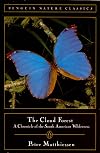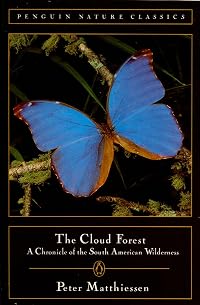
The Cloud Forest: A Chronicle of the South American Wilderness
by Peter Matthiessen
On This Page
Description
For twenty thousand miles, Peter Matthiessen crisscrossed the South American wilderness, traveling from the Amazonian rain forests to Machu Picchu high in the Andes, down to the edge of the world at Tierra del Fuego and back. In the course of his journey, he followed the trails of old explorers; encountered river bandits, wild tribesmen, and the evidence of ancient ruins; and discovered a fossilized snout of a giant unknown crocodilian hidden in the depths of the jungle on the wild mountain show more rivers of Peru.Filled with observations and descriptions of the people and the fading wildlife of this vast world to the south, The Cloud Forest is Matthiessen’s incisive, wry report of his expedition into some of the last and most exotic wild terrains in the world. show lessTags
Recommendations



















Member Reviews
The Cloud Forest is an account of an extended trip the author took to South America, spending most of his time in Peru although he also wandered through Argentina and Brazil, and did get as far as Patagonia and Tierra del Fuego at one point. Given the amount of territory he covered, it is perhaps not surprising that Matthiessen spends less time talking about cultures or ecosystems, and more time describing the succession of truly precarious conveyances he was forced to use--rickety buses driven by men with little concern for the safety of their passengers, standing room-only rail cars for trips that would take fourteen hours, flimsy boats manned by inexperienced crews, tiny airplanes piloted with the kind of fatalism that comes from show more flying over innumerable crash sites. Each time the author climbs into one of these things, one gets the sense he is putting himself in the hands of fate. Presumably, such an attitude was a requirement when traveling in the bush, or one would never get anywhere.
A writer of naturalist inclinations, Matthiessen faithfully records all the birds he sees with the diligence of a birder adding species to his life list, and he is suitably interested, and wary, of fauna with teeth. There is an extended section where he tries to determine the "most dangerous" animal in the jungle, and everyone he asks agrees that it is the Bushmaster-- a pit viper -- but that it is a thing rarely encountered. He does confirm, by personal experience, that it is safe to swim in a river with piranhas as long as one isn't bleeding or sporting any open wounds. But he doesn't go into the natural histories of the species he encounters, so they remain mere snapshots as he floats, or drives, or walks, or flies by.
But landscape he does beautifully, especially when he is describing scenes from the windows of whatever doubtful aircraft he has consigned himself to.
The last part of the book is devoted to a poorly-planned, poorly-executed, and almost absurd "expedition" to search out a giant fossilized mandibula that was rumored to have been discovered on the banks of the Pongo river deep in the Peruvian jungle. It's the kind of trip that would make John Reveirs, the savvy guide from Turn Right at Machu Picchu, shake his head in disgust. Matthiessen seems to have got through on a wing and a prayer and a whole lot of dumb luck.
But he does devote considerable time to describing the indigenous peoples he comes across--most of them in a state of cultural disintegration owing to the effects of industrial forays into the jungle, "modernization" and civilization beating back the forest, and the indefatigable efforts of various Christian missionaries to save their souls. This last group comes in for some very harsh criticism by the author, who finds that those who have been "saved" are almost always left in a worse condition than they had been as heathens. Despite the occasional missionary who seems to have the well being of the natives truly at heart, the general practice seems to have been to strip the natives of their culture, hand them Bibles, force them into clothes, and then take off for the next wild tribe in need of salvation, leaving the newly saved peoples to fend for themselves in a culture they neither understood nor had any place in. Sort of an evangelical version of the slash and burn agriculture that was decimating the rain forest.
This was in 1960, so steps have been taken to slow down the decimation of indigenous peoples -- indeed, Matthiessen makes a point of talking about steps that were being taken even at that point: including one law that made it illegal to murder a native even in self defense. Of course, laws are only as good as your ability to enforce them, and the country Matthiessen is traveling through is utterly lawless. He learned to go armed. But the only thing he shot was a capybara, which he promptly lost in the river, thus losing his chance for something besides yuca for dinner.
As is probably clear at this point, The Cloud Forest is ultimately more of an adventure story than a "travel" narrative. But as adventure stories go, it is pretty impressive. show less
A writer of naturalist inclinations, Matthiessen faithfully records all the birds he sees with the diligence of a birder adding species to his life list, and he is suitably interested, and wary, of fauna with teeth. There is an extended section where he tries to determine the "most dangerous" animal in the jungle, and everyone he asks agrees that it is the Bushmaster-- a pit viper -- but that it is a thing rarely encountered. He does confirm, by personal experience, that it is safe to swim in a river with piranhas as long as one isn't bleeding or sporting any open wounds. But he doesn't go into the natural histories of the species he encounters, so they remain mere snapshots as he floats, or drives, or walks, or flies by.
But landscape he does beautifully, especially when he is describing scenes from the windows of whatever doubtful aircraft he has consigned himself to.
The last part of the book is devoted to a poorly-planned, poorly-executed, and almost absurd "expedition" to search out a giant fossilized mandibula that was rumored to have been discovered on the banks of the Pongo river deep in the Peruvian jungle. It's the kind of trip that would make John Reveirs, the savvy guide from Turn Right at Machu Picchu, shake his head in disgust. Matthiessen seems to have got through on a wing and a prayer and a whole lot of dumb luck.
But he does devote considerable time to describing the indigenous peoples he comes across--most of them in a state of cultural disintegration owing to the effects of industrial forays into the jungle, "modernization" and civilization beating back the forest, and the indefatigable efforts of various Christian missionaries to save their souls. This last group comes in for some very harsh criticism by the author, who finds that those who have been "saved" are almost always left in a worse condition than they had been as heathens. Despite the occasional missionary who seems to have the well being of the natives truly at heart, the general practice seems to have been to strip the natives of their culture, hand them Bibles, force them into clothes, and then take off for the next wild tribe in need of salvation, leaving the newly saved peoples to fend for themselves in a culture they neither understood nor had any place in. Sort of an evangelical version of the slash and burn agriculture that was decimating the rain forest.
This was in 1960, so steps have been taken to slow down the decimation of indigenous peoples -- indeed, Matthiessen makes a point of talking about steps that were being taken even at that point: including one law that made it illegal to murder a native even in self defense. Of course, laws are only as good as your ability to enforce them, and the country Matthiessen is traveling through is utterly lawless. He learned to go armed. But the only thing he shot was a capybara, which he promptly lost in the river, thus losing his chance for something besides yuca for dinner.
As is probably clear at this point, The Cloud Forest is ultimately more of an adventure story than a "travel" narrative. But as adventure stories go, it is pretty impressive. show less
Adventure travel writing at its finest, absolutely enthralling, especially when you stop to contemplate the logistics of travel in the Amazon, pre-roads, telephone, etc. A wonderful read, by one of my favorite authors.
Beautiful and meticulous: a travel book without any manufactured drama, just close and absorbing observation.
Another of Mattheissen's great travel tales.
Ratings
Members
- Recently Added By
Lists

Trees
22 works; 5 members
Author Information

48+ Works 13,947 Members
Peter Matthiessen was born in Manhattan, New York on May 22, 1927. He served in the Navy at Pearl Harbor. He graduated with a degree in English from Yale University in 1950. It was around this time that he was recruited by the CIA and traveled to Paris, where he became acquainted with several young expatriate American writers. In the postwar years show more the CIA covertly financed magazines and cultural programs to counter the spread of Communism. While in Paris, he helped found The Paris Review in 1953. After returning to the United States, he worked as a commercial fisherman and the captain of a charter fishing boat. His first novel, Race Rock, was published in 1954. His other fiction works include Partisans, Raditzer, Far Tortuga, and In Paradise. His novel, Shadow Country, won a National Book Award. His novel, At Play in the Fields of the Lord, was made into a movie. He started writing nonfiction after divorcing his first wife. An assignment for Sports Illustrated to report on American endangered species led to the book Wildlife in America, which was published in 1959. His travels took him to Asia, Australia, South America, Africa, New Guinea, the Florida swamps, and beneath the ocean. These travels led to articles in The New Yorker as well as numerous nonfiction books including The Cloud Forest: A Chronicle of the South American Wilderness, Under the Mountain Wall: A Chronicle of Two Seasons of Stone Age New Guinea, Blue Meridian: The Search for the Great White Shark, The Tree Where Man Was Born, and Men's Lives. The Snow Leopard won the 1979 National Book Award for nonfiction. He died from leukemia on April 5, 2014 at the age of 86. (Bowker Author Biography) show less
Series
Belongs to Publisher Series
Common Knowledge
- Canonical title
- The Cloud Forest: A Chronicle of the South American Wilderness
- Important places
- South America; Amazon Rainforest, Amazon Basin, South America
- Dedication
- For Andres Porras Caceres, my excdellent friend and mentor on the Urubamba, whose wiser head prevailed, and
For Lucha and Alfredo Porras Caceres, whose kind welcome in Lima and at La Honda, in January, March, and May, made... (show all) so much difference. - First words
- A pale November sky, like a sky on the moon.
- Last words
- (Click to show. Warning: May contain spoilers.)"Between the outer world and the secrets of ancient South America," as Colonel Fawcett once lamented, "a veil has descended," and it now appears that the giant mandibula will remain behind it, sinking slowly beneath man's detritus on the steaming banks of the Ucayali.
Classifications
Statistics
- Members
- 328
- Popularity
- 97,167
- Reviews
- 4
- Rating
- (3.86)
- Languages
- English, French
- Media
- Paper, Audiobook, Ebook
- ISBNs
- 20
- ASINs
- 6