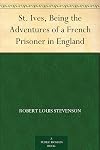
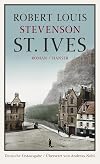
St. Ives
by Robert Louis Stevenson
On This Page
Description
Short excerpt: It was in the month of May 1813 that I was so unlucky as to fall at last into the hands of the enemy.Tags
Recommendations























Member Reviews
I love this story, but I confess that I stopped reading at p. 390. So, don't worry about spoilers….
I've always maintained a coldly mechanical willingness to stop reading a book whenever the time comes….in St. Ives, the time comes at Chapter XXXI.
Stevenson died after writing XXX chapters of St. Ives, and a respected contemporary, Sir Arthur Thomas Quiller-Couch, wrote the remaining VI chapters from Stevenson's notes.
Stevenson's oeuvre is fastidiously lush, precise, sophisticated, with deeply contextual character development and dialogue that leaves me breathless with anticipation for more. There's an abstractly beautiful love interest. Did I mention that I'm a fan of 19th century prose?
Quiller-Couch doubtless had his merits as a 19th show more century writer. He ain't no Stevenson.
Q-C's contribution to St. Ives lacks the prepossessing heartiness of Stevenson's dialogue and storyline.
Q-C can't quite gin up the panache and persiflage that RLS animates on nearly every page.
Q-C makes a too sincere but unavailing effort to match the rural patois that Stevenson offers for the reader's delight.
Q-C bungles the parlous adventures of the eponymous protagonist, injecting a wretched slapstick element that leads an RLS fan to transition uncomfortably into pursed-lips mode.
Stevenson's prosaic mastery is, sadly, missing in the last VI chapters of St. Ives, and, therefore, ignorance shall be my penalty for closing this truncated masterpiece before I reached the end.
Read more on my blog: http://barleyliterate.blogspot.com/2013/11/book-review-st-ives-being-adventures-... show less
I've always maintained a coldly mechanical willingness to stop reading a book whenever the time comes….in St. Ives, the time comes at Chapter XXXI.
Stevenson died after writing XXX chapters of St. Ives, and a respected contemporary, Sir Arthur Thomas Quiller-Couch, wrote the remaining VI chapters from Stevenson's notes.
Stevenson's oeuvre is fastidiously lush, precise, sophisticated, with deeply contextual character development and dialogue that leaves me breathless with anticipation for more. There's an abstractly beautiful love interest. Did I mention that I'm a fan of 19th century prose?
Quiller-Couch doubtless had his merits as a 19th show more century writer. He ain't no Stevenson.
Q-C's contribution to St. Ives lacks the prepossessing heartiness of Stevenson's dialogue and storyline.
Q-C can't quite gin up the panache and persiflage that RLS animates on nearly every page.
Q-C makes a too sincere but unavailing effort to match the rural patois that Stevenson offers for the reader's delight.
Q-C bungles the parlous adventures of the eponymous protagonist, injecting a wretched slapstick element that leads an RLS fan to transition uncomfortably into pursed-lips mode.
Stevenson's prosaic mastery is, sadly, missing in the last VI chapters of St. Ives, and, therefore, ignorance shall be my penalty for closing this truncated masterpiece before I reached the end.
Read more on my blog: http://barleyliterate.blogspot.com/2013/11/book-review-st-ives-being-adventures-... show less
I would call it a 19th century bathtub book (def: book suitable for reading in the bathtub). Writing is lovely, characterizations are disarming, storyline is farfetched. Its near-fatal drawback: RLS died before finishing it and the publisher gave it to Mr. Quiller-Couch to wrap up based on Stevenson's notes. Unfortunately, he turned a charming treat into a boring slog.
I enjoyed this novel, chancing upon a film version of the story shortly afterwards. The escape from Edinburgh Castle may reflect a real event in 1799, when French prisoners-of-war were assisted in their escape by the Revd William Fitzsimmons, the incumbent of the Cowgate Episcopal Chapel; the escapees in 1799 headed for a ship in the Firth of Forth.
Postuum voltooid (door Arthur Quiller-Couch)
Ratings
Members
- Recently Added By
Author Information

2,802+ Works 139,520 Members
Novelist, poet, and essayist Robert Louis Stevenson was born in Edinburgh, Scotland. A sickly child, Stevenson was an invalid for part of his childhood and remained in ill health throughout his life. He began studying engineering at Edinburgh University but soon switched to law. His true inclination, however, was for writing. For several years show more after completing his studies, Stevenson traveled on the Continent, gathering ideas for his writing. His Inland Voyage (1878) and Travels with a Donkey (1878) describe some of his experiences there. A variety of essays and short stories followed, most of which were published in magazines. It was with the publication of Treasure Island in 1883, however, that Stevenson achieved wide recognition and fame. This was followed by his most successful adventure story, Kidnapped, which appeared in 1886. With stories such as Treasure Island and Kidnapped, Stevenson revived Daniel Defoe's novel of romantic adventure, adding to it psychological analysis. While these stories and others, such as David Balfour and The Master of Ballantrae (1889), are stories of adventure, they are at the same time fine studies of character. The Master of Ballantrae, in particular, is a study of evil character, and this study is taken even further in The Strange Case of Dr. Jekyll and Mr. Hyde (1886). In 1887 Stevenson and his wife, Fanny, went to the United States, first to the health spas of Saranac Lake, New York, and then on to the West Coast. From there they set out for the South Seas in 1889. Except for one trip to Sidney, Australia, Stevenson spent the remainder of his life on the island of Samoa with his devoted wife and stepson. While there he wrote The Wrecker (1892), Island Nights Entertainments (1893), and Catriona (1893), a sequel to Kidnapped. He also worked on St. Ives and The Weir of Hermiston, which many consider to be his masterpiece. He died suddenly of apoplexy, leaving both of these works unfinished. Both were published posthumously; St. Ives was completed by Sir Arthur Quiller-Couch, and The Weir of Hermiston was published unfinished. Stevenson was buried on Samoa, an island he had come to love very much. Although Stevenson's novels are perhaps more accomplished, his short stories are also vivid and memorable. All show his power of invention, his command of the macabre and the eerie, and the psychological depth of his characterization. (Bowker Author Biography) show less
All Editions
Some Editions
Awards and Honors
Series
Belongs to Publisher Series
Work Relationships
Common Knowledge
- Canonical title*
- St. Ives
- Original title
- St. Ives: Being The Adventures of a French Prisoner in England
- Original publication date
- 1897
- People/Characters
- Jacques St Ives
- Related movies
- St. Ives (2000 | IMDb)
- First words
- It was in the month of May 1813 that I was so unlucky as to fall at last into the hands of the enemy.
- Last words
- (Click to show. Warning: May contain spoilers.)And I turned from my own conflicting thoughts to comfort her.
*Some information comes from Common Knowledge in other languages. Click "Edit" for more information.
Classifications
Statistics
- Members
- 275
- Popularity
- 117,359
- Reviews
- 4
- Rating
- (3.28)
- Languages
- 8 — Dutch, English, Finnish, German, Italian, Polish, Russian, Spanish
- Media
- Paper, Ebook
- ISBNs
- 62
- ASINs
- 43