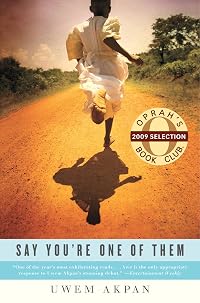
Say You're One of Them
by Uwem Akpan
On This Page
Description
Uwem Akpan's stunning stories humanize the perils of poverty and violence so piercingly that few readers will feel they've ever encountered Africa so immediately. The eight-year-old narrator of 'An ex-mas feast' needs only enough money to buy books and pay fees in order to attend school. Even when his twelve-year-old sister takes to the streets to raise these meager funds, his dream can't be granted. Food comes first. His family lives in a street shanty in Nairobi, Kenya, but their way of show more both loving and taking advantage of each other strikes a universal chord. In the second of his stories published in a New Yorker special fiction issue, Akpan takes us far beyond what we thought we knew about the tribal conflict in Rwanda. The story is told by a young girl, who, with her little brother, witnesses the worst possible scenario between parents. They are asked to do the previously unimaginable in order to protect their children. In 'What language is that?' two little Ethiopian girls are best friends until their parents suddenly say they cannot speak to each other anymore because one is Muslim and the other is Christian. This singular collection will also take the reader inside Nigeria, Benin, and Ethiopia, revealing in beautiful prose the harsh consequences for children of life in Africa. show lessTags
Recommendations






Member Recommendations

Member Reviews
Although I don't often read short stories, the spine of this book caught my eye, and I'm glad it did. Uwem Akpan is a Jesuit priest from Nigeria who was educated in Kenya and the US. He says he wanted to write "a book about how children are faring in these endless conflicts in Africa. The world is not looking. I think fiction allows us to sit for a while with people we would rather not meet...I want their voices heard, their faces seen" (from an interview in The New Yorker quoted in the after matter). The result is a collection of five stories narrated by children who are trying to make sense of a violent world without the help of adults and often at the mercy of them.
In An Ex-mas Feast Jigana is waiting in a leaky shanty in Kenya for show more his twelve-year-old sister, Maisha, to return. She is a prostitute and the only reliable income for the family. Sniffing glue to stave off the pangs of hunger, Jigana argues with his parents that he would rather give up going to school than have Maisha move to a brothel to earn the school fees.
Fattening for Gabon is the story of ten-year-old Kotchikpa and his five-year-old sister Yewa. They are being raised by their uncle because their parents have aids. In an attempt to increase his fortunes, Uncle Fofo trades his wards for a motorcycle that he can use to illegally ferry more people across the Benin-Nigeria border. He is instructed to teach the children certain things in preparation for their journey to Gabon.
In What Language is That? a younger sibling talks about the relationship between two little girls who live across the street from one another in Ethiopia. They are best friends until sectarian violence breaks out, and their parents forbid them to speak to one another.
In Luxurious Hearses sixteen-year-old Jubril boards a bus of refugees bound for southern Nigeria. Ethnic cleansing has swept through the north, and despite considering himself a conservative Muslim, one who has willingly submitted to Sharia law, he is targeted by his friends for having Christian relatives. The bus is a microcosm of society as a whole and conflict between religions, genders roles, politics, civilian/military, and age consumes the passengers.
The last story, My Parents' Bedroom is the shortest but most devastating. Nine-year-old Monique is from a blended family. Her mother is Tutsi and her father is Hutu. One night she is told to watch her younger brother and to not open the door for anyone.
Despite their horrific nature, each story contains a moment of grace: an act of kindness that, although unable to mitigate the present, offers a glimmer of hope for the future. Sometimes a child can be saved, sometimes a person of one religion will protect a person of another religion, sometimes an adult is a safe person. But not often. And there are always consequences.
These stories are well-written and, with the exception of Luxurious Hearses which drags a bit, page-turners. I can't say I enjoyed reading this collection, but I am glad I read it. show less
In An Ex-mas Feast Jigana is waiting in a leaky shanty in Kenya for show more his twelve-year-old sister, Maisha, to return. She is a prostitute and the only reliable income for the family. Sniffing glue to stave off the pangs of hunger, Jigana argues with his parents that he would rather give up going to school than have Maisha move to a brothel to earn the school fees.
Fattening for Gabon is the story of ten-year-old Kotchikpa and his five-year-old sister Yewa. They are being raised by their uncle because their parents have aids. In an attempt to increase his fortunes, Uncle Fofo trades his wards for a motorcycle that he can use to illegally ferry more people across the Benin-Nigeria border. He is instructed to teach the children certain things in preparation for their journey to Gabon.
In What Language is That? a younger sibling talks about the relationship between two little girls who live across the street from one another in Ethiopia. They are best friends until sectarian violence breaks out, and their parents forbid them to speak to one another.
In Luxurious Hearses sixteen-year-old Jubril boards a bus of refugees bound for southern Nigeria. Ethnic cleansing has swept through the north, and despite considering himself a conservative Muslim, one who has willingly submitted to Sharia law, he is targeted by his friends for having Christian relatives. The bus is a microcosm of society as a whole and conflict between religions, genders roles, politics, civilian/military, and age consumes the passengers.
The last story, My Parents' Bedroom is the shortest but most devastating. Nine-year-old Monique is from a blended family. Her mother is Tutsi and her father is Hutu. One night she is told to watch her younger brother and to not open the door for anyone.
Despite their horrific nature, each story contains a moment of grace: an act of kindness that, although unable to mitigate the present, offers a glimmer of hope for the future. Sometimes a child can be saved, sometimes a person of one religion will protect a person of another religion, sometimes an adult is a safe person. But not often. And there are always consequences.
These stories are well-written and, with the exception of Luxurious Hearses which drags a bit, page-turners. I can't say I enjoyed reading this collection, but I am glad I read it. show less
Each one of these stories is a dagger through the heart. The stories in this collection are all seen through the eyes of children, and each story illuminates in gripping and heartbreaking detail and intensity the violence, strife and economic struggles to be found throughout Africa. Each story takes place in a different country, and through the eyes of the child protagonists, we are taken into the heart of poverty, child slavery and cold-blooded inter-tribal and inter-religion slaughter. The writing is stunning, bringing each character and each tragic situation fully alive in all its inhuman, but also human, intensity. This is a very rough book, but, I think, an essential one. Highest possible rating.
If you are looking for a book that will restore your faith in humanity and your hope for a brighter future for mankind, this is not the book you are looking for. The stories in this collection show kids in horrible situations, victims of the various evils their communities create for them, including extreme poverty, child trafficking, sexual molestation, murder, and genocidal violence. While the stories are fiction, they are based on real life, and bring to life several horrible events in recent African history that are often reduced to less unpleasant, safer narratives in news reports and history books. Kids all over the world are subjected to similar evils, so not only do these stories make the horrific conditions in parts of Africa show more disturbingly real, but they also show what kids closer to home are going through, from their own perspectives. Reading this book may not inspire readers to like humanity more, but it may lead to some rather fruitful discussions about what we are doing to ourselves and how we can make things better. show less
I would have given this book 5 stars if the dialog had been easier to follow. There's a lot of French and other words thrown in the dialog so it was a bit hard to follow, but the narrative and actions around the dialog were clear and concise, so I was able to follow the stories well enough. Having footnotes at the bottom of pages with a translation would have helped.
These stories are NOT happy, so you cannot consider this a 'light' read, and as for enjoyable... well... I didn't enjoy it in the sense that I might enjoy a Stephen King or Nora Roberts novel or such. These stories are depressing, and are supposed to be. There's various topics - poverty, starvation, violence, slavery, child trafficking, violence between the government and show more citizens as well as violence over religion, violence between Tutsis and Hutus... the list goes on. Even a abused child here in America is better off than these poor kids, since at least here you have Child Protective Services, social workers, foster homes, you get the idea. The last story of this book (My Parents' Bedroom) reminded me of the movie 'Hotel Rwanda', since it was about the violence between the Hutus and Tutsis, though in the book it's especially more poignant since it's told from a child's perspective (all of these stories are)
This fact was hard to remember in 'Luxurious Hearses' because the narrator is 16 years old, but he actually sounds much older and more mature because of what he has been through, and I will say that after reading this book, I felt especially lucky that I was born and raised here in America. It's especially sad when you know that the stories in this book might be of fictional characters, but everything that happens - slavery, violence, etc - really does happen in Africa even today and you know that real children have to deal with this crap every day. It's awful, really. show less
These stories are NOT happy, so you cannot consider this a 'light' read, and as for enjoyable... well... I didn't enjoy it in the sense that I might enjoy a Stephen King or Nora Roberts novel or such. These stories are depressing, and are supposed to be. There's various topics - poverty, starvation, violence, slavery, child trafficking, violence between the government and show more citizens as well as violence over religion, violence between Tutsis and Hutus... the list goes on. Even a abused child here in America is better off than these poor kids, since at least here you have Child Protective Services, social workers, foster homes, you get the idea. The last story of this book (My Parents' Bedroom) reminded me of the movie 'Hotel Rwanda', since it was about the violence between the Hutus and Tutsis, though in the book it's especially more poignant since it's told from a child's perspective (all of these stories are)
This fact was hard to remember in 'Luxurious Hearses' because the narrator is 16 years old, but he actually sounds much older and more mature because of what he has been through, and I will say that after reading this book, I felt especially lucky that I was born and raised here in America. It's especially sad when you know that the stories in this book might be of fictional characters, but everything that happens - slavery, violence, etc - really does happen in Africa even today and you know that real children have to deal with this crap every day. It's awful, really. show less
Digital audiobook (abridged) performed by Robin Miles & Dion Graham
4****
This is a collection of short stories, dealing with various social issues facing African people throughout numerous countries on the continent. One story may deal with the Rwandan genocide (My Parents’ Bedroom), while another explores the competing goals of a family at Christmas (An Ex-Mas Feast), and yet another shows how a desperate uncle raising children orphaned by AIDS is coerced into an agreement he cannot keep (Fattening for Gabon). Two stories deal with the differences between Muslims and Christians (Luxurious Hearses focuses on a Muslim youth living with his mother in Nigeria’s north who is hoping to reunite with his Christian father in the south, show more while two six-year-old Best Friends in Ethiopia try to understand why their parents now tell them they must not play with one another (What Language Is That?).
All are beautifully written even when heart-wrenchingly difficult to read. Uwem focuses an unblinking eye on serious issues and while the reader is fortunate to not have to face such dilemmas, the reactions of the characters are totally understandable and relatable. The local English dialect used in some of the stories was sometimes difficult to get used to, but really gave a sense of place to the narrative.
The audiobook is abridged, with narrators reading only three of the stories. Still, Robin Miles and Dion Graham do a wonderful job of performing the text. And it is sometimes easier to understand the local dialect by hearing it than reading it on the page. show less
4****
This is a collection of short stories, dealing with various social issues facing African people throughout numerous countries on the continent. One story may deal with the Rwandan genocide (My Parents’ Bedroom), while another explores the competing goals of a family at Christmas (An Ex-Mas Feast), and yet another shows how a desperate uncle raising children orphaned by AIDS is coerced into an agreement he cannot keep (Fattening for Gabon). Two stories deal with the differences between Muslims and Christians (Luxurious Hearses focuses on a Muslim youth living with his mother in Nigeria’s north who is hoping to reunite with his Christian father in the south, show more while two six-year-old Best Friends in Ethiopia try to understand why their parents now tell them they must not play with one another (What Language Is That?).
All are beautifully written even when heart-wrenchingly difficult to read. Uwem focuses an unblinking eye on serious issues and while the reader is fortunate to not have to face such dilemmas, the reactions of the characters are totally understandable and relatable. The local English dialect used in some of the stories was sometimes difficult to get used to, but really gave a sense of place to the narrative.
The audiobook is abridged, with narrators reading only three of the stories. Still, Robin Miles and Dion Graham do a wonderful job of performing the text. And it is sometimes easier to understand the local dialect by hearing it than reading it on the page. show less
Say You're One of Them by Uwem Akpan is a searing, rewarding read that opened a new door and sent me on a long overdue delve into African history and culture.
Akpan writes with elegance and a palpable sense of mission. The collection of five beautifully paced stories serve a secondary function of reportage as well - so much you need to know about Africa is here, a million questions answered including the stupid ones, the morbid ones, the unspeakable ones.
Such as - how do the different religions rub along with each other and the indigenous shamanistic traditions? Is everyone in Africa starving? What precisely is going on inside a country during genocide? Are African people in general sociable or reserved? Are they class-conscious? What show more becomes of charitable, religious and military missions entering Africa from the developed world?
And so on...
The stories are just glorious and moving and bittersweet anshocking. Violence is shown delicately, for the most part, but without censorship. Sharing a child's perspective is to share the uncomprehending acceptance as the protagonists scrabble for life in their various resourceful ways.
This book would go well on a high school curriculum; studied carefully the stories would reap a rich harvest of understanding and allow Africa's children to speak to their counterparts all over the world. show less
Akpan writes with elegance and a palpable sense of mission. The collection of five beautifully paced stories serve a secondary function of reportage as well - so much you need to know about Africa is here, a million questions answered including the stupid ones, the morbid ones, the unspeakable ones.
Such as - how do the different religions rub along with each other and the indigenous shamanistic traditions? Is everyone in Africa starving? What precisely is going on inside a country during genocide? Are African people in general sociable or reserved? Are they class-conscious? What show more becomes of charitable, religious and military missions entering Africa from the developed world?
And so on...
The stories are just glorious and moving and bittersweet anshocking. Violence is shown delicately, for the most part, but without censorship. Sharing a child's perspective is to share the uncomprehending acceptance as the protagonists scrabble for life in their various resourceful ways.
This book would go well on a high school curriculum; studied carefully the stories would reap a rich harvest of understanding and allow Africa's children to speak to their counterparts all over the world. show less
I'm really torn about this book. On the one hand, Akpan tells a crucial and gripping story about violence and the horrors of war upon children. We can't ignore these fallen voices. On the other hand, I feel like people *already* have this perception of Africa as a continent of violence, of genocide, of poverty. And if there's anything I've learned from Chimamanda Ngozi Adichie's amazing talk, "The Danger of a Single Story," it's this: we cannot reduce a complex history to a single story. Therefore, I won't be teaching this in a survey course but will instead save for a seminar in a more focused conversation about diverse African (or even Nigerian) writers.
That said, the story, "My Parents' Bedroom," would make an interesting show more conversation piece if you needed a short story unit. show less
That said, the story, "My Parents' Bedroom," would make an interesting show more conversation piece if you needed a short story unit. show less
Members
- Recently Added By
Published Reviews
ThingScore 88
Even the most realistic humanist films and literature are rendered with a beauty of perception that lifts us beyond ourselves even as it wounds us.
Though he is obviously a talented writer, in these stories such transcendence eludes Uwem Akpan. Inevitability is an integral part of tragedy, but for it to overwhelm us, we mustn’t see it coming. Inevitability is far different from the queasy show more dread of waiting for horrors we’ve already guessed at. show less
Though he is obviously a talented writer, in these stories such transcendence eludes Uwem Akpan. Inevitability is an integral part of tragedy, but for it to overwhelm us, we mustn’t see it coming. Inevitability is far different from the queasy show more dread of waiting for horrors we’ve already guessed at. show less
added by Shortride
[The] imagery... is far more vibrant than the mechanical ways in which these stories move toward doom. With his trajectory always a fait accompli, Mr. Akpan fares better with small, evocative details than with broad strokes.
added by Shortride
The distinct voices of these child narrators and the horrors they bear witness to make Say You're One of Them a haunting debut short-story collection. Or, perhaps it would be more faithful to the bleak tone of these stories to say that readers will be damned to remember them.
added by Shortride
Lists

Oprah's Book Club (original and 2.0)
91 works; 21 members

Short Story Collections and Anthologies
261 works; 42 members

Favorite Short Fiction
228 works; 99 members

Literature by People of Color
81 works; 9 members

Books To Get From The Library
115 works; 5 members

Books Set In Africa
81 works; 4 members

Florida
366 works; 3 members
Author Information

4+ Works 2,566 Members
Uwem Akpan (1971) is a Nigerian Jesuit priest and the author of Say You¿re One of Them (2008), a collection of five stories (each set in a different African country) published by Little, Brown & Company. It was picked by the Oprah Winfrey Book Club on September 17, 2009. He was born in the southern Nigerian village of Ikot Akpan Eda; his parents show more were teachers. He and his three brothers grew up speaking both English and Annang. He joined the Jesuit order at 19 in 1990 and became a priest in 2003; he later earned an M.F.A. degree in creative writing at the University of Michigan. He has also studied theology at Creighton University. (Bowker Author Biography) show less
Awards and Honors
Awards
Distinctions
Notable Lists
Common Knowledge
- Canonical title
- Say You're One of Them
- Original publication date
- 2008-06-09
- People/Characters
- Jean; Monique; Jubril; Selam; Fofo; Big Guy (show all 10); Yewa/Mary; Kotchikpa/Pascal; Maisha; Jigana
- Important places
- Nigera; Rwanda
- Important events
- Rwandan Genocide (1994)
- Epigraph
- If our God, the one we serve, is able to save us from the burning fiery furnace and from your power, O king, he will save us; and even if he does not, then you must know, O king, that we will not serve your god or worship the... (show all) statue you have erected. - - Daniel 3:17-18
What is good has been explained to you . . . to act justly, to love tenderly, and to walk humbly with your God. - - Micah 6:8 - Dedication
- For my parents, Linus and Margaret, whose love is a world of stories between them.
And for Uncle George, who was there. - First words
- Now that my eldest sister, Maisha, was twelve, none of us knew how to relate to her anymore.
- Last words
- (Click to show. Warning: May contain spoilers.)My brother is playing with the glow of the crucifix, babbling Maman's name.
- Blurbers
- Karr, Mary; Abani, Chris; Erdrich, Louise; Maslin, Janet; Orner, Peter; Hijuelos, Oscar (show all 9); Wright, Franz; Godwin, Peter; Shepard, Jim
- Original language
- English
Classifications
Statistics
- Members
- 2,473
- Popularity
- 7,822
- Reviews
- 76
- Rating
- (3.62)
- Languages
- 9 — Chinese, Dutch, English, French, German, Italian, Korean, Portuguese, Spanish
- Media
- Paper, Audiobook, Ebook
- ISBNs
- 28
- ASINs
- 20