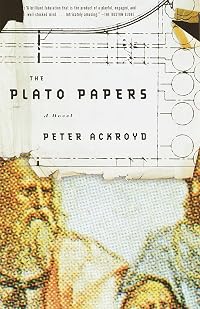
The Plato Papers
by Peter Ackroyd
On This Page
Description
Plato, the orator, summons the citizens of London on ritual occasions to impart the ancient history of their city. He dwells particularly on the unhappy era of Mouldwarp (AD 1500-2300), which existed before the dimming of the stars and the burning of the machines. He lectures upon THE ORGIN OF SPECIES by the nineteenth-century novelist Charles Dickens and upon the pantomimic routines of Sigmund Freud. But then he has a dream, or vision, or he goes on a real journey -opinions are divided - show more and enters a vast underground cavern, where citizens of Mouldwarp London still live. When Plato returns with stories of this lost world he is put on trial for corrupting the youth by means of lies and fables. Are their lives part of some greater reality? And, if they learn to doubt, perhaps they will be able to recognise a truth beyond that of their own world. All will depend upon the judgement of Plato by his fellow citizens. show lessTags
Recommendations

















Member Recommendations


Member Reviews
This is a strange little book set in a version of London, which takes place about 1800 years in the future. The characters are living at the end of what is described as a long dark age followed by a new period of enlightenment (literally--the beings inhabiting this world radiate their own light). It's a meditation on our desire to paint cyclical pictures of history and to impose our own understandings onto past eras. At first, it seems like a long joke, a more philosophical version of David Macauley's great "Motel of the Mysteries."
But, the second half, in which Plato sees a version of the past superimposed on and coexisting with his own world, was strangely haunting. He leaves us with the urgent reminder to question everything. Though show more it is twenty years old, this does not yet feel dated, in spite of some gloomy pronouncements about Mouldwarp humans being ensnared in a "Web" of darkness that led to the downfall of their civilization. Rather, I think given our times, it's even more important to look head-on at how the needs of the present always necessitate shaping the past to suit ourselves. show less
But, the second half, in which Plato sees a version of the past superimposed on and coexisting with his own world, was strangely haunting. He leaves us with the urgent reminder to question everything. Though show more it is twenty years old, this does not yet feel dated, in spite of some gloomy pronouncements about Mouldwarp humans being ensnared in a "Web" of darkness that led to the downfall of their civilization. Rather, I think given our times, it's even more important to look head-on at how the needs of the present always necessitate shaping the past to suit ourselves. show less
I found Peter Ackroyd’s The Plato Papers, his mostly forgotten 1999 offering, in the basement of a Bemidji bookstore. Bought it, put it on a shelf for a couple of years, and having lately finished a re-read of some Plato, thought it a good time to polish this diminutive book off. Well, it’s actually 173 pages but that’s Nan A. Talese’s formatting trick. A small hardcover with giant margins and maximum use of white space at the start (and usually finish) of all 55 chapters. Naturally enough, much of the text is in dialogue. And what does it all have to do with Plato? Next to nothing, actually.
The Plato Papers uses the future as a conceit to talk about the past. In 2299 a "collapsophe" plunges London into a new sci-fi dark age but show more the city endures and by 3705 the orator Plato is entertaining crowds with his interpretations of 'ancient texts.' When he’s not delivering orations, he’s conversing with his soul. When he’s not on the page, friends with improbable names are discussing him and his ideas.
That’s it. My hopes were not high, as it sounds like a glib work of postmodernism with no greater purpose than to showcase Ackroyd’s cleverness. Some of it does fall into that trap. The Plato Papers can be split roughly in half – while the second half delves into metaphysics, the first is all about the blithely overeducated joke as when Plato offers definitions of ancient idioms.
"dead end: a place where corpses were taken … Those who chose to inhabit these areas apparently suffered from a ‘death wish.’"
"literature: a word of unknown provenance, generally attributed to ‘litter’ or waste."
I mean, come on! These are glorified puns, funny literalisms it can’t have taken Ackroyd more than a second to compile. Occasionally, one hits the mark:
"pedestrian: one who journeyed on foot. Used as a term of abuse, as in ‘this is a very pedestrian plot.’ It is possible, therefore, that in ancient days walking was considered to be an ignoble or unnatural activity; this would explain the endless varieties of transport used to convey people for very short distances."
This is amusing yet reflective. The conclusion is wrong but it feels plausible and the verdict is pleasantly illuminating. It’s also very lightly treated, which sums up my experience with the whole work. Some call it a satire, but it’s not mean enough by half. And as a novel of ideas, it puts all the right ingredients together…in the smallest possible amounts. Throughout, Ackroyd is making a point about the treatment of history, the interpretations we make about 'the wrong ages' (essentially how we always feel about the past). Each new generation unaware that history has them in its gunsights as well.
Madrigal: … But why are the beliefs of our ancestors so ridiculous? I am sure that they were sincerely held.
Ornatus: No doubt.
Madrigal: Perhaps, in the future someone might laugh at – well – you and me.
Ornatus: There is nothing funny about us.
Madrigal: As far as we know.
Of course, The Plato Papers is too diffuse to really impress with its intellect. It flits from scene to scene and all the critical praise adorning the dust jacket can’t obscure the fact that this is foremost a light read. It wants to amuse. Plato’s orations are postmodern routines and they form the bulk of the text. Dickens and Darwin are confuted in the best sequence, offering The Origin of Species as a novel with an unreliable narrator at the helm. Freud (pronounced Fraud, ha ha) is assumed a comedian. Poe’s Tales and Histories is taken at face value as a factual account of the American people. "Its inhabitants dwelled in very large and very old houses which, perhaps because of climactic conditions, were often covered with lichen or ivy. In many respects the architecture of these ancient mansions conformed to the same pattern; they contained libraries and galleries, chambers of antique painting and long corridors leading in serpentine fashion to great bolted doors. … they were a highly nervous people, who suffered from a morbid acuteness of their faculties. They experienced continually ‘a vague feeling of terror and despair’. They were prone to the most extreme sensations of wonder or hilarity and there seems to have been an unusual amount of lunacy among the young."
As Plato talks to his soul, the cheap jokes go by the wayside and Ackroyd gets down to business. History is bent and run through Plato’s Cave. Willful illusion, rather than simple ignorance, becomes a main tenet of human behaviour. The stubborn Ornatus says “Ignorance is better than doubt” and the citizens of London reject Plato’s new and more accurate findings on ancient ways because to countenance them would introduce uncertainty – and require humility. To class your ancestors as ignorant makes you enlightened; to call them barbarians is to make yourself civilized. Plato tests the limits of his world, not by journeying to another, but by admitting his own errors. This makes him a pariah and he is soon put on trial…
In a final prank, Ackroyd chose not to finish his fable with an ending everyone already knows. Perhaps he thought that would be predictable, or would clash with his established tone. Or perhaps he was making the point that, even while unconscious of the past, history does not always repeat and there is hope for the human race. Deeper meaning aside, Ackroyd’s finale is diffuse, anti-climactic and very appropriately the final word in the book is dream.
Yes, there’s a fair amount of artistry on display in The Plato Papers. However, it’s not likely to satisfy many readers with its combination of highly metaphorical sci-fi and postmodern jokery. Sure, it stimulates the intellect, but it bounces around too much to feel really substantial and based on this sample it makes sense that he’s more known for his non-fiction these days. I enjoyed it but I would never claim it qualifies as a necessary addition to the library of any non-Ackroyd fan. The characters are flat, the prose is average, the imagery does not dazzle…and yet the whole concoction is so odd I can’t help but like it. In its favour, it absolutely does have the ability to spark thought. It’s one of those cases where the reviews are a necessary addendum to the book. There’s an excellent essay on it at London Fictions that I direct you to as a case in point. Ackroyd’s erudite. In the end I’m glad I picked it up.
http://pseudointellectualreviews.wordpress.com/2014/04/24/the-plato-papers-peter... show less
The Plato Papers uses the future as a conceit to talk about the past. In 2299 a "collapsophe" plunges London into a new sci-fi dark age but show more the city endures and by 3705 the orator Plato is entertaining crowds with his interpretations of 'ancient texts.' When he’s not delivering orations, he’s conversing with his soul. When he’s not on the page, friends with improbable names are discussing him and his ideas.
That’s it. My hopes were not high, as it sounds like a glib work of postmodernism with no greater purpose than to showcase Ackroyd’s cleverness. Some of it does fall into that trap. The Plato Papers can be split roughly in half – while the second half delves into metaphysics, the first is all about the blithely overeducated joke as when Plato offers definitions of ancient idioms.
"dead end: a place where corpses were taken … Those who chose to inhabit these areas apparently suffered from a ‘death wish.’"
"literature: a word of unknown provenance, generally attributed to ‘litter’ or waste."
I mean, come on! These are glorified puns, funny literalisms it can’t have taken Ackroyd more than a second to compile. Occasionally, one hits the mark:
"pedestrian: one who journeyed on foot. Used as a term of abuse, as in ‘this is a very pedestrian plot.’ It is possible, therefore, that in ancient days walking was considered to be an ignoble or unnatural activity; this would explain the endless varieties of transport used to convey people for very short distances."
This is amusing yet reflective. The conclusion is wrong but it feels plausible and the verdict is pleasantly illuminating. It’s also very lightly treated, which sums up my experience with the whole work. Some call it a satire, but it’s not mean enough by half. And as a novel of ideas, it puts all the right ingredients together…in the smallest possible amounts. Throughout, Ackroyd is making a point about the treatment of history, the interpretations we make about 'the wrong ages' (essentially how we always feel about the past). Each new generation unaware that history has them in its gunsights as well.
Madrigal: … But why are the beliefs of our ancestors so ridiculous? I am sure that they were sincerely held.
Ornatus: No doubt.
Madrigal: Perhaps, in the future someone might laugh at – well – you and me.
Ornatus: There is nothing funny about us.
Madrigal: As far as we know.
Of course, The Plato Papers is too diffuse to really impress with its intellect. It flits from scene to scene and all the critical praise adorning the dust jacket can’t obscure the fact that this is foremost a light read. It wants to amuse. Plato’s orations are postmodern routines and they form the bulk of the text. Dickens and Darwin are confuted in the best sequence, offering The Origin of Species as a novel with an unreliable narrator at the helm. Freud (pronounced Fraud, ha ha) is assumed a comedian. Poe’s Tales and Histories is taken at face value as a factual account of the American people. "Its inhabitants dwelled in very large and very old houses which, perhaps because of climactic conditions, were often covered with lichen or ivy. In many respects the architecture of these ancient mansions conformed to the same pattern; they contained libraries and galleries, chambers of antique painting and long corridors leading in serpentine fashion to great bolted doors. … they were a highly nervous people, who suffered from a morbid acuteness of their faculties. They experienced continually ‘a vague feeling of terror and despair’. They were prone to the most extreme sensations of wonder or hilarity and there seems to have been an unusual amount of lunacy among the young."
As Plato talks to his soul, the cheap jokes go by the wayside and Ackroyd gets down to business. History is bent and run through Plato’s Cave. Willful illusion, rather than simple ignorance, becomes a main tenet of human behaviour. The stubborn Ornatus says “Ignorance is better than doubt” and the citizens of London reject Plato’s new and more accurate findings on ancient ways because to countenance them would introduce uncertainty – and require humility. To class your ancestors as ignorant makes you enlightened; to call them barbarians is to make yourself civilized. Plato tests the limits of his world, not by journeying to another, but by admitting his own errors. This makes him a pariah and he is soon put on trial…
In a final prank, Ackroyd chose not to finish his fable with an ending everyone already knows. Perhaps he thought that would be predictable, or would clash with his established tone. Or perhaps he was making the point that, even while unconscious of the past, history does not always repeat and there is hope for the human race. Deeper meaning aside, Ackroyd’s finale is diffuse, anti-climactic and very appropriately the final word in the book is dream.
Yes, there’s a fair amount of artistry on display in The Plato Papers. However, it’s not likely to satisfy many readers with its combination of highly metaphorical sci-fi and postmodern jokery. Sure, it stimulates the intellect, but it bounces around too much to feel really substantial and based on this sample it makes sense that he’s more known for his non-fiction these days. I enjoyed it but I would never claim it qualifies as a necessary addition to the library of any non-Ackroyd fan. The characters are flat, the prose is average, the imagery does not dazzle…and yet the whole concoction is so odd I can’t help but like it. In its favour, it absolutely does have the ability to spark thought. It’s one of those cases where the reviews are a necessary addendum to the book. There’s an excellent essay on it at London Fictions that I direct you to as a case in point. Ackroyd’s erudite. In the end I’m glad I picked it up.
http://pseudointellectualreviews.wordpress.com/2014/04/24/the-plato-papers-peter... show less
This is a playful intellectual exercise in speculative fiction which postulates a thirty-eighth century scholar trying to understand how people lived in former eras, principally our own, from the snippets of material culture which have been left behind. And he invariably gets it hilariously wrong; the twentieth century's greatest comedian was named Sigmund Freud, the finest source for how Americans lived in the nineteenth century was E. A. Poe, and their favorite comic novelist was named Charles Darwin. He also provides his disciples with a similarly garbled glossary of terms used in the period for their own researches. This is great fun and wildly inventive; the spell broken occasionally by the author interjecting political opinion, show more presumably his own, and some lackluster interstitial bits which advance a skeletal plot. show less
Peter Ackroyd is best known to me as one of England's finest writers, and an entertaining expert on London and the country it dominates. 'The Plato Papers' is, for me, a brightly illuminating star in an infinitely broader canvas, that of life and its self-perception. All societies seem to throw up outsiders, and the human subject of the society which is here the context is fortunate in having his alien qualities accepted as such without rancour, despite endemic misunderstanding. The setting is a London of the far future, for which present times are pathetically (and amusingly) mistaken, and the character called Plato is found arguing that the accepted world picture of his future existence invites and embraces enlightening comparisons show more that are unpalatable to this future picture. It is a short novel whose arguments are both clearly set out and startlingly illuminating. A superb book. show less
A clever short novel set in the year 3700, in a future London where a future Plato orates to the people of the city about the distant, obscured past (including on the novelist Charles Dickens' reviled story On the Origin of Species, the humorist Sigmund Freud, and the Esteemed American Poet known as E. A. Poe. The book ends up being both a playful meditation on misinterpretation of historical evidence and on the nature of philosophical inquiry generally.
Ackroyd makes a sharp criticism of modern society and fully creates a utopian future society. Use of quotes from created texts helps him transition the reader seamlessly from present day into a future utopia which he prompts the reader to fill in with just enough detail.
His structure, floating between direct storytelling from the perspective of Plato and dialogue, mimics the Socratic dialogues, and fits the form perfectly, and is fresh and incisive as the plot follows Plato's increasing frenzy.
Occasionally, especially during his worldbuilding, Ackroyd would dip from satiric commentary to abrasive condescension, but generally his thoughts were seamlessly inserted into his characters' points of view.
Altogether, recommended: an show more enjoyable if a bit pretentious satire. show less
His structure, floating between direct storytelling from the perspective of Plato and dialogue, mimics the Socratic dialogues, and fits the form perfectly, and is fresh and incisive as the plot follows Plato's increasing frenzy.
Occasionally, especially during his worldbuilding, Ackroyd would dip from satiric commentary to abrasive condescension, but generally his thoughts were seamlessly inserted into his characters' points of view.
Altogether, recommended: an show more enjoyable if a bit pretentious satire. show less
Not one of the Ackroyd must-reads, in my opinion. It is stylistically interesting, but seems obscure about the theme of the tale. It uses a good deal of imagery arising from Plato's cave. Perhaps we are dealing with a story about the amount of direct and brutal experience is compatible with normal levels of human comfort.
Members
- Recently Added By
Lists

99
19 works; 1 member
Author Information

90+ Works 31,852 Members
Peter Ackroyd was born in London in 1949. He graduated from Cambridge University and was a Fellow at Yale (1971-1973). A critically acclaimed and versatile writer, Ackroyd began his career while at Yale, publishing two volumes of poetry. He continued writing poetry until he began delving into historical fiction with The Great Fire of London show more (1982). A constant theme in Ackroyd's work is the blending of past, present, and future, often paralleling the two in his biographies and novels. Much of Ackroyd's work explores the lives of celebrated authors such as Dickens, Milton, Eliot, Blake, and More. Ackroyd's approach is unusual, injecting imagined material into traditional biographies. In The Last Testament of Oscar Wilde (1983), his work takes on an autobiographical form in his account of Wilde's final years. He was widely praised for his believable imitation of Wilde's style. He was awarded the British Whitbread Award for biography in 1984 of T.S. Eliot, and the Whitbread Award for fiction in 1985 for his novel Hawksmoor. Ackroyd currently lives in London and publishes one or two books a year. He still considers poetry to be his first love, seeing his novels as an extension of earlier poetic work. (Bowker Author Biography) Peter Ackroyd is the award-winning author of four biographies, most recently the national bestseller "The Life of Thomas More", as well as ten novels, including "Chatterton" & "Hawksmoor". He lives in London, where he is at work on his next book, "London: The Biography. (Publisher Provided) Peter Ackroyd is a bestselling writer of both fiction and nonfiction. He lives in London. (Publisher Provided) show less
Awards and Honors
Awards
Series
Belongs to Publisher Series
Иллюминатор (43)
Work Relationships
Is contained in
Common Knowledge
- Original title
- The Plato Papers
- Alternate titles*
- Повесть о Платоне
- Original publication date
- 1999
- Dedication
- For Elizabeth Wyndham
- First words
- Sparkler: Wait, Sidonia, wait!
- Original language
- English
*Some information comes from Common Knowledge in other languages. Click "Edit" for more information.
Classifications
Statistics
- Members
- 531
- Popularity
- 56,490
- Reviews
- 14
- Rating
- (3.41)
- Languages
- 7 — Dutch, English, Greek, Polish, Romanian, Spanish, Turkish
- Media
- Paper, Audiobook, Ebook
- ISBNs
- 11
- ASINs
- 2