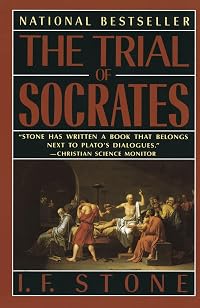
The Trial of Socrates
by I. F. Stone
On This Page
Description
The Athens of Socrates's time has gone down in history as the very place where democracy and freedom of speech were born. Yet this city put Socrates, its most famous philosopher, to death. Presumably this was because it citizens did not like what he was teaching. Yet he had been teaching there all his life, unmolested. Why did they wait until he was 70, and had only a few years to live, before executing him? In unraveling the long-hidden issues of the most famous free speech case of all show more time, noted author I.F. Stone ranges far and wide over both Roman and Greek history to present an engaging and rewarding introduction to classical antiquity and its relevance to society today. show lessTags
Recommendations













Member Recommendations
Member Reviews
Athens put its most prominent philosopher, Socrates, to death by hemlock in 399 BCE, when he was 70 years old and had been practicing philosophy all over Athens for many decades. Why? And what does the fact of the trial and its resulting death sentence mean?
Here’s the accepted narrative over the centuries: Socrates was a martyr to the cause of philosophy, free speech, and truth-seeking. He was so devoted to questioning everything to find the underlying truth that he came into inevitable conflict with the authorities, and eventually the state, even open-minded democratic Athens, had to silence him by execution.
I.F. Stone does a great job digging through all the layers of this story to seek out the underlying facts, to the extent they show more can be known over 2400 years later. As usual, the truth is much more nuanced - and interesting - than the simple story.
Start with the political backdrop, to which Stone, with his background as a political journalist, is especially attuned. We are used to seeing freethinkers (and speakers and writers) being silenced by authoritarian regimes. But in this case it was the democratic government that did the silencing. And Socrates, although politics was never his focus, had been critical of democracy, a relatively new invention, through the decades.
Furthermore, Athens had suffered through two recent bouts of authoritarian rule by groups of so-called oligarchs. The most recent was just four years before the trial, at the end of the Peloponnesian War, when The Thirty took over, backed by Sparta, and purged their enemies, executing many of their political adversaries and even just wealthy citizens to seize their assets. The strongman leading the regime was Critias. And Critias, it turns out, had been a student of Socrates.
So this is the political counter narrative that Stone promotes: Socrates was a long-standing opponent of democracy in Athens and supporter of authoritarian governments in places like Sparta and Crete. One of his students takes action and overthrows the democratic government, becoming a murderous dictator. When the democratic forces eventually return to power, Socrates is under suspicion and even held to blame for the political disaster. He is put on trial a few years later.
A modern analogy would be democratic Germany putting Hitler’s teacher and mentor on trial in 1949.
Of course, it’s not that simple; it never is. For example, some of the texts cited by Stone in evidence of Socrates’ pro-authoritarian views come from Republic and other Platonic dialogs where Socrates was basically a literary character mouthing positions that Plato held decades after the death of Socrates. Stone then has to speculate the extent to which Plato’s views were “inspired” by the historic Socrates.
And as Stone does acknowledge, the conviction and execution of Socrates did in fact make him the greatest martyr for free speech and free thought in the 2500 year history of Western civilization. So the accepted story has some core of truth after all. And did Socrates actively seek that martyrdom? That’s another of the many interlocking issues that Stone investigates.
Overall I found Stone to be an honest investigator, acknowledging weaknesses and gaps in sources, and counterarguments to his thesis. It is obvious that he has spent a great deal of time investigating both the primary and secondary sources, and his comments about various reference works, commentators, and translations are evidence of the great amount of time and energy he has put in to this work.
Especially notable is Stone’s careful use of ancient Greek to parse the subtle shades of meaning of key words in Plato, Xenophon, Thucydides, and other contemporary writers. He is very eloquent on the beauty of reading Aeschylus’ Oresteia in the original Greek - and the amount of time and effort needed for him to work through the entire trilogy in the original.
Although I don’t accept Stone’s full thesis, he is convincing on key parts, and the depth of the political and social backdrop to the trial make every chapter of this book richly rewarding. show less
Here’s the accepted narrative over the centuries: Socrates was a martyr to the cause of philosophy, free speech, and truth-seeking. He was so devoted to questioning everything to find the underlying truth that he came into inevitable conflict with the authorities, and eventually the state, even open-minded democratic Athens, had to silence him by execution.
I.F. Stone does a great job digging through all the layers of this story to seek out the underlying facts, to the extent they show more can be known over 2400 years later. As usual, the truth is much more nuanced - and interesting - than the simple story.
Start with the political backdrop, to which Stone, with his background as a political journalist, is especially attuned. We are used to seeing freethinkers (and speakers and writers) being silenced by authoritarian regimes. But in this case it was the democratic government that did the silencing. And Socrates, although politics was never his focus, had been critical of democracy, a relatively new invention, through the decades.
Furthermore, Athens had suffered through two recent bouts of authoritarian rule by groups of so-called oligarchs. The most recent was just four years before the trial, at the end of the Peloponnesian War, when The Thirty took over, backed by Sparta, and purged their enemies, executing many of their political adversaries and even just wealthy citizens to seize their assets. The strongman leading the regime was Critias. And Critias, it turns out, had been a student of Socrates.
So this is the political counter narrative that Stone promotes: Socrates was a long-standing opponent of democracy in Athens and supporter of authoritarian governments in places like Sparta and Crete. One of his students takes action and overthrows the democratic government, becoming a murderous dictator. When the democratic forces eventually return to power, Socrates is under suspicion and even held to blame for the political disaster. He is put on trial a few years later.
A modern analogy would be democratic Germany putting Hitler’s teacher and mentor on trial in 1949.
Of course, it’s not that simple; it never is. For example, some of the texts cited by Stone in evidence of Socrates’ pro-authoritarian views come from Republic and other Platonic dialogs where Socrates was basically a literary character mouthing positions that Plato held decades after the death of Socrates. Stone then has to speculate the extent to which Plato’s views were “inspired” by the historic Socrates.
And as Stone does acknowledge, the conviction and execution of Socrates did in fact make him the greatest martyr for free speech and free thought in the 2500 year history of Western civilization. So the accepted story has some core of truth after all. And did Socrates actively seek that martyrdom? That’s another of the many interlocking issues that Stone investigates.
Overall I found Stone to be an honest investigator, acknowledging weaknesses and gaps in sources, and counterarguments to his thesis. It is obvious that he has spent a great deal of time investigating both the primary and secondary sources, and his comments about various reference works, commentators, and translations are evidence of the great amount of time and energy he has put in to this work.
Especially notable is Stone’s careful use of ancient Greek to parse the subtle shades of meaning of key words in Plato, Xenophon, Thucydides, and other contemporary writers. He is very eloquent on the beauty of reading Aeschylus’ Oresteia in the original Greek - and the amount of time and effort needed for him to work through the entire trilogy in the original.
Although I don’t accept Stone’s full thesis, he is convincing on key parts, and the depth of the political and social backdrop to the trial make every chapter of this book richly rewarding. show less
Stone's thesis is that the charges of impiety and corrupting the youth against Socrates was just a contrived charge to get rid of a man that was always in their face. Stone posits that the real reason Socrates was charged is that there was a fear that Socrates encouraged civic disloyalty by questioning the status quo. Athens had just been defeated in the Peloponnesian War and was suspicious of any anti-democratic activity. The author emphasizes Socrates’ association with oligarchic figures such as Critias and Alcibiades (Thirty Tyrants) and his open contempt for democratic decision-making. According to the author, it was a strategic move that the accusers called for the banishment of Socrates, for they knew that would not be show more acceptable to him, that he would opt for death. By his death, Socrates became one of the most famous martyrs for free speech. Had he lived, he might have become just another old man wandering the streets talking to himself. This book made the New York Times Best-Seller List and the 501 Books YMR List. I may have read this book before—the arguments feel familiar—but if so, it would have been twenty-five to thirty years ago. show less
If you've read some Plato, found Socrates vaguely annoying but you're not sure why, Stone can help you out. He juxtaposes Socratic idealism with the messy business of living in the real world, and shows that Socrates' philosophy doesn't offer much practical advice. Not to mention that Socrates was an elitist and really thinks that average people have nothing to offer the world.
Stone also discusses Athenian democracy, and how messy any democracy is because it tries to deal with real life situations which don't have black-and-white answers. Socrates was (and is) less than helpful in this endeavor.
Stone goes on to explain how Socrates ended up pissing the Athenians off so much that they decided to get rid of him.
Stone's writing is lucid show more and fun, though he tends to make his point very thoroughly, which if you're more interested in the point than the details can be a bit tiresome.
Another reviewer here on LibraryThing questions Stone's understanding of the Greek historical sources. Quite, frankly I'm not sure it matters. He's really talking to modern idealists who don't want to participate in modern democracies because they're messy. Stone is saying it's better to get your hands dirty rather than wait for the ideal solution to come out of the sky. show less
Stone also discusses Athenian democracy, and how messy any democracy is because it tries to deal with real life situations which don't have black-and-white answers. Socrates was (and is) less than helpful in this endeavor.
Stone goes on to explain how Socrates ended up pissing the Athenians off so much that they decided to get rid of him.
Stone's writing is lucid show more and fun, though he tends to make his point very thoroughly, which if you're more interested in the point than the details can be a bit tiresome.
Another reviewer here on LibraryThing questions Stone's understanding of the Greek historical sources. Quite, frankly I'm not sure it matters. He's really talking to modern idealists who don't want to participate in modern democracies because they're messy. Stone is saying it's better to get your hands dirty rather than wait for the ideal solution to come out of the sky. show less
This excellent, well-researched, engaging and even at times sadly funny book is well worth owning, rereading, and researching further. Stone suggests, highly recommends in the strongest terms, learning the ancient Greek for oneself, and I heartily agree. These ancient plays and commentaries have the strongest bearing on our current situation, and need to be looked at critically again.
I like to go through topical phases with my reading… choosing a country or time in history and reading a combination of 8 or 10 related books. Mixing it up with a combination of history, bios, memoirs, and fiction helps give a clear perspective and adds depth to understanding. Right now the focus is on Ancient Greece.
The 4th book into my Ancient Greek phase is "The Trial of Socrates". The first 2 were history books covering theTrojan, Messenian, Persian, and the Peloponnesian Wars. The stories of many armed conflicts were mixed with philosophy, theology, politics, and cultural issues. The 3rd was a novel titled "Aphrodite" written in 1896 by the French author Pierre Louys. "The Trial of Socrates" therefore, followed as a welcome show more variation.
Focusing on politics, culture, and philosophy during the Greek Classical period of Democracy, I. F. Stone tells the story of Socrates’ rise to infamy, with analytical details about his trial and execution.
Aside from the fascinating well-told story of Socrates, there are always valuable lessons to be learned from history. Examples: One of the first- and most primary- rights to be taken away when obliterating democracy is the right to free speech. And one of the surest and most efficient ways to insure the downfall of democracy is to deprive the citizens of the right to bear arms.
Throughout the book are references to the Dialogues of Plato and Stone’s analysis provides enlightenment as to why Socrates became a martyr. He was Plato’s mentor and hero. Stone summarizes “his (Socrates) martyrdom, and the genius of Plato, made him a secular saint, the superior man confronting the ignorant mob with serenity and humor. This was Socrates’ triumph and Plato’s masterpiece. Socrates needed the hemlock, as Jesus needed the Crucifixion, to fulfill a mission. The mission left a stain forever on democracy. That remains Athens’ tragic crime.”
I can’t help but wonder though… if Socrates had been allowed to live, would he have lost his charm and faded into obscurity? At best, he appeared to be a clownish buffoon. At worst, his peers viewed him as a pompous ass. If by time travel he could miraculously be transported to America today he would be despised by everyone. He did not believe in democracy, free speech, equality, education for the poor, or the paid profession of teaching. He didn’t believe in education at all except for the elite ruling class under private tutors. For Stone to compare him to Jesus in any way is blasphemy. Socrates and Jesus were polar opposites. Nevertheless, Socrates will always be revered as the “father of philosophy.” The one thing he did bring to civilization was the power of free thought.
"The Trial of Socrates" is an easy book to read, rich in historical detail, deep in philosophical reflection, and sound in theory. show less
The 4th book into my Ancient Greek phase is "The Trial of Socrates". The first 2 were history books covering theTrojan, Messenian, Persian, and the Peloponnesian Wars. The stories of many armed conflicts were mixed with philosophy, theology, politics, and cultural issues. The 3rd was a novel titled "Aphrodite" written in 1896 by the French author Pierre Louys. "The Trial of Socrates" therefore, followed as a welcome show more variation.
Focusing on politics, culture, and philosophy during the Greek Classical period of Democracy, I. F. Stone tells the story of Socrates’ rise to infamy, with analytical details about his trial and execution.
Aside from the fascinating well-told story of Socrates, there are always valuable lessons to be learned from history. Examples: One of the first- and most primary- rights to be taken away when obliterating democracy is the right to free speech. And one of the surest and most efficient ways to insure the downfall of democracy is to deprive the citizens of the right to bear arms.
Throughout the book are references to the Dialogues of Plato and Stone’s analysis provides enlightenment as to why Socrates became a martyr. He was Plato’s mentor and hero. Stone summarizes “his (Socrates) martyrdom, and the genius of Plato, made him a secular saint, the superior man confronting the ignorant mob with serenity and humor. This was Socrates’ triumph and Plato’s masterpiece. Socrates needed the hemlock, as Jesus needed the Crucifixion, to fulfill a mission. The mission left a stain forever on democracy. That remains Athens’ tragic crime.”
I can’t help but wonder though… if Socrates had been allowed to live, would he have lost his charm and faded into obscurity? At best, he appeared to be a clownish buffoon. At worst, his peers viewed him as a pompous ass. If by time travel he could miraculously be transported to America today he would be despised by everyone. He did not believe in democracy, free speech, equality, education for the poor, or the paid profession of teaching. He didn’t believe in education at all except for the elite ruling class under private tutors. For Stone to compare him to Jesus in any way is blasphemy. Socrates and Jesus were polar opposites. Nevertheless, Socrates will always be revered as the “father of philosophy.” The one thing he did bring to civilization was the power of free thought.
"The Trial of Socrates" is an easy book to read, rich in historical detail, deep in philosophical reflection, and sound in theory. show less
A really outstanding example of popular intellectual history. Contrary to what is stated in the review by "Chris" above, Stone was actually meticulous in distinguishing between the historical Socrates, the Platonic Socrates, the Xenophantic Socrates, and so on. Also, while "outing" the Platonic Socrates as an anti-democrat may not be news, the way Stone explains this in the specific social and ideological context of classical Athens has clarified a great deal for me. He really transformed my thinking on the Sophists, for example.
The tone is polemical rather than scholarly, but the book is extremely well researched and I have been learning a lot from it. It is heartening to think this book became a bestseller.
The tone is polemical rather than scholarly, but the book is extremely well researched and I have been learning a lot from it. It is heartening to think this book became a bestseller.
Interesting book which shows the real reason why Socrates was executed, because of his political beliefs against democracy. The key point of the book is the chapter that describes Socrates interview with the dictators. He could have chosen to say an offense to the dictators, but he did not. On the other hand he decided to offend the democratic jury forcing the democracy to kill him, proving that democracies are not much different from dictatorships (which we can see nowadays in Guantánamo) and becoming a martyr.
Members
- Recently Added By
Published Reviews
ThingScore 100
added by danielx
Lists

501 Must-Read Books
529 works; 72 members
Author Information

21+ Works 2,444 Members
Some Editions
Awards and Honors
Distinctions
Notable Lists
Work Relationships
Is a reply to
Common Knowledge
- Canonical title
- The Trial of Socrates
- Original publication date
- 1988
- People/Characters
- Socrates; Plato
- Important places
- Athens, Greece
- Important events
- Trial of Socrates
- Dedication
- To my wife, Esther
without whom this, and so much else of me, would not have been possible - First words
- This is really a fragment of what was originally meant to be a larger, a much larger, work.
- Last words
- (Click to show. Warning: May contain spoilers.)Pericles could not have wished for a finer epitaph on his city and the free traditions it preserved to the very brink of the Dark Ages.
- Blurbers
- Knox, Bernard
- Original language
- Inglese
Classifications
- Genres
- Philosophy, History, Nonfiction, General Nonfiction, Biography & Memoir
- DDC/MDS
- 183.2 — Philosophy & psychology Ancient, medieval & eastern philosophy Sophistic, Socratic, related Greek philosophies Socrates
- LCC
- B317 .S76 — Philosophy, Psychology and Religion Philosophy (General) By period Ancient
- BISAC
Statistics
- Members
- 1,559
- Popularity
- 14,731
- Reviews
- 17
- Rating
- (4.04)
- Languages
- 10 — Chinese, Dutch, English, German, Greek, Italian, Polish, Portuguese, Spanish, Swedish
- Media
- Paper, Ebook
- ISBNs
- 20
- ASINs
- 15