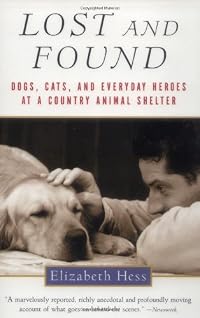
Lost and Found: Dogs, Cats, and Everyday Heroes at a Country Animal Shelter
by Elizabeth Hess
On This Page
Description
Based on her years of volunteer work at the Columbia-Greene Humane Society, the author sheds light on the often unheralded experiences that both animals and people have as they try to make the most of life together.Tags
Recommendations



















Member Reviews
The author is a journalist who went to volunteer at an animal shelter in New York state. This tells of some of the behind-the-scenes happenings at the shelter.
I was surprised at how much the author was invited to help with, but maybe they had to her doing more to help with her book? I have volunteered at both “kill” and “no-kill” animal shelters, so much of the book wasn’t a surprise, including reasons people surrender their animals, etc. Although, not a surprise to me, still sad and/or frustrating, and/or sometimes just making me completely angry! Though I’ve read and seen video (see “Animal Cops” on Animal Planet), one of the hardest chapters for me to read was when the author accompanied the director of the shelter show more on a puppy mill raid. Another tough one was the one discussing euthanasia. Overall, a good look at animal shelters. show less
I was surprised at how much the author was invited to help with, but maybe they had to her doing more to help with her book? I have volunteered at both “kill” and “no-kill” animal shelters, so much of the book wasn’t a surprise, including reasons people surrender their animals, etc. Although, not a surprise to me, still sad and/or frustrating, and/or sometimes just making me completely angry! Though I’ve read and seen video (see “Animal Cops” on Animal Planet), one of the hardest chapters for me to read was when the author accompanied the director of the shelter show more on a puppy mill raid. Another tough one was the one discussing euthanasia. Overall, a good look at animal shelters. show less
Wow. This book should be a must read for every person who has ever given up an animal to a shelter, those who think rescuing pets will be easy, and those who are considering volunteering.
The author, Elizabeth Hess, volunteers at a shelter partly because she thinks it will give material for a book, and partly because her daughter joins the junior volunteers at the shelter. She starts with certain expectation (all good dogs get adopted), and that the staff are over the top animal activists who are too picky about where the animals go to. She quickly learns the staff has to be picky, or else the shelter runs a revolving door as animals get returned as quickly as they get adopted out. She follows investigators as they determine an animals show more life or death status (by law, they can only take animals that are neglected to the point of almost death), a puppy-mill raid, those who give up their animals because they have no where else to turn for help, and others who give up animals because the animal no longer is fun. She covers how a kill-shelter works, and compares it to a no-kill.
Its a hard book to read, but its not dark. There are stories about animals that make it, and many that don't. The hardest chapters to read is the one about Euthanasia, and the difference between a no-kill and kill shelters, although I do want to point not all no-kill shelters are of the type described in the book, a few no-kill shelters are open admission and adopt out all healthy animals (without skewing numbers by describing healthy animals as unadoptable) show less
The author, Elizabeth Hess, volunteers at a shelter partly because she thinks it will give material for a book, and partly because her daughter joins the junior volunteers at the shelter. She starts with certain expectation (all good dogs get adopted), and that the staff are over the top animal activists who are too picky about where the animals go to. She quickly learns the staff has to be picky, or else the shelter runs a revolving door as animals get returned as quickly as they get adopted out. She follows investigators as they determine an animals show more life or death status (by law, they can only take animals that are neglected to the point of almost death), a puppy-mill raid, those who give up their animals because they have no where else to turn for help, and others who give up animals because the animal no longer is fun. She covers how a kill-shelter works, and compares it to a no-kill.
Its a hard book to read, but its not dark. There are stories about animals that make it, and many that don't. The hardest chapters to read is the one about Euthanasia, and the difference between a no-kill and kill shelters, although I do want to point not all no-kill shelters are of the type described in the book, a few no-kill shelters are open admission and adopt out all healthy animals (without skewing numbers by describing healthy animals as unadoptable) show less
Ratings
Members
- Recently Added By
Author Information

9+ Works 420 Members
Classifications
- Genres
- Nonfiction, General Nonfiction
- DDC/MDS
- 636.08 — Applied Science & Technology Agriculture Farm Animals & Pets General Zootechny
- LCC
- HV4765 .N69 .H47 — Social sciences Social pathology. Social and public welfare. Criminology Social pathology. Social and public welfare. Protection, assistance and relief Protection of animals. Animal rights. Animal
- BISAC
Statistics
- Members
- 89
- Popularity
- 351,508
- Reviews
- 2
- Rating
- (3.81)
- Languages
- English
- Media
- Paper
- ISBNs
- 2