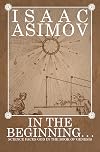
In the Beginning: Science Faces God in the Book of Genesis
by Isaac Asimov
On This Page
Description
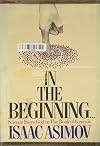
In the Beginning: Science Faces God in the Book of Genesis. The beginning of time. The origin of life. In our Western civilization, there are two influential accounts of beginnings. One is the biblical account, compiled more than two thousand years ago by Judean writers who based much of their thinking on the Babylonian astronomical lore of the day. The other is the account of modern science, which, in the last century, has slowly built up a coherent picture of how it all began. Both show more represent the best thinking of their times, and in this line-by-line annotation of the first eleven chapters of Genesis, Isaac Asimov carefully and evenhandedly compares the two accounts, pointing out where they are similar and where they are different. "There is no version of primeval history, preceding the discoveries of modern science, that is as rational and as inspiriting as that of the Book of Genesis," Asimov says. However, human knowledge does increase, and if the biblical writers "had written those early chapters of Genesis knowing what we know today, we can be certain that they would have written it completely differently." Isaac Asimov brings to this fascinating subject his wide-ranging knowledge of science and history--and his award-winning ability to explain the complex with accuracy, clarity, and wit. show lessTags
Recommendations















Member Reviews
This is an extremely interesting read. Of course, Asimov as a scientist offers a rational explanation for the imagery in the book of Genesis. But in my experience, a mythic, literary, psychological, and scientific perspective can enrich and complement a more literalistic interpretation. Even people who firmly believe in young-earth creationism can benefit from these insights, if they are willing to accept a bit of cognitive dissonance along the way and cut the author some slack. As for me, I see no real conflict in looking at Scripture through various lenses. The Bible is a many-layered book.
In In the Beginning, Asimov goes verse by verse through the first eleven chapters of Genesis, up to the death of Terah father of Abram, after Terah has moved with his family from Ur to Canaan - the so-called primordial history.
He gives background information including history of the peoples mentioned in these chapters. When Genesis tells a story more than once, Asimov comments on the amount of agreement and disagreement between the two or three versions. In the case of those stories for which physics, astronomy, geology or biology are relevant, he discusses the science too: the subtitle Science Faces God in the Book of Genesis is something of an overemphasis on this aspect.
He gives background information including history of the peoples mentioned in these chapters. When Genesis tells a story more than once, Asimov comments on the amount of agreement and disagreement between the two or three versions. In the case of those stories for which physics, astronomy, geology or biology are relevant, he discusses the science too: the subtitle Science Faces God in the Book of Genesis is something of an overemphasis on this aspect.
Interesting
Ratings
Members
- Recently Added By
Lists

Books Read in 2021
5,361 works; 113 members
Author Information

Isaac Asimov was born in Petrovichi, Russia, on January 2, 1920. His family emigrated to the United States in 1923 and settled in Brooklyn, New York, where they owned and operated a candy store. Asimov became a naturalized U.S. citizen at the age of eight. As a youngster he discovered his talent for writing, producing his first original fiction at show more the age of eleven. He went on to become one of the world's most prolific writers, publishing nearly 500 books in his lifetime. Asimov was not only a writer; he also was a biochemist and an educator. He studied chemistry at Columbia University, earning a B.S., M.A. and Ph.D. In 1951, Asimov accepted a position as an instructor of biochemistry at Boston University's School of Medicine even though he had no practical experience in the field. His exceptional intelligence enabled him to master new systems rapidly, and he soon became a successful and distinguished professor at Columbia and even co-authored a biochemistry textbook within a few years. Asimov won numerous awards and honors for his books and stories, and he is considered to be a leading writer of the Golden Age of science fiction. While he did not invent science fiction, he helped to legitimize it by adding the narrative structure that had been missing from the traditional science fiction books of the period. He also introduced several innovative concepts, including the thematic concern for technological progress and its impact on humanity. Asimov is probably best known for his Foundation series, which includes Foundation, Foundation and Empire, and Second Foundation. In 1966, this trilogy won the Hugo award for best all-time science fiction series. In 1983, Asimov wrote an additional Foundation novel, Foundation's Edge, which won the Hugo for best novel of that year. Asimov also wrote a series of robot books that included I, Robot, and eventually he tied the two series together. He won three additional Hugos, including one awarded posthumously for the best non-fiction book of 1995, I. Asimov. "Nightfall" was chosen the best science fiction story of all time by the Science Fiction Writers of America. In 1979, Asimov wrote his autobiography, In Memory Yet Green. He continued writing until just a few years before his death from heart and kidney failure on April 6, 1992. (Bowker Author Biography) show less
All Editions
Common Knowledge
- Original title
- In the Beginning...
- Alternate titles
- In the Beginning: Science Faces God in The Book of Genesis (Cover title) (Cover title)
- Original publication date
- 1981
- People/Characters
- Adam; Eve; Cain; Abel; Noah; God (Deity)
- Important places
- Garden of Eden; Tigris–Euphrates river system; Babylon, Mesopotamia; Sumeria
- Important events
- The Flood
- Dedication
- Dedicated to:
Izzy and Annie Adler,
who have advanced degrees in lovability. - First words
- The Bible is the most-read book that has ever existed, and there are uncounted millions of people in the world who, even today, take it for granted that it is the inspired word of God; that it is literally true at every point... (show all); that there are no mistakes or contradictions except where these can be trace to errors in copying or in translation.
--Introduction - Last words
- (Click to show. Warning: May contain spoilers.)With this, the Biblical account of primeval history comes to an end.
- Original language
- English US
- Disambiguation notice
- Contains the first eleven chapters of The Book of Genesis, King James Version.
Classifications
Statistics
- Members
- 222
- Popularity
- 146,819
- Reviews
- 3
- Rating
- (3.44)
- Languages
- English, German, Italian
- Media
- Paper, Ebook
- ISBNs
- 13
- ASINs
- 7