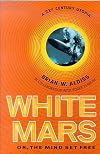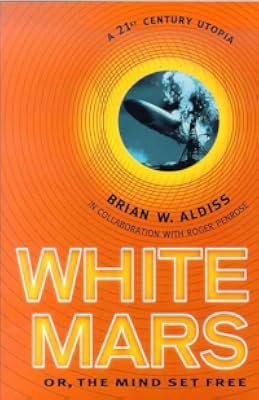
White Mars
by Brian W. Aldiss
On This Page
Description
A breathtaking vision of a utopian future on Mars by one of science fiction's most renowned authors In the middle decades of the twenty-first century, the corporate powers on Earth have established a thriving colony on Mars as an alternative to life on the overpopulated, war-torn, ecologically ravaged home planet. But when the economy of EUPACUS--Earth's collective industrialized nations--collapses, all contact between the two worlds abruptly ceases, and the Martian pioneers are left to fend show more for themselves. Led by Tom Jeffries, a philosopher and a visionary, the colonists now face a twofold challenge: No longer supported and subsidized by Earthbound interests, they must somehow form a working planetary alliance to create a new society based firmly in freedom and fairness for all while at the same time eliminating war, hunger, hatred, environmental abuse, and other former scourges of humanity. But first and foremost, they must survive. Brian W. Aldiss, a Hugo and Nebula Award-winning Grand Master of Science Fiction, presents a vision for the future that is startling, uplifting, and endlessly exciting. Written in collaboration with noted mathematician and physicist Roger Penrose--and with essential input from international law expert Laurence Lustgarten--Aldiss's remarkable White Mars opens a window onto a relentlessly thrilling and gloriously possible tomorrow. show lessTags
Recommendations

























Member Reviews
This is more a philosophical treatise than a novel, and viewed from that perspective, it's not bad. It's utopian fiction, along the lines of H.G. Wells, and the prose style is reminiscent of early twentieth century utopian writings. The plot, such as it is, exists only to provide a platform for a discussion of political theories, metaphysics, thoughts on eduction, ethics, and other such things. It is presented as a sequence of first person narrated journal entries by people stranded on Mars after an economic collapse on Earth, but the characters sound like Victorians with Bohemian inclinations. They don't seem modern, and certainly not futuristic. The book does bring up interesting points and pokes at pet peeves, some of which I share.
More than SF this is also a good reflection upon our modern societies, world those defects are extrapolated to serve as a basis to this scientist utopia.
Capitalism, politics, religion, education, sex... Beyond science and the idea of terraforming the solar system, 'White Mars' has indeed a good philosophical touch.
A good read.
Capitalism, politics, religion, education, sex... Beyond science and the idea of terraforming the solar system, 'White Mars' has indeed a good philosophical touch.
A good read.
...Adiss and Penrose have delivered a fairly impenetrable counter argument to Kim Stanley Robinson's Mars trilogy. Maybe he is right in saying that Robinson dismissed the 'Red' (or I guess Adiss would call in White) argument for humanity's treatment of the planet but he doesn't present it in a particularly engaging way. Without the connection to Robinson's work, I don't think I would have thought it worth my time to be honest. While the novel is certainly intellectually challenging I found the prose rather stiff and incapable of conveying the passion Jefferies must have felt about creating a new society. The characterization is pretty uniform, each of the character delivering their part of the tale in a detached and almost academic show more style. White Mars is clearly the work of a great intellect (or maybe I should say two great intellects), but, without having read any of his other books, I do get the impression we are not seeing Aldiss at the top of his abilities here.
Full Random Comments review show less
Full Random Comments review show less
I would not ordinarily read an Aldiss SF novel, but the presence of mathematician/physicist Penrose changes things. He is notorious for advancing the notion that a hoped-for theory of quantum gravity will someday provide an explanation for consciousness. In this respect, his influence on the story is evident.
Ratings
Members
- Recently Added By
Lists

Books Set on Mars
22 works; 7 members
Author Information

563+ Works 27,375 Members
Brian W. Aldiss was born in Dereham, United Kingdom on August 18, 1925. In 1943, he joined the Royal Signals regiment, and saw action in Burma. After World War II, he worked as a bookseller at Oxford University. His first book, The Brightfount Diaries, was published in 1955. His first science fiction novel, Non-Stop (Starship in the United show more States), was published in 1958. He wrote more than 80 books including Hothouse, Greybeard, The Helliconia Trilogy, The Squire Quartet, Frankenstein Unbound, The Malacia Tapestry, Walcot, and Mortal Morning. His short story Super-Toys Last All Summer Long was the basis for the film A.I. Artificial Intelligence. He has received numerous awards for his work including two Hugo Awards, the Nebula Award, the John W. Campbell Memorial Award, and an OBE for services to literature. He was also an anthologist and an artist. He was the editor of 40 anthologies including Introducing SF, The Penguin Science Fiction Omnibus, Space Opera, Space Odysseys, Galactic Empires, Evil Earths, and Perilous Planets. He was an abstract artist and his first solo exhibition, The Other Hemisphere, was held in Oxford in August-September 2010. He died on August 19, 2017 at the age of 92. (Bowker Author Biography) show less
All Editions
Work Relationships
Is a reply to
Common Knowledge
- Alternate titles
- White Mars, or, The Mind Set Free: A 21st Century Utopia
- Original publication date
- 1999
- People/Characters
- Tom Jefferies
- Important places
- Mars
- Epigraph
- This people is 500 miles from Utopia eastward
Sir Thomas More, Utopia
We are getting to the end of visioning
The impossible within this universe,
Such as that better whiles may follow worse,
And that our race may mend by reasoning
Thomas Hardy, We Are Getting To The End - Dedication
- "Dedicated to the Warden and Fellows
of
Green College, Oxford" - First words
- On this day, Leo Anstruther decided he would walk to the jetport because he believed in being unpredictable.
- Last words
- (Click to show. Warning: May contain spoilers.)At least it is a consolation to know she will enjoy the promises of what to me is the inaccessible future.
Classifications
Statistics
- Members
- 224
- Popularity
- 145,073
- Reviews
- 4
- Rating
- (2.59)
- Languages
- English, French, German
- Media
- Paper, Ebook
- ISBNs
- 7
- ASINs
- 3