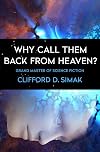
Why Call Them Back from Heaven?
by Clifford D. Simak
On This Page
Description
A corporation promising immortality hides a sinister secret in this "extremely provocative" sci-fi novel (Judith Merril, author and editor). Since the dawn of mankind, immortality has been the ultimate reward. But by the year 2148, it requires no act of faith to believe in an afterlife. Forever Center promises to bring people back to a life beyond death. Now everyone spends their lives in poverty, giving all their money to Forever Center to ensure their happiness and comfort in the next show more eternal life. Daniel Frost is a key man at Forever Center, but when he accidentally stumbles onto some classified documents, Dan incurs the wrath of an unseen enemy and is framed for a terrible crime. Now, his right to immortality has been revoked and he is a social outcast, condemned to the desperate life of a hunted animal. As a renegade lawyer and a brilliant mathematician attempt to help him, they reveal some shattering information about Forever Center . . . and the essence of life itself. show lessTags
Recommendations








Member Reviews
3.9
Parts of this are possibly Simak at peak clunky, and the dialogue can be very expository, but the premise is fantastic. The larger narrative and themes explored elevate this above its shortcomings.
On initial reading, I think I was thrown by the structure of the novel, how it bounces between different perspectives that don't necessarily have a larger part to play in the story. Going in with a better understanding of their thematic role made for a better experience. The representation of gender and technology is dated, but this is a small thing in contrast to the big questions Simak asks: the nature of faith and the capacity for the spiritual to survive in a world where flesh may obtain a premature immortality.
What role does an show more afterlife play in a world where physical existence need not be terminated? What encouragement can a man of faith give to a convicted man who has been denied his right to a second physical existence? What value does that faith have when the religious too invest in the promise of a physical immortality? What value does the first life hold, when its entire focus becomes a preparation for eternity? And is our notion of eternity as real and secure as we think it is?
The main narrative "wrap-up" feels pulled straight out of an old b movie, sickly quaint and convenient with a romance begging soft filter and melodramatic strings. But the closing chapter, the "true" ending, is a haunting reflection on an unresolved question. The matter of faith and the search for truth. show less
Parts of this are possibly Simak at peak clunky, and the dialogue can be very expository, but the premise is fantastic. The larger narrative and themes explored elevate this above its shortcomings.
On initial reading, I think I was thrown by the structure of the novel, how it bounces between different perspectives that don't necessarily have a larger part to play in the story. Going in with a better understanding of their thematic role made for a better experience. The representation of gender and technology is dated, but this is a small thing in contrast to the big questions Simak asks: the nature of faith and the capacity for the spiritual to survive in a world where flesh may obtain a premature immortality.
What role does an show more afterlife play in a world where physical existence need not be terminated? What encouragement can a man of faith give to a convicted man who has been denied his right to a second physical existence? What value does that faith have when the religious too invest in the promise of a physical immortality? What value does the first life hold, when its entire focus becomes a preparation for eternity? And is our notion of eternity as real and secure as we think it is?
The main narrative "wrap-up" feels pulled straight out of an old b movie, sickly quaint and convenient with a romance begging soft filter and melodramatic strings. But the closing chapter, the "true" ending, is a haunting reflection on an unresolved question. The matter of faith and the search for truth. show less
I read this as part of my ongoing investigation of life extension in science fiction. In this book's future, everyone is frozen upon death; the society hasn't figured out resurrection yet, but they're sure that bit is coming.
What really works are the novel's various ideas about how society would change around such a development. People live very frugally, saving all their money for the second life; preventing someone from being frozen, even inadvertently, is a crime because you're essentially killing them; investors buy swampland because they know the Earth will need tons of room for all these people upon resurrection so even worthless land ought to have value.
It's very 1950s/60s sf: kind of off-kilter, a dose of spiritualism, a lot of show more discussion of marketing, an ending that doesn't quite come together. We follow a group of parallel characters in this future society, but I felt like their stories petered out in the end. Simak had great worldbuilding, but I am not entirely convinced he really knew what the book was about thematically.
It is short, and probably would be pretty fun to teach in my putative course, but hasn't been in print since 1988! There's an ebook from Gollancz, but you can only get it in the UK. show less
What really works are the novel's various ideas about how society would change around such a development. People live very frugally, saving all their money for the second life; preventing someone from being frozen, even inadvertently, is a crime because you're essentially killing them; investors buy swampland because they know the Earth will need tons of room for all these people upon resurrection so even worthless land ought to have value.
It's very 1950s/60s sf: kind of off-kilter, a dose of spiritualism, a lot of show more discussion of marketing, an ending that doesn't quite come together. We follow a group of parallel characters in this future society, but I felt like their stories petered out in the end. Simak had great worldbuilding, but I am not entirely convinced he really knew what the book was about thematically.
It is short, and probably would be pretty fun to teach in my putative course, but hasn't been in print since 1988! There's an ebook from Gollancz, but you can only get it in the UK. show less
My copy is hardcover, but really stained and old ex-library. I don't know why Simak is out-of-fashion - I think he's as much a master as, say, del Rey.
I like how so many different reactions to the idea of a Second Life were explored. There was the main character, the people he interacted with, and some that he just encountered peripherally - so some readers might think of the book as disjointed or something, but I liked how rich, and yet concise, it was. And there's no tidy ending....
I like how so many different reactions to the idea of a Second Life were explored. There was the main character, the people he interacted with, and some that he just encountered peripherally - so some readers might think of the book as disjointed or something, but I liked how rich, and yet concise, it was. And there's no tidy ending....
What if physical resurrection and immortality were a possibility? A great idea. Unfortunately there are problems with the execution. Take chapter seven. This features three unnamed characters we will never meet again: the salesman, the woman and the woman's husband. They are thinking about buying some land, as land will be worth more once the dead are resurrected. Meanwhile, the hero's character is being left undeveloped. A few chapters before we have been treated to a scene of him attending a team meeting. Why doesn't the hero consider buying land? You could have character development and world building rolled into one. What we have is poorly handled exposition.
Despite this, I would actually read something else by Simak. There are some show more flashes of quality and I get the impression something has gone wrong with this novel. show less
Despite this, I would actually read something else by Simak. There are some show more flashes of quality and I get the impression something has gone wrong with this novel. show less
3.5
Not Simak's best, but I found the concept intriguing enough to keep me reading and overlook its flaws; the writing generally gets better as you get further into the book, as if it were a first draft that Simak was just settling into, and there are some nice pastoral passages reminiscent of some of his other, stronger work.
Lots of themes are covered in the book, some felt very apt and others a bit forced. The most prominent being religion, faith, life after death, which was often explored through minor characters, thier stories interwoven throughout the main plot.
The closing chapter felt like a bit of a strange note to end on. Maybe I just didn't get it, but I don't see why Simak chose to end the story on the line that he did. show more Generally though, the overall experience is pretty satisfying - which is more than can be said for a lot of Simak's work. show less
Not Simak's best, but I found the concept intriguing enough to keep me reading and overlook its flaws; the writing generally gets better as you get further into the book, as if it were a first draft that Simak was just settling into, and there are some nice pastoral passages reminiscent of some of his other, stronger work.
Lots of themes are covered in the book, some felt very apt and others a bit forced. The most prominent being religion, faith, life after death, which was often explored through minor characters, thier stories interwoven throughout the main plot.
The closing chapter felt like a bit of a strange note to end on. Maybe I just didn't get it, but I don't see why Simak chose to end the story on the line that he did. show more Generally though, the overall experience is pretty satisfying - which is more than can be said for a lot of Simak's work. show less
Not one of Simak's best, slightly obvious and moralising, but with an interesting premise even if it isn't fully explored in this short novel.
Daniel Frost is one of the directors of the Forever Centre, with the responsibility of ensuring subversive literature isn't published. When he is framed by Security and Ostracized from the human race he realises his Second Life is going to be a poor one. No it's not a 40 year early reference to the internet; instead it's cryo-technology. The Forever centre sometime in the future, have in an unspecified manner solved all the problems and damage associated with freezing bodies, cured cancer, and most other diseases (although not heart attack) and are working on immortality. It's only another show more 20years away; meanwhile people are being frozen, and are saving every spare penny so that when they are re-awakened the interest earned will make them rich. Meanwhile the Forever Centre looks after their money, and is trying to deal with the space and resource issues involved with such a vast population increase.
Of course not everyone is happy about this and here and there are odd scatterings of the remnants of religion, which is supposed to be the counter example to the offered technological nirvana. However it's also the first indication of how the book has aged, and the general short sightedness of the plot. The only religion mentioned is an unspecified form of christianity. There are other major shortcomings, also not mentioned: Inflation. If everyone is 'rich' no-one will be able to buy anything because the cost of producing it will also rise; And children. They aren't mentioned at all, other than that one character has a wife and two children. There's no incentive for them in this new world model, and yet no discussion of them.
The writing also isn't Simak's best. As in most multi-character short stories there just isn't enough space to fully develop any of the characters, the descriptions are all brief, and worst of all, the plot is badly integrated. Daniel has very little interaction with any of the religious characters, and yet they keep making appearances with no relevance. I guess the idea is to try and promote a feeling of look what technology has done to religion.... but it doesn't really work.
Readable - with a couple of clever ideas, but it doesn't take any of them far enough. Simak can be much better. show less
Daniel Frost is one of the directors of the Forever Centre, with the responsibility of ensuring subversive literature isn't published. When he is framed by Security and Ostracized from the human race he realises his Second Life is going to be a poor one. No it's not a 40 year early reference to the internet; instead it's cryo-technology. The Forever centre sometime in the future, have in an unspecified manner solved all the problems and damage associated with freezing bodies, cured cancer, and most other diseases (although not heart attack) and are working on immortality. It's only another show more 20years away; meanwhile people are being frozen, and are saving every spare penny so that when they are re-awakened the interest earned will make them rich. Meanwhile the Forever Centre looks after their money, and is trying to deal with the space and resource issues involved with such a vast population increase.
Of course not everyone is happy about this and here and there are odd scatterings of the remnants of religion, which is supposed to be the counter example to the offered technological nirvana. However it's also the first indication of how the book has aged, and the general short sightedness of the plot. The only religion mentioned is an unspecified form of christianity. There are other major shortcomings, also not mentioned: Inflation. If everyone is 'rich' no-one will be able to buy anything because the cost of producing it will also rise; And children. They aren't mentioned at all, other than that one character has a wife and two children. There's no incentive for them in this new world model, and yet no discussion of them.
The writing also isn't Simak's best. As in most multi-character short stories there just isn't enough space to fully develop any of the characters, the descriptions are all brief, and worst of all, the plot is badly integrated. Daniel has very little interaction with any of the religious characters, and yet they keep making appearances with no relevance. I guess the idea is to try and promote a feeling of look what technology has done to religion.... but it doesn't really work.
Readable - with a couple of clever ideas, but it doesn't take any of them far enough. Simak can be much better. show less
(Original Review, 1980-11-28)
In response to a SF fan query about computers that can interpret law, I just finished "Why Call Them Back from Heaven" by Clifford Simak. Although a minor feature of the story, the law of the land dictates the use of jury trials in which the jury is a machine. A couple of paragraphs is devoted to a discussion of how the use of machines has caused lawyers to stick strictly to the letter of the law and objective facts instead of the "sympathy tricks" and other appeals to emotion that are often used in modern day jury trials. (I once saw a TV show where someone sat on a jury for a civil suit and I was amazed by the fact that no one in the courtroom seemed to want the jury to hear the actual FACTS of the case. A show more lot of mumbo-jumbo about if this or that information was admissible without the jury finding out what the information was. Also, seemed that the lawyers' chief job was to KEEP certain info from becoming known!! And oh the theatrics of the lawyer for the plaintiff!! Truly a thing to behold.) Anyway, this gives me as good as excuse as any to give a mini review of WBTBfH (a book I picked up after reading the name in a friend’s SF list) All in all I thought it was pretty good. It did a better job of describing a possible future world than it did in characterizations. In this sense it reminded me of "The Man in the High Castle" (correct name?) by Philip K. Dick. The world that was described was a very interesting one. In general, I like SF that attempts to be philosophically thought provoking instead of merely portraying a lot of action in an alien environment (space westerns, for example). The greatest shortcoming of the story, in my opinion, is that the reader is asked to believe some rather unbelievable coincidences that just happen to bring the main characters back together at unpredictable times. Also, the ending wraps up all the loose ends in about 2 pages that needed 170 pages to lead up to. All in all, though, NOT RECOMMENDED. I would like to finish this message with a totally unrelated query. Can anyone point me in the direction of "Venus on the Half-shell"? Is this a real book? And if so, who is the author and what is the publishing firm, etc.? I have read just about everything by Kurt Vonnegut and would like to tie up this loose end in my reading.
[2018 EDIT: "Venus on the Halfshell" by Kilgore Trout is a science fiction novel mentioned in several of Vonnegut's novels. At the time that Vonnegut wrote those novels, VotH was simply a prop from his imaginary universes. Since then however, P. J. Farmer wrote a book published as "Venus on the Halfshell" by Kilgore Trout (Farmer’s pseudonym). It follows the descriptions and situations given by Vonnegut quite closely. It is also part of general series of realizations of "imaginary" books and references being done by Farmer. How I wish I had proper Internet back then…]
[2018 EDIT: This review was written at the time as I was running my own personal BBS server. Much of the language of this and other reviews written in 1980 reflect a very particular kind of language: what I call now in retrospect a “BBS language”.] show less
In response to a SF fan query about computers that can interpret law, I just finished "Why Call Them Back from Heaven" by Clifford Simak. Although a minor feature of the story, the law of the land dictates the use of jury trials in which the jury is a machine. A couple of paragraphs is devoted to a discussion of how the use of machines has caused lawyers to stick strictly to the letter of the law and objective facts instead of the "sympathy tricks" and other appeals to emotion that are often used in modern day jury trials. (I once saw a TV show where someone sat on a jury for a civil suit and I was amazed by the fact that no one in the courtroom seemed to want the jury to hear the actual FACTS of the case. A show more lot of mumbo-jumbo about if this or that information was admissible without the jury finding out what the information was. Also, seemed that the lawyers' chief job was to KEEP certain info from becoming known!! And oh the theatrics of the lawyer for the plaintiff!! Truly a thing to behold.) Anyway, this gives me as good as excuse as any to give a mini review of WBTBfH (a book I picked up after reading the name in a friend’s SF list) All in all I thought it was pretty good. It did a better job of describing a possible future world than it did in characterizations. In this sense it reminded me of "The Man in the High Castle" (correct name?) by Philip K. Dick. The world that was described was a very interesting one. In general, I like SF that attempts to be philosophically thought provoking instead of merely portraying a lot of action in an alien environment (space westerns, for example). The greatest shortcoming of the story, in my opinion, is that the reader is asked to believe some rather unbelievable coincidences that just happen to bring the main characters back together at unpredictable times. Also, the ending wraps up all the loose ends in about 2 pages that needed 170 pages to lead up to. All in all, though, NOT RECOMMENDED. I would like to finish this message with a totally unrelated query. Can anyone point me in the direction of "Venus on the Half-shell"? Is this a real book? And if so, who is the author and what is the publishing firm, etc.? I have read just about everything by Kurt Vonnegut and would like to tie up this loose end in my reading.
[2018 EDIT: "Venus on the Halfshell" by Kilgore Trout is a science fiction novel mentioned in several of Vonnegut's novels. At the time that Vonnegut wrote those novels, VotH was simply a prop from his imaginary universes. Since then however, P. J. Farmer wrote a book published as "Venus on the Halfshell" by Kilgore Trout (Farmer’s pseudonym). It follows the descriptions and situations given by Vonnegut quite closely. It is also part of general series of realizations of "imaginary" books and references being done by Farmer. How I wish I had proper Internet back then…]
[2018 EDIT: This review was written at the time as I was running my own personal BBS server. Much of the language of this and other reviews written in 1980 reflect a very particular kind of language: what I call now in retrospect a “BBS language”.] show less
Members
- Recently Added By
Author Information

385+ Works 25,270 Members
Some Editions
Series
Belongs to Publisher Series
Common Knowledge
- Canonical title
- Why Call Them Back from Heaven?
- Original title
- Why Call Them Back From Heaven?
- Original publication date
- 1967
- People/Characters
- Daniel Frost
- First words
- The Jury chortled happily. The type bars blurred with frantic speed as they set down the verdict, snaking smoothly across the roll of paper.
- Last words
- (Click to show. Warning: May contain spoilers.)"We have been abandoned," the ghastly whisper said. "God has turned His back on us."
- Original language*
- English
*Some information comes from Common Knowledge in other languages. Click "Edit" for more information.
Classifications
Statistics
- Members
- 530
- Popularity
- 56,182
- Reviews
- 15
- Rating
- (3.27)
- Languages
- 7 — Bulgarian, English, French, German, Portuguese, Spanish, Swedish
- Media
- Paper, Ebook
- ISBNs
- 9
- ASINs
- 21