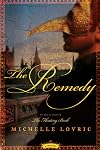
The Remedy
by Michelle Lovric
On This Page
Description
Two people meet in a crowded London theatre one night in 1785. They quickly become lovers - and slowly discover that neither is what he/she at first appeared to be. As a spy for the Venetian state, Mimosina trades in dangerous secrets, and Valentine Greatrakes, the mastermind behind London's quacks, in elaborate lies. As Valentine pursues the murderer of his right-hand man, he gets closer to the truth of his lover's background - and both are forced to admit the similarities between the show more different kinds of contraband they trade in. show lessTags
Recommendations







Member Reviews
Venetian convents are famous above all things for their laxity, with sweets and cakes; visitors; fine fashions; and beautiful music. But the headstrong young woman we meet at the start of The Remedy isn’t interested in the things that come in to the convent, so much as in how to get out. She has been confined within the walls of S. Zaccaria by her noble parents, quite unfairly of course, after allegedly bringing shame on the family. Since good behaviour hasn’t made an ounce of difference to her prospects, bad behaviour might just be her ticket back out into the world. After all, everyone knows that discerning gentlemen can make donations to certain convents in exchange for the company of nuns. Such arrangements take place at S. show more Zaccaria and our narrator is confident that her well-bred beauty will find her a lover who’ll whisk her away. Alas! When her plans are betrayed, leaving her ruined and furious, our narrator’s prospects seem darker than ever. But then the state’s spymasters make her an offer she can’t refuse: to have her crimes wiped clean in return for service as one of their agents. A pitch-perfect tale of double-dealing, murder, sex, and opera in 18th-century Venice and London, written in sumptuous prose, this deeply satisfying period romp never quite lets you forget the grit under its fingernails...
For the full review, please see my blog:
https://theidlewoman.net/2020/02/26/the-remedy-michelle-lovric/ show less
For the full review, please see my blog:
https://theidlewoman.net/2020/02/26/the-remedy-michelle-lovric/ show less
It took me more than a month to read this novel, which is extremely long for me. Honestly I don't think the novel is all that bad, but it is certainly confusing and frustrating. Ironically the plot is clear and predictable after the first few pages of the second part, how it all plays out after that is a bit of a mess though.
A rebellious Venetian girl is shipped off to a local convent where she at least can't make any more trouble for her noble family. Inside the convent things go from bad to worse and pretty soon the innocent girl is sleeping with invited male 'customers' of the nuns. Quite predictably she gets pregnant by her dashingly interesting stranger. After some final altercations she manages to escape the convent and ends up in show more London as an actress and spy for hire. We then switch to the perspective (although not in first person) of 18th century master of the London dispensaries by the name of Valentine Greatrakes. A more unbelievable and silly name if I've ever seen. Intrigue ensues. Valentine falls for the actress who turns out to be related to this and the other, they hate each other, miss each other, try to find each other again and again and so on. If you like coincidences then this is one you'll like.
Characters are beyond flat and modeled after what the author thinks current gender stereotypes are, and then projected on 18th century templates. None of the characters are particularly likable, which is not a requirement for a good novel, but they should at least be interesting. Granted the period is rendered in vividly accurate detail, but then again that is what we expect these days from authors. Flat novels is unfortunately also something we've become to expect. The male characters are all single minded and only interested in carnal pleasures. Women are either stunningly graceful or beyond ugly and/or boring, all of them being eternal victims who might also be seen as strong if it weren't for the overwhelming victim mentality portrayed in this book by all female characters.
So then why did I read it? I'm a bit of a sucker for immersive novels, especially those taking place in exotic locations from exciting periods of history. In this particular novel the opening recipes for quack medicines added an additional touch to the text although you quickly find out that the subject of the recipes doesn't have much to do with the contents of the chapter. You know the author got things right, you don't know why specifically but you know. Both London and Venice feel real and appear to be quite genuinely depicted in the appropriate period settings.
All of the world descriptions and depictions work together well on the other hand many of infuriatingly little narrative details stand out and detract from the story. All the female character's chapters are in first person but not the male protagonist. One of the female characters, the daughter of Valentine's best friend Tom, is given a very small amount of chapters to add something useful to the narrative but those fragments make things more confusing than they already are. Supposedly this girl/woman/child is dense and quite selfish. Certainly the selfish part is consistent but if we have to believe the author she is far from stupid. If this is a deliberate touch then nowhere in the rest of the novel does it make sense or fit in. show less
A rebellious Venetian girl is shipped off to a local convent where she at least can't make any more trouble for her noble family. Inside the convent things go from bad to worse and pretty soon the innocent girl is sleeping with invited male 'customers' of the nuns. Quite predictably she gets pregnant by her dashingly interesting stranger. After some final altercations she manages to escape the convent and ends up in show more London as an actress and spy for hire. We then switch to the perspective (although not in first person) of 18th century master of the London dispensaries by the name of Valentine Greatrakes. A more unbelievable and silly name if I've ever seen. Intrigue ensues. Valentine falls for the actress who turns out to be related to this and the other, they hate each other, miss each other, try to find each other again and again and so on. If you like coincidences then this is one you'll like.
Characters are beyond flat and modeled after what the author thinks current gender stereotypes are, and then projected on 18th century templates. None of the characters are particularly likable, which is not a requirement for a good novel, but they should at least be interesting. Granted the period is rendered in vividly accurate detail, but then again that is what we expect these days from authors. Flat novels is unfortunately also something we've become to expect. The male characters are all single minded and only interested in carnal pleasures. Women are either stunningly graceful or beyond ugly and/or boring, all of them being eternal victims who might also be seen as strong if it weren't for the overwhelming victim mentality portrayed in this book by all female characters.
So then why did I read it? I'm a bit of a sucker for immersive novels, especially those taking place in exotic locations from exciting periods of history. In this particular novel the opening recipes for quack medicines added an additional touch to the text although you quickly find out that the subject of the recipes doesn't have much to do with the contents of the chapter. You know the author got things right, you don't know why specifically but you know. Both London and Venice feel real and appear to be quite genuinely depicted in the appropriate period settings.
All of the world descriptions and depictions work together well on the other hand many of infuriatingly little narrative details stand out and detract from the story. All the female character's chapters are in first person but not the male protagonist. One of the female characters, the daughter of Valentine's best friend Tom, is given a very small amount of chapters to add something useful to the narrative but those fragments make things more confusing than they already are. Supposedly this girl/woman/child is dense and quite selfish. Certainly the selfish part is consistent but if we have to believe the author she is far from stupid. If this is a deliberate touch then nowhere in the rest of the novel does it make sense or fit in. show less
The Remedy is a historical novel full of interesting details, rather than an interesting historical novel, I'm afraid. In the author's notes, Michelle Lovric claims, 'I have tried to paint the London and Venice of the eighteenth century, in all their flavours, but more importantly to bring to life two personalities with whom the modern reader can identify.' Where she succeeds in recreating not only the geographical markers of both cities, from the crumbling buildings and dank streets of eighteenth century London to the unique waterways and edifices of Venice, but also the rich atmosphere of both time and place, I was less than convinced by her main characters: larger than life Irish wideboy, Valentine Greatrakes (his name doesn't help, show more real or not), and the manipulative actress Mimosina Dolcezza, formerly a Venice blueblood and fugitive nun named Caterina Venier, alias Mistress Giallofiore, AKA Jaune-Fleur Kindness. Nor is the pacing of the story helped by delivering Mimosina's narrative in first person, when, for such an enigmatic and patently false character, an omniscient narrator would have served better. The characters merely struggle along between two cities searching for a plot. Valentine comes across as distant and dense, surrendering his powerful underworld reputation as a 'free trader' of quack remedies after a quick fling with an actress, and Mimosina is an unbelievable anti-heroine and unrealiable narrator. Her involvement in the death of Valentine's friend is foreshadowed from the beginning, but I was genuinely surprised by the second unlikely blast from the past. Perhaps that connection was also signposted, but the possibility was far too farfetched for me to predict.
That Mimosina cannot be trusted is cleverly established, but my problem was more that she is wholly unsympathetic. Everything happens to her, and she is forced into her career of lies, yet we are supposed to believe that she really loves Valentine? Or that he is charismatic and unforgettable enough to inspire her sudden independence? And the whole theme of 'class' - 'Caterina has proved the ephemeral nature of class by floating downwards, he by rising upwards in his great material success', etc. or 'I had proved renegade to my class, after all, and turned actress. Could not a London criminal rise above his station and become in life and habit noble' - is very heavy-handed and anachronistic. That Mimosina couldn't tell a lord from a Irish charmer makes her dimwitted, not democratic.
The plot hinges on coincidences and the even more incredible concept of true love. Valentine cannot forget his actress, Mimosina is hellbent on Valentine making an honest woman out of her. He chases her to Venice and discovers the dark secret of her true identity, she waits for him in London, biding her time as a quack's assistant. The twists and turns of the final chapters are convoluted, but the bulk of the story is dull. I found myself distracted by two other books - one a classic I have read before many times, and the other a terrible Regency romance - and had to force myself to return and finish The Remedy. Although well written and filled with wonderful language and archaic recipes for mixtures, powders, decoctions and juleps, Michelle Lovric's novel unfortunately goes down like a horse pill. show less
That Mimosina cannot be trusted is cleverly established, but my problem was more that she is wholly unsympathetic. Everything happens to her, and she is forced into her career of lies, yet we are supposed to believe that she really loves Valentine? Or that he is charismatic and unforgettable enough to inspire her sudden independence? And the whole theme of 'class' - 'Caterina has proved the ephemeral nature of class by floating downwards, he by rising upwards in his great material success', etc. or 'I had proved renegade to my class, after all, and turned actress. Could not a London criminal rise above his station and become in life and habit noble' - is very heavy-handed and anachronistic. That Mimosina couldn't tell a lord from a Irish charmer makes her dimwitted, not democratic.
The plot hinges on coincidences and the even more incredible concept of true love. Valentine cannot forget his actress, Mimosina is hellbent on Valentine making an honest woman out of her. He chases her to Venice and discovers the dark secret of her true identity, she waits for him in London, biding her time as a quack's assistant. The twists and turns of the final chapters are convoluted, but the bulk of the story is dull. I found myself distracted by two other books - one a classic I have read before many times, and the other a terrible Regency romance - and had to force myself to return and finish The Remedy. Although well written and filled with wonderful language and archaic recipes for mixtures, powders, decoctions and juleps, Michelle Lovric's novel unfortunately goes down like a horse pill. show less
A Cephalic Electuary
Take Conserve of Rue 3 ounces;Venice Treacle 1 ounce;
Camphor 8 grains; Oil of Amber 16 drops. mix.
It reprimands the Animal Spirits when too furious, and
ready for Tumult and Explosion, disciplines them into order
again, and shakes of their heterogeneous Copuls, and sometimes
expels it quite upon these Accounts, it's found by Experience
To be very serviceable to Hysteric Women, howbeit some
cannot away with the odious Ructus, which Oil Amber
causeth.
Every chapter starts with a quote from an 18th century apothecary. This is a romance novel - I think. Not my kind of book, but it has a lead character called Valentine Greatrakes, and I wanted to add it to my Greatrakes collection. Lovric's Greatrakes is the bastard show more Irish son of washerwomen improbably named after the 17th Anglo-Irish healer.
This book was 'long listed' for the Orange prize - don't know how long the list is, but I hope there were some better books in it than this one. The plot concerns a Venetian lady - turned courtesan, spy and actress; and Greatrakes, lord of the London underworld, smuggler and creator of nostrums for the curing of all ills. It comes complete with missing children, violent nuns and gruesome deaths. I started out hating it - the early scenes, where Greatrakes falls for the 'actress', contain the least convincing writing about men, sex and love that I have ever read. Here is my submission for the Literary Review's Annual Bad Sex Award :
Suddenly he is anxious to lead her to her predestined alter : the
bedroom. He is afire to unwrap and suckle her breasts, slide over
her belly and heave himself into her peach-fish, her warm place,
and not stop, not for a very, very long time.
Peach-fish! Good grief.
Lovric is also obsessed with men's relationship with their penis - almost as though we should be astonished to find it's still there in the morning - lots of lines like this one : "Valentine feels a great commotion in his trews", someone should tell her, we get used to having one after the first year, or so.
Despite, or partly because of, the ridiculous plot and overblown dialogue, complete with anachronisms - did people in the 18th century really ask, "how pathetic is that?" - I was almost won over by the end, but I won't be rushing out to buy her other books. show less
Take Conserve of Rue 3 ounces;Venice Treacle 1 ounce;
Camphor 8 grains; Oil of Amber 16 drops. mix.
It reprimands the Animal Spirits when too furious, and
ready for Tumult and Explosion, disciplines them into order
again, and shakes of their heterogeneous Copuls, and sometimes
expels it quite upon these Accounts, it's found by Experience
To be very serviceable to Hysteric Women, howbeit some
cannot away with the odious Ructus, which Oil Amber
causeth.
Every chapter starts with a quote from an 18th century apothecary. This is a romance novel - I think. Not my kind of book, but it has a lead character called Valentine Greatrakes, and I wanted to add it to my Greatrakes collection. Lovric's Greatrakes is the bastard show more Irish son of washerwomen improbably named after the 17th Anglo-Irish healer.
This book was 'long listed' for the Orange prize - don't know how long the list is, but I hope there were some better books in it than this one. The plot concerns a Venetian lady - turned courtesan, spy and actress; and Greatrakes, lord of the London underworld, smuggler and creator of nostrums for the curing of all ills. It comes complete with missing children, violent nuns and gruesome deaths. I started out hating it - the early scenes, where Greatrakes falls for the 'actress', contain the least convincing writing about men, sex and love that I have ever read. Here is my submission for the Literary Review's Annual Bad Sex Award :
Suddenly he is anxious to lead her to her predestined alter : the
bedroom. He is afire to unwrap and suckle her breasts, slide over
her belly and heave himself into her peach-fish, her warm place,
and not stop, not for a very, very long time.
Peach-fish! Good grief.
Lovric is also obsessed with men's relationship with their penis - almost as though we should be astonished to find it's still there in the morning - lots of lines like this one : "Valentine feels a great commotion in his trews", someone should tell her, we get used to having one after the first year, or so.
Despite, or partly because of, the ridiculous plot and overblown dialogue, complete with anachronisms - did people in the 18th century really ask, "how pathetic is that?" - I was almost won over by the end, but I won't be rushing out to buy her other books. show less
Well Michelle Lovric definitely can create a picture of times gone by. This is the underbelly of eighteenth century Venice and London. A world of quack doctors and their potions or remedies; the man who provides these and a woman who isn't all she seems.
It is difficult for me to say what I think about The Remedy. I admire Lovric's ability to create a picture of the life that these characters could have lived but I couldn't connect in any way with their actions. Great writing and research but not as appealing to me as her other books. There is one character who also appears in her later The Book of Human Skin who I would love to learn more about - so hope that at some point she appears in a book of her own.
It is difficult for me to say what I think about The Remedy. I admire Lovric's ability to create a picture of the life that these characters could have lived but I couldn't connect in any way with their actions. Great writing and research but not as appealing to me as her other books. There is one character who also appears in her later The Book of Human Skin who I would love to learn more about - so hope that at some point she appears in a book of her own.
This was a good book, but not as engrossing as I've found other books by Lovric to be. I did like the characters, but I never grew attached to them. I think the other drawback was that it was just a bit to far fetched. Lovric often seems to straddle the line between the impossible to believe and the could be possible line. Usually she stays a little more in the possible realm, bringing credibility. For me, using inspired historical context calls for a little bit more realism for the story line. The Remedy went just a bit too far into the fantastical.
Despite my misgivings, I'm happy I read this book. Ever since I introduced to Lovric through winning [b:The True and Splendid History of The Harristown Sisters|20903440|The True and show more Splendid History of The Harristown Sisters|Michelle Lovric|https://d.gr-assets.com/books/1393320675s/20903440.jpg|40267376] in a First Reads competition I've been hooked. While The Harristown Sisters was the better book, Lovric still managed to take my mind off of my not so fantastic commute. At the end of the day, the reason I read is to be entertained and that was definitely accomplished. show less
Despite my misgivings, I'm happy I read this book. Ever since I introduced to Lovric through winning [b:The True and Splendid History of The Harristown Sisters|20903440|The True and show more Splendid History of The Harristown Sisters|Michelle Lovric|https://d.gr-assets.com/books/1393320675s/20903440.jpg|40267376] in a First Reads competition I've been hooked. While The Harristown Sisters was the better book, Lovric still managed to take my mind off of my not so fantastic commute. At the end of the day, the reason I read is to be entertained and that was definitely accomplished. show less
I always like historical novels, and if they are set in Venice it's definitely a biggie. In this case though, I had trouble suspending disbelief. The hidden and darker parts of society in Venice and London are very well depicted, which gives a certain amount of freshness to the genre; but the twists and turns of the plot, which ended up being very predictable, had me raising an eyebrow more than once
Members
- Recently Added By
Author Information

93+ Works 3,652 Members
Michelle Lovric writes, researches, and design-illustrated anthologies and Children's books. She splits her time between London and Venice. (Bowker Author Biography)
Awards and Honors
Awards
Common Knowledge
- Canonical title
- The Remedy
- People/Characters
- Mimosina Dolcezza; Valentine Greatrakes
- Important places
- London, England, UK; Venice, Veneto, Italy
Classifications
- Genres
- Fiction and Literature, General Fiction, Historical Fiction, Romance
- DDC/MDS
- 813.54 — Literature & rhetoric American literature in English American fiction in English 1900-1999 1945-1999
- LCC
- PS3562 .O8765 .R46 — Language and Literature American literature American literature Individual authors 1961-
- BISAC
Statistics
- Members
- 240
- Popularity
- 135,134
- Reviews
- 12
- Rating
- (3.33)
- Languages
- 6 — Dutch, English, French, German, Greek, Portuguese
- Media
- Paper, Audiobook, Ebook
- ISBNs
- 14
- ASINs
- 5