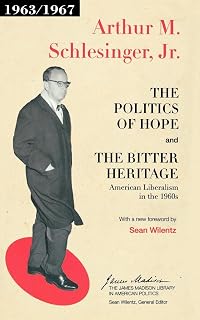
The Politics of Hope and The Bitter Heritage: American Liberalism in the 1960s
by Arthur M. Schlesinger, Jr.
On This Page
Description
The Politics of Hope and The Bitter Heritage brings together two important books that bracket the tempestuous politics of 1960s America. In The Politics of Hope, which historian Arthur Schlesinger, Jr., published in 1963 while serving as a special assistant to President Kennedy, Schlesinger defines the liberalism that characterized the Kennedy administration and the optimistic early Sixties. In lively and incisive essays, most of them written between 1956 and 1960, on topics such as the show more basic differences underlying liberal and conservative politics, the writing of history, and the experience of Communist countries, Schlesinger emphasizes the liberal thinker's responsibility to abide by goals rather than dogma, to learn from history, and to look to the future. Four years later, following Kennedy's assassination and the escalation of America's involvement in Vietnam, Schlesinger's tone changes. In The Bitter Heritage, a brief but penetrating appraisal of the "war that nobody wanted," he recounts America's entry into Vietnam, the history of the war, and its policy implications. The Bitter Heritage concludes with an eloquent and sobering assessment of the war's threat to American democracy and a reflection on the lessons or legacies of the Vietman conflict. With a new foreword by Sean Wilentz, the James Madison Library edition of The Politics of Hope and The Bitter Heritage situates liberalism in the convulsive 1960s--and illuminates the challenges that still face liberalism today. show lessTags
Recommendations


























Member Reviews
This is actually two books put together in one nice collection. The first, The Politics of Hope, is a series of essays Mr. Schlesinger Jr. wrote from the 1950s to 1963. The topics focus on liberalism, it's differences with conservatism, and even the writing of history. It is in these pages where you can see the optimism of the early 1960s and the liberalism.
The second half of the book, The Bitter Heritage, is written during the war in Vietnam and the tone changes to one of bitterness and defeat.
I really liked this book. I am a huge fan of Arthur M. Schlesinger, Jr. and I think he is a great historian and writer. This collection is especially interesting because the reader can plainly see the differences between the early and late show more 1960s.
It does get a little slow in sections, mainly a few of the last essays in the Politics of Hope section. However, this is an interesting book over all and if you are interested in this time period, or just a fan of Mr. Schlesinger, Jr. I definitely recommend this. show less
The second half of the book, The Bitter Heritage, is written during the war in Vietnam and the tone changes to one of bitterness and defeat.
I really liked this book. I am a huge fan of Arthur M. Schlesinger, Jr. and I think he is a great historian and writer. This collection is especially interesting because the reader can plainly see the differences between the early and late show more 1960s.
It does get a little slow in sections, mainly a few of the last essays in the Politics of Hope section. However, this is an interesting book over all and if you are interested in this time period, or just a fan of Mr. Schlesinger, Jr. I definitely recommend this. show less
Members
- Recently Added By
Author Information

91+ Works 9,209 Members
Arthur M. Schlesinger, Jr. is renowned as a historian, a public intellectual, & a political activist. He served as a special assistant to President John F. Kennedy; won two Pulitzer Prizes, in 1946 for "The Age of Jackson" & in 1966 for "A Thousand Days," & in 1998 was the recipient of the National Humanities Medal. He lives in New York City. show more (Publisher Provided) Arthur Meier Schlesinger, Jr., 1917 - 2007 U.S. historian Arthur Schlesinger was born in Columbus, Ohio in 1917 and was educated at Harvard University. Schlesinger was an associate professor of history at Harvard from 1946-1954 and professor from 1954-1961. He was a campaign staff member for the Democratic presidential candidates in 1952, 1956 and 1960. When John F. Kennedy took office after the 1960 campaign, he appointed Schlesinger special assistant. He resigned, in 1964, after Kennedy's assassination and then became professor of Humanities at the City University of New York in 1967. Schlesinger wrote an account of the Kennedy administration titled "A Thousand Days: John F. Kennedy in the White House" (1965), which won the Pulitzer Prize for a biography in 1966. He also wrote "The Age of Jackson" (1945), which won the Pulitzer Prize for history in 1946, "The Age of Roosevelt" (3 vol., 1957-60), "The Politics of Hope" (1963), "The Bitter Heritage" (1967), "The Imperial Presidency" (1973), "Robert Kennedy and His Times" (1978), and "The Cycles of American History" (1986). He died on February 28, 2007 at the age of 89 (Bowker Author Biography) show less
Some Editions
Series
Belongs to Publisher Series
Work Relationships
Common Knowledge
- Canonical title
- The Politics of Hope and The Bitter Heritage: American Liberalism in the 1960s
Classifications
- Genres
- Politics and Government, Nonfiction, History
- DDC/MDS
- 320.97309046 — Society, government, & culture Political science Types of Government Political situation and conditions North America United States
- LCC
- JC574.2 .U6 .S25 — Political Science Political theory Political theory. The state. Theories of the state Purpose, functions, and relations of the state
- BISAC
Statistics
- Members
- 9
- Popularity
- 2,308,383
- Reviews
- 1
- Rating
- (4.00)
- Languages
- English
- Media
- Paper
- ISBNs
- 1