The Use and Misuse of Language
by S. I. Hayakawa
On This Page
Tags
Recommendations
























Member Reviews
What can one say about a collection of essays from the 1940s and 50s? Some of them are hopelessly out of date. (Plank on Science Fiction) Others would need total rewriting to be usable today, both to update the examples and get rid of overt sexism. ('But few people, other than psychiatrists and women, have had much training in listening.') Most of the theoretical articles belong in one or the other of these categories.
But others are so well written that they ought to be reread now and again. In this category I would include Hayakawa's essays on 1957 cars and Haley's 'The Art of Psychoanalysis'. When the emphasis is on the use of these theories in everyday life, they seem to overcome the decades and delight the reader.
I had actually show more hoped that this rereading would convince me that this book had outlived its right to a place on our shelves. But I guess it can stick around a few years more. show less
But others are so well written that they ought to be reread now and again. In this category I would include Hayakawa's essays on 1957 cars and Haley's 'The Art of Psychoanalysis'. When the emphasis is on the use of these theories in everyday life, they seem to overcome the decades and delight the reader.
I had actually show more hoped that this rereading would convince me that this book had outlived its right to a place on our shelves. But I guess it can stick around a few years more. show less
This is a sometimes interesting anthology of articles and talked from a journal on General Semantics and the body's meetings. Especially the talks seem to have lost sparkle in the transcription. Maybe a quality issue to be explained by a general semanticist?
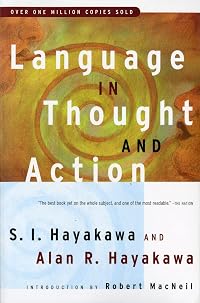
Editor Hayakawa has said, "My deepest debt [[book:Language in Action|15792683]] is to the General Semantics ('non-Aristotelian system') of Alfred Korzybski. I have also drawn heavily upon the works of other contributors to semantic thought..." Comments and criticisms on Korzybski are interesting here, but are only a seasoning. "SEMANTIC DIFFICULTIES IN. INTERNATIONAL COMMUNICATION" by Edmund S. Glenn is very interesting for parsing an actual day in the life of the UN Security show more Council and the subtleties of meaning transformed after passage through the admittedly highly effective UN translators. Hayakawa himself provides, for me, and probably as a music enthusiast, the most engaging piece, "Popular Songs vs. The Facts of Life". He concluded that "The blues tend to be extensionally oriented, while. Popular songs tend to exhibit grave, even pathological intensional orientations." OK, I am still trying to understand that. What will stick with me is the application of speech pathologist Wendell Johnson IFD cycle: I, unrealistic expectations and ideals, lead to F, frustrations, which discourage us, and may delude us with even less realistic expectations or ideal; the IFD can quickly become viciously circular. Probably the IFD cycle affects almost everyone to some degree and Hayakawa uses this to analyze blues songs from W. C. Handy, Bessie Smith, etc. show less
Editor Hayakawa has said, "My deepest debt [[book:Language in Action|15792683]] is to the General Semantics ('non-Aristotelian system') of Alfred Korzybski. I have also drawn heavily upon the works of other contributors to semantic thought..." Comments and criticisms on Korzybski are interesting here, but are only a seasoning. "SEMANTIC DIFFICULTIES IN. INTERNATIONAL COMMUNICATION" by Edmund S. Glenn is very interesting for parsing an actual day in the life of the UN Security show more Council and the subtleties of meaning transformed after passage through the admittedly highly effective UN translators. Hayakawa himself provides, for me, and probably as a music enthusiast, the most engaging piece, "Popular Songs vs. The Facts of Life". He concluded that "The blues tend to be extensionally oriented, while. Popular songs tend to exhibit grave, even pathological intensional orientations." OK, I am still trying to understand that. What will stick with me is the application of speech pathologist Wendell Johnson IFD cycle: I, unrealistic expectations and ideals, lead to F, frustrations, which discourage us, and may delude us with even less realistic expectations or ideal; the IFD can quickly become viciously circular. Probably the IFD cycle affects almost everyone to some degree and Hayakawa uses this to analyze blues songs from W. C. Handy, Bessie Smith, etc. show less
Collection of essays edited by S.I.Hayakawa on General Semantics--or how people talk. From the Foreword, he comes considerably short of the behaviorist assertion that all thought is subvocal speech, although much may be. Many words create the illusion of meaning, where little is clear cut. And it is naive to objectify language, where meaning (semantic reactions) take place in people. Starts with the indebtedness to Alfred Korzybski--who maintained that the structural assumptions implicit in language manifest (show up) in behavior [9] and even shape the human psyche. [10]
The Hayakawa essay--"How to Attend a Conference" is included. This is the one in which he suggest that although often done, it is only marginally useful to insist on show more defining terms in any absolute sense without understanding that "there is no ultimately correct and single meaning".[70] While the purpose of conferences is to exchange ideas, many attendees are prisoners of words. Suggests refraining from praise or censure of views until one is certain what the views actually are. Ask questions--like all good listeners--of "uniqueness". There is self-satisfaction in successfully imparting a message, but there is self-insight {improvement} in receipt.[76]
The four principles of GS are easy to grasp:
(1) Propositional Function - where Aristotle assumes the logic of a judgment can be broken into its propositional constituents, and the system was closed, the functionalist notion of propositions ...
(2) the Operational definition...
(3) predictive value as the criterion of truth...
(4) The Theory of Types.
Note that the 1st and last owe a great deal to Bertrand Russel (I keep forgetting to mention). show less
The Hayakawa essay--"How to Attend a Conference" is included. This is the one in which he suggest that although often done, it is only marginally useful to insist on show more defining terms in any absolute sense without understanding that "there is no ultimately correct and single meaning".[70] While the purpose of conferences is to exchange ideas, many attendees are prisoners of words. Suggests refraining from praise or censure of views until one is certain what the views actually are. Ask questions--like all good listeners--of "uniqueness". There is self-satisfaction in successfully imparting a message, but there is self-insight {improvement} in receipt.[76]
The four principles of GS are easy to grasp:
(1) Propositional Function - where Aristotle assumes the logic of a judgment can be broken into its propositional constituents, and the system was closed, the functionalist notion of propositions ...
(2) the Operational definition...
(3) predictive value as the criterion of truth...
(4) The Theory of Types.
Note that the 1st and last owe a great deal to Bertrand Russel (I keep forgetting to mention). show less
Ratings
Members
- Recently Added By
Author Information

31+ Works 1,975 Members
S.I. Hayakawa's full name is Samuel Ichiye Hayakawa. The son of an import-export merchant, Hayakawa was born on July 18, 1906, in Vancouver, British Columbia. Hayakawa received his bachelors degree from the University of Manitoba and his masters degree from McGill University. While he was studying for his Ph.D. at the University of Wisconsin, show more Hayakawa worked as an assistant instructor in English, becoming a professor in the English extension division in 1936. In the 40 years that followed, Hayakawa joined the faculties at numerous universities and colleges as a professor, eventually becoming president emeritus at San Francisco State University. Hayakawa is the author of a number of books that cover the meaning of language and similar subjects. Among his book credits are the Book-of-the-Month selection Language in Action, Modern Guide to Synonyms and Related Words, Dimensions in Meaning, and Quotations from Chairman S.I. Hayakawa. The periodical ETC: Of Our Language and Our World is considered one of Hayakawa's greatest contributions to modern letters. Hayakawa has also contributed to New Republic, Harper's, Sewanee Review, and other periodicals. (Bowker Author Biography) show less
Common Knowledge
- Quotations
- But few people, other than psychiatrists and women, have had much training in listening.
Classifications
Statistics
- Members
- 165
- Popularity
- 199,265
- Reviews
- 4
- Rating
- (3.63)
- Languages
- English
- Media
- Paper
- ISBNs
- 1
- ASINs
- 9