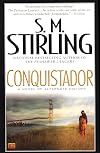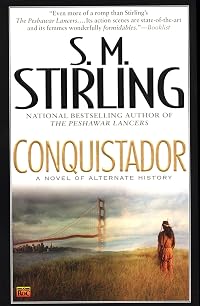
Conquistador
by S. M. Stirling
On This Page
Description
“In this luscious alternative universe, sidekicks quote the Lone Ranger and Right inevitably triumphs with panache. What more could adventure-loving readers ask for?”—Publishers WeeklyOakland, 1946. Ex-soldier John Rolfe, newly back from the Pacific, has made a fabulous discovery: A portal to an alternate America where Europeans have never set foot—and the only other humans in sight are a band of very curious Indians. Able to return at will to the modern world, Rolfe summons the show more only people with whom he is willing to share his discovery: his war buddies. And tells them to bring their families...
Los Angeles, twenty-first century. Fish and Game warden Tom Christiansen is involved in the bust of a smuggling operation. What he turns up is something he never anticipated: a photo of authentic Aztec priests decked out in Grateful Dead T-shirts, and a live condor from a gene pool that doesn’t correspond to any known in captivity or the wild. It is a find that will lead him to a woman named Adrienne Rolfe—and a secret that’s been hidden for sixty years…. show less
Tags
Recommendations


Member Recommendations
Member Reviews
This book continues the tradition that Stirling never writes sequels to the books of his I like best. Ah well.
I especially like the acknowledgments to this volume:
To Jerry Pournelle, for help and assistance; Giovanni Spinella and Mario Panzanelli, for help with Sicilian dialect; Steve Brady, for Afrikaans, Greg Saunders, for local knowledge of LA; to the Critical Mass, for continuing massively helpful criticism; and any others on the list.
All faults, errors, infelicities and lapses are my own.
And a special acknowledgement to the author of Niven's Law:
"There is a technical, literary term for those who mistake the opinions and beliefs of characters in a novel for those of an author.
"The term is 'idiot.'"
I suspect the last entry was show more necessary because all of the major players in this book are 'deplorables', to use an anachronistic term for a book written in 2003. Un-reconstructed Southerners. Former Waffen-SS. Pied noirs, white Rhodesians, and Boers. As a high concept, this book seems to be about: what would happen if all of the losers of Western Civilization's great internal conflicts got together and created a new society free from the influence of history's winners, but the losers could take any knowledge [cultural or technological] they wished into extra-dimensional exile?
Stirling's answer turns out to be pretty interesting. For example, the Commonwealth of New Virginia, is an environmentalists paradise: completely sustainable, driven largely by renewable energy, with strict limits on urban sprawl and massive reserves of untouched wilderness. The alternate history California of Conquistador is a prose poem to Nature along the lines of Steve Nichols' Paradise Found. Or perhaps I should say it would be an environmentalist's paradise, if you could separate environmentalism from the political Left. There is plenty of mining and hunting, because the New Virginians are conservationists of the strict observance. They preserve the wilderness because it is pretty, and because animals taste good and look nice as rugs.
The social arrangements of the Commonwealth are similarly perplexing, if you insist on maintaining the alliances of convenience that characterize current American politics. Political power is concentrated in the Thirty Families, the descendants of those who settled the New World. The head of each family sits on a council, and their word is law. Yet, laborers have a great deal of power, due to a short supply of labor due to an extremely strict guest-worker program. The entreaties of beleaguered businessmen are dismissed with contempt.
Fertility is high, as is religious observance. Free-thinkers exist, they just aren't paid much heed. Which isn't to say the state, such as it is, is theocratic. For historical reasons, the settlers largely brought Christianity with them into exile, but it seems to have been shorn of its universalizing tendencies. That may be because we mostly see the Commonwealth through the eyes of its masters, who are hard and unsentimental men.
While there are some references to "missions", there doesn't seem to be anything like the Franciscan order that accompanied our world's conquistadors. Which makes sense, since the ruling elite wouldn't want anyone with real allegiance to a completely autonomous center of power, and largely come from places with strong traditions of political control of religion.
Stirling's presentation of all this strikes me as bold and interesting, because he gives the impression that the Commonwealth of New Virginia isn't a terrible place to live. In fact, it is rather nice in many ways. It is sometimes unjust, as all states are, but it has more virtues than you might expect. Unlike his Draka series, this state founded by horrible people isn't a living nightmare. It is simply another place in the realm of possibility, that represents a slightly different mix of the features that make up the West.
I want sequels because I would like to explore the future evolution of this society. I suspect that a Western polity that amputated the radical and universalizing features of Christianity would eventually turn into something quite different than what we see today. I doubt the result would be good, but I would say that. I'd like to see what Stirling's answer to that question is, but I suspect I won't get it. Which is a pity. show less
I especially like the acknowledgments to this volume:
To Jerry Pournelle, for help and assistance; Giovanni Spinella and Mario Panzanelli, for help with Sicilian dialect; Steve Brady, for Afrikaans, Greg Saunders, for local knowledge of LA; to the Critical Mass, for continuing massively helpful criticism; and any others on the list.
All faults, errors, infelicities and lapses are my own.
And a special acknowledgement to the author of Niven's Law:
"There is a technical, literary term for those who mistake the opinions and beliefs of characters in a novel for those of an author.
"The term is 'idiot.'"
I suspect the last entry was show more necessary because all of the major players in this book are 'deplorables', to use an anachronistic term for a book written in 2003. Un-reconstructed Southerners. Former Waffen-SS. Pied noirs, white Rhodesians, and Boers. As a high concept, this book seems to be about: what would happen if all of the losers of Western Civilization's great internal conflicts got together and created a new society free from the influence of history's winners, but the losers could take any knowledge [cultural or technological] they wished into extra-dimensional exile?
Stirling's answer turns out to be pretty interesting. For example, the Commonwealth of New Virginia, is an environmentalists paradise: completely sustainable, driven largely by renewable energy, with strict limits on urban sprawl and massive reserves of untouched wilderness. The alternate history California of Conquistador is a prose poem to Nature along the lines of Steve Nichols' Paradise Found. Or perhaps I should say it would be an environmentalist's paradise, if you could separate environmentalism from the political Left. There is plenty of mining and hunting, because the New Virginians are conservationists of the strict observance. They preserve the wilderness because it is pretty, and because animals taste good and look nice as rugs.
The social arrangements of the Commonwealth are similarly perplexing, if you insist on maintaining the alliances of convenience that characterize current American politics. Political power is concentrated in the Thirty Families, the descendants of those who settled the New World. The head of each family sits on a council, and their word is law. Yet, laborers have a great deal of power, due to a short supply of labor due to an extremely strict guest-worker program. The entreaties of beleaguered businessmen are dismissed with contempt.
Fertility is high, as is religious observance. Free-thinkers exist, they just aren't paid much heed. Which isn't to say the state, such as it is, is theocratic. For historical reasons, the settlers largely brought Christianity with them into exile, but it seems to have been shorn of its universalizing tendencies. That may be because we mostly see the Commonwealth through the eyes of its masters, who are hard and unsentimental men.
While there are some references to "missions", there doesn't seem to be anything like the Franciscan order that accompanied our world's conquistadors. Which makes sense, since the ruling elite wouldn't want anyone with real allegiance to a completely autonomous center of power, and largely come from places with strong traditions of political control of religion.
Stirling's presentation of all this strikes me as bold and interesting, because he gives the impression that the Commonwealth of New Virginia isn't a terrible place to live. In fact, it is rather nice in many ways. It is sometimes unjust, as all states are, but it has more virtues than you might expect. Unlike his Draka series, this state founded by horrible people isn't a living nightmare. It is simply another place in the realm of possibility, that represents a slightly different mix of the features that make up the West.
I want sequels because I would like to explore the future evolution of this society. I suspect that a Western polity that amputated the radical and universalizing features of Christianity would eventually turn into something quite different than what we see today. I doubt the result would be good, but I would say that. I'd like to see what Stirling's answer to that question is, but I suspect I won't get it. Which is a pity. show less
What would be the state of America if the Europeans had never made it there? In 'Conquistador' SM Stirling tries to answer this question. The story starts in 1946 when John Rolfe, late of the US army, is experimenting with a war surplus radio when an explosion leaves the far wall of his cellar a rippling silver. Showing the sort of bravery that had almost not got him through World War 2, Rolfe goes through the shimmer to find himself in an unspoilt San Francisco bay. The next question is 'is this the present, or the past?' Rolfe puts together a group of old army colleagues so they could all exploit this practically virgin territory. When Tom Christiansen and his partner Tully from the Californian Department of Game and Fisheries are show more involved in a failed bust they think they're on the trail of a bunch of animal smugglers, but they little realise just how far away they had been smuggled!.
It's a great tale that's reasonably well paced and would have been almost as good if the later parts of the book hadn't been written. show less
It's a great tale that's reasonably well paced and would have been almost as good if the later parts of the book hadn't been written. show less
Conquistador has an action-filled plot of a parallel Earth in which there was no European exploration of the New World, and the entire world is far behind in technological development. This world is accessed through a single gate in California and controlled by its discoverer (in 1946) and his close military friends, as well as others they choose to help build a new society. Most of the action takes place in the year 2009, sixty-three years after the opening of the gate. Within vignettes of other times, the reader learns of some aspects of the political, economic, and social develpment of the civilization outward from the gate.
I enjoyed the detailed (at times too much so) descriptions of an untouched Bay Area, as I grew up there on show more "this" Earth. I think others might find that aspect somewhat overdone. I found the main characters Mary Sue-ish, especially the rich, beautiful, highly intelligent, hunts-rides-shoots-flies a plane-kills-talks like a man, but makes love-etc. like a courtesan, female protagonist.
One occurence on the alternate earth is that 90% of the native populations of the world are killed off in waves as they are exposed to the "bugs" of the immigrants from "our" Earth. The new rulers, and most everyone, are of the thought that since nothing could be done to prevent it, why not enjoy the fact that all this world is theirs with little opposition. In addition, the immigrant make-up is carefully controlled to prevent entry to any groups that are non-white, although there is the one Jewish friend of the discoverer who is a founding member. Most women are also there mainly to reproduce and care for their men and families. I would be interested to know whether the author thought that this is what would have to happen in light of who found the gate and the times in which he lived, or if it is a world in which he himself would like to live. There is some attempt to create conversation around these facets of the growing civilization, but they seem inconsequential, almost as though thrown in to pacify those readers who might find such a world disturbing.
I found the book to be interesting, but not all that suspenseful or captivating. It did make me wonder what I'd do with the entire unspoiled Earth as my playground. show less
I enjoyed the detailed (at times too much so) descriptions of an untouched Bay Area, as I grew up there on show more "this" Earth. I think others might find that aspect somewhat overdone. I found the main characters Mary Sue-ish, especially the rich, beautiful, highly intelligent, hunts-rides-shoots-flies a plane-kills-talks like a man, but makes love-etc. like a courtesan, female protagonist.
One occurence on the alternate earth is that 90% of the native populations of the world are killed off in waves as they are exposed to the "bugs" of the immigrants from "our" Earth. The new rulers, and most everyone, are of the thought that since nothing could be done to prevent it, why not enjoy the fact that all this world is theirs with little opposition. In addition, the immigrant make-up is carefully controlled to prevent entry to any groups that are non-white, although there is the one Jewish friend of the discoverer who is a founding member. Most women are also there mainly to reproduce and care for their men and families. I would be interested to know whether the author thought that this is what would have to happen in light of who found the gate and the times in which he lived, or if it is a world in which he himself would like to live. There is some attempt to create conversation around these facets of the growing civilization, but they seem inconsequential, almost as though thrown in to pacify those readers who might find such a world disturbing.
I found the book to be interesting, but not all that suspenseful or captivating. It did make me wonder what I'd do with the entire unspoiled Earth as my playground. show less
After enjoying Stirling's Dies the Fire series, I decided to test the waters with some of his other works. I chose the stand alone novel Conquistador as a quick way to evaluate if my enjoyment was purely from good writing and storytelling, or if it was tied up merely in the thematic material of the original series of novels.
Even prior to finishing the book it was obvious that Stirling has developed a keen ability for providing interesting and fast moving narratives. Though it was not as enjoyable as my experience with his more recent series, it was still a fun work to read and with a completely different milieu, ranging from a modern mystery detective story to something like a western action novel.
Back and forth in time and spanning show more across two universes, the narrative of this story is given an air of mystery as critical elements of the plot are revealed much like unwrapping a gift one small piece of paper at a time. The core of the story revolves around a gateway to a parallel universe discovered by an American soldier after his return from the second World War. Using the abundant natural resources of the the alternate reality as seed capital, he sets up a new feudal society there. The story develops around efforts sixty years later to keep the gate and the new society secret from the First Side, as internal political forces threaten to expose the gate and tear the new society apart in civil war.
The story is set primarily in the Bay Area both of our world and the alternate reality. Stirling uses his geographical knowledge well, and the places will be familiar to anyone who has lived or spent time in the area. He also uses the ecological contrasts between our world and the untouched primitive land on the other side of the gateway as a unique way to expose the details of environmental changes that have occurred during post-industrial history. Along with this, he paints a morally ambiguous portrait of the inner politics of this new world (representing a more agrarian society) and compares it with our current post-industrial society. He dispels our sometimes mythic, grass is greener view of history while at the same time pointing out some of the good things we may have lost during the societal changes brought about by large population growth and industrialization. This is one of the areas I appreciated more in Conquistador as opposed to the philosophical bits that came from Dies the Fire, which were generally painted in more black and white terms. show less
Even prior to finishing the book it was obvious that Stirling has developed a keen ability for providing interesting and fast moving narratives. Though it was not as enjoyable as my experience with his more recent series, it was still a fun work to read and with a completely different milieu, ranging from a modern mystery detective story to something like a western action novel.
Back and forth in time and spanning show more across two universes, the narrative of this story is given an air of mystery as critical elements of the plot are revealed much like unwrapping a gift one small piece of paper at a time. The core of the story revolves around a gateway to a parallel universe discovered by an American soldier after his return from the second World War. Using the abundant natural resources of the the alternate reality as seed capital, he sets up a new feudal society there. The story develops around efforts sixty years later to keep the gate and the new society secret from the First Side, as internal political forces threaten to expose the gate and tear the new society apart in civil war.
The story is set primarily in the Bay Area both of our world and the alternate reality. Stirling uses his geographical knowledge well, and the places will be familiar to anyone who has lived or spent time in the area. He also uses the ecological contrasts between our world and the untouched primitive land on the other side of the gateway as a unique way to expose the details of environmental changes that have occurred during post-industrial history. Along with this, he paints a morally ambiguous portrait of the inner politics of this new world (representing a more agrarian society) and compares it with our current post-industrial society. He dispels our sometimes mythic, grass is greener view of history while at the same time pointing out some of the good things we may have lost during the societal changes brought about by large population growth and industrialization. This is one of the areas I appreciated more in Conquistador as opposed to the philosophical bits that came from Dies the Fire, which were generally painted in more black and white terms. show less
The concept behind this book was great: in a parallel world, Alexander the Great does not die on schedule, causing history to widely divirge. I would have liked for Stirling to go back further and show us more of that alternate history, instead of simply plopping us down in an alternate California that is just less populated and cleaner. Yes, we get it: We have overpopulated and screwed up the environment. Still the story was a pretty good page-turner, and it did bring up some interesting questions about the proper use of power in a situation like that. If you were essentially rediscovering the New World, what would you do differently than the original "Conquistadors"? What type of government would you set up? How would you keep your show more secret, and control who comes into your new world? One last nit-pick: The main character is a walking stereotype. Most people won't care, because he is a stereotypical burly Scandanavian from North Dakota who says "Yah, you betcha" on every page. As a North Dakotan, I was annoyed by this. If I want that crap, I'll watch "Fargo." show less
Stirling, S. M. Conquistador. Roc, 2003.
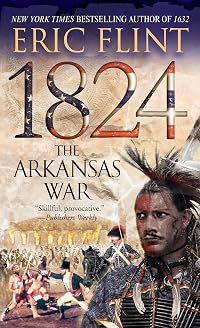
S. M. Stirling’s Conquistador is a high-concept alternate history saga in the tradition of Eric Flint and Harry Turtledove. In this standalone work, Stirling focuses on action and adventure rather than on historical exposition. The story begins in 1946 when a WWII vet creates a portal to a parallel Earth when he is rewiring a radio. He finds himself in a version of California that has not been settled by Europeans. The vet and some of his Army buddies move to the new California and set up a feudal oligarchy with a Native American underclass. The families are discovered in 2009 by a couple of fish and game wardens investigating illegal trading in the pelts of endangered species. There are more show more racial, cultural, and gender stereotypes than I like, though they are usually justified by historical verisimilitude. There is so little science here, it might as well be a magic door, and the alternate history is not much more plausible. 4 stars for a plot with an intrepid game warden. show less
S. M. Stirling’s Conquistador is a high-concept alternate history saga in the tradition of Eric Flint and Harry Turtledove. In this standalone work, Stirling focuses on action and adventure rather than on historical exposition. The story begins in 1946 when a WWII vet creates a portal to a parallel Earth when he is rewiring a radio. He finds himself in a version of California that has not been settled by Europeans. The vet and some of his Army buddies move to the new California and set up a feudal oligarchy with a Native American underclass. The families are discovered in 2009 by a couple of fish and game wardens investigating illegal trading in the pelts of endangered species. There are more show more racial, cultural, and gender stereotypes than I like, though they are usually justified by historical verisimilitude. There is so little science here, it might as well be a magic door, and the alternate history is not much more plausible. 4 stars for a plot with an intrepid game warden. show less
Fascinating concept. A passage to a Pre-Columbian California enables a 20th Century set his own country. The alternate California, which exists in parallel with the real California, is very well drawn. The flaw in this book is that sometimes the dialogue is corny.
Members
- Recently Added By
Lists

Books Read in 2016
4,666 works; 197 members
Author Information

149+ Works 32,556 Members
Stephen Michael Stirling is a French-born Canadian-American science fiction and fantasy author. His Birthday is September 30, 1953. He has lived in several countries and currently resides in the United States in New Mexico with his wife. He is probably best known for his Draka series of novels and his more recent time travel/alternate history show more Nantucket series and Emberverse series. In 2014 his title The Golden Princess made The New York Times Best Seller List. (Bowker Author Biography) show less
Some Editions
Awards and Honors
Awards
Common Knowledge
- Canonical title
- Conquistador
- Original title
- Conquistador
- Original publication date
- 2003-02
- People/Characters
- Ralph Barnes (physicist); Dimitri Batyushkov; Piet Botha; Tom Christiansen; Cecil Chumley (Lord Chumley); Giovanni Colletta (show all 25); Salvatore Colletta; Auguste Devereux; Alan Fitzmorton (John Rolfe's cousin); Robert Fitzmorton (John Rolfe's cousin); Kolomusnim; Andy O'Brien; Sarah Perkins (FBI); Abraham Pearlmutter; Solomon Pearlmutter; Adrienne Rolfe; Charles Rolfe; John Rolfe VI; Louisa Rolfe; Mr. Sorenson (engineer); Susan Sorenson; Roy Tully; Schalk van der Merwe; Henry Villers; Otto von Traupitz (Lieutenant)
- Important places
- Los Angeles, California, USA; San Francisco, California, USA; Oakland, California, USA; Berkeley, California, USA (Rolfeston)
- Dedication
- To Jan, forever
- First words
- John Rolfe had rented the house for seventy-five a month, which sounded extortionate but was something close to reasonable, given the way costs had gone crazy in the Bay Area since Pearl Harbor.
- Last words
- (Click to show. Warning: May contain spoilers.)Paws braced on it, the saber-tooth bared its foot-long fangs and screamed, flattening its ears and bristling its orange-and-black-striped fur.
- Original language
- English
Classifications
Statistics
- Members
- 957
- Popularity
- 27,826
- Reviews
- 24
- Rating
- (3.74)
- Languages
- English
- Media
- Paper, Ebook
- ISBNs
- 6
- ASINs
- 1