On This Page
Description
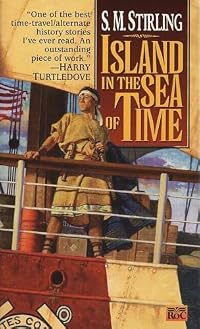
During a perfect spring evening on Nantucket, a violent storm erupts and a dome of crawling, colored fire blankets the island. When the howling winds subside and the night skies clear, the stars appear to have shifted. The mainland has become a wilderness of unbroken forest, where tools of bronze and stone litter the beaches, and primitive natives scatter in terror.A startling phenomenon has occurred: The island of Nantucket has been swept into the long-ago past. With its inhabitants adrift show more in the year 1250 BC, there is only one question to be answered: Can they survive? show lessTags
Recommendations














Member Recommendations


lquilter If what you liked in Island in the Sea of Time was the civilization-building, but you were annoyed by the politics of the author, give Kim Stanley Robinson's Mars trilogy (starting with Red Mars) a try: World-building in a new (future) world, so less offensiveness in the portrayal of actual past human civilizations, and -- for all that KSR is not exactly a master of characterization -- much more nuanced good and bad guys.
21
Member Reviews
Weaker than the companion/parallel trilogy taking place in the modern era. I'd probably give it 2.5-2.75 instead of 2, but limits of the rating system.
The biggest points against it: 1)there's some really distasteful anti-lgbtqia language in here, and while I think the point is that we're supposed to see those views as incorrect it still feels pretty uncomfortable given when it was written and that it was written by a straight cis white male. 2)overall the plot and major antagonist feel a lot less well/believably written than in the companion trilogy. At least there, there was a pretty considered effort to explain why and how the antagonist was able to achieve what he did (from his education and background, to early attempts at show more organization, to a consolidation of knowledge resources whether in print or in the form of experts). There really isn't any of that here...yet the antagonist is able to demonstrate knowledge and expertise *well* beyond what should be available to him across a wide array of technical and historical fields. show less
The biggest points against it: 1)there's some really distasteful anti-lgbtqia language in here, and while I think the point is that we're supposed to see those views as incorrect it still feels pretty uncomfortable given when it was written and that it was written by a straight cis white male. 2)overall the plot and major antagonist feel a lot less well/believably written than in the companion trilogy. At least there, there was a pretty considered effort to explain why and how the antagonist was able to achieve what he did (from his education and background, to early attempts at show more organization, to a consolidation of knowledge resources whether in print or in the form of experts). There really isn't any of that here...yet the antagonist is able to demonstrate knowledge and expertise *well* beyond what should be available to him across a wide array of technical and historical fields. show less
Here's a fun idea: Take a bunch of modern folks and send them helplessly back in time. What kind of culture clash could we get from smashing together past civilizations with a modern community, technologies, ideas, and knowledge?
You could get a fabulous novel of ideas, as well as an amazing rip-roaring adventure.
Unfortunately, Stirling's all-too-evident Libertarian-right politics killed any possible "novel of ideas" angle, leaving only the shell of a fun adventure.
This painful preachiness plays out most obviously in characterizations. One notices right away that the hippie-lefty feminist environmentalist crowd are strawfolks. Oh how ironic that their crazy lefty ideas about the peaceful Native Americans got them eaten by show more cannibalistic Caribs! If only they hadn't gotten Good People killed on account of their naively wrongheaded ideas.
What are all those lefties and anti-racists and shrill feminists complaining about anyhow? All good white folks are color-blind, etc., etc., so there's absolutely no need to worry about racism or sexism or heterosexism in Nantucket civilization. This is obvious, because Captain Marian Alston -- an African American lesbian Coast Guard captain -- has succeeded in the US Coast Guard and is even more successful in enlightened Nantucket civilization. Can you spell TOKEN, girls and boys? ("S-A-R-A-H P-A-L-" -- ahem.) Is anyone surprised that Captain Alston is of course a martial arts expert, doing tai chi (or whatever) in the early dawn on her deck?
The gruff and kindly somewhat over-the-hill alpha male (aka "mary stu") is right about everything, except -- of course -- he is a little too trusting of the villains. But that's okay, because how else would the Nantucketers get to demonstrate the need to arm society, spread Western style democracy about the world, and play tough with lefties and villains alike? (And of course the Nantucketers ally very early on with British Isles folks.)
This political simplicity harms the characterization (and the resulting plot points) but also effectively destroys the suspense. Do we, really, worry about the survival of the Nantucketers through their first hard winter? No, because we know that their Yankee pluck and ingenuity -- and their wise leadership -- will carry them through. At least, anyone smart enough to go along with the wise leadership will survive; naive and foolish environmentalists, lefties, etc., will perish, because of course that's what those crazy ideas would naturally lead to if faced with reality.
The whole damn thing is a paean to how almost-perfect "our" (US, middle-class) civilization is, and how just a few libertarian tweaks would make it even more perfect.
No, I'm not exaggerating. The *concept* at the core of this series had the potential to become a great series of novels of ideas. But when the ideas being put forward are so painfully simplistic and unrealistically drawn, you just can't take it seriously.
But, hopefully, you didn't mean to take it seriously. Because on the good side, if you can ignore Stirling's aggravating preachiness, and the various too-convenient coincidences that make life so peachy-keen for the Nantucketers, it's a pretty fast and entertaining read. And there are lots of battles with various cool historical figures and peoples, and loving descriptions of various archaic and modern technologies. And who doesn't love Robinsonade survival / encounter stuff?
So, in conclusion: Pick it up if you want to while away a few pleasant hours in escapist adventure with fun trappings, so long as you have a high tolerance for straw-feminists and other eye-rolling characterizations. show less
You could get a fabulous novel of ideas, as well as an amazing rip-roaring adventure.
Unfortunately, Stirling's all-too-evident Libertarian-right politics killed any possible "novel of ideas" angle, leaving only the shell of a fun adventure.
This painful preachiness plays out most obviously in characterizations. One notices right away that the hippie-lefty feminist environmentalist crowd are strawfolks. Oh how ironic that their crazy lefty ideas about the peaceful Native Americans got them eaten by show more cannibalistic Caribs! If only they hadn't gotten Good People killed on account of their naively wrongheaded ideas.
What are all those lefties and anti-racists and shrill feminists complaining about anyhow? All good white folks are color-blind, etc., etc., so there's absolutely no need to worry about racism or sexism or heterosexism in Nantucket civilization. This is obvious, because Captain Marian Alston -- an African American lesbian Coast Guard captain -- has succeeded in the US Coast Guard and is even more successful in enlightened Nantucket civilization. Can you spell TOKEN, girls and boys? ("S-A-R-A-H P-A-L-" -- ahem.) Is anyone surprised that Captain Alston is of course a martial arts expert, doing tai chi (or whatever) in the early dawn on her deck?
The gruff and kindly somewhat over-the-hill alpha male (aka "mary stu") is right about everything, except -- of course -- he is a little too trusting of the villains. But that's okay, because how else would the Nantucketers get to demonstrate the need to arm society, spread Western style democracy about the world, and play tough with lefties and villains alike? (And of course the Nantucketers ally very early on with British Isles folks.)
This political simplicity harms the characterization (and the resulting plot points) but also effectively destroys the suspense. Do we, really, worry about the survival of the Nantucketers through their first hard winter? No, because we know that their Yankee pluck and ingenuity -- and their wise leadership -- will carry them through. At least, anyone smart enough to go along with the wise leadership will survive; naive and foolish environmentalists, lefties, etc., will perish, because of course that's what those crazy ideas would naturally lead to if faced with reality.
The whole damn thing is a paean to how almost-perfect "our" (US, middle-class) civilization is, and how just a few libertarian tweaks would make it even more perfect.
No, I'm not exaggerating. The *concept* at the core of this series had the potential to become a great series of novels of ideas. But when the ideas being put forward are so painfully simplistic and unrealistically drawn, you just can't take it seriously.
But, hopefully, you didn't mean to take it seriously. Because on the good side, if you can ignore Stirling's aggravating preachiness, and the various too-convenient coincidences that make life so peachy-keen for the Nantucketers, it's a pretty fast and entertaining read. And there are lots of battles with various cool historical figures and peoples, and loving descriptions of various archaic and modern technologies. And who doesn't love Robinsonade survival / encounter stuff?
So, in conclusion: Pick it up if you want to while away a few pleasant hours in escapist adventure with fun trappings, so long as you have a high tolerance for straw-feminists and other eye-rolling characterizations. show less
This is an alternate history in which the island of Nantucket is unexpectedly and inexplicably thrown back in time from 1998 to 1250 B.C. Nantucket is a real island, part of Massachusetts in the U.S. The story focuses on how they survive, considering Nantucket had relied mostly on outside food sources. They also needed raw materials that were limited in supply in order to make various goods, tools, and weapons, and politics are involved as they decide how to rule their island and how to handle the distribution of labor and supplies. A Coast Guard ship was conveniently near the island at the time of the event, so it was caught in the past too, providing a valuable resource for seeking trade among the natives of both North America and show more England.
Most of the story held my interest. I liked the political parts, and seeing what they had to do to survive, and I loved the parts where they met native cultures for the first time and learned about each other. There were times, though, when I started to lose interest and got bogged down in details that didn’t interest me as much. The event that caused them to be thrown back in time is never explained. There’s some speculation in the beginning, but nothing remotely close to a real answer. I don’t know if it will be addressed later in the trilogy, but my impression so far is that it was just the vehicle for the story the author wanted to tell and probably not something that will ever be dealt with in detail.
As a side note, the Kindle edition I have has erratic section breaks. Sometimes there were section breaks in the form of a little extra line spacing, and sometimes there weren’t any breaks at all and it wasn’t always immediately clear that the setting had changed.
I’m giving this 3.5 stars on sites where I can give half stars, and rounding up to 4 on Goodreads. I enjoyed it well enough to try the second book in the series. show less
Most of the story held my interest. I liked the political parts, and seeing what they had to do to survive, and I loved the parts where they met native cultures for the first time and learned about each other. There were times, though, when I started to lose interest and got bogged down in details that didn’t interest me as much. The event that caused them to be thrown back in time is never explained. There’s some speculation in the beginning, but nothing remotely close to a real answer. I don’t know if it will be addressed later in the trilogy, but my impression so far is that it was just the vehicle for the story the author wanted to tell and probably not something that will ever be dealt with in detail.
As a side note, the Kindle edition I have has erratic section breaks. Sometimes there were section breaks in the form of a little extra line spacing, and sometimes there weren’t any breaks at all and it wasn’t always immediately clear that the setting had changed.
I’m giving this 3.5 stars on sites where I can give half stars, and rounding up to 4 on Goodreads. I enjoyed it well enough to try the second book in the series. show less
The people on the island of Nantucket, wake up one morning to find themselves and their island transported into the past, to about 2000BC. The island and one Coast Guard sailing ship are, as far as they know, the only people from their time suddenly in the past.
What do they do now? How do they survive? What sort of people will step up and take control and make the island ready for their new reality, and what people will see the situation as an opportunity to grasp power through any means necessary.
The story is complex and believable, in that you can see how and why they make the decisions they do. It is also surprising in that what they find, and the enemies they face, are realistic and drawn with care and depth. There are no real show more monsters here, well, other than monsters men can become when they decide to carve out a kingdom rather than work together with others to make a new world where all can live in relative comfort.
I also found Stirling's treatment of the idea that if you change things, will you change the future so much that you won't ever even be in it, well thought out. For the folks of Nantucket, they have little choice. They're trying to find a way to merely survive. If that changes 'history' well, they really can't afford the luxury of altering their actions in hopes of not mucking about with things. No, all they can do is put one foot in front of the other and deal with the consequences. show less
What do they do now? How do they survive? What sort of people will step up and take control and make the island ready for their new reality, and what people will see the situation as an opportunity to grasp power through any means necessary.
The story is complex and believable, in that you can see how and why they make the decisions they do. It is also surprising in that what they find, and the enemies they face, are realistic and drawn with care and depth. There are no real show more monsters here, well, other than monsters men can become when they decide to carve out a kingdom rather than work together with others to make a new world where all can live in relative comfort.
I also found Stirling's treatment of the idea that if you change things, will you change the future so much that you won't ever even be in it, well thought out. For the folks of Nantucket, they have little choice. They're trying to find a way to merely survive. If that changes 'history' well, they really can't afford the luxury of altering their actions in hopes of not mucking about with things. No, all they can do is put one foot in front of the other and deal with the consequences. show less
The entire island of Nantucket is somehow transported from the year 1998 all the way back to 1250 B.C. The exact reason and mechanism for this aren't really explored here; it remains a deep mystery to everyone involved. Instead, Stirling focuses on what happens next: how the islanders survive, what kinds of technology they are able to reinvent or maintain, how they reorganize their society, and what encounters they have with the people of that era. That last thing gets very messy and complicated; there are a lot of bloody conflicts in the second half of the book.
This is a really intriguing premise. I have slightly mixed feelings about how Stirling handles it, though, because what he presents strikes me as a highly unrealistic best-case show more scenario for this situation, in terms of just how much people are able to accomplish in a very short period of time, and I think he glosses over a lot of technological and psychological difficulties. To he credit, he doesn't ignore them, but he does gloss over them. And I never could quite stop being aware of the fact that the author was manipulating everything about the situation to take the story in exactly the directions he wanted it. (E.g., they just happen to have a talented blacksmith, but most of their guns get destroyed early on. Yay, sword fights for everybody!) Of course, all authors do this, but it always works better when you don't notice it.
None of that, however, kept me from being interested in how things were going for the Nantucketers and what they were accomplishing. Stirling really does put a lot of attention into all the details, and conjures up the feeling of suddenly entering a vanished, long-ago world pretty well. I found it all much more engaging than I initially expected to, even when nothing much was going on. Actually... Possibly especially when nothing much was going on, because just about halfway through the book, which is where most of the real action starts, I was beginning to get tired. Not that I'd stopped being interested, exactly, but... Well, this isn't exactly a fast-paced page-turner, and it was taking me so long to get through it that by that point I just kind of felt like I wanted to get to the conclusion so I could go on to something else.
Even when I did, though, I don't know that it was a terribly satisfying conclusion. The central conflict is temporarily resolved, but the feel of the ending was very much, "Thus ends Book One! Stay tuned for the sequel!" Whether I actually will pick up the next book or not, I don't really know. I'd kind of like to return to this world and see how it fares as the years pass, but, man, 600 pages of this at a shot may just be a little too much for me. show less
This is a really intriguing premise. I have slightly mixed feelings about how Stirling handles it, though, because what he presents strikes me as a highly unrealistic best-case show more scenario for this situation, in terms of just how much people are able to accomplish in a very short period of time, and I think he glosses over a lot of technological and psychological difficulties. To he credit, he doesn't ignore them, but he does gloss over them. And I never could quite stop being aware of the fact that the author was manipulating everything about the situation to take the story in exactly the directions he wanted it. (E.g., they just happen to have a talented blacksmith, but most of their guns get destroyed early on. Yay, sword fights for everybody!) Of course, all authors do this, but it always works better when you don't notice it.
None of that, however, kept me from being interested in how things were going for the Nantucketers and what they were accomplishing. Stirling really does put a lot of attention into all the details, and conjures up the feeling of suddenly entering a vanished, long-ago world pretty well. I found it all much more engaging than I initially expected to, even when nothing much was going on. Actually... Possibly especially when nothing much was going on, because just about halfway through the book, which is where most of the real action starts, I was beginning to get tired. Not that I'd stopped being interested, exactly, but... Well, this isn't exactly a fast-paced page-turner, and it was taking me so long to get through it that by that point I just kind of felt like I wanted to get to the conclusion so I could go on to something else.
Even when I did, though, I don't know that it was a terribly satisfying conclusion. The central conflict is temporarily resolved, but the feel of the ending was very much, "Thus ends Book One! Stay tuned for the sequel!" Whether I actually will pick up the next book or not, I don't really know. I'd kind of like to return to this world and see how it fares as the years pass, but, man, 600 pages of this at a shot may just be a little too much for me. show less
Wow. I had this book on my to-read shelf for some time as I'd heard it was a good alt history book but I never got around to reading it til one of my book clubs picked it as a series read. And I'm glad I finally read it.
A fascinating, thrilling story of an incident which send the island of Nantucket, MA, USA (plus a sailing vessel of the Coast Guard) back in time to around 1250 BC. The affected having to come to terms with the loss of everyone and everything they once knew and learn to live in the Bronze Age.
Now I will admit there is a lot of handwaving here. It seems to be amazing luck that they have fishermen, farmers, blacksmiths, historians, anthropologists, a vast array of people who know how to make or find everything required to show more get a society running at at least Industrial Revolution standards. But you know what? I didn't care. It meant the book kept moving and didn't end after two chapters with everyone dying. Which is what would happen if 9000 random people from my city were sent back to the past.
I loved the little details of the civilisations of the time. I wanted to see more interactions and explorations but I believe that will occur in the rest of the series. This book really was about getting the Islanders to a stable point from which they could be self-sufficient plus the breakaway groups.
There were times that I wish this book was written at a higher level though like [b:Opening Atlantis|666256|Opening Atlantis (Atlantis, #1)|Harry Turtledove|http://photo.goodreads.com/books/1266611676s/666256.jpg|652308] or [b:Foundation|29579|Foundation (Foundation, #1)|Isaac Asimov|http://photo.goodreads.com/books/1320416085s/29579.jpg|1783981], spanning generations to see what changes the Event caused. Especially, and this ties in with something that bugged me, when they were getting close to year 0. So here's something I really disliked. After everything else going ok, yeah sure existing tribes and civilisations would be completely changed but they had to survive somehow, they decide to unleash Christianity on the locals. A religion based on someone who wouldn't even be "born" for over 1000 years. I guess they at least might get a coming of Jesus. But I wouldn't have thought the scientists who were helping oversee would have just allowed that through without some challenge.
Though they were all thrown thousands of years into the past by an unknown force. Maybe that's a good time to start praying to someone.
One of the other points I really loved was the questions and implications raised by such an event. Should they have tried to live a completely isolationist existence? They had to resort to whaling for oil and food and other by-products, but was that a bad thing in a time when whale populations would be immense and sustainable hunting could be enacted from day 1?I understand needing to help the local British inhabitants protect themselves from a force lead by an American but was the wholesale slaughter and hatred of the Olmecs necessary? The way they talked about eradicating them was akin to genocide. Plus destroying the Olmec culture would lead to their being no Aztecs or Mayans or any other Central/South American civilisations.
This was a great book. History was always my favourite subject and I would love the chance to live it for myself. Though could I really give up all the modern luxuries? Who knows. I can't wait to read the next book. show less
A fascinating, thrilling story of an incident which send the island of Nantucket, MA, USA (plus a sailing vessel of the Coast Guard) back in time to around 1250 BC. The affected having to come to terms with the loss of everyone and everything they once knew and learn to live in the Bronze Age.
Now I will admit there is a lot of handwaving here. It seems to be amazing luck that they have fishermen, farmers, blacksmiths, historians, anthropologists, a vast array of people who know how to make or find everything required to show more get a society running at at least Industrial Revolution standards. But you know what? I didn't care. It meant the book kept moving and didn't end after two chapters with everyone dying. Which is what would happen if 9000 random people from my city were sent back to the past.
I loved the little details of the civilisations of the time. I wanted to see more interactions and explorations but I believe that will occur in the rest of the series. This book really was about getting the Islanders to a stable point from which they could be self-sufficient plus the breakaway groups.
There were times that I wish this book was written at a higher level though like [b:Opening Atlantis|666256|Opening Atlantis (Atlantis, #1)|Harry Turtledove|http://photo.goodreads.com/books/1266611676s/666256.jpg|652308] or [b:Foundation|29579|Foundation (Foundation, #1)|Isaac Asimov|http://photo.goodreads.com/books/1320416085s/29579.jpg|1783981], spanning generations to see what changes the Event caused. Especially, and this ties in with something that bugged me, when they were getting close to year 0. So here's something I really disliked. After everything else going ok, yeah sure existing tribes and civilisations would be completely changed but they had to survive somehow, they decide to unleash Christianity on the locals. A religion based on someone who wouldn't even be "born" for over 1000 years. I guess they at least might get a coming of Jesus. But I wouldn't have thought the scientists who were helping oversee would have just allowed that through without some challenge.
Though they were all thrown thousands of years into the past by an unknown force. Maybe that's a good time to start praying to someone.
One of the other points I really loved was the questions and implications raised by such an event. Should they have tried to live a completely isolationist existence? They had to resort to whaling for oil and food and other by-products, but was that a bad thing in a time when whale populations would be immense and sustainable hunting could be enacted from day 1?
This was a great book. History was always my favourite subject and I would love the chance to live it for myself. Though could I really give up all the modern luxuries? Who knows. I can't wait to read the next book. show less
After just reading the entire 15 book Emberverse series (and previously having read the 9 “Lost Regiment” series by Forstchen and about a half dozen of the “Ring of Fire” stories by Flint) I find myself a bit exhausted with “Nantucket”. I’ll read the other two books, and enjoy them…but Stirling is doing something so strange here that he’s making me a bit uncomfortable. “Dies the Fire” requires a modification of the laws of physics that doesn’t exist in the particular ‘time’ frame of the current story (some 3,000 years in the past in this sequence). Both series involve something happening to Nantucket…but that seems to be the only commonality. And, while I can’t see that it makes any difference which show more CHANGE series you read first, I’m hoping someone can tell me what book(s) ties them all together. I’m looking for closure here, people.
Meanwhile, just as in the “Emberverse”, Stirling allows a convenient Deus Ex Machina (in the form of a Coast Guard training sailing ship) to be caught within the ‘change’ such that, with the already technical industrial underpinnings of Nantucket itself we’re off to a roaring good start. But, of course, we need some bad guys. So, in addition to the local weirdos who can’t handle the ‘change’ and/or want/need to alter the direction of the efforts to reestablish some semblance of order—and survivability—we have some really smart people with some really megalomaniac tendencies to contend with. We’re talking all-out war. And on two continents. show less
Meanwhile, just as in the “Emberverse”, Stirling allows a convenient Deus Ex Machina (in the form of a Coast Guard training sailing ship) to be caught within the ‘change’ such that, with the already technical industrial underpinnings of Nantucket itself we’re off to a roaring good start. But, of course, we need some bad guys. So, in addition to the local weirdos who can’t handle the ‘change’ and/or want/need to alter the direction of the efforts to reestablish some semblance of order—and survivability—we have some really smart people with some really megalomaniac tendencies to contend with. We’re talking all-out war. And on two continents. show less
Members
- Recently Added By
Lists

Best Time Travel Novels
165 works; 123 members

Best Science Fiction Novels
816 works; 426 members

Best time travel books
56 works; 21 members

Books Read in 2014
2,341 works; 89 members

Good (mostly) modern science fiction
40 works; 4 members
Author Information

149+ Works 32,331 Members
Stephen Michael Stirling is a French-born Canadian-American science fiction and fantasy author. His Birthday is September 30, 1953. He has lived in several countries and currently resides in the United States in New Mexico with his wife. He is probably best known for his Draka series of novels and his more recent time travel/alternate history show more Nantucket series and Emberverse series. In 2014 his title The Golden Princess made The New York Times Best Seller List. (Bowker Author Biography) show less
Some Editions
Awards and Honors
Awards
Series

Work Relationships
Common Knowledge
- Canonical title
- Island in the Sea of Time
- Original publication date
- 1998-03
- People/Characters
- Marian Alston-Kurlelo; Ian Arnstein; Jared Cofflin; Alice Hong; Isketerol of Tartessos; Swindapa Kurlelo-Alston (show all 43); Ohotolarix; William Walker, the Wolf Lord; Doreen Rosenthal; Martha Stoddard; Daurthunnicar son of Ubrotarix; Pamela Lisketter; Victor Ortiz; George Swain; Ed Geary; Andy Toffler; Joseph Starbuck; Sandy Rapczewicz; Angelica Brand; Ron Leaton; Jared Roberts; Shaumsrix son of Telenthaur; Dennis Brown; Tom Hiller; Miskelefol; John Detterson; Sam Macy; David Lisketter; John Martins; Barbara Allis; Rosita Menendez; Ekhnonpa daughter of Daurthunnicar; Cynthia Kelton; Marian Deer Dancer Cofflin; Keruwthena; Pelanstorn son of Kaddapal; Maltonr son of Sinsewid; Dekarchar son of Wirronax; Dhinwarn of the Star Blood Line of the Kurlelo; Jack Elkins; Amelia Seckel; Drauntorn; Merenthraur
- Important places
- Nantucket, Massachusetts, USA; Coatzacoalcos River, Veracruz, Mexico; United Kingdom; Ireland; Narragansett Bay, Rhode Island, USA
- Important events
- Bronze Age
- Dedication
- To Jan, as always, forever.
And to Harry -
for setting a good example. - First words
- March, 1998 A.D.
Ian Arnstein stepped off the ferry gangway and hefted his bags. - Last words
- (Click to show. Warning: May contain spoilers.)The years stretched ahead, and the work that filled them stoked the glow below her breastbone.
(Click to show. Warning: May contain spoilers.)They still served a mean seafood dinner in the basement restaurant at the John Coffin House, even in the Bronze Age. (epilogue) - Blurbers
- Sawyer, Robert J.; Turtledove, Harry; Anderson, Poul; Shwartz, Susan; Martin, George R.R.; Sawyer, Robert J.
- Original language
- English
Classifications
Statistics
- Members
- 1,753
- Popularity
- 12,467
- Reviews
- 44
- Rating
- (3.89)
- Languages
- English, Norwegian
- Media
- Paper, Audiobook, Ebook
- ISBNs
- 10
- ASINs
- 6