On This Page
Description
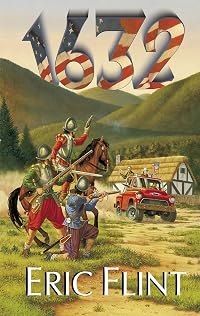
A mysterious accident in time causes twenty-first-century American democracy to collide head-on with the Thirty Years War in seventeenth-century Germany as Mike Stearn and a group of armed miners take on a gang of strangely attired invaders who are threatening peaceful Grantville, West Virginia. Original. Freedom and Justice-American Style 1632. And in northern Germany things couldn't get much worse. Famine. Disease. Religious war laying waste the cities. Only the aristocrats remained show more relatively unscathed; for the peasants, death was a mercy. 2000 Things are going OK in Grantville, West Virginia, and everybody attending the wedding of Mike Stearn's sister (including the entire local chapter of the United Mine Workers of America, which Mike leads) is having a good time. Then, everything changed. When the dust settles, Mike leads a group of armed miners to find out what happened and finds the road into town is cut, as with a sword. On the other side, a scene out of Hell: a man nailed to a farmhouse door, his wife and daughter attacked by men in steel vests. Faced with this, Mike and his friends don't have to ask who to shoot. At that moment Freedom and Justice, American style, are introduced to the middle of the Thirty Years' War. show lessTags
Recommendations






Member Recommendations

Member Reviews
Every now and then a new series really grabs me and Eric Flint's 1632 (Ring of Fire) certainly did so. The setup is simple: A small mining town from West Virginia (circa 1999) is snatched out of time and space (don't worry about why or how, it doesn't matter) and dropped into the middle of Germany in 1631 in the middle of the Thirty Years War (one of the bloodiest conflicts ever). How will the Americans cope with their new surroundings and situation? How will the neighboring Germans cope with these new republicans and their strange machines and strangerer beliefs (freedom of religion?!). How will the rest of Europe respond and how will these events change history. A great idea, well told. Bravo. Highly recommended.
Reading Eric Flint’s 1632 reminded me of two classic science fiction works. The first is L. Sprague de Camp’s [b:Lest Darkness Fall|94715|Lest Darkness Fall|L. Sprague de Camp|https://images.gr-assets.com/books/1171292734s/94715.jpg|615593], which is predicated on a similar premise: a man from the present finds himself suddenly transported to the collapsing Roman Empire, where he uses his knowledge of modern ways to change history. In this novel, however, it is not a solitary historian who is dropped into the past, but an entire West Virginia town. This gives them a significant advantage over de Camp’s character, as they have tools, weapons, even a functioning power plant to provide electricity in a pre-steam engine age. The show more circumstances may not be quite as challenging, but the similar goals lead to a lot of fun, as the residents of Grantville find themselves bringing American values and know-how to the tumultuous struggle of the Thirty Years War.
This transformation of 17th century Germany brought to mind another science fiction tale, the [b:Janissaries|197183|Janissaries (Janissaries, #1)|Jerry Pournelle|https://images.gr-assets.com/books/1345305978s/197183.jpg|2530397] series by Jerry Pournelle. In it, a group of American mercenaries are plucked off of a hill in Africa and taken to a planet to supervise the harvesting of a narcotic plant. Like Eric Flint’s West Virginians, they encounter humans from earlier ages who had been deposited there previously. Yet whereas Pournelle used this scenario to depict very human fragmentation and conflict between the mercenaries, Flint’s Grantvillians present a virtuous front adhering to idealized values – a front that is perhaps a little too virtuous. Such an approach constricts the novel, as well as creating lopsided clashes between the united Americans and their outmatched opponents. It would have been far more interesting to depict a divided community with opportunists allying themselves with Grantville’s enemies.
It all adds up to a series that is entertaining but largely predictable. Hopefully Flint and his subsequent collaborators overcame these limitations in later volumes of this popular series, which makes for enjoyable reading but left me with the sense that it could have been so much better. show less
This transformation of 17th century Germany brought to mind another science fiction tale, the [b:Janissaries|197183|Janissaries (Janissaries, #1)|Jerry Pournelle|https://images.gr-assets.com/books/1345305978s/197183.jpg|2530397] series by Jerry Pournelle. In it, a group of American mercenaries are plucked off of a hill in Africa and taken to a planet to supervise the harvesting of a narcotic plant. Like Eric Flint’s West Virginians, they encounter humans from earlier ages who had been deposited there previously. Yet whereas Pournelle used this scenario to depict very human fragmentation and conflict between the mercenaries, Flint’s Grantvillians present a virtuous front adhering to idealized values – a front that is perhaps a little too virtuous. Such an approach constricts the novel, as well as creating lopsided clashes between the united Americans and their outmatched opponents. It would have been far more interesting to depict a divided community with opportunists allying themselves with Grantville’s enemies.
It all adds up to a series that is entertaining but largely predictable. Hopefully Flint and his subsequent collaborators overcame these limitations in later volumes of this popular series, which makes for enjoyable reading but left me with the sense that it could have been so much better. show less
At a well attended wedding reception, partyers see a flash in the sky and find their West Virginia hometown has been transported in space to Germany and in time to 1632. The well armed population does their best to bring the United States to war torn Europe.
This was a rollicking good fun alternate history. From the United Mine Workers union to the strong female characters, both American and historical European, it is a great imagining of how things might go should such a thing happen. I'm going after the first sequel, at least.
This was a rollicking good fun alternate history. From the United Mine Workers union to the strong female characters, both American and historical European, it is a great imagining of how things might go should such a thing happen. I'm going after the first sequel, at least.
What happens when a small West Virginia town circa 1999 gets sent back to 1632 and plopped in the middle of the 30 Years War, a conflagration that burnt down pretty much all of Germany? Well, for the good people of Grantville, it's time to kickstart the American Revolution 150 years early, and bring the 17th century democracy, human rights, and the American Way.
This book excels in fist pumping America, Fuck Yeah! moments. When the people of Grantville decide to make the best of their situation, or waste some particularly scummy mercenaries, or include refugees of all circumstances in their situation, it's really good. Flint is an old school union Democrat. He wanted to write a book about blue collar folk succeeding in a weird situation, show more and he did it.
That said, a lot of this book just kind of flops around with too many characters, most of whom are too calm. I really couldn't tell you what distinguished any of the viewpoints from Mike Stearns, the local man turned leader. Three cross-cultural romances tie the human side of the story together, but they were kind of awkward, which may be the point. Similarly, the military side is modern firearms laying waste to tercios, which is fun maybe twice.
Flint has really strong female characters, which is a plus, but he still has no idea how to write women. They're competent, smart, calm, utterly lethal with their choice of weapons, and barely seem human, let alone female. The high school cheerleader and biathlete turned ace sniper is at the top of the list. It's good that they're not damsels in distress, but they're still fetishized. show less
This book excels in fist pumping America, Fuck Yeah! moments. When the people of Grantville decide to make the best of their situation, or waste some particularly scummy mercenaries, or include refugees of all circumstances in their situation, it's really good. Flint is an old school union Democrat. He wanted to write a book about blue collar folk succeeding in a weird situation, show more and he did it.
That said, a lot of this book just kind of flops around with too many characters, most of whom are too calm. I really couldn't tell you what distinguished any of the viewpoints from Mike Stearns, the local man turned leader. Three cross-cultural romances tie the human side of the story together, but they were kind of awkward, which may be the point. Similarly, the military side is modern firearms laying waste to tercios, which is fun maybe twice.
Flint has really strong female characters, which is a plus, but he still has no idea how to write women. They're competent, smart, calm, utterly lethal with their choice of weapons, and barely seem human, let alone female. The high school cheerleader and biathlete turned ace sniper is at the top of the list. It's good that they're not damsels in distress, but they're still fetishized. show less
What if a sphere, 6 miles in diameter, that included a small town in the hills of 21st century West Virginia was somehow transported to 17th Century Germany? How would modern American attitudes, technology, and values--especially the parts about all men are created equal, freedom of religion, and separation of Church and State--go over a 17th century Europe engulfed in the wars of the Reformation, the Holy Inquisition, and the Spanish Inquisition?
1632 is Eric Flint's answer to this question. And it's very hard to put down. Rich detail of both the 21st century and the 17th century are woven together to make a wonderful, optimistic story. The pace is fast and if the main characters are a little too good, a little too noble, they are show more richly drawn and hold the readers attention. The plot is (from my own American point of view) perfectly plausible, and the leader of the American community embodies what we think we should be.
It's not a perfect SF or Alt History novel, the good guys are a little too good, and the bad guys are a little too bad; the heroism is a little to heroic and the villainy is a little too villainous. In Bahktinian reads more like an epic than a novel. And there is one storytelling technique that Flint likes to use that gets on my nerves--often times the narrator and everyone in the story knows what a character is thinking or planning and the characters react to that knowledge while the reader is left in the dark. The first few times I encountered this, I had to go back and re-read a page or two to see if I missed something. Fortunately, Flint resolves the situation fairly quickly, but it makes at least this reader feel a little foolish.
Overall, I give the book 4.5 stars, and I'd recommend it to SF, Alt. History, and 17th century European History buffs. I'm looking forward to reading the other books in the series. show less
1632 is Eric Flint's answer to this question. And it's very hard to put down. Rich detail of both the 21st century and the 17th century are woven together to make a wonderful, optimistic story. The pace is fast and if the main characters are a little too good, a little too noble, they are show more richly drawn and hold the readers attention. The plot is (from my own American point of view) perfectly plausible, and the leader of the American community embodies what we think we should be.
It's not a perfect SF or Alt History novel, the good guys are a little too good, and the bad guys are a little too bad; the heroism is a little to heroic and the villainy is a little too villainous. In Bahktinian reads more like an epic than a novel. And there is one storytelling technique that Flint likes to use that gets on my nerves--often times the narrator and everyone in the story knows what a character is thinking or planning and the characters react to that knowledge while the reader is left in the dark. The first few times I encountered this, I had to go back and re-read a page or two to see if I missed something. Fortunately, Flint resolves the situation fairly quickly, but it makes at least this reader feel a little foolish.
Overall, I give the book 4.5 stars, and I'd recommend it to SF, Alt. History, and 17th century European History buffs. I'm looking forward to reading the other books in the series. show less
I didn't mind the book at first, and its depiction of Appalachia is sound, but the more I read of it the more exasperated I became.
To take a vice characteristic of both sides in a conflict, and depict one side as completely innocent of that vice, and the other side as evil on account of that vice, is intellectually dishonest, and is exactly what this author does. After Westphalia, the Swedes had a reputation for being nasty to the civilian population even by the standards of the era, but there is not a word of that in this book. (We also see plenty of the evil of the Austrians' Croat light cavalry, but the Hackapells are depicted as if they were angels of the battlefield, when in reality they were as bad as the Croats or worse.)
Nor is show more there a single word of the fact that Gustavus Adolphus was fighting for Sweden, not for Protestantism; or that Richelieu was fighting for France and to hurt the Habsburgs -- not for Catholicism. (He is utterly out-of-character in this novel.) The author even has the audacity to say that had Gustavus Adolphus won, Adolf Hitler would never have come to power -- but it was Adolphus, the French, and the Protestants in general who were responsible for the Westphalian system of sovereign states, in which, to use the term of a French jurist of the era, "the king can do no wrong." Which of these sounds more Hitler-friendly: a system in which the king is responsible to no man (and his subjects are taught to do his will unconditionally), or a system in which he has superiors (the Holy Roman Emperor and the Pope) who can and will depose him if he gets out of control, and in which his subordinate know that if the king orders them to do something evil, they are to resist him to the death?
The Second World War is excessively on this author's mind; so perhaps it shouldn't be surprising that his style of propaganda is familiar from it. Summarize it this way: Gustavus Adolphus gets the Josef Stalin treatment in this book, depicted as a hero because he's working on the main character's side -- after all, whoever's on the main character's side is a good guy, and good guys are not capable of doing anything wrong, by definition.
This is without even bothering to point out that the Black Legend is a flat-out lie, invented by a woman who tortured more people for death for religious reasons in her reign alone than the Spanish Inquisition did over the course of its 350-year existence.
If you want a plausible novel set in the Thirty Years' War, which doesn't arbitrarily designate villains and warp the historical record until they fit, read The Adventures of Simplicius Simplicissimus, a novel by an actual veteran of the war (and which, unlike most works of its era, is still eminently readable). Avoid this piece of dreck: it starts out plausible, entertaining, even gripping, then proceeds to go insane.
(Reposted from Amazon.com) show less
To take a vice characteristic of both sides in a conflict, and depict one side as completely innocent of that vice, and the other side as evil on account of that vice, is intellectually dishonest, and is exactly what this author does. After Westphalia, the Swedes had a reputation for being nasty to the civilian population even by the standards of the era, but there is not a word of that in this book. (We also see plenty of the evil of the Austrians' Croat light cavalry, but the Hackapells are depicted as if they were angels of the battlefield, when in reality they were as bad as the Croats or worse.)
Nor is show more there a single word of the fact that Gustavus Adolphus was fighting for Sweden, not for Protestantism; or that Richelieu was fighting for France and to hurt the Habsburgs -- not for Catholicism. (He is utterly out-of-character in this novel.) The author even has the audacity to say that had Gustavus Adolphus won, Adolf Hitler would never have come to power -- but it was Adolphus, the French, and the Protestants in general who were responsible for the Westphalian system of sovereign states, in which, to use the term of a French jurist of the era, "the king can do no wrong." Which of these sounds more Hitler-friendly: a system in which the king is responsible to no man (and his subjects are taught to do his will unconditionally), or a system in which he has superiors (the Holy Roman Emperor and the Pope) who can and will depose him if he gets out of control, and in which his subordinate know that if the king orders them to do something evil, they are to resist him to the death?
The Second World War is excessively on this author's mind; so perhaps it shouldn't be surprising that his style of propaganda is familiar from it. Summarize it this way: Gustavus Adolphus gets the Josef Stalin treatment in this book, depicted as a hero because he's working on the main character's side -- after all, whoever's on the main character's side is a good guy, and good guys are not capable of doing anything wrong, by definition.
This is without even bothering to point out that the Black Legend is a flat-out lie, invented by a woman who tortured more people for death for religious reasons in her reign alone than the Spanish Inquisition did over the course of its 350-year existence.
If you want a plausible novel set in the Thirty Years' War, which doesn't arbitrarily designate villains and warp the historical record until they fit, read The Adventures of Simplicius Simplicissimus, a novel by an actual veteran of the war (and which, unlike most works of its era, is still eminently readable). Avoid this piece of dreck: it starts out plausible, entertaining, even gripping, then proceeds to go insane.
(Reposted from Amazon.com) show less
Sometimes, a writer will come up with a watertight plot. Sometimes... not so much.
Robert Ludlum wrote a foreword for The Road To Gandolfo where he said that he really hadn't intended for his novel (about a former US soldier kidnapping the pope and replacing him with a failed opera singer) to turn into a comedy. It was just that the more he worked at it, the more a voice at the back of his head kept screaming with laughter: "You can NOT be serious!" And so eventually, he couldn't make the plot work, and gave up and just let it be a self-parody.
Eric Flint doesn't do that, though it must have been tempting. He has a plot that hinges on something that makes no rational sense in the world he wants to set it, about a West Virginia coal-mining show more town from the year 2000 getting sent back to the 30 Years' War, and so he opens with an introduction that essentially says: "Aliens did it. I'm not going to mention them again. They have nothing to do with the plot at all. But just so you know - the reason a chunk of West Virginia is now in 17th century Germany? Aliens. Now, let's not worry about the hows and just get on with the story."
It really takes the pressure off, gives the readers a chance to decide for themselves how seriously they want to take the story while he gets to play it more or less straight. That's good. Because if I were to try to take this story completely seriously, I'd probably hate it. That's the problem with a writer like Dan Brown, for instance; he lays claim to credibility that he simply cannot live up to, while Flint starts it all off with a knowing wink.
Anyway, I'm sure you can guess what happens when a bunch of hard-workin' straight-shootin' no-bullshittin' mountain folk end up in the middle of a huge war over religion and politics; they cock their 21st century shotguns, load up the pickup, blast Reba McEntire and decide to start the American revolution a few hundred years earlier. And to do this, of course, they join up with the good protestant king Gustav Adolf of Sweden and start kicking papist ass. It's to Flint's credit, though, that for all its flirts with jingoism, machismo and blond-heroes-vs-swarthy-heathens, 1632 never becomes the flag-waving God&Guns fantasy it might have. Flint's WVians aren't necessarily PC liberals, but the novel constantly checks itself, asking what can be done, what should be done, arguing tolerance, adaptation and co-operation over domination and isolation. That's good too. And it's interesting to see the choices they have to make to try and survive and help out when there's just a handful of them caught up in one of the most devastating wars of all history; as one Vietnam war veteran puts it, all he knows how to do is call in air support, and they're not getting any of that. They have to build from scratch, and they can't do it alone.
What's not so good is... well, as entertaining as it often is, and it is a lot of fun watching him play out his over-the-top plot as if it made perfect sense, nobody could really call Flint a good writer. His prose is functional meat-n-potatoes stuff at best, unbearably flowery at worst, and his characters are for the most part painfully one-dimensional; the time travel trip that means they'll never get back home doesn't really impact the characters much, the good guys are completely good with no flaws or doubts whatsoever, the bad guys are bad baddy bad bad, and the poor people caught in between are just misled and have no problem at all adapting to the new way of things. Flint has certainly done his homework - perhaps a little too much so - on early-modern warfare and technology, but perhaps not so much on the other differences that have played out over the last 400 years.
But nevermind; aliens did it. 1632 is an entertaining romp, one with perhaps more thought put into it than it needed to be just an entertaining romp, and while some of it falls flat on its face (and please, Flint, get someone who speaks German to write the German dialogue for you) I can't help but admire the sheer ballsiness of it. show less
Robert Ludlum wrote a foreword for The Road To Gandolfo where he said that he really hadn't intended for his novel (about a former US soldier kidnapping the pope and replacing him with a failed opera singer) to turn into a comedy. It was just that the more he worked at it, the more a voice at the back of his head kept screaming with laughter: "You can NOT be serious!" And so eventually, he couldn't make the plot work, and gave up and just let it be a self-parody.
Eric Flint doesn't do that, though it must have been tempting. He has a plot that hinges on something that makes no rational sense in the world he wants to set it, about a West Virginia coal-mining show more town from the year 2000 getting sent back to the 30 Years' War, and so he opens with an introduction that essentially says: "Aliens did it. I'm not going to mention them again. They have nothing to do with the plot at all. But just so you know - the reason a chunk of West Virginia is now in 17th century Germany? Aliens. Now, let's not worry about the hows and just get on with the story."
It really takes the pressure off, gives the readers a chance to decide for themselves how seriously they want to take the story while he gets to play it more or less straight. That's good. Because if I were to try to take this story completely seriously, I'd probably hate it. That's the problem with a writer like Dan Brown, for instance; he lays claim to credibility that he simply cannot live up to, while Flint starts it all off with a knowing wink.
Anyway, I'm sure you can guess what happens when a bunch of hard-workin' straight-shootin' no-bullshittin' mountain folk end up in the middle of a huge war over religion and politics; they cock their 21st century shotguns, load up the pickup, blast Reba McEntire and decide to start the American revolution a few hundred years earlier. And to do this, of course, they join up with the good protestant king Gustav Adolf of Sweden and start kicking papist ass. It's to Flint's credit, though, that for all its flirts with jingoism, machismo and blond-heroes-vs-swarthy-heathens, 1632 never becomes the flag-waving God&Guns fantasy it might have. Flint's WVians aren't necessarily PC liberals, but the novel constantly checks itself, asking what can be done, what should be done, arguing tolerance, adaptation and co-operation over domination and isolation. That's good too. And it's interesting to see the choices they have to make to try and survive and help out when there's just a handful of them caught up in one of the most devastating wars of all history; as one Vietnam war veteran puts it, all he knows how to do is call in air support, and they're not getting any of that. They have to build from scratch, and they can't do it alone.
What's not so good is... well, as entertaining as it often is, and it is a lot of fun watching him play out his over-the-top plot as if it made perfect sense, nobody could really call Flint a good writer. His prose is functional meat-n-potatoes stuff at best, unbearably flowery at worst, and his characters are for the most part painfully one-dimensional; the time travel trip that means they'll never get back home doesn't really impact the characters much, the good guys are completely good with no flaws or doubts whatsoever, the bad guys are bad baddy bad bad, and the poor people caught in between are just misled and have no problem at all adapting to the new way of things. Flint has certainly done his homework - perhaps a little too much so - on early-modern warfare and technology, but perhaps not so much on the other differences that have played out over the last 400 years.
But nevermind; aliens did it. 1632 is an entertaining romp, one with perhaps more thought put into it than it needed to be just an entertaining romp, and while some of it falls flat on its face (and please, Flint, get someone who speaks German to write the German dialogue for you) I can't help but admire the sheer ballsiness of it. show less
Members
- Recently Added By
Lists

Best Alternate History
111 works; 60 members

Best Military Science Fiction
57 works; 26 members

Favorite Series
238 works; 94 members

Books Read in 2013
1,630 works; 51 members

Set in the 1600s
15 works; 5 members

SWORDS GUNS BATTLES
30 works; 3 members

to get
244 works; 2 members

KayStJ's to-read list
1,616 works; 11 members
Recommended AltHist
24 works; 1 member

Baen Free Library
72 works; 2 members

Books We Love to Reread
688 works; 296 members
Talk Discussions
Past Discussions
The entire town is transported back to the 17th or 18th century - Sci fi/Fantasy? in Name that Book (April 2009)
Author Information

207+ Works 28,953 Members
Eric Flint was born in southern California in 1947. He received a bachelor's degree from UCLA in 1968 and did some work toward a Ph.D. in history, with a specialization in history of southern Africa in the 18th and early 19th centuries, also at UCLA. After leaving the doctoral program over political issues, he supported himself from that time show more until age 50 as a laborer, machinist and labor organizer. In 1993, his short story entitled Entropy and the Strangler won first place in the Winter 1992 Writers of the Future contest. His first novel, Mother of Demons, was published in 1997 and was picked by the Science Fiction Chronicle as a best novel of the year. He became a full-time writer in 1999. He writes science fiction and fantasy works including The Philosophical Strangler and the Belisarius series. (Bowker Author Biography) show less
Some Editions
Awards and Honors
Series


Common Knowledge
- Canonical title
- 1632
- Original title
- 1632
- Original publication date
- 2000
- People/Characters
- Mike Stearns; Gustavus Adolphus; Rebecca Abrabanel Stearns; Gretchen Richter Higgins; Hans Richter; Melissa Mailey (show all 15); James Nichols; Alexander Mackay; Ed Piazza; Julie Sims; Jeff Higgins; Axel Oxenstierna; Johann Tserclaes, Graf von Tilly; Albrecht von Wallenstein; Cardinal Richelieu
- Important places
- Grantville, West Virginia, USA; Thuringia, Germany
- Important events
- Thirty Years' War; Battle of Breitenfeld
- Epigraph
- Tiger! Tiger! burning bright
In the forests of the night - Dedication
- To my mother, Mary Jeanne McCormick Flint, and to the West Virginia from which she came.
- First words
- The mystery would never be solved.
- Last words
- (Click to show. Warning: May contain spoilers.)"Hillbillies! You have no respect."
- Blurbers
- Drake, David
- Original language
- English
Classifications
Statistics
- Members
- 2,358
- Popularity
- 8,315
- Reviews
- 72
- Rating
- (3.83)
- Languages
- English, Polish
- Media
- Paper, Audiobook, Ebook
- ISBNs
- 13
- ASINs
- 7