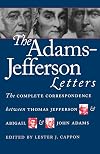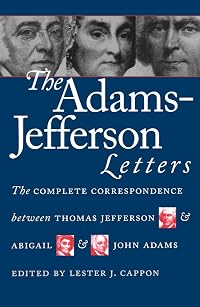
The Adams-Jefferson Letters: The Complete Correspondence Between Thomas Jefferson and Abigail and John Adams
by John Adams  , Abigail Adams, Thomas Jefferson
On This Page
Description
An intellectual dialogue of the highest plane achieved in America, the correspondence between John Adams and Thomas Jefferson spanned half a century and embraced government, philosophy, religion, quotidiana, and family griefs and joys. First meeting as delegates to the Continental Congress in 1775, they initiated correspondence in 1777, negotiated jointly as ministers in Europe in the 1780s, and served the early Republic--each, ultimately, in its highest office. At Jefferson's defeat of show more Adams for the presidency in 1800, they became estranged, and the correspondence lapses from 1801 to 1812, then is renewed until the death of both in 1826, fifty years to the day after the Declaration of Independence. Lester J. Cappon's edition, first published in 1959 in two volumes, provides the complete correspondence between these two men and includes the correspondence between Abigail Adams and Jefferson. Many of these letters have been published in no other modern edition, nor does any other edition devote itself exclusively to the exchange between Jefferson and the Adamses. Introduction, headnotes, and footnotes inform the reader without interrupting the speakers. This reissue of The Adams-Jefferson Letters in a one-volume unabridged edition brings to a broader audience one of the monuments of American scholarship and, to quote C. Vann Woodward, 'a major treasure of national literature.' show lessTags
Recommendations









Member Reviews
Quite possibly the best book of history I've ever read - the American Revolution, the Enlightenment, the French Revolution, shopping lists, child care instructions, treaty negotiations, rumination on religion, book reviews, art criticism, and too many more subjects to list. The complete correspondence between three of the founders (Abigail Adam's letters to and from Jefferson are included) constitutes in my humble opinion the best of history in the raw, the very stuff that still weaves it's way through our world two hundred years later. I cannot recommend this highly enough.
The first 3rd of this book, minus Abigail's notes*, is pretty dull business--because it's really just that. But, then, during Jefferson's tenure as President, it suddenly got personal and beautiful. I feel like Adams especially would have been a good friend. Which probably says more about me than him. They covered all the topics... except, directly, slavery. It would have been interesting to get their opinions. As it is, their voracious reading and writing habits exhaust me.
It's interesting that these 2 men, so involved in the 1776 business were so distanced from the Constitutional Convention. Their candid, off-hand remarks on the document in their European correspondence telling. And, as time goes on, we see Adams put forth the show more opinion that the constitution itself isn't a guarantor of good government. What matters is the people of the country.
John Adams is great fun. He doesn't mince words nor is he afraid to admit what he doesn't know. He's frank about his faith, his life, philosophy, and his intentions. Jefferson is hesitant, somewhat non-committal, and proper---making it impossible to forget the differences in their lives and the fact that slavery was a large, if unmentioned, part of his life.
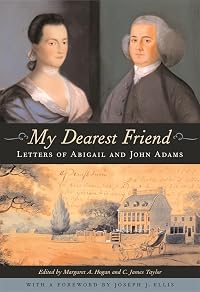
Possibly should be read with [b:My Dearest Friend: Letters of Abigail and John Adams|436582|My Dearest Friend Letters of Abigail and John Adams|Abigail Adams|https://i.gr-assets.com/images/S/compressed.photo.goodreads.com/books/1348447801l/436582._SX50_.jpg|425488]. To be fair, most of the rating is due to Adams(x2). Jefferson contributed 1 letter to every 6 or so of theirs.
*One cannot help loving Abigail. show less
It's interesting that these 2 men, so involved in the 1776 business were so distanced from the Constitutional Convention. Their candid, off-hand remarks on the document in their European correspondence telling. And, as time goes on, we see Adams put forth the show more opinion that the constitution itself isn't a guarantor of good government. What matters is the people of the country.
John Adams is great fun. He doesn't mince words nor is he afraid to admit what he doesn't know. He's frank about his faith, his life, philosophy, and his intentions. Jefferson is hesitant, somewhat non-committal, and proper---making it impossible to forget the differences in their lives and the fact that slavery was a large, if unmentioned, part of his life.
Possibly should be read with [b:My Dearest Friend: Letters of Abigail and John Adams|436582|My Dearest Friend Letters of Abigail and John Adams|Abigail Adams|https://i.gr-assets.com/images/S/compressed.photo.goodreads.com/books/1348447801l/436582._SX50_.jpg|425488]. To be fair, most of the rating is due to Adams(x2). Jefferson contributed 1 letter to every 6 or so of theirs.
*One cannot help loving Abigail. show less
This wonderful book transports you to a different time from that which one experiences reading biographies and history of these two giants. There are thirteen sections, date ranges, each preceded by the editor with a brief introduction of the period when they wrote the letters. The letters begin in 1777 after declaring independence. About half the book are letters written when they were in Europe and England endeavoring to get support, loans, and commercial trading treaties. During this time, Jefferson and Abigail Adams also maintained a correspondence often of a lighter fare such as Abigail requesting Jefferson to procure items of clothing from Paris and during a time after Jefferson sent for his daughter who stayed with the Adams’s show more for some time in London before joining her father in France. For about 12 years, the two statesmen did not write to each other owing to differences of opinions exacerbated by the times during which they were candidates for president and the emergence of party politics. A dear friend of each, Dr. Benjamin Rush, was instrumental in encouraging them to resume their correspondence during their retirement from politics. This second series of letters show touching insights of two great minds no longer burdened by the pressures of office yet eager to explain themselves as they said: “…that we ought not to die before we have explained ourselves to each other…”. During this period, we learn how much each has read histories of societies and philosophers from ancient to modern as they quote freely from, and often in the original language, i.e., for example, Greek, translations provided. Never do they resort to salutations or use of their first name, it’s always Sir, Dear Sir, My Dear Sir. Accordingly, their writing structure never resorts to casual but always shows complete esteem for each other. To be expected, the language of the time required me to occasionally look up a word, phrase or quote to fully understand its origin and meaning and was often drawn into tangential forays to satisfy my curiosity. show less
Adams and Jefferson, who are two of the greatest correspondents in history, take it up a notch with their letters to each other. They had a great falling out at the end of Adams' presidency and did not communicate with each other for about 11 years, until 1812. Their correspondence for the last 14 years of their lives (they famously died on the same day, July 4, 1826) is beautiful. As they age, you can see how important they become to each other, although they never met again. This is a wonderful book.
Ratings
Members
- Recently Added By
Lists

John Adams Books
12 works; 1 member

Thomas Jefferson Books
43 works; 1 member

Shaykh Hamza's Book Recommendations
439 works; 3 members

Books in the Bibliography of Freethinkers by Susan Jacoby
155 works; 1 member

Books Cited in Blueprint by Nicholas Christakis
261 works; 1 member
Author Information

116+ Works 2,902 Members
John Adams has a Legacy Library. Legacy libraries are the personal libraries of famous readers, entered by LibraryThing members from the Legacy Libraries group.

16+ Works 1,570 Members

420+ Works 12,779 Members
Politician, philosopher, farmer, architect, and author, Jefferson was born to Peter and Jane Randolph Jefferson on April 13, 1743, in Tuckahoe, Virginia. As Jefferson observed in his autobiography, his parents could "trace their pedigree far back in England and Scotland." At the age of 16, Thomas Jefferson entered William and Mary College; at age show more 24, Jefferson was admitted to the bar; at 25, he was elected to the Virginia Assembly. Renowned for his political contributions to the American colonies, and later, to the embryonic Republic, Jefferson published in 1774 A Summary View of the Rights of British America, celebrating the inalienable natural rights claimed by the colonialists. In 1775 Jefferson was elected to the Continental Congress; in 1776 he joined the five-person committee responsible for drafting the Declaration of Independence---a document that is widely regarded as being largely Jefferson's own work. In 1779 Jefferson was elected governor of the state of Virginia, and in subsequent years he distinguished himself both as a cosmopolitan international politician and as a man committed to the future of Virginia. In 1789 he was appointed U.S. secretary of state, in 1797 he served as vice president under President John Adams, and in 1801 he was elected third president of the United States. Jefferson's literary career was no less stellar than his political accomplishments. He authored tracts and books on such diverse subjects as gardening, the life of Jesus, the history of Virginia, and the practices of farming. The precise descriptions of nature that inform his Notes on the State of Virginia (1787) are frequently credited with foreshadowing the Hudson River school of aesthetics. Thomas Jefferson died on the fourth of July. His grave marker, engraved with words of his own choosing, states, "Here lies Thomas Jefferson, Author of the Declaration of American Independence, of the Statute of Virginia for Religious Freedom and Father of the University of Virginia." (Bowker Author Biography) show less
Thomas Jefferson has a Legacy Library. Legacy libraries are the personal libraries of famous readers, entered by LibraryThing members from the Legacy Libraries group.
Common Knowledge
- Original publication date
- 1959
- People/Characters
- Thomas Jefferson; Abigail Adams; John Adams
- Dedication
- For Dorothy Bernet Cappon "with every sentiment of tenderness, esteem, and admiration"
- First words
- Preface: No correspondence in American history is more quotable or more readily recognized for its historical significance than that of John Adams and Thomas Jefferson.
Introduction: Faneuil Hall, the "Cradle of Liberty", attracted a large crowd of Bostonians on August 12, 1826.
Chapter 1: John Adams and Thomas Jefferson first met in Philadelphia during the summer of 1775 as delegates to the Continental Congress. - Last words
- (Click to show. Warning: May contain spoilers.)(Adams to Jefferson, April 17, 1826): My love to all your family, and best wishes for your health.
- Blurbers
- Commager, Henry Steele; Malone, Dumas; Woodward, C. Vann
Classifications
- Genres
- History, Nonfiction, General Nonfiction, Biography & Memoir
- DDC/MDS
- 973.440924 — History & geography History of North America United States Constitutional period (1789-1809) Proclamation of Neutrality, Whiskey Rebellion, Jay Treaty
- LCC
- E322 .A4 — History of the United States United States Revolution to the Civil War, 1775/1783-1861 By period 1789-1809. Constitutional period John Adams' administration, 1797-1801
- BISAC
Statistics
- Members
- 617
- Popularity
- 47,403
- Reviews
- 4
- Rating
- (4.40)
- Languages
- English
- Media
- Paper, Ebook
- ISBNs
- 5
- ASINs
- 6