On This Page
Description
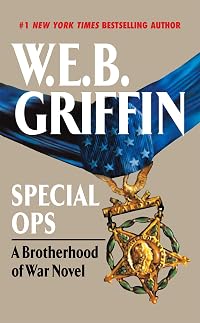
W.E.B. Griffin returns to the series that launched his phenomenal career— in an explosive new novel that pits a team of Special Forces warriors against the legendary revolutionary Che Guevara.Tags
Recommendations





Member Reviews
I gave this book a chance, I really did, but I found it so bloody boring that I just gave up after 130 pages (which is a lot more than I'd usually give most books!).
It's part of a series, apparently the last one, and in it US Special Forces serviceman Jack Portet has just finished helping Belgian paratroopers liberate his family from Stanleyville in the Congo and is being reunited with his fiance, Marjorie Bellmon. Why his family is in Stanleyville, I'm not sure if we're ever told. It's a big mystery to me. And Marjorie is the daughter of a general, which makes Jack being a sergeant a bit of a problem. However, the main plot of the book is supposed to be about the arrival of Che Guevara from Cuba in a hope of driving the fascist show more imperialists out and bring communism to the people of the Congo. Yep. This is taking place in 1964, btw.
Aside from mistakes made in the book that other people have pointed out, like Kennedy Airport being named such in 1959 when it wasn't named that until 1963 and Visa cards mentioned in the late '50s when they didn't come into existence for another decade, I was quite simply just bored. I never knew that everyone in the military knew everyone else. General So and So? Oh yes, I know him. His daughter is my son-in-law's best friend's neighbor. General Such and Such? Know him too. We served together 30 years ago. Different units, but I've heard of him. Geez. So many dinner parties. So many wedding and honeymoon arrangements. So many vacation arrangements. Don't these people ever freakin' DO anything? Could they be any more boring? I know this has a good rating on Goodreads, so I know I'm in the minority, but I guess I just didn't get it. I don't see what's so great about this book. Maybe if I had labored through the whole thing, I would have ended with a different perspective, but I just couldn't do it. Not recommended. show less
It's part of a series, apparently the last one, and in it US Special Forces serviceman Jack Portet has just finished helping Belgian paratroopers liberate his family from Stanleyville in the Congo and is being reunited with his fiance, Marjorie Bellmon. Why his family is in Stanleyville, I'm not sure if we're ever told. It's a big mystery to me. And Marjorie is the daughter of a general, which makes Jack being a sergeant a bit of a problem. However, the main plot of the book is supposed to be about the arrival of Che Guevara from Cuba in a hope of driving the fascist show more imperialists out and bring communism to the people of the Congo. Yep. This is taking place in 1964, btw.
Aside from mistakes made in the book that other people have pointed out, like Kennedy Airport being named such in 1959 when it wasn't named that until 1963 and Visa cards mentioned in the late '50s when they didn't come into existence for another decade, I was quite simply just bored. I never knew that everyone in the military knew everyone else. General So and So? Oh yes, I know him. His daughter is my son-in-law's best friend's neighbor. General Such and Such? Know him too. We served together 30 years ago. Different units, but I've heard of him. Geez. So many dinner parties. So many wedding and honeymoon arrangements. So many vacation arrangements. Don't these people ever freakin' DO anything? Could they be any more boring? I know this has a good rating on Goodreads, so I know I'm in the minority, but I guess I just didn't get it. I don't see what's so great about this book. Maybe if I had labored through the whole thing, I would have ended with a different perspective, but I just couldn't do it. Not recommended. show less
You can always tell when you have a bad book by the "Gee, when will this end?" feeling. This book is sort of like paint drying. An example might be he spends 2 pages 'discussing' how a character in the book doesn't have a sticker for her car, and goes about getting one.
There is a saying when someone tells you something you don't really want to hear and that is "TMI - Too Much Information." Well I have coined a new one: "TMD - Too Much Detail."
If it furthers the plot, or endures the reader to the character, or paints a more detailed background, fine, but detail for detail sake is wasting my time.
I kept waiting, all 772 pages for something to happen. I knew (or sort of knew the ending) but Griffin waited until the last page to confirm show more it.
It wasn't a suspense issue. It just felt like I weeded through the swamp to see road I knew was there all the time.
My recommendation, is don't waste your time on this book. I have read two in the past month. Now I recall why I quite reading him years ago. Maybe I won't forget the next time. show less
There is a saying when someone tells you something you don't really want to hear and that is "TMI - Too Much Information." Well I have coined a new one: "TMD - Too Much Detail."
If it furthers the plot, or endures the reader to the character, or paints a more detailed background, fine, but detail for detail sake is wasting my time.
I kept waiting, all 772 pages for something to happen. I knew (or sort of knew the ending) but Griffin waited until the last page to confirm show more it.
It wasn't a suspense issue. It just felt like I weeded through the swamp to see road I knew was there all the time.
My recommendation, is don't waste your time on this book. I have read two in the past month. Now I recall why I quite reading him years ago. Maybe I won't forget the next time. show less
"Special Ops" could easily have been the eighth book of the series and "The Aviators" could have been skipped altogether. In fact, Special Ops picks up almost immediately where "The New Breed" left off. Jack Portet had just finished helping the Belgian paratroopers liberate his family from Stanleyville in the Congo and was being reunited with Marjorie Bellmon. However, just because one crisis in the Congo was averted it doesn't mean everything had settled down. In fact new international intrigue is just about to start with the arrival of Che Guevara from Cuba in a hope to drive the fascist, imperialist, pigs out and bring communism to the people.
Honestly this book isn't really about Guevara much either - except as a way to document his show more overall ineptitude at being a guerrilla leader. Instead, I think, it is more of an opportunity to introduce Argentina, of all places, to W.E.B. Griffin's fans - a locale he revisits in some of the books in his other series dealing with the O.S.S. and the German's in WW2. About 1/5 of this story takes place in Argentina presumably to show the US intelligence gathering techniques which are used to track Guevara. Overall this book didn't really have much of a purpose in relation to the initial "Brotherhood of War Series" and I found it a general letdown as a sequel to "The New Breed."
The worst part of this book was the end of it. A huge portion of the story is told via memo's between the Special Forces detachment (17) in the Congo and Stanford Felter in Washington DC. It was as if even Griffin realized he didn't have a story to tell so he just gave up on it, went to the bank, and cashed his royalty check. Some people may appreciate the memorandum style but, for me, it was off-putting. Typically, in the series, when I saw the memo format I would just gloss over it. However, in this story you can't or you'll actually miss a large part of the story.
In other words this couldn't have been a much worse book to finish the series with (though, "The Aviators" would have been an even worse final book - I'll discuss that in it's own review). I realize he left a few things hanging at the end of "The New Breed" but the series would have been better off had he just stopped there. show less
Honestly this book isn't really about Guevara much either - except as a way to document his show more overall ineptitude at being a guerrilla leader. Instead, I think, it is more of an opportunity to introduce Argentina, of all places, to W.E.B. Griffin's fans - a locale he revisits in some of the books in his other series dealing with the O.S.S. and the German's in WW2. About 1/5 of this story takes place in Argentina presumably to show the US intelligence gathering techniques which are used to track Guevara. Overall this book didn't really have much of a purpose in relation to the initial "Brotherhood of War Series" and I found it a general letdown as a sequel to "The New Breed."
The worst part of this book was the end of it. A huge portion of the story is told via memo's between the Special Forces detachment (17) in the Congo and Stanford Felter in Washington DC. It was as if even Griffin realized he didn't have a story to tell so he just gave up on it, went to the bank, and cashed his royalty check. Some people may appreciate the memorandum style but, for me, it was off-putting. Typically, in the series, when I saw the memo format I would just gloss over it. However, in this story you can't or you'll actually miss a large part of the story.
In other words this couldn't have been a much worse book to finish the series with (though, "The Aviators" would have been an even worse final book - I'll discuss that in it's own review). I realize he left a few things hanging at the end of "The New Breed" but the series would have been better off had he just stopped there. show less
Final book of the series, but not chronologically. Old and new characters chase Che' in the Congo; a strange mix of tactical operations combined with President Johnson's hands-on approach. I enjoyed the book and the series. Will try another Griffin series.
Characters in the series have always been very solid. This book I thought had a bit too much detail, and a lot less character. Not bad, but not my favorite.
Ratings
Members
- Recently Added By
Author Information

197+ Works 34,504 Members
W. E. B. Griffin is one of eight pseudonyms used by William E. Butterworth III, who was born in Newark, New Jersey on November 10, 1929. He enlisted in the U.S. Army as a private in 1946 and was assigned to the Army of Occupation in Germany. He left the service in 1947 but was recalled to active duty in 1951 because of the Korean War. After show more leaving the service for the second time, he remained in Korea as a combat correspondent. He was later appointed chief of the publications division of the Signal Aviation Test and Support Activity at the Army Aviation Center in Fort Rucker, Alabama. He received the Brigadier General Robert L. Dening Memorial Distinguished Service Award of the U.S. Marine Corps Combat Correspondents Association in 1991 and the Veterans of Foreign Wars News Media Award in 1999. He wrote more than 200 books including the Brotherhood of War series, The Corps series, Badge of Honor series, Honor Bound series, Presidential Agent series, Men at War series, and A Clandestine Operations Novel series. Under his own name, he wrote 12 sequels in the 1970s to Richard Hooker's book M*A*S*H. His other pen names included Alex Baldwin, Webb Beech, and Walter E. Blake. He wrote over 20 books with his son William E. Butterworth IV. He received the Alabama Author's Award in 1982 from the Alabama Library Association. He died on February 12, 2019 at the age of 89. (Bowker Author Biography) show less
Some Editions
Awards and Honors
Distinctions
Series

Work Relationships
Common Knowledge
- Canonical title
- Special Ops
- Original publication date
- 2001
- Important places*
- Congo-Kinshasa
*Some information comes from Common Knowledge in other languages. Click "Edit" for more information.
Classifications
- Genres
- Fiction and Literature, General Fiction, Historical Fiction, Suspense & Thriller
- DDC/MDS
- 813.54 — Literature & rhetoric American literature in English American fiction in English 1900-1999 1945-1999
- LCC
- PS3557 .R489137 .S6 — Language and Literature American literature American literature Individual authors 1961-
- BISAC
Statistics
- Members
- 713
- Popularity
- 39,809
- Reviews
- 5
- Rating
- (3.75)
- Languages
- 5 — English, French, German, Hungarian, Polish
- Media
- Paper, Audiobook, Ebook
- ISBNs
- 22
- ASINs
- 5