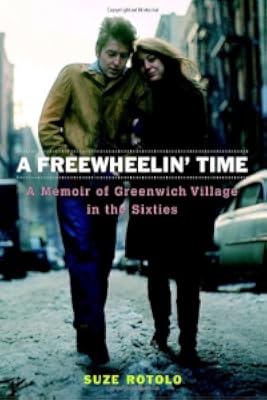
A Freewheelin' Time: A Memoir of Greenwich Village in the Sixties
by Suze Rotolo
On This Page
Description
Suze Rotolo chronicles her coming of age in Greenwich Village during the 1960s and the early days of the folk music explosion, when Bob Dylan was finding his voice and she was his muse. A shy girl from Queens, Suze was the daughter of Italian working-class Communists, growing up at the dawn of the Cold War. It was the age of McCarthy and Suze was an outsider in her neighborhood and at school. She found solace in poetry, art, and music-and in Greenwich Village, where she encountered show more like-minded and politically active friends. One hot July day in 1961, Suze met Bob Dylan, then a rising musician, at a concert at Riverside Church. She was seventeen, he was twenty; they were both vibrant, curious, and inseparable. During the years they were together, Dylan transformed from an obscure folk singer into an uneasy spokesperson for a generation. A Freewheelin' Time is a hopeful, intimate memoir of a vital movement at its most creative. It captures the excitement of youth, the heartbreak of young love, and the struggles for a brighter future in a time when everything seemed possible. show lessTags
Recommendations















Member Reviews
I enjoyed reading this first permission account of watching the genesis of Bob Dylan in NYC in the 60's. Suze Rotolo easily could have lambasted the two-faced, self-indulged, and mendacious Dylan, but Rotolo chooses to cast those negative aspects in dim allusion and focus on the genius, the fun, and the growing up. Part of what I felt compelling was having Rotolo recall how the arc of Dylan casting himself as a folkie onto breaking with the purists for demon electricity happened with a backdrop of the Cuban missile crisis, the Kennedy Assassination, the Civil Rights movement, and more.
Another bestseller I am years late coming to, but Suze Rotolo's fine coming-of-age-in-the-60s memoir, A FREEWHEELIN' TIME, is still relevant, still a fine and compelling read. And not just because she was Bob Dylan's first girlfriend and appeared on the cover of that album with him. Nope. She's got a voice of her own, and this is not just an "I knew him when" kind of book. It's a true memoir, and she tells her own story the best she can remember it, fifty years later. True there is plenty of name-dropping here and there throughout the narrative, but she still manages to tell her own story, and does it with charm and honesty. The one revelation that did shock me - was I the last one to know? - was that she became pregnant during her show more Dylan years, and had an abortion, which was illegal and could be dangerous at the time. She suffered a long period of depression after that too.
Indeed, in looking back at those pre-feminist years, Rotolo recognizes now how innocent and 'unfree' she was then, as a young woman, noting -
"In my youthful confusion I was still struggling for permission to be. All that was offered to a musician's girlfriend in the early 1960s was a role as her boyfriend's 'chick,' a string on his guitar."
She remembers too going with Dylan to see PULL MY DAISY, an experimental new film from the time which featured Kerouac, Ginsberg, Corso and other writers and artists.
"I identified with the men in the film, not the women, who seemed insignificant in the midst of these wild, funny and offbeat guys. I wanted to be them, but didn't know how. I envied them their freedom. Many years later when I saw the film again, I was shaken by that memory. This time I was cognizant of the women and their role in the story. They were inconsequential and extraneous in the way a prop is part of the set."
Rotolo went on to become an artist in her own right. She carries no grudges or hard feelings from those years, saying -
"... I see no reason to take anyone to task for the foibles of the young. We were a passionate lot, dedicated to whatever it was we were doing."
Suze Rotolo is a fine writer, who knows by now just who she is. She's the same age as I am, so a lot of her memories are mine too, only different, of course. It might have helped too that I was listening to some early Dylan as I read. I enjoyed the heck outa her story. Thanks, Suze. Very highly recommended.
- Tim Bazzett, author of the memoir, BOOKLOVER show less
Indeed, in looking back at those pre-feminist years, Rotolo recognizes now how innocent and 'unfree' she was then, as a young woman, noting -
"In my youthful confusion I was still struggling for permission to be. All that was offered to a musician's girlfriend in the early 1960s was a role as her boyfriend's 'chick,' a string on his guitar."
She remembers too going with Dylan to see PULL MY DAISY, an experimental new film from the time which featured Kerouac, Ginsberg, Corso and other writers and artists.
"I identified with the men in the film, not the women, who seemed insignificant in the midst of these wild, funny and offbeat guys. I wanted to be them, but didn't know how. I envied them their freedom. Many years later when I saw the film again, I was shaken by that memory. This time I was cognizant of the women and their role in the story. They were inconsequential and extraneous in the way a prop is part of the set."
Rotolo went on to become an artist in her own right. She carries no grudges or hard feelings from those years, saying -
"... I see no reason to take anyone to task for the foibles of the young. We were a passionate lot, dedicated to whatever it was we were doing."
Suze Rotolo is a fine writer, who knows by now just who she is. She's the same age as I am, so a lot of her memories are mine too, only different, of course. It might have helped too that I was listening to some early Dylan as I read. I enjoyed the heck outa her story. Thanks, Suze. Very highly recommended.
- Tim Bazzett, author of the memoir, BOOKLOVER show less
Rotolo masterfully avoids the pitfall of a voyeuristic obsession with The Great Man, and takes us instead into a journey through Greenwich Village in the days of its bohemian incarnation. She writes lightly, playfully almost, but her words are multi-dimensional, weaving in and out of personal, societal and global narratives that explore politics, sociology, sociology of music, the politics of friendship, the politics of fame. This is, rightly, not a Dylan book, but a Suze Rotolo book, and outstanding with it. If it provides insights into the early maelstrom life of The Bard (and it does), so be it, but it will long be valuable for providing insights into one helluva a maelstrom place in one helluva maelstrom era.
Suze Rotolo is best known as Bob Dylan's girlfriend at the start of his career, but this memoir shows that there's so much more to her than that. It is clearly marketed as a bit of Dylanology, with the famous album cover photo of the couple on the front cover of the book, but it's as much a memoir of a young woman growing up and making a life for herself.
I enjoyed her portrait of the period. She was a red diaper baby - her parents were communists - and brought her up with a commitment to social change and justice and an ability to think for herself. By 17 she was living independently of her family and earning a living with a variety of casual jobs while pursuing her interests in art, reading, music etc.
Her relationship with Dylan lasted show more a few years though they only lived together briefly for various reasons. He also had affairs with others including a very public liaison with Joan Baez, and in the end they went through a slow and painful split. But this is no kiss and tell memoir - she writes about it all in a very dignified way.
There are also stories which have little to do with Dylan, such as her trip to Cuba with a group of students to test the US government ban on travel to Cuba. After this Rotolo became a bit disillusioned with the politics of her upbringing and of the New Left, and dropped out of political activity.
Recommended reading particularly if you're interested in the 60s, the music or the history of the American left.
Review written June 2010 show less
I enjoyed her portrait of the period. She was a red diaper baby - her parents were communists - and brought her up with a commitment to social change and justice and an ability to think for herself. By 17 she was living independently of her family and earning a living with a variety of casual jobs while pursuing her interests in art, reading, music etc.
Her relationship with Dylan lasted show more a few years though they only lived together briefly for various reasons. He also had affairs with others including a very public liaison with Joan Baez, and in the end they went through a slow and painful split. But this is no kiss and tell memoir - she writes about it all in a very dignified way.
There are also stories which have little to do with Dylan, such as her trip to Cuba with a group of students to test the US government ban on travel to Cuba. After this Rotolo became a bit disillusioned with the politics of her upbringing and of the New Left, and dropped out of political activity.
Recommended reading particularly if you're interested in the 60s, the music or the history of the American left.
Review written June 2010 show less
A charming but uneven book. Part touching recollection, well-told, part reflection of life close to genius, made all the more moving because it is not a reckoning. Other parts of the book contain a touch of nostalgia for a time and place -- this is where it gets a bit narcissistic. Then there are sections that read as catalogs of met him, went there, without analysis or narrative, although many of these vignettes are nonetheless interesting.
I'm glad the author waited as long as she did to publish this (but not any longer, she died soon after it came out). If she had written it sooner, it would have seemed as if she were trying to cash in on her proximity to Dylan. In the decades of her silence, she gained the respect of many for show more guarding both her own privacy but his as well. Yet hers was a story worth telling. And the wait paid off in that her maturity and taste show through in her crafted prose. A good read. show less
I'm glad the author waited as long as she did to publish this (but not any longer, she died soon after it came out). If she had written it sooner, it would have seemed as if she were trying to cash in on her proximity to Dylan. In the decades of her silence, she gained the respect of many for show more guarding both her own privacy but his as well. Yet hers was a story worth telling. And the wait paid off in that her maturity and taste show through in her crafted prose. A good read. show less
Okay, I'm nostalgic about the Sixties. I enjoyed this memoir of Greenwich Village in the early 1960's--despite the cover photo and Rotolo's well-known status as Bob Dylan's girlfriend at the time, she writes about so much more than Dylan. This book covers, among other things, the Red Scare and its effect on left-wing families; the folk revival; experimental theater; the Cuban Revolution and the ban on travel to Cuba; and Rotolo's childhood and early adulthood. It's very engaging, and near the end she states a truth that needs to be stated now more than ever: the Sixties wasn't just about sex drugs and rock and roll, it was about making a better world.
Rotolo writes about her recollections of Greenwich Village when she moved there in the early 60’s. Evoking a buzzing, musical area attracting various cultural artists. The writing was fine, but I didn’t warm to her humourlessness and generalisations (we all felt….).
And maybe I was disappointed as it was the cover that had drawn my eye: a photo of her & Bob Dylan on the cover. Apparently she was an early girlfriend, so I was hoping for some insights about his creativity. But he gets mentioned discreetly in passing, seemingly as a sometime friend. Maybe this is inevitable with the long passage of time, and that she had resented and seemingly ended their relationship, unhappy about her diminishment as girlfriend to the rising star. show more And perhaps also tricky to write about a relationship when the partner is still living.
Instead, she preferred to travel or assist in fringe theatre, & comes across as a strong independent woman, with an interest in the changing politics of the time. show less
And maybe I was disappointed as it was the cover that had drawn my eye: a photo of her & Bob Dylan on the cover. Apparently she was an early girlfriend, so I was hoping for some insights about his creativity. But he gets mentioned discreetly in passing, seemingly as a sometime friend. Maybe this is inevitable with the long passage of time, and that she had resented and seemingly ended their relationship, unhappy about her diminishment as girlfriend to the rising star. show more And perhaps also tricky to write about a relationship when the partner is still living.
Instead, she preferred to travel or assist in fringe theatre, & comes across as a strong independent woman, with an interest in the changing politics of the time. show less
Members
- Recently Added By
Published Reviews
ThingScore 75
One night in the early 1960s, when Dylan came home drunk, she writes, he accidentally dropped the contents of his wallet on the floor. Rotolo, then a teenager, picked up his draft card and was shaken. His last name wasn’t Dylan; it was Zimmerman. And even though they were essentially living together in a tiny walk-up on West Fourth Street, he hadn’t told her the truth, too committed to show more maintaining his mysterious persona. show less
added by danielx
Lists

1960s
281 works; 16 members
Author Information

1 Work 447 Members
Common Knowledge
- Original publication date
- 2008
- People/Characters
- Bob Dylan; Suze Rotolo
- Important places
- Greenwich Village, New York, New York, USA
- Epigraph
- Who are we, if not a combination of experiences, information, books we have read, things imagined? Each life is an encyclopedia, a library, an inventory of objects, a series of styles, and everything can be constantly reshu... (show all)ffled and reordered in every conceivable way. --- Italo Calvino
- Dedication
- For Luca so he will know and Enzo who always did
- First words
- I met Bob Dylan in 1961 when I was seventeen years old and he was twenty.
- Quotations
- People say he is so secretive- why doesn't he reveal more of himself? I never understand what they mean by that. Songs and poems reveal the artist's core. Bob Dylan is his work. There is a fine line between analyz... (show all)ing lyrics and destroying the art. When does parsing words and phrases begin to smudge or erase the magic in them? (p. 289)
I don't like to claim any Dylan songs as having been written about me, to do so would violate the art he puts out in the world. The songs are for the listener to relate to, identify with , and interpret through his or her own... (show all) experience. (p. 290)
Sex, drugs, and rock and roll became the sound bite for the 1960s. It characterized the times- decade of this, decade of that- but it was not really about anything that superficial. Those years were about a way of... (show all) thinking, seeing, and believing- a way to live. We had depth; we were not superficial. We honestly believed we could change the world, and we did, for the better. (p. 363) - Last words
- (Click to show. Warning: May contain spoilers.)The new generation causing all the fuss was not driven by the market: we had something to say, not something to sell.
- Blurbers
- Marcus, Greil
Classifications
- Genres
- Music, Biography & Memoir, Nonfiction, General Nonfiction
- DDC/MDS
- 782.42164092 — Arts & recreation Music Vocal music Secular forms of vocal music Songs General principles and musical forms Traditions of secular songs {genres} Western popular songs
- LCC
- ML420 .D98 .R67 — Music Literature on music Literature on music History and criticism Biography
- BISAC
Statistics
- Members
- 447
- Popularity
- 68,777
- Reviews
- 18
- Rating
- (3.72)
- Languages
- 5 — English, French, German, Italian, Spanish
- Media
- Paper, Audiobook, Ebook
- ISBNs
- 15
- ASINs
- 9