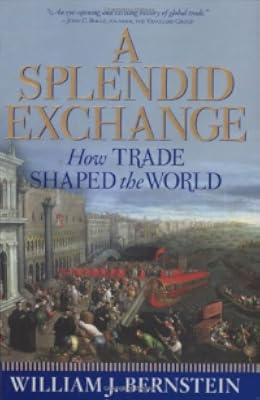
A Splendid Exchange: How Trade Shaped the World
by William J. Bernstein
On This Page
Description
Traces the evolution of international trade, from ancient Mesopotamia to today's global marketplace, exploring the influence of commerce on agriculture, technology, politics, and civilization as a whole.Tags
Recommendations





































Member Recommendations
Member Reviews
A dense but compulsively readable survey of world trade for the last 1000 years. Wished it would have delved into some topics deeper - sugar and coffee to pick two - and almost no historical developments in finance but excellent for exactly what it is. Recommended.
A good readable run through the history of trade, and how trade affects real life. It is excellent in parts, notably in earlier times, but is rushed towards the end, just as trade gets deeper, richer, and more complex. What clearly stands out is the human propensity to acquire things, especially novel or exotic things, which seems to encompass all ages and all cultures. I credit the author with having the sense to admit that trade does not do all things. Sometimes it doesn't bring prosperity. However, he zeroed in on the fundamental value of trade, in common with other forms of international intercourse, in bringing people together. What price peace? Good read.
It's a very thorough look at how our world has been shaped by international trade, both intentionally (such as the creation of fashion by the East India Company in the 18th century, to increase the demand for its Indian cotton) to the unintentional (such as the Plague of Justinian, brought to the eastern Mediterranean Europe by the first opening of the overland silk route (and apparently an important factor in clearing the way for the rise of Islam a few generations later)).
He comes down heavily on the side in favour of free trade, but doesn't ignore that there have always been those who have lost when trade barriers fall. The tone is occasionally almost chatty when he compares 16th century Mexican silk weavers to 21st century American show more auto-workers. (Both justifiably worried by cheaper Chinese imports.) He similarly compares modern-day bloggers with the 18th century pamphleteers.
He even argues that America would have had a significantly larger share of international economy if GATT and similar free-trade endeavours hadn't been so successful - but the world economy would definitely have been much much smaller.
Not to mention that free trade has a very strong correlation with peace. It's surely no coincidence that the only historically significant absence of war in Europe (these last 65 years) coincide with the European Common Market. show less
He comes down heavily on the side in favour of free trade, but doesn't ignore that there have always been those who have lost when trade barriers fall. The tone is occasionally almost chatty when he compares 16th century Mexican silk weavers to 21st century American show more auto-workers. (Both justifiably worried by cheaper Chinese imports.) He similarly compares modern-day bloggers with the 18th century pamphleteers.
He even argues that America would have had a significantly larger share of international economy if GATT and similar free-trade endeavours hadn't been so successful - but the world economy would definitely have been much much smaller.
Not to mention that free trade has a very strong correlation with peace. It's surely no coincidence that the only historically significant absence of war in Europe (these last 65 years) coincide with the European Common Market. show less
A good book if not a great one that covers its subject in plenty of detail over an enormous time-span. There are plenty of juicy facts to add to your knowledge base alongside the core understanding of the sweeps of trade across the centuries and maybe a deeper understanding of what drove some of the early explorers and their backers.
There are a few places where it gets slightly confusing and maybe over-long and some when you wonder if you've just read essentially the same thing a few pages back - particularly as the Europeans get a toe-hold on the Indian ocean, but these are excusable given the subject-matter.
I did find this interesting coming from an American perspective and it made me wonder how many histories I've read written by show more Americans that aren't solely about America. For example, whilst the author wasn't US-centric, other than in his comparators - which is understandable, mixing up "British" and "English" or "Holland" and "Netherlands" in the same sentence did jar a little.
Overall it is well worth the read and thus gets a solid 4 stars from me. show less
There are a few places where it gets slightly confusing and maybe over-long and some when you wonder if you've just read essentially the same thing a few pages back - particularly as the Europeans get a toe-hold on the Indian ocean, but these are excusable given the subject-matter.
I did find this interesting coming from an American perspective and it made me wonder how many histories I've read written by show more Americans that aren't solely about America. For example, whilst the author wasn't US-centric, other than in his comparators - which is understandable, mixing up "British" and "English" or "Holland" and "Netherlands" in the same sentence did jar a little.
Overall it is well worth the read and thus gets a solid 4 stars from me. show less
Bernstein provides a well-written and fascinating overview throughout the centuries regarding the incredible and fantastic lengths that people have undertaken to trade. He traverses the byways and alley ways of little-known incidents to realistically portray the splendid exchange of trade throughout time.
Today’s world trade network is very complex and affects every individual’s life. In “A Splendid Exchange: How Trade Shaped the World”, William J. Bernstein makes the case that globalization is not new and has in fact played an important part in the world’s development throughout the ages. Bernstein draws upon his extensive knowledge of history and written accounts to weave a fascinating narrative of man’s participation in trade throughout the millennia. From ancient Sumer to modern times, Bernstein incorporates an astonishing amount of information into a lively, interesting novel which convincingly proves his thesis. Bernstein effectively shows how man since earliest times has an innate desire to barter and trade and that show more for better or worse, trade has and will continue to shape the world that we live in.
Bernstein challenges the societal convention that rulers and religions were the primary drivers of nations and human development. He makes the case that it is man’s “propensity to trade and barter” that has shaped the world. “A Splendid Exchange: How Trade Shaped the World” tells the history of the world through a different lens and changes how the reader views history. Bernstein correlates every event with an economic gain, trade rivalry, or trade blockage and provides an economic reason for most of the major wars in world history and the economic cause of their outcomes. Bernstein explains the building of the Athenian Empire for example, not as a despotic ruler’s quest for power, but as a necessity to keep vital trade routes open to the Black Sea. Every major historical event is explained by this commerce driven perspective. By challenging the reader to see the history of the world through the importance of man’s desire to trade, Bernstein changes the way the reader views history and enlightens our understanding of world events.
“A Splendid Exchange” is a book worth recommending to a friend. William J. Bernstein is a masterful writer who has an extensive knowledge of history. Bernstein is able to incorporate a seemingly overwhelming amount of information over such a long period of time and over such an extensive part of the globe and weave it into a fascinating and easily comprehensive work that shows history from a new perspective. He winds the history of the world with the history of trade and gives the reader an economic perspective of the world which crosses all cultures and time periods. His brilliant reflection of the past provides examples and insight into the problems we as Homo sapiens have had to tackle in the past and will unavoidably face in the future. show less
Bernstein challenges the societal convention that rulers and religions were the primary drivers of nations and human development. He makes the case that it is man’s “propensity to trade and barter” that has shaped the world. “A Splendid Exchange: How Trade Shaped the World” tells the history of the world through a different lens and changes how the reader views history. Bernstein correlates every event with an economic gain, trade rivalry, or trade blockage and provides an economic reason for most of the major wars in world history and the economic cause of their outcomes. Bernstein explains the building of the Athenian Empire for example, not as a despotic ruler’s quest for power, but as a necessity to keep vital trade routes open to the Black Sea. Every major historical event is explained by this commerce driven perspective. By challenging the reader to see the history of the world through the importance of man’s desire to trade, Bernstein changes the way the reader views history and enlightens our understanding of world events.
“A Splendid Exchange” is a book worth recommending to a friend. William J. Bernstein is a masterful writer who has an extensive knowledge of history. Bernstein is able to incorporate a seemingly overwhelming amount of information over such a long period of time and over such an extensive part of the globe and weave it into a fascinating and easily comprehensive work that shows history from a new perspective. He winds the history of the world with the history of trade and gives the reader an economic perspective of the world which crosses all cultures and time periods. His brilliant reflection of the past provides examples and insight into the problems we as Homo sapiens have had to tackle in the past and will unavoidably face in the future. show less
I discovered this book when it was available on Amazon Prime Reading. I read it on my Kindle over the course of a year when I was on business trips. It is a fascinating book that provides a historical perspective of the ebb and flow of nation and regional economies and how they can be quickly disrupted by changes in policy, technology, political powers, and market forces. Insights into ancient trade routes and cities that were often centers of commerce that are shadows of their former glory reminds the reader how quickly the world can change. I frequently used Google Maps as a companion, looking at maps and images of the locations in the book. Very interesting from a business and historical perspective.
Members
- Recently Added By
Lists

Big History
72 works; 1 member

Books Read in 2023
5,638 works; 145 members

Books recommended in the history category on FiveBooks.com
329 works; 4 members
Author Information

14 Works 2,836 Members
William J. Bernstein is a neurologist, financial theorist, and historian whose books include A Splendid Exchange, Masters of the Word, The Birth of Plenty, and The Four Pillars of Investing. He is the cofounder of the investment management firm Efficient Frontier Advisors and has written for national publications including the Wall Street Journal show more and Money magazine. He was the winner of the 2017 James R. Vertin Award from CFA Institute. He lives in Oregon. show less
Awards and Honors
Distinctions
Common Knowledge
- Canonical title
- A Splendid Exchange: How Trade Shaped the World
- Original publication date
- 2008
- Dedication
- To Jane
- First words
- The circumstances could not have been more ordinary: a September morning in a hotel lobby in central Berlin. (Introduction)
Sometime around 3000 BC, a tribe of herders attacked a small community of Sumerian farmers at harvest time. - Last words
- (Click to show. Warning: May contain spoilers.)By remembering the straits navigated along the way, we might just avoid the shoals that lie ahead.
- Blurbers
- Sylla, Richard; Rivoli, Pietra; Bongiorni, Sara; Laffer, Arthur; Bernstein, Peter L.
Classifications
Statistics
- Members
- 877
- Popularity
- 30,951
- Reviews
- 23
- Rating
- (3.96)
- Languages
- English, Portuguese, Spanish, Swedish
- Media
- Paper, Audiobook, Ebook
- ISBNs
- 17
- ASINs
- 7