On This Page
Description
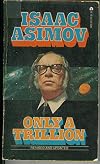
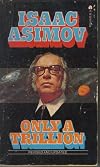
A trillion seconds is equal to 31,700 years.A trillion inches is equal to 15,800,000 miles.In other words, a trillion seconds ago, Stone Age man lived in caves, and mastodons roamed Europe and North America.Or, a trillion-inch journey will carry you 600 times around the Earth, and leave more than enough distance to carry you to the moon and back.And yet a good part of the chapters that follow ought to show you quite plainly that even a trillion can become a laughably small figure in the show more proper circumstances.Isaac Asimov is curious about nearly everything, and he has made it his business to share whatever he learns with us--there are few people as good at it as he is.ONLY A TRILLION is only one example of the range of his talents and the depth of his knowledge. These twelve essays are on such diverse subjects as life on other planets, the famous Thiotimoline--and The Goose That Laid The Golden Eggs...but you're just going to have to buy this book to find out what he knows about that. show lessTags
Recommendations





















Member Reviews
I lost a copy of this book in high school. It was given to me by my favorite teacher, and I've never forgotten that. There was some interesting aspect to the content that never let me go, either. So recently, all this historical baggage converged, and I picked up a used copy through Amazon. The content was not quite what I remembered, nor as compelling, but there were some high spots. In particular, I liked the discussion of the possible atmospheres that might exist elsewhere in the universe - all based on arguments of chemistry (and a little physics). Also enjoyed the discussion of bile salts and their role in digestion - note that humans are like our (herbivorous) primate cousins, well-equipped to handle plant food and poorly equipped show more to handle animal products.
A side note - who is the present-day Asimov, explaining a wide variety of science to a lay audience? We need another Sagan or Asimov, a good writer with good story-telling skills who can explain difficult science concepts to the masses. show less
A side note - who is the present-day Asimov, explaining a wide variety of science to a lay audience? We need another Sagan or Asimov, a good writer with good story-telling skills who can explain difficult science concepts to the masses. show less
Science!
Ratings
Members
- Recently Added By
Author Information

2,400+ Works 292,919 Members
Isaac Asimov was born in Petrovichi, Russia, on January 2, 1920. His family emigrated to the United States in 1923 and settled in Brooklyn, New York, where they owned and operated a candy store. Asimov became a naturalized U.S. citizen at the age of eight. As a youngster he discovered his talent for writing, producing his first original fiction at show more the age of eleven. He went on to become one of the world's most prolific writers, publishing nearly 500 books in his lifetime. Asimov was not only a writer; he also was a biochemist and an educator. He studied chemistry at Columbia University, earning a B.S., M.A. and Ph.D. In 1951, Asimov accepted a position as an instructor of biochemistry at Boston University's School of Medicine even though he had no practical experience in the field. His exceptional intelligence enabled him to master new systems rapidly, and he soon became a successful and distinguished professor at Columbia and even co-authored a biochemistry textbook within a few years. Asimov won numerous awards and honors for his books and stories, and he is considered to be a leading writer of the Golden Age of science fiction. While he did not invent science fiction, he helped to legitimize it by adding the narrative structure that had been missing from the traditional science fiction books of the period. He also introduced several innovative concepts, including the thematic concern for technological progress and its impact on humanity. Asimov is probably best known for his Foundation series, which includes Foundation, Foundation and Empire, and Second Foundation. In 1966, this trilogy won the Hugo award for best all-time science fiction series. In 1983, Asimov wrote an additional Foundation novel, Foundation's Edge, which won the Hugo for best novel of that year. Asimov also wrote a series of robot books that included I, Robot, and eventually he tied the two series together. He won three additional Hugos, including one awarded posthumously for the best non-fiction book of 1995, I. Asimov. "Nightfall" was chosen the best science fiction story of all time by the Science Fiction Writers of America. In 1979, Asimov wrote his autobiography, In Memory Yet Green. He continued writing until just a few years before his death from heart and kidney failure on April 6, 1992. (Bowker Author Biography) show less
Series

Common Knowledge
- Canonical title
- Only a Trillion
- Original title
- Only a Trillion
- Original publication date
- 1957
- Original language
- English
- Disambiguation notice
- Original title, "Only a Trillion"
Classifications
Statistics
- Members
- 145
- Popularity
- 225,707
- Reviews
- 3
- Rating
- (3.86)
- Languages
- Dutch, English
- Media
- Paper, Ebook
- ISBNs
- 8
- ASINs
- 6