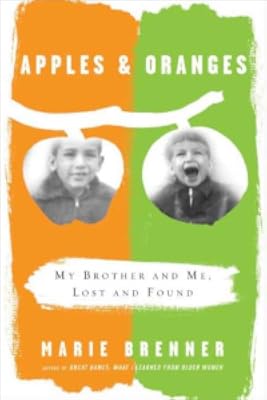
Apples and Oranges: My Brother and Me, Lost and Found
by Marie Brenner
On This Page
Description
A liberal Vanity Fair reporter recounts her attempt to reconnect with her conservative apple-farmer brother when the latter fell ill, an attempt that brought to the surface their disparate beliefs about politics, lifestyle choices, and priorities.Tags
Recommendations


























Member Reviews
I was three when my brother entered this world. My mother had to be rushed to the hospital, nearly dropping my brother out right there in the hospital parking lot. My father's parents were visiting, my grandmother watching me while my parents were away. I remember my father coming home with a grin on his face. It's a boy! My brother and I were like most other brother and sister pairs, friends one minute, playing in the dirt together or taking to the high seas on our boats made of furniture in the living room, to mortal enemies the next, struggling over who would sit in the passenger seat of the car. As we got older, we grew closer; while at other times we seemed to grow farther apart, family circumstances bringing us together but also show more keeping us at arms distance.
I have this image of me as the older sister, the protector and the one who had to set the good example. My brother was the youngest child, the only boy, and the one who got away with more. While early on that bothered me, later it seemed the natural way of things--how it works in families--and my brother deserved a break. His was a battle that seemed uphill more so than mine. Our story is an old and familiar one. Life as it was went on for both of us. Our relationship was one that ebbed and flowed like the tide. In recent years, we have not had much of a relationship at all. We are both to blame. There are reasons, some obvious and others less so, none of which I will go into here.
Marie Brenner is a well respected journalist having accomplished much in her career. Her work on an exposé entitled “The Man Who Knew Too Much” was the basis for the movie The Insider, which took a hard look at tobacco company practices. She has built a life on asking questions and telling stories. Her brother Carl had been a trial attorney at one time who later in life chose to give that up and grow apples and pears much to the surprise of his family.
Marie was the polar opposite of her brother. She was liberal where he was conservative. She preferred city life while Carl felt most at home in the country surrounded by his orchards. Marie was married with a child. Carl was more of a lady’s man. He liked things just so and preferred a quiet life. Marie was constantly on the go, searching out details and looking for meaning. Both were stubborn and set in their ways, believing the other was wrong more often than not. The two may have held different beliefs and ideas and lived very different lives, but they were both very similar as well.
Marie Brenner and her brother Carl have always had a difficult relationship. They spoke just about every week; however, their conversations almost always turned into arguments. The constant bickering and lack of connection between them weighed heavily on Marie, especially after learning that her brother had cancer. Suddenly, she wanted nothing more than to connect with him, to understand him and to be there for him. She set out to make that happen, deciding to surprise him with an extended visit. She left her home in New York and headed for Washington. Marie studied up on apples and orchards with the intention of using the information to get close to her brother, but her constant questions and search for knowledge often seemed more like a way to avoid talking about the real issues that lingered between them.
Marie and Carl's story was one that crept up on me. I had trouble settling into it at first. I wasn't sure what to think of Marie, and it took me a while to warm up to her. I connected with Carl much more quickly despite his more curmudgeonly manner. Carl's struggle with cancer, his will to live, along with his resilience and strength, hit close to home for me with my friend's recent battle with cancer. The lack of availability of treatment options despite the fact that they may exist (albeit not in perfect form) must be so frustrating for families in similar situations who only want to exhaust all means before it is too late.
I was most drawn into the Brenner family history, learning about Carl and Marie's father and his relationship with his siblings as well as that of their parents. History was repeating itself. The strain between Milton Brenner and his sister, Anita, was being played out in Marie and Carl's own relationship.
The author’s story unfolds bit by bit, interweaving past and present. Where one began and the other ended was not always clear. The writing is stylish and poetic at times, almost a stream of consciousness. Marie Brenner effectively was able get across her own fear and the control she was trying to maintain as she dealt with her brother's illness, her frustration with both herself and her brother for not having a closer relationship, and her attempts at developing a closer bond with him before it was too late.
So many years went by where sister and brother constantly battled with each other, their own egos and stubbornness getting in the way. It was not until her brother's diagnosis of cancer that the two reached out for each other, already with so many years lost in between. Marie did grow and mature during the course of the book, and by the end, I felt a kinship with her. I could see bits and pieces of my own relationship with my brother in her relationship with Carl. I understood better what she was going through and what she had been trying to achieve with her brother. Both she and Carl made mistakes as we all do in our own relationships. Even when they didn't recognize it, they shared a bond and loved each other as only a brother and sister can.
Apples and Oranges demonstrates the strength and fragility of familial ties against all odds. It is a story of love and redemption and of hope and perseverance. show less
I have this image of me as the older sister, the protector and the one who had to set the good example. My brother was the youngest child, the only boy, and the one who got away with more. While early on that bothered me, later it seemed the natural way of things--how it works in families--and my brother deserved a break. His was a battle that seemed uphill more so than mine. Our story is an old and familiar one. Life as it was went on for both of us. Our relationship was one that ebbed and flowed like the tide. In recent years, we have not had much of a relationship at all. We are both to blame. There are reasons, some obvious and others less so, none of which I will go into here.
Marie Brenner is a well respected journalist having accomplished much in her career. Her work on an exposé entitled “The Man Who Knew Too Much” was the basis for the movie The Insider, which took a hard look at tobacco company practices. She has built a life on asking questions and telling stories. Her brother Carl had been a trial attorney at one time who later in life chose to give that up and grow apples and pears much to the surprise of his family.
Marie was the polar opposite of her brother. She was liberal where he was conservative. She preferred city life while Carl felt most at home in the country surrounded by his orchards. Marie was married with a child. Carl was more of a lady’s man. He liked things just so and preferred a quiet life. Marie was constantly on the go, searching out details and looking for meaning. Both were stubborn and set in their ways, believing the other was wrong more often than not. The two may have held different beliefs and ideas and lived very different lives, but they were both very similar as well.
Marie Brenner and her brother Carl have always had a difficult relationship. They spoke just about every week; however, their conversations almost always turned into arguments. The constant bickering and lack of connection between them weighed heavily on Marie, especially after learning that her brother had cancer. Suddenly, she wanted nothing more than to connect with him, to understand him and to be there for him. She set out to make that happen, deciding to surprise him with an extended visit. She left her home in New York and headed for Washington. Marie studied up on apples and orchards with the intention of using the information to get close to her brother, but her constant questions and search for knowledge often seemed more like a way to avoid talking about the real issues that lingered between them.
Marie and Carl's story was one that crept up on me. I had trouble settling into it at first. I wasn't sure what to think of Marie, and it took me a while to warm up to her. I connected with Carl much more quickly despite his more curmudgeonly manner. Carl's struggle with cancer, his will to live, along with his resilience and strength, hit close to home for me with my friend's recent battle with cancer. The lack of availability of treatment options despite the fact that they may exist (albeit not in perfect form) must be so frustrating for families in similar situations who only want to exhaust all means before it is too late.
I was most drawn into the Brenner family history, learning about Carl and Marie's father and his relationship with his siblings as well as that of their parents. History was repeating itself. The strain between Milton Brenner and his sister, Anita, was being played out in Marie and Carl's own relationship.
The author’s story unfolds bit by bit, interweaving past and present. Where one began and the other ended was not always clear. The writing is stylish and poetic at times, almost a stream of consciousness. Marie Brenner effectively was able get across her own fear and the control she was trying to maintain as she dealt with her brother's illness, her frustration with both herself and her brother for not having a closer relationship, and her attempts at developing a closer bond with him before it was too late.
So many years went by where sister and brother constantly battled with each other, their own egos and stubbornness getting in the way. It was not until her brother's diagnosis of cancer that the two reached out for each other, already with so many years lost in between. Marie did grow and mature during the course of the book, and by the end, I felt a kinship with her. I could see bits and pieces of my own relationship with my brother in her relationship with Carl. I understood better what she was going through and what she had been trying to achieve with her brother. Both she and Carl made mistakes as we all do in our own relationships. Even when they didn't recognize it, they shared a bond and loved each other as only a brother and sister can.
Apples and Oranges demonstrates the strength and fragility of familial ties against all odds. It is a story of love and redemption and of hope and perseverance. show less
Either there are more memoirs being published today or my eye has become better attuned to picking them from the stacks and stacks of new books I am exposed to every month. But, while there may be more memoir choices than ever before, finding an honestly written one is still the challenge. And why anyone would want to waste time on memoirs that are less than honest is beyond me.
Marie Brenner’s Apples and Oranges: My Brother and Me, Lost and Found is definitely one of the honest ones. In fact, in its frank discussion of family relationships it reminds me of Mary Gordon’s Circling My Mother: A Memoir, perhaps the bluntest, most honest, memoir I have ever read. Neither of these books could have been easy for their authors to write.
The show more title of Brenner’s book is an apt description of the relationship she had with her only sibling, Carl, for so many years. Marie and her older brother simply could not have been more different from one another. Carl, a loner who seems to have been a conservative almost from birth, joined the John Birch Society at age thirteen in their hometown of San Antonio, Texas. Marie, on the other hand, was outgoing and her politics were the polar opposite of Carl’s. As Marie describes it, their childhood relationship was a tension-filled one that continued into adulthood even though they were eventually divided by a geographic distance as wide as the one between their political and social views.
Carl gave up the legal profession at age 40 and became a Washington apple grower. Marie became an investigative journalist and “writer at large” for Vanity Fair in New York City. Carl saw her lifestyle and her political views as stand-ins for everything he hated most in the world and he was never reluctant to remind her of that. The two were never really close, and it seemed impossible that they ever would be.
Then came news from Carl that, at age 55, he was suffering a type of glandular cancer with a survival rate of only 11% and that he needed her help. Marie, sensing that she might be running out of time to reconcile her differences with her brother, quickly joined Carl at his Washington orchard where she diligently employed her investigative skills in a quest to find a cure for his illness. At the same time, she tried to connect with Carl in a way, and to a degree, that would lead to the kind of brother-sister relationship she so badly wanted for them.
Apples and Oranges is about family relationships, especially those between siblings, and it explores the strengths and weaknesses that a family can pass from generation to generation. Brenner speaks of the frustrations, hurt feelings and anger that define her lifelong relationship with her brother but, just as importantly, she exhibits the type of love, compassion and understanding that would survive the worst that her brother could throw her way. It is a remarkable book for its honesty and the insights it offers into the nature of sibling relationships and why some work so well while others are doomed to fail.
Rated at: 4.0 show less
Marie Brenner’s Apples and Oranges: My Brother and Me, Lost and Found is definitely one of the honest ones. In fact, in its frank discussion of family relationships it reminds me of Mary Gordon’s Circling My Mother: A Memoir, perhaps the bluntest, most honest, memoir I have ever read. Neither of these books could have been easy for their authors to write.
The show more title of Brenner’s book is an apt description of the relationship she had with her only sibling, Carl, for so many years. Marie and her older brother simply could not have been more different from one another. Carl, a loner who seems to have been a conservative almost from birth, joined the John Birch Society at age thirteen in their hometown of San Antonio, Texas. Marie, on the other hand, was outgoing and her politics were the polar opposite of Carl’s. As Marie describes it, their childhood relationship was a tension-filled one that continued into adulthood even though they were eventually divided by a geographic distance as wide as the one between their political and social views.
Carl gave up the legal profession at age 40 and became a Washington apple grower. Marie became an investigative journalist and “writer at large” for Vanity Fair in New York City. Carl saw her lifestyle and her political views as stand-ins for everything he hated most in the world and he was never reluctant to remind her of that. The two were never really close, and it seemed impossible that they ever would be.
Then came news from Carl that, at age 55, he was suffering a type of glandular cancer with a survival rate of only 11% and that he needed her help. Marie, sensing that she might be running out of time to reconcile her differences with her brother, quickly joined Carl at his Washington orchard where she diligently employed her investigative skills in a quest to find a cure for his illness. At the same time, she tried to connect with Carl in a way, and to a degree, that would lead to the kind of brother-sister relationship she so badly wanted for them.
Apples and Oranges is about family relationships, especially those between siblings, and it explores the strengths and weaknesses that a family can pass from generation to generation. Brenner speaks of the frustrations, hurt feelings and anger that define her lifelong relationship with her brother but, just as importantly, she exhibits the type of love, compassion and understanding that would survive the worst that her brother could throw her way. It is a remarkable book for its honesty and the insights it offers into the nature of sibling relationships and why some work so well while others are doomed to fail.
Rated at: 4.0 show less
This is one of those books I picked up off the "new books" shelves at the library because I liked the cover. It's a memoir, sort of, more of an exploration of the author's relationship with her brother taken through his cancer, her career, family history, and his apple orchards.
It took awhile for me to get into the book, but once I did I quite enjoyed it. The writing has a stream of consciousness style to it, although since she is a journalist I'm sure it's all very intentional and edited.
Even though the story has quite sad parts and even though you see them coming (early in the book she says "I could never have written this book while my brother was alive.") I found the book to be optimistic and hopeful. I don't have siblings, but I show more do have difficult relatives (who doesn't) and this book is a wonderful reminder to try and understand and accept those difficult people in our lives, to try and bridge the gaps between us and them, so that we can enjoy all the good things they bring to our lives. show less
It took awhile for me to get into the book, but once I did I quite enjoyed it. The writing has a stream of consciousness style to it, although since she is a journalist I'm sure it's all very intentional and edited.
Even though the story has quite sad parts and even though you see them coming (early in the book she says "I could never have written this book while my brother was alive.") I found the book to be optimistic and hopeful. I don't have siblings, but I show more do have difficult relatives (who doesn't) and this book is a wonderful reminder to try and understand and accept those difficult people in our lives, to try and bridge the gaps between us and them, so that we can enjoy all the good things they bring to our lives. show less
Non-fiction is a tricky genre for me. It is unfamiliar territory, yet I want to read more of it in order to understand it better. I also like to learn more about real people and their lives. Perhaps connecting in a way that might help me better understand mine.
Hence why I was drawn to this book.
Not to get too personal, but I too have had issues with my own sibling relationship and wonder if someday, somehow, it can ever be repaired. I cannot say if this book offers me hope in that regard, but it has offered comfort in knowing that what has happened in my life is not unique. Feeling alone in something can be the worst kind of torture. To know you are not alone helps.
One sentiment that struck me most was this: "The stage is set, soon show more enough we will live on opposite sides of the country. By then, we will have developed dossiers of grievances against each other."
How those words resonate with me.
In the end, I was left with these questions that I still ponder as I have no answer to them: Where is the line drawn that runs between the relationship that should be versus the one that will be? That no matter how we are raised, we end up being the individuals we are fated to be, and many times, that person cannot get along with or understand someone who is born from the same gene pool. Why does this happen? How can it be fixed?
As the author noted: "That we are not close seems a badge of shame, a personal failure, a more of my inabilities . . ."
And it is this I struggle with each as to me, to be so estranged from family is some kind of shame – a failure. But as the author learns, there is no shame or failure in a sibling relationship gone awry.
In answer to an interview question about the competition inherent in sibling relationships, Brenner answers in a way that shows clearly, she and her brother did indeed come to terms regarding this aspect of their rivalry:
That was what the last years were about. We fought and fought, and then something happened. I went to visit him in his world. It was glorious. I’d never imagined how great it was and is. I worked with him in the orchards and learned about the apple. That caused him to relax – somewhat. Anyway, it gave us something new to talk about. I learned something huge: to try to see him as he was. And I realized I loved who he was – however maddening he could be. He might say a version of this, too. We were finally able to be a brother and sister, not two only children in the same family.
As memoirs go, this is one of the better ones I’ve read. I’m still unsure if I will grow to appreciate non-fiction as much as what I usually read, but if there are more on the shelves as good as this one, then it just may happen show less
Hence why I was drawn to this book.
Not to get too personal, but I too have had issues with my own sibling relationship and wonder if someday, somehow, it can ever be repaired. I cannot say if this book offers me hope in that regard, but it has offered comfort in knowing that what has happened in my life is not unique. Feeling alone in something can be the worst kind of torture. To know you are not alone helps.
One sentiment that struck me most was this: "The stage is set, soon show more enough we will live on opposite sides of the country. By then, we will have developed dossiers of grievances against each other."
How those words resonate with me.
In the end, I was left with these questions that I still ponder as I have no answer to them: Where is the line drawn that runs between the relationship that should be versus the one that will be? That no matter how we are raised, we end up being the individuals we are fated to be, and many times, that person cannot get along with or understand someone who is born from the same gene pool. Why does this happen? How can it be fixed?
As the author noted: "That we are not close seems a badge of shame, a personal failure, a more of my inabilities . . ."
And it is this I struggle with each as to me, to be so estranged from family is some kind of shame – a failure. But as the author learns, there is no shame or failure in a sibling relationship gone awry.
In answer to an interview question about the competition inherent in sibling relationships, Brenner answers in a way that shows clearly, she and her brother did indeed come to terms regarding this aspect of their rivalry:
That was what the last years were about. We fought and fought, and then something happened. I went to visit him in his world. It was glorious. I’d never imagined how great it was and is. I worked with him in the orchards and learned about the apple. That caused him to relax – somewhat. Anyway, it gave us something new to talk about. I learned something huge: to try to see him as he was. And I realized I loved who he was – however maddening he could be. He might say a version of this, too. We were finally able to be a brother and sister, not two only children in the same family.
As memoirs go, this is one of the better ones I’ve read. I’m still unsure if I will grow to appreciate non-fiction as much as what I usually read, but if there are more on the shelves as good as this one, then it just may happen show less
Alfred Uhry (Driving Miss Daisy, Last Night of Ballyhoo) has been commissioned to write a play based on this memoir by Marie Brenner. It's scheduled to premier in Atlanta in October. I'm looking forward to it because I think the play is likely to improve it.
There are parts of the memoir that are very beautifully written, especially when Ms. Brenner, a writer for Vanity Fair, conveys the positive aspects of her relationship with her dying brother. Much of it is, however, disjointed and very hard to follow, especially the experiences of their parents and Aunt Anita.
One of the themes in the memoir that Mr. Uhry will likely pick up on (and which he has done so well in the past) is the experience of Jews trying to succeed in the 20th show more century South. Ms. Brenner is a talented writer, but this memoir needed smoother passages and better linking among events.
*********************
Update on the play: saw it last weekend in Atlanta. Uhry has another hit on his hands. He wisely chose to eliminate much of the background story and pared it down to two characters in a moving, 75-minute, one-act play. Patricia Richardson (yes, the wife of Tim the Toolman in Home Improvement) did a marvelous job as Brenner. We laughed and we cried. I hope they make it into a movie. show less
There are parts of the memoir that are very beautifully written, especially when Ms. Brenner, a writer for Vanity Fair, conveys the positive aspects of her relationship with her dying brother. Much of it is, however, disjointed and very hard to follow, especially the experiences of their parents and Aunt Anita.
One of the themes in the memoir that Mr. Uhry will likely pick up on (and which he has done so well in the past) is the experience of Jews trying to succeed in the 20th show more century South. Ms. Brenner is a talented writer, but this memoir needed smoother passages and better linking among events.
*********************
Update on the play: saw it last weekend in Atlanta. Uhry has another hit on his hands. He wisely chose to eliminate much of the background story and pared it down to two characters in a moving, 75-minute, one-act play. Patricia Richardson (yes, the wife of Tim the Toolman in Home Improvement) did a marvelous job as Brenner. We laughed and we cried. I hope they make it into a movie. show less
I was disappointed. When Brenner stuck to her relationship with her brother Carl, I enjoyed the book. Carl is a fascinating character and Brenner is better at fleshing him out than she is about herself. I found the amount of time devoted to the family history distracting.
Marie Brenner, who has written exposés of the tobacco industry and the Enron scandal and the best-selling "House of Dreams", uses her journalist/reporter skills to get to the bottom of her troubling relationship with her dying brother. She ties dysfunctional family dynamics, Mexico, politics, art, even the apple growing industry, all together in one riveting hard to put down memoir.
The book has something for everyone, but if you have siblings, and particularly if you are a younger sister to an older brother, you will want to read this story. It will speak to you. On some level it will surely speak to you.
The book has something for everyone, but if you have siblings, and particularly if you are a younger sister to an older brother, you will want to read this story. It will speak to you. On some level it will surely speak to you.
Members
- Recently Added By
Author Information

15+ Works 520 Members
Marie Brenner is the author of four books, Her numerous articles have been published in the New York Times, The New Yorker, and Vanity Fair, where she is writer-at-large
Classifications
Statistics
- Members
- 123
- Popularity
- 266,227
- Reviews
- 11
- Rating
- (3.16)
- Languages
- English
- Media
- Paper, Ebook
- ISBNs
- 3
- ASINs
- 3