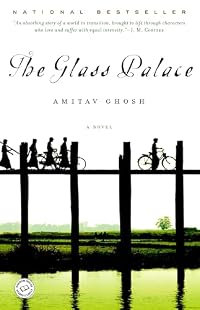
The Glass Palace
by Amitav Ghosh
On This Page
Description
"Tells of Rajkumar, a poor boy lifted on the tides of political and social chaos, who creates an empire in the Burmese teak forest. During the British invasion of 1885, when soldiers force the royal family out of the Glass Palace and into exile, Rajkumar befriends Dolly, the woman whose love will shape his life. He cannot forget her, and years later, as a rich man, he goes in search of her."--Jacket.Tags
Recommendations
















Member Recommendations


Member Reviews
Covering the period of time between the mid-19th century to the present, set mostly in Burma, The Glass Palace is a story of two Indian/Burmese families over a period of generations during times of vast political and social changes in Burma. It is a fascinating account of the large Indian migration to Burma in the 19th and early 20th centuries, first to harvest teak, then to work the rubber plantations. The Indians imported into Burma--and “imported” is a euphemism for economic slavery--were mostly exploited by other Indians, who were able to become wealthy by contracting to supply labor for the teak and rubber plantations mostly (but not entirely) owned by foreigners, especially the English.
Rajkumar Raha enters Burma in the late show more 19th century as an illiterate worker. He is present during the British invasion of Burma in 1885, when teh English deposed the Burmese royal family, ousting them from the Glass Palace, and forcing them into exile in India. Rajkumar sees and is immediately obsessed by Dolly, a young Burmese attendant of the Queen; many years later as a wealthy man, he pursues Dolly into India and persuades her to marry him and return to Burma.
The story line follows Rajkumar and his family, along with those of his mentor Saya John and his family. Their fates follow that of Burma and India, as the rising movement for Indian independence, one of whose factions is led by Gandhi, affects the politics of Burma as well, with its large Indian laboring class.
One of the best sections of the book covers the Japanese invasion of Burma in World War II. It is impossible not to compare it with J.G. Farrell’s The Singapore Grip, which covers the exact same event, since it led to the invasion and fall of Singapore. Farrell, an Irishman who had no love for the British colonial policies in any part of the Empire, and Ghosh, writing from the Indian point of view, tell almost exactly the same story, differing only in the details of separate events in Burma and Malaya. Of the two, Ghosh is the more forgiving of British military blunders and failures, simply because his point of view is that of the Indians caught up in the invasion; Farrell is far more scathing, given his British protagonists.
The best way I can describe Ghosh’s writining is that is is “old fashioned,” far more formal than that of most contemporary Indian writers. This serves very, very well for the story up until the present day, including the military coup that took over Myanmar (Burma). Perhaps because Ghosh was not that invested in the modern story, the tale loses momentum and impact at the end. However, the contemporary section is not that long--it's almost an epilogue-- and should not deter anyone from reading what is a very fine historical novel. Highly recommended. show less
Rajkumar Raha enters Burma in the late show more 19th century as an illiterate worker. He is present during the British invasion of Burma in 1885, when teh English deposed the Burmese royal family, ousting them from the Glass Palace, and forcing them into exile in India. Rajkumar sees and is immediately obsessed by Dolly, a young Burmese attendant of the Queen; many years later as a wealthy man, he pursues Dolly into India and persuades her to marry him and return to Burma.
The story line follows Rajkumar and his family, along with those of his mentor Saya John and his family. Their fates follow that of Burma and India, as the rising movement for Indian independence, one of whose factions is led by Gandhi, affects the politics of Burma as well, with its large Indian laboring class.
One of the best sections of the book covers the Japanese invasion of Burma in World War II. It is impossible not to compare it with J.G. Farrell’s The Singapore Grip, which covers the exact same event, since it led to the invasion and fall of Singapore. Farrell, an Irishman who had no love for the British colonial policies in any part of the Empire, and Ghosh, writing from the Indian point of view, tell almost exactly the same story, differing only in the details of separate events in Burma and Malaya. Of the two, Ghosh is the more forgiving of British military blunders and failures, simply because his point of view is that of the Indians caught up in the invasion; Farrell is far more scathing, given his British protagonists.
The best way I can describe Ghosh’s writining is that is is “old fashioned,” far more formal than that of most contemporary Indian writers. This serves very, very well for the story up until the present day, including the military coup that took over Myanmar (Burma). Perhaps because Ghosh was not that invested in the modern story, the tale loses momentum and impact at the end. However, the contemporary section is not that long--it's almost an epilogue-- and should not deter anyone from reading what is a very fine historical novel. Highly recommended. show less
[b:The Glass Palace|77103|The Glass Palace|Amitav Ghosh|https://i.gr-assets.com/images/S/compressed.photo.goodreads.com/books/1520866736l/77103._SY75_.jpg|74541] is a magnificent novel of war, colonialism, money, loyalty, and family. If anything I enjoyed it even more than Ghosh's wonderful Ibis trilogy, in which he also gives the reader careful insight into major historical events via a fascinating cast of many characters. Here, action is split between Burma, Malaya, and India from Burma's colonisation in the late 19th century to life in Myanmar the end of the 20th. I knew next to nothing about Burma's history, so found this focus fascinating. The royal family of Burma were exiled to India; meanwhile thousands of impoverished Indians show more were brought to Burma as indentured labour on rubber plantations. Ghosh excels at showing the complicated dynamics of colonialism through the experiences of his characters. His beautiful, vivid writing brings the settings to life.
I found the whole novel extremely compelling, however the most powerful and memorable parts concerned the run up to and events of the Second World War in Burma from the point of view of Arjun, an Indian officer in the British army. I've never before read such an insightful depiction of how the colonial system operated for the colonial subjects charged with violently enforcing it. Arjun and his fellow Indian officers exist in a state of ambivalence: they have to constantly prove their loyalty to Britain by emulating white officers' habits of eating, drinking, speaking, socialising, etc. Yet they are always paid less, treated worse, and liable for much worse punishment for any transgression than white officers. When deployed to Burma to fight the Japanese in the Second World War, Arjun and other Indian officers question who and what they are defending. Before the war:
And during the war:
Ghosh avoids any simplistic or didactic approaches to colonialism. He is always subtle, nuanced, and thoughtful. His writing is sweeping yet personalised in his engaging characters. [b:The Glass Palace|77103|The Glass Palace|Amitav Ghosh|https://i.gr-assets.com/images/S/compressed.photo.goodreads.com/books/1520866736l/77103._SY75_.jpg|74541] is a fantastic novel that cemented my belief that Ghosh is among the very best historical novelists, up there with [a:Hilary Mantel|58851|Hilary Mantel|https://images.gr-assets.com/authors/1582036110p2/58851.jpg] and [a:Patrick O'Brian|5600|Patrick O'Brian|https://images.gr-assets.com/authors/1212630063p2/5600.jpg]. show less
I found the whole novel extremely compelling, however the most powerful and memorable parts concerned the run up to and events of the Second World War in Burma from the point of view of Arjun, an Indian officer in the British army. I've never before read such an insightful depiction of how the colonial system operated for the colonial subjects charged with violently enforcing it. Arjun and his fellow Indian officers exist in a state of ambivalence: they have to constantly prove their loyalty to Britain by emulating white officers' habits of eating, drinking, speaking, socialising, etc. Yet they are always paid less, treated worse, and liable for much worse punishment for any transgression than white officers. When deployed to Burma to fight the Japanese in the Second World War, Arjun and other Indian officers question who and what they are defending. Before the war:
"Look at us!" Arjun would say, after a whisky or two, "we're the first modern Indians; the first Indians to be truly free. We eat what we like, we drink what we like, we're the first Indians who're not weighed down by the past."
And during the war:
But where would his loyalties go now that they were unmoored? He was a military man and he knew that nothing - nothing important - was possible without loyalty, without faith. But who would claim his loyalty now? The old loyalties of India, the ancient ones - they'd been destroyed long ago; the British had built their Empire by effacing them. But the Empire was dead now - he knew this because he had felt it die within himself, where it had held its strongest dominion - and with whom was he now to keep faith? Loyalty, commonalty, faith - these things were as essential and as fragile as the muscles of the human heart; easy to destroy, impossible to rebuild. How would one begin the work of re-creating the tissues that bound people to each other? This was beyond the abilities of someone such as himself; someone trained to destroy. It was a labour that would last not one year, not ten, not fifty - it was the work of centuries.
Ghosh avoids any simplistic or didactic approaches to colonialism. He is always subtle, nuanced, and thoughtful. His writing is sweeping yet personalised in his engaging characters. [b:The Glass Palace|77103|The Glass Palace|Amitav Ghosh|https://i.gr-assets.com/images/S/compressed.photo.goodreads.com/books/1520866736l/77103._SY75_.jpg|74541] is a fantastic novel that cemented my belief that Ghosh is among the very best historical novelists, up there with [a:Hilary Mantel|58851|Hilary Mantel|https://images.gr-assets.com/authors/1582036110p2/58851.jpg] and [a:Patrick O'Brian|5600|Patrick O'Brian|https://images.gr-assets.com/authors/1212630063p2/5600.jpg]. show less
What a very rewarding book this proved to be! The Glass Palace falls into the family saga category (albeit characterized by rigorous historical research and analysis), and so there is love, death, enlightenment, disappointment, contentment, astonishment, sickness, fear, happiness, and tears – both by the characters and by me.
In this book, Ghosh uses personal stories to shed light on the social, political, and historical changes in Burma, India, and Malaysia at the close of the British Empire. Further, he skillfully illustrates the fact that, as he suggests, the angle, or trajectory of a people’s entry into the future and the choices they have are inexorably set by their starting point. Thus the present condition of a people cannot show more always be easily overcome; one must know the past to understand the present. And like a photograph, one must know the negative to understand its reverse, and the shadows and omissions to understand what is right before your eyes.
The story begins in Mandalay, Burma (present day Myanmar) in November of 1885, where Rajkumar, an Indian orphan, is a young boy of 11. The King and Queen of Burma then resided in Mandalay in “The Glass Palace,” named for the vast central hall that had crystal walls and mirrored ceilings. At the end of that month, the British, crossing over from India (most of which they controlled at that time) took control of Burma. King Thebaw and his entourage were exiled to Ratnagiri on the west coast of India.
Rajkumar was taken under the wing of a businessman, Saya John, and taught to work in the teak industry: a fascinating enterprise that necessitated cooperation between man and elephant. The business was based in Burma. The characters lived in a settlement ringed by a towering wall of foliage:
"Hidden behind this wall were vast flocks of parakeets and troops of monkeys and apes – white-faced langurs and copper-skinned rhesus. Even commonplace domestic sounds from the village – the scraping of a coconut-shell ladle on a metal pot, the squeaking wheel of a child’s toy – were enough to send gales of alarm sweeping through the dappled darkness: monkeys would flee in chattering retreat, and birds would rise from the treetops in an undulating mass, like a wind-blown sheet.”
When Rajkumar became successful on his own, he traveled to Ratnigiri to find Dolly, another orphan who served as one of the queen’s attendants. He brought her back as his wife. The stories of Rajkumar, Dolly, Saya John, Uma (the wife of the Ratnigiri Imperial District Collector whom Dolly befriended), and their families intertwine over the years in the long strands of DNA that extend over three countries and generations and bind them all together.
As the years pass, the families expand their teak empire to include rubber trees, and the children get caught up in the world wars. In World War II, Burma and Malaysia are particularly vulnerable, sitting between Japan and India. Indians had to answer questions raised by not only others but themselves: do we fight for the power that has enslaved us (India), or against it for our own freedom, but risk letting the Axis win the war? At one point, one of the adjutants asks:
"What is the fear that keeps us hiding here, for instance? Is it a fear of the Japanese, or is it a fear of the British? Or is it a fear of ourselves because we do not know who to fear more?”
One of the Indian soldiers wanted to support the Japanese precisely because they were worse than the British:
"What are we? Dogs? Sheep? There are no good masters and bad masters… in a way the better the master, the worse the condition of the slave, because it makes him forget what he is...”
By the end of the book, you will learn a great deal about the history of British relations with its Asian colonies and the nature of the racism that infected all the actors, but via a literary landscape rather than by reading the often cold and dispassionate facts of nonfiction. Scholarly texts militate against emotional reactions. Intimate family histories, on the other hand, encourage them. Which represents reality more faithfully? Or are they complementary?
Evaluation: I loved this book. I really like authors such as Ghosh, Uris, and Wouk who do meticulous research and on whom I can depend to let fictional characters express the authentic concerns and emotions of an historical era. Ghosh’s characters aren't always fully sketched, especially the women, but it didn’t affect my enjoyment of the story. Give me the rudiments of life, love, and death, and I can fill in the blanks. I loved the descriptions of how the teak and rubber industries operated, and what life was like for members of different castes and classes in that part of the world. I loved getting enmeshed in the debates over colonialism. I learned a lot, and cried a lot. Who can ask for anything more? show less
In this book, Ghosh uses personal stories to shed light on the social, political, and historical changes in Burma, India, and Malaysia at the close of the British Empire. Further, he skillfully illustrates the fact that, as he suggests, the angle, or trajectory of a people’s entry into the future and the choices they have are inexorably set by their starting point. Thus the present condition of a people cannot show more always be easily overcome; one must know the past to understand the present. And like a photograph, one must know the negative to understand its reverse, and the shadows and omissions to understand what is right before your eyes.
The story begins in Mandalay, Burma (present day Myanmar) in November of 1885, where Rajkumar, an Indian orphan, is a young boy of 11. The King and Queen of Burma then resided in Mandalay in “The Glass Palace,” named for the vast central hall that had crystal walls and mirrored ceilings. At the end of that month, the British, crossing over from India (most of which they controlled at that time) took control of Burma. King Thebaw and his entourage were exiled to Ratnagiri on the west coast of India.
Rajkumar was taken under the wing of a businessman, Saya John, and taught to work in the teak industry: a fascinating enterprise that necessitated cooperation between man and elephant. The business was based in Burma. The characters lived in a settlement ringed by a towering wall of foliage:
"Hidden behind this wall were vast flocks of parakeets and troops of monkeys and apes – white-faced langurs and copper-skinned rhesus. Even commonplace domestic sounds from the village – the scraping of a coconut-shell ladle on a metal pot, the squeaking wheel of a child’s toy – were enough to send gales of alarm sweeping through the dappled darkness: monkeys would flee in chattering retreat, and birds would rise from the treetops in an undulating mass, like a wind-blown sheet.”
When Rajkumar became successful on his own, he traveled to Ratnigiri to find Dolly, another orphan who served as one of the queen’s attendants. He brought her back as his wife. The stories of Rajkumar, Dolly, Saya John, Uma (the wife of the Ratnigiri Imperial District Collector whom Dolly befriended), and their families intertwine over the years in the long strands of DNA that extend over three countries and generations and bind them all together.
As the years pass, the families expand their teak empire to include rubber trees, and the children get caught up in the world wars. In World War II, Burma and Malaysia are particularly vulnerable, sitting between Japan and India. Indians had to answer questions raised by not only others but themselves: do we fight for the power that has enslaved us (India), or against it for our own freedom, but risk letting the Axis win the war? At one point, one of the adjutants asks:
"What is the fear that keeps us hiding here, for instance? Is it a fear of the Japanese, or is it a fear of the British? Or is it a fear of ourselves because we do not know who to fear more?”
One of the Indian soldiers wanted to support the Japanese precisely because they were worse than the British:
"What are we? Dogs? Sheep? There are no good masters and bad masters… in a way the better the master, the worse the condition of the slave, because it makes him forget what he is...”
By the end of the book, you will learn a great deal about the history of British relations with its Asian colonies and the nature of the racism that infected all the actors, but via a literary landscape rather than by reading the often cold and dispassionate facts of nonfiction. Scholarly texts militate against emotional reactions. Intimate family histories, on the other hand, encourage them. Which represents reality more faithfully? Or are they complementary?
Evaluation: I loved this book. I really like authors such as Ghosh, Uris, and Wouk who do meticulous research and on whom I can depend to let fictional characters express the authentic concerns and emotions of an historical era. Ghosh’s characters aren't always fully sketched, especially the women, but it didn’t affect my enjoyment of the story. Give me the rudiments of life, love, and death, and I can fill in the blanks. I loved the descriptions of how the teak and rubber industries operated, and what life was like for members of different castes and classes in that part of the world. I loved getting enmeshed in the debates over colonialism. I learned a lot, and cried a lot. Who can ask for anything more? show less
The Glass Palace - Ghosh
audio performance by Simon Vance
4 stars
“Ah, Burma! Burma was a golden land.” - Rajkumar ”
This book starts in Burma at the time of the 1885 British invasion. It tells the story of an illiterate Indian boy named Rajkumar, and Dolly, a young woman in the court of the last Burmese Queen. The publisher’s synopsis of this novel paints a grand, passionate, love story in which the poor boy builds a financial empire to win the girl and rescue her from reduced circumstances. I think this is misleading. The story is about the rise and fall of the British Raj throughout the East, but especially in Burma and India. It’s a story that spans more than 100 years. Rajkumar and Dolly form the center of a group of show more multi-national characters who are intermarried and interrelated in a way that allows Ghosh to show the individual human toll of major political changes from a variety of Eastern perspectives. It made me feel inadequately aware of my Western ignorance.
It’s a fairly long book, over 500 pages, and there are many characters. There were times when I found it difficult to keep them sorted out. The story jumped through time quite a bit. Certain specific incidents were described in great detail while whole decades were skimmed through in brief paragraphs, leaving me feeling that there were significant gaps in the lives of the characters, places where I was missing some important information or insight.
On the other hand, the writing is beautiful. There are many heartbreaking moments throughout the book, but the worst are concentrated in the second generation characters during World War 2. Ghosh’s writing is most powerful when he details the internal conflicts of Arjun in his evolution from proud soldier in His Majesty’s army to mutineer in collaboration with the Japanese.
But if it were true that his life had somehow been molded by acts of power of which he was unaware—then it would follow that he had never acted of his own volition; never had a moment of true self-consciousness. Everything he had ever assumed about himself was a lie, an illusion. And if this were so, how was he to find himself now?
“Was this how a mutiny was sparked? In a moment of heedlessness, so that one became a stranger to the person one had been a moment before? Or was it the other way around? That this was when one recognized the stranger that one had always been to oneself; that all one’s loyalties and beliefs had been misplaced?”
This book stayed with me and the pieces of the story came together as I thought about it days after I read it. It sent me to google to learn more. It added to the list of books I want to read, more of them by Amitav Ghosh. show less
audio performance by Simon Vance
4 stars
“Ah, Burma! Burma was a golden land.” - Rajkumar ”
This book starts in Burma at the time of the 1885 British invasion. It tells the story of an illiterate Indian boy named Rajkumar, and Dolly, a young woman in the court of the last Burmese Queen. The publisher’s synopsis of this novel paints a grand, passionate, love story in which the poor boy builds a financial empire to win the girl and rescue her from reduced circumstances. I think this is misleading. The story is about the rise and fall of the British Raj throughout the East, but especially in Burma and India. It’s a story that spans more than 100 years. Rajkumar and Dolly form the center of a group of show more multi-national characters who are intermarried and interrelated in a way that allows Ghosh to show the individual human toll of major political changes from a variety of Eastern perspectives. It made me feel inadequately aware of my Western ignorance.
It’s a fairly long book, over 500 pages, and there are many characters. There were times when I found it difficult to keep them sorted out. The story jumped through time quite a bit. Certain specific incidents were described in great detail while whole decades were skimmed through in brief paragraphs, leaving me feeling that there were significant gaps in the lives of the characters, places where I was missing some important information or insight.
On the other hand, the writing is beautiful. There are many heartbreaking moments throughout the book, but the worst are concentrated in the second generation characters during World War 2. Ghosh’s writing is most powerful when he details the internal conflicts of Arjun in his evolution from proud soldier in His Majesty’s army to mutineer in collaboration with the Japanese.
But if it were true that his life had somehow been molded by acts of power of which he was unaware—then it would follow that he had never acted of his own volition; never had a moment of true self-consciousness. Everything he had ever assumed about himself was a lie, an illusion. And if this were so, how was he to find himself now?
“Was this how a mutiny was sparked? In a moment of heedlessness, so that one became a stranger to the person one had been a moment before? Or was it the other way around? That this was when one recognized the stranger that one had always been to oneself; that all one’s loyalties and beliefs had been misplaced?”
This book stayed with me and the pieces of the story came together as I thought about it days after I read it. It sent me to google to learn more. It added to the list of books I want to read, more of them by Amitav Ghosh. show less
The synopsis on the back of my edition of The Glass Palace says it is "set in Burma during the British invasion of 1885." In fact, this 470-page novel begins at that point and covers a sweep of around 120 years, right through the "present" day (the book was published in 2000). That narrative sweep is one of the book's thematic strengths but also it's major narrative flaw, in my view. The thematic strength arises from Ghosh's deft examination of the complicated relationship between Burma (now Myanmar), India and the British Empire which occupied and ruled both for so long. One of the most fascinating episodes revolves around the Japanese invasion of Burma in World War 2, and the complicated and varied reactions of the Indian soldiers show more serving in the British army (a generations-long tradition), just as agitation for independence from the Raj had been growing. And while much of the narrative drive of the plot is interesting enough, there are long stretches of the book where the characters seemed to me to be more in place to serve these thematic ends then to present the reader with engrossing personal tales. One of the problems for me was that, while one of the main characters begins life as a young ragamuffin, he soon uses his wiles and ambition to gain success. From then on, the book focuses on characters of relative privilege. Such stories have always held less fascination for me than tales told from closer to the bottom of the ladder looking up. I can't help but compare this book to Väinö Linna's brilliant Under the North Star trilogy, which shows us the struggles and triumphs of three generations of Finnish tenant farmers and which, to me, was so much more moving.
Your mileage may well vary on this book, but for myself, I would have preferred the Ghosh focus in more closely on a specific time period and set of characters. I'm going to say, though, that overall I'm glad I read the book, and remember to point out that in most places the actual writing and descriptions are very, very strong. show less
Your mileage may well vary on this book, but for myself, I would have preferred the Ghosh focus in more closely on a specific time period and set of characters. I'm going to say, though, that overall I'm glad I read the book, and remember to point out that in most places the actual writing and descriptions are very, very strong. show less
There is much love for Ghosh's The Glass Palace. This was the right balance of historical fiction, love story, and political commentary within a sweeping saga. Dolly is a woman who has been in the service of the Queen for as long as she can remember. Rajkumar is an orphan boy taken in by a teak logger and taught the trade. Glass Palace follows them through childhood, their storybook romance, growing families and the inevitable, old age. Intertwined are the stories of their children, their children's children, war, politics, fashion, feminism, and life. The way it was written the story could have been without end.
In 1885, Great Britain deposed the king of Burma and sent him into exile in India. During the subsequent looting of the palace a young homeless orphan named Rajkumar saw a breathtakingly beautiful young servant girl named Dolly. Unknown to Dolly, Raj vowed to become rich and then find her. Dolly went with the royal family into exile and Rajkumar kept the promise he made to himself.
So begins a historical fiction lasting through the generations and World War II. It’s wonderfully detailed about the history, politics and chaos in Burma, Siam and Malaysia, and of course, the impacts of British colonialism in these areas.
As we approached WWII, I felt the novel was beginning to drag a bit – but then the war begins and Burmese soldiers who show more have finally been allowed to fight proudly for India in the British army, are now faced with the choice of continuing to fight for the oppressor Britain, or fight with the Japanese soldiers against Britain.
It’s a highly nuanced historical novel with characters I felt sad to leave behind. show less
So begins a historical fiction lasting through the generations and World War II. It’s wonderfully detailed about the history, politics and chaos in Burma, Siam and Malaysia, and of course, the impacts of British colonialism in these areas.
As we approached WWII, I felt the novel was beginning to drag a bit – but then the war begins and Burmese soldiers who show more have finally been allowed to fight proudly for India in the British army, are now faced with the choice of continuing to fight for the oppressor Britain, or fight with the Japanese soldiers against Britain.
It’s a highly nuanced historical novel with characters I felt sad to leave behind. show less
Members
- Recently Added By
Lists

Best of World Literature
431 works; 51 members

All Things India
95 works; 21 members

Historical Fiction
889 works; 91 members

BBC Radio 4 Bookclub
340 works; 13 members

A Novel Cure
742 works; 23 members

I Could Live There
185 works; 12 members

Mustich's 1000 Books to Read Before You Die: A Life Changing List
1,001 works; 18 members

living room bookshelf
150 works; 1 member
Author Information

44+ Works 15,806 Members
Born in Calcutta, and spent his childhood in Bangladesh, Sri Lanka, and Northern India. He studied in Delhi, Oxford, and Egypt and taught at various Indian and American universities. Author of a travel book and three acclaimed novels. Ghosh has also written for GRANTA, THE NEW YORKER, THE NEW YORK TIMES, and THE OBSERVER. He lives in New York City show more with his wife and two children. (Publisher Provided) Amitav Ghosh was born in Calcutta, India on July 11, 1956. He studied in Delhi, Oxford and Alexandria. His first book, The Circle of Reason, won France's Prix Médicis. He has won several other awards including the Sahitya Akademi Award and the Ananda Puraskar for The Shadow Lines, the Arthur C. Clarke award for The Calcutta Chromosome, and the Crossword Book Prize for The Hungry Tide and Sea of Poppies. His other works include In an Antique Land, Dancing in Cambodia, The Glass Palace, and River of Smoke. In 2007, he was awarded the Padma Shri, one of India's highest honors, by the President of India. He made the New Zealand Best Seller List in 2015 with his title Flood of Fire. (Bowker Author Biography) show less
Some Editions
Awards and Honors
Series
Belongs to Publisher Series
btb (73036)
Common Knowledge
- Canonical title
- The Glass Palace
- Original title
- The Glass Palace
- Original publication date
- 2000
- People/Characters
- Rajkumar; Dolly; Uma; Dinu; Saya John; Arjun (show all 9); Manju; Kishan Singh; Allison
- Important places
- Burma; Mandalay, Burma; Malaya (now Peninsular Malaysia); Calcutta, India; Ratnagiri, India (Maharashtra)
- Important events
- Third Anglo-Burmese War; World War II
- Dedication
- To my father's memory
- First words
- There was only one person in the food-stall who knew exactly what that sound was rolling in across the plain, along the silver curve of the Irrawaddy, to the western wall of Mandalay's fort.
- Last words
- (Click to show. Warning: May contain spoilers.)What I saw in my great-great-aunt Uma's bedroom remains the most tender, the most moving sight I have ever seen, and from that day when I sat down to write this book--the book my mother never wrote--I knew that it was here that it would end.
- Blurbers
- Paley, Grace; McPhee, Martha; Weinberger, Eliot; Levi, Jonathan; Bukiet, Melvin Jules; Divakaruni, Chitra Banerjee (show all 7); Coetzee, J.M.
- Original language
- English
Classifications
- Genres
- Fiction and Literature, General Fiction, Historical Fiction
- DDC/MDS
- 823.914 — Literature & rhetoric English & Old English literatures English fiction 1900- 1901-1999 1945-1999
- LCC
- PR9499.3 .G536 .G58 — Language and Literature English English Literature English literature: Provincial, local, etc.
- BISAC
Statistics
- Members
- 2,977
- Popularity
- 5,966
- Reviews
- 67
- Rating
- (3.84)
- Languages
- 10 — Danish, Dutch, English, French, German, Greek, Italian, Norwegian (Bokmål), Portuguese, Spanish
- Media
- Paper, Audiobook, Ebook
- ISBNs
- 54
- ASINs
- 20