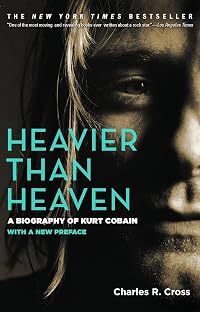
Heavier than Heaven: A Biography of Kurt Cobain
by Charles R. Cross
On This Page
Description
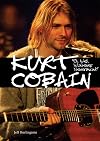
When Kurt Cobain died by his own hand in April 1994, it was an act of will that typified his short, angry, inspired life. Veteran music journalist Charles R. Cross fuses his intimate knowledge of the Seattle music scene with his deep compassion for his subject in this extraordinary story of artistic brilliance and the pain that extinguished it. Based on four years of exhaustive research, with exclusive access to Cobain's unpublished diaries, Heavier than Heaven traces Cobain's life from his show more early days in a trailer to his rise to fame, success, and the adulation of a generation. show lessTags
Recommendations











Member Recommendations
by anonymous user
Member Reviews
I didn’t expect this book to be a happy one, but I didn’t expect it describe so clearly how much of a troubled genius Kurt Kobain was. The man suffered severe depression and I think he was bi-polar as well—all undiagnosed and untreated for all of his life. So because he didn’t get the proper help, he learned to self-diagnose and self-medicate his affliction with a cornucopia of drugs. And at 27 he finally gave up his fight, and took his own life. And what a life it was! The man was a genius and his music defined a generation. Cross has thoroughly researched and explored the life of Kurt Cobain, and has offered this information to us with this book. No one reading this book will come away unchanged. We thank Cobain for his show more incomparable body of work, and we feel sympathy and empathy for him. (Empathy was one of Kurt’s favourite words, but I don’t think he ever thought that he found anyone with this trait in his short life.) The book ends with one of my favourite Leonard Cohen poems, and I think it summarizes Kurt Cobain’s longings and his life very well.
“I Have Not Lingered in European Monasteries
I have not lingered in European monasteries
And discovered among the tall grasses tombs of knights
Who fell as beautifully as their ballads tell.
I have not parted the grasses or purposefully left them thatched.
I have not released my mind to wander and wait
In those great distances between the snowy mountains and the fishermen.”
For those loved Nirvana and Kurt Cobain’s music, I recommend you read this book which is like a ballad or like Cohen’s poetry. Beautiful, unrelenting, poignant and ethereal. show less
“I Have Not Lingered in European Monasteries
I have not lingered in European monasteries
And discovered among the tall grasses tombs of knights
Who fell as beautifully as their ballads tell.
I have not parted the grasses or purposefully left them thatched.
I have not released my mind to wander and wait
In those great distances between the snowy mountains and the fishermen.”
For those loved Nirvana and Kurt Cobain’s music, I recommend you read this book which is like a ballad or like Cohen’s poetry. Beautiful, unrelenting, poignant and ethereal. show less
A book striking for its objectivity. Charles Cross not only has done a great biographical work by dispelling a few myths surrounding Kurt (most invented by Cobain himself!) but, he also shows as best as can be the contradictory personality of a very talented artist, still very difficult to understand. Was Kurt Cobain a sensible and romantic young man victim of a difficult childhood and a tough life or, on the contrary, an annoying self-centred wimp? The reader will make his own opinion. Charles Cross doesn't judge -he's offering us here an intimate picture as deep as it is well researched.
The author does a commendable job fleshing out every single detail of Kurt's life, from birth to death; however, towards the middle of the book, it became overwhelming. There were *so* many details, especially small music-related details, that the narrative began to become bogged down. It felt as if I were reading a music history rather than a biography of Kurt Cobain. While I enjoyed reading Kurt's history, I felt that some of the music history belonged in another novel.
I read a lot of biographies as they are my favorite and this one on Kurt or Kurdt, as he may have preferred at times depending upon his condition, was one that will stick with me a while to ponder. I wasn't quite sure what to expect when I picked it up or why I would want to explore this seemingly wasted life. But shortly into the story I sound it both fascinating and riveting. Since completing the book I read some commentary regarding Charles Cross' supposed slant and those questioning some truthfulness in the book. Also I read a mention of Courtney Love's influence and direction on it, as well as her supposed shopping of it for a movie. That would seem to be Courtney, not one to hold back on anything. But setting that aside I came show more away with a feeling that Cross was not grinding out an agenda and found his writing quite impressive.
Cobain in my take from what I saw here was a suicide in the making from birth. The torture he lived through from the very start gendered in me both feelings of pity and scorn. I could not help to feel his destiny was driven by his self paved path of destruction. Much like some of his music a crying out in the dark of the pain and suffering he perceived in so much. Bordering on psychosis it was hard to feel much sympathy for a guy that could not be reached by no matter what or whom. Not even his love for little Frances Bean could alter that path he was on.
Certainly his early childhood and the trauma of his parents' struggles could be cited as a lot of his own trauma, but he is among many in that regard. His physical pain also could be blamed for leading to the heroin downfall, but again not the only one. Yet looking at his creative side the "reluctant" star driven by his private ambition and stood out like not many in the rarefied air of musical stardom. Maybe like many of genius in this field he simply got caught up in the overwhelming pressure and expectation the fame demands. He would not be the first or last. But as Neil Young put it so well in his lyrics, every junky's like a setting sun. show less
Cobain in my take from what I saw here was a suicide in the making from birth. The torture he lived through from the very start gendered in me both feelings of pity and scorn. I could not help to feel his destiny was driven by his self paved path of destruction. Much like some of his music a crying out in the dark of the pain and suffering he perceived in so much. Bordering on psychosis it was hard to feel much sympathy for a guy that could not be reached by no matter what or whom. Not even his love for little Frances Bean could alter that path he was on.
Certainly his early childhood and the trauma of his parents' struggles could be cited as a lot of his own trauma, but he is among many in that regard. His physical pain also could be blamed for leading to the heroin downfall, but again not the only one. Yet looking at his creative side the "reluctant" star driven by his private ambition and stood out like not many in the rarefied air of musical stardom. Maybe like many of genius in this field he simply got caught up in the overwhelming pressure and expectation the fame demands. He would not be the first or last. But as Neil Young put it so well in his lyrics, every junky's like a setting sun. show less
Kurt Cobain died my senior year in college, during our annual Rites of Spring, and I always associate his death with the end of college and the beginning of the real world. This is an interesting and well-researched account of his life and music. It was interesting to read, because when I was young of course I identified with his emotional angst, but now I'm the parent of teenagers and I identified with his parents. I kept trying to think of how he could have been helped. A good therapist at an early age, for example. A mentor. Prozac.
It just seems like such a waste, even more now that I have kids and I think of all the time with his daughter that he missed.
It just seems like such a waste, even more now that I have kids and I think of all the time with his daughter that he missed.
Kurt Cobain died my senior year in college, during our annual Rites of Spring, and I always associate his death with the end of college and the beginning of the real world. This is an interesting and well-researched account of his life and music. It was interesting to read, because when I was young of course I identified with his emotional angst, but now I'm the parent of teenagers and I identified with his parents. I kept trying to think of how he could have been helped. A good therapist at an early age, for example. A mentor. Prozac.
It just seems like such a waste, even more now that I have kids and I think of all the time with his daughter that he missed.
It just seems like such a waste, even more now that I have kids and I think of all the time with his daughter that he missed.
It has been twenty years since Kurt Cobain died by his own hand in April 1994; it was an act of will that typified his short, angry, inspired life. Veteran music journalist Charles R. Cross fuses his intimate knowledge of the Seattle music scene with his deep compassion for his subject in this extraordinary story of artistic brilliance and the pain that extinguished it. Based on more than four hundred interviews; four years of research; exclusive access to Cobain's unpublished diaries, lyrics, and family photos; and a wealth of documentation, Heavier Than Heaven traces Cobain's life from his early days in a double-wide trailer outside of Aberdeen, Washington, to his rise to fame, success, and the adulation of a generation. Charles Cross show more has written a preface for this new edition, in which he recounts some of the events regarding Kurt Cobain and this book in the past two decades since his death. show less
Members
- Recently Added By
Author Information

13+ Works 2,299 Members
Charles R. Cross was editor of the Rocket, the Northwest's highly regarded music magazine and the first publication to do a cover story on Nirvana. He is the author of eight other books including the bestsellers Room Full of Mirrors: A Biography of Jimi Hendrix and Kicking Dreaming: A Story of Heart, Soul, and Rock 'n' Roll. His writing has show more appeared in Rolling Stone and Esquire, among many other publications. He lives in Seattle. show less
Some Editions
Awards and Honors
Series
Belongs to Publisher Series
Common Knowledge
- Canonical title
- Heavier than Heaven: A Biography of Kurt Cobain
- Original publication date
- 2001-08-15
- People/Characters
- Kurt Cobain; Dave Grohl; Krist Novoselić; Courtney Love; Gibby Haynes; Pat Smear (show all 7); Wendy Fradenburg Cobain O'Connor
- Important places
- Seattle, Washington, USA; Aberdeen, Washington, USA
- Dedication
- For my family, for Christina and for Ashland.
- First words
- The first time he saw heaven came six hours and fifty-seven minutes after the very moment an entire generation fell in love with him.
- Quotations*
- Kurt was a complicated, contradictory misanthrope, and what at times appeared to be an accidental revolution showed hints of careful orchestration.
Fame and success only seemed to make him feel worse.
Kurt enjoyed making up his own lyrcis, even as a toddler.
Kurt wrote on his bedroom wall: "I hate Mom, I hate Dad. Dad hates Mom, Mom hates Dad. It simply makes you want to be so sad."
One day he and John Fields were walking home from school when Fields told Kurt, he should be an artist, but Kurt casually announced: "I'm going to be a superstar musician, kill myself, and go out in a flame of glory."
Kurt was never one to let the truth get in the way of a good story: the tale that he'd pawned his stepfather's guns for his first guitar was simply too good for the storyteller in him to resist. In this one story were all the... (show all) elements of how he wished to be perceived as an artist - someone who turned redneck swords into punk rock plowshares. In truth, he did pawn the guns, but used the proceeds to acquire a Fender deluxe amp.
"He was really into getting fucked up; drugs, acid, any kind of drug," Novoselic observed. "He'd get hammered in the middle of the day. He was a mess."
By their very first public show, it was all there, every bit of the Nirvana that would conquer the world in the years to come: the tone, the attitude, the frenzy, the slightly-off-kilter rhythms, the remarkably melodic guitar... (show all) chords, the driving bass lines that were guaranteed to move your body, and, most important, the hypnotizing focus of Kurt.
Kurt enjoyed stealing sculptures of the Virgin Mary from the cemetery and painting blood tears under her eyes.
His songs and his journal entries fused together at times, but both were obsessed with human body functions: Birth, urination, defecation and sexuality were topics he was accomplished in.
Despite the fact that he'd say the exact opposite in interviews, Kurt cared very much what people thought of him.
Even in the early stages of his career, Kurt had already begun the process of retelling his own story in a manner that formed a separate self. He was commencing the creation of his greatest character, the mythical "Kurdt Koba... (show all)in".
Far too often the band's shows turned into loud feeedback sessions where virtually none of Kurt's words could be heard above the din.
When the world tapped him on the shoulder and said, "Mr. Cobain, we are ready for your closeup," he had planned how he'd walk toward the cameras, going so far as to even rehearse the way he would shrug his shoulders, as if to... (show all) give the impression he had only grudgingly acquiesced.
Nothing the band ever did, either in the studio or onstage, matched the way it sounded in his head. He loved the idea of a record until it came out, and then immediately he had to find something wrong with it. It was part of ... (show all)a larger dissatisfaction.
Walking into his apartment any afternoon during 1989, you were as likely to find him with a paintbrush in his hand as a guitar. But he wasn't actually a painter as much as he was a creator. He used whatever implement was in f... (show all)ront of him as a brush, and whatever flat object he found as a canvas.
There were seven people in the band's entourage, and among them they couldn't afford a burrito.
"My lyrics are a big pile of contradictions. They're split down the middle between very sincere opinions and feelings that I have, and sarcastic, hopeful, humorous rebuttals towards cliché, bohemian ideals that have been exh... (show all)austed for years. I mean to be passionate and sincere, but I also like to have fund an act like a dork."
Kurt never actually told Jason he was fired - he simply never called again.
Years later, upon first seeing Nirvana in concert, Bob Dylan picked "Polly" out of the entire Nirvana catalog as Kurt's most courageous song, and one that inspired him to remark of Kurt, "The kid has heart."
Around the same time, he wrote out yet another fake biography of the band, one that would prove strangely prophetic, even as it was filled with adolescent jokes. It described the band as "three time Granny Award Winners, No. ... (show all)1 on "Billlbored" Top 100 fur 36 consecutive "weaks" in a row. Two times on the cover of "Bowling Stoned", hailed as the most original, thought-provoking and important band of our decade by "Thyme" and "Newsweak"."
"Everything I do is an overly conscious and neurotic attempt at trying to prove to others that I am at least more intelligent and cool than they think."
The hatred he had for others was mild compared to the violence he described against himself. Suicide came up as a topic repeatedly.
One draft of a dedication for the record said more about his childhood than his attempt at biography: "Thanks to unencouraging parents everywhere," he wrote, "for giving their children the will to show them up."
To him, punk rock was a class struggle, but that was always secondary to the struggle to pay the rent, or find a place to sleep other than in the backseat of a car. Music was more than just a fad for Kurt - it had become his ... (show all)only career option.
He felt Courtney intrinsically knew the smell of the shit he'd crawled through.
"So I decided, if I feel like a junkie as it is, I may as well be one."
"He was about to get famous. And it freaked him out."
Later at night at their hotel, Kurt and Courtney were so harrassed by other guests, they put a sign on their door: "No Famous People Please. We're Fucking."
Kurt's harshest critic was always his own inner voice. - Last words
- (Click to show. Warning: May contain spoilers.)At the bottom of the hill, he would wave his mitten-covered hand at his family, and a wide, warm smile would come over his face, his blue eyes sparkling in the winter sun.
*Some information comes from Common Knowledge in other languages. Click "Edit" for more information.
Classifications
- Genres
- Music, Biography & Memoir, Nonfiction, General Nonfiction
- DDC/MDS
- 782.42166092 — Arts & recreation Music Vocal Music, Singing Secular forms of vocal music Songs General principles and musical forms Traditions of secular songs {genres} Rock songs modified standard subdivisions History, geographic treatment, biography Biography
- LCC
- ML420 .C59 .C76 — Music Literature on music Literature on music History and criticism Biography
- BISAC
Statistics
- Members
- 1,448
- Popularity
- 16,144
- Reviews
- 26
- Rating
- (3.84)
- Languages
- 13 — Danish, Dutch, English, Estonian, French, German, Hungarian, Italian, Lithuanian, Polish, Croatian, Spanish, Portuguese (Portugal)
- Media
- Paper, Audiobook, Ebook
- ISBNs
- 48
- ASINs
- 9