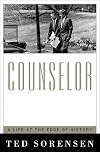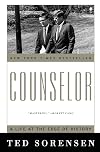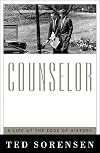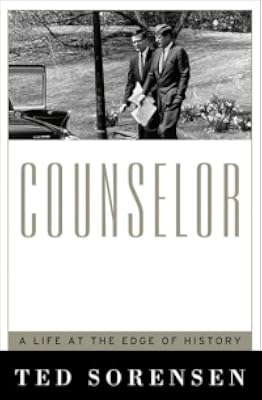
Counselor: A Life at the Edge of History
by Ted Sorensen
On This Page
Description
In this gripping memoir, John F. Kennedy's closest advisor recounts in full for the first time his experience counseling Kennedy through the most dramatic moments in American history.... from the decision to go to the moon to the Cuban Missile Crisis, when JFK requested that the thirty-four-year-old Sorensen draft the key letter to Khrushchev at the most critical point of the world's first nuclear confrontation. After Kennedy was assassinated, Sorensen stayed with President Johnson for a few show more months before leaving to write a biography of JFK. In 1968 he returned to Washington to help run Robert Kennedy's presidential campaign. Through it all, Sorensen never lost sight of the ideals that brought him to Washington and to the White House, working tirelessly to promote and defend free, peaceful societies.--From publisher's description. show lessTags
Recommendations
















Member Reviews
Ted Sorensen, often thought to be the most influential presidential speechwriter of all time due to his indispensability to John F. Kennedy, writes his first full memoir in "Counselor: A Life at the Edge of History" (2008) -- though some note autobiographical elements in his early reminiscences of the Kennedy administration in his 1965 book, "Kennedy." Although the book covers Sorensen's full life, it focuses mostly on his decade-plus association with Kennedy.
With the flavor of a transcribed oral history -- which it probably is, due to the limitations imposed on Sorensen by a stroke late in his life -- Sorensen breezily relates much of his life, from his boyhood in Nebraska to his later years in New York City. Unlike many memoirs, it show more offers a refreshing amount of candor, including personal details of shortcomings and misconceptions, culminating in a brief chapter on Sorensen's failed nomination to head the CIA under then-incoming president Jimmy Carter.
Unlike other autobiographies, except possibly for those written by people with more famous spouses, the shadow of another life looms larger in these pages than the subject. Partially, this is because Sorensen's career is so closely allied with Kennedy's career -- their collaboration from Kennedy's Senate years, through the 1960 presidential campaign, and into the White House. Mostly, though, it is because the loyalty that Kennedy obviously prized in Sorensen has never faded and the affection that Sorensen felt for his boss is still explicit 40 years after Kennedy's assassination.
This leads to an odd overtone. In places where Sorensen feels obliged to explain or defend something in the past, it is almost always a defense of Kennedy's reputation, even at the expense of his own. In this book, Sorensen admits to playing a role in writing Kennedy's award-winning book "Profiles in Courage," but he defers authorship to Kennedy. Sorensen admits to offering candid advice, but he defers all decisions to Kennedy.
Even as he built on his experience to become a legal consultant to leaders around the world, Sorensen downplays his capability and judgment (though his discretion with regards to these later years is apparent). In some ways, the tone of the book could be an echo of Lou Gehrig's great speech at the end of the 1942 film "The Pride of the Yankees": "Today I consider myself the luckiest man in the world."
There is much to appreciate in "Counselor." Even though the mostly chronological text has frequent leaps and omissions, Sorensen's account is appealing, with the flavor of a free-wheeling, if extended, dinnertime storytelling session. The narrative style is consistently pleasant to read. And, again, the echoes of Camelot ring, if in slightly muted fashion, harkening to another era. show less
With the flavor of a transcribed oral history -- which it probably is, due to the limitations imposed on Sorensen by a stroke late in his life -- Sorensen breezily relates much of his life, from his boyhood in Nebraska to his later years in New York City. Unlike many memoirs, it show more offers a refreshing amount of candor, including personal details of shortcomings and misconceptions, culminating in a brief chapter on Sorensen's failed nomination to head the CIA under then-incoming president Jimmy Carter.
Unlike other autobiographies, except possibly for those written by people with more famous spouses, the shadow of another life looms larger in these pages than the subject. Partially, this is because Sorensen's career is so closely allied with Kennedy's career -- their collaboration from Kennedy's Senate years, through the 1960 presidential campaign, and into the White House. Mostly, though, it is because the loyalty that Kennedy obviously prized in Sorensen has never faded and the affection that Sorensen felt for his boss is still explicit 40 years after Kennedy's assassination.
This leads to an odd overtone. In places where Sorensen feels obliged to explain or defend something in the past, it is almost always a defense of Kennedy's reputation, even at the expense of his own. In this book, Sorensen admits to playing a role in writing Kennedy's award-winning book "Profiles in Courage," but he defers authorship to Kennedy. Sorensen admits to offering candid advice, but he defers all decisions to Kennedy.
Even as he built on his experience to become a legal consultant to leaders around the world, Sorensen downplays his capability and judgment (though his discretion with regards to these later years is apparent). In some ways, the tone of the book could be an echo of Lou Gehrig's great speech at the end of the 1942 film "The Pride of the Yankees": "Today I consider myself the luckiest man in the world."
There is much to appreciate in "Counselor." Even though the mostly chronological text has frequent leaps and omissions, Sorensen's account is appealing, with the flavor of a free-wheeling, if extended, dinnertime storytelling session. The narrative style is consistently pleasant to read. And, again, the echoes of Camelot ring, if in slightly muted fashion, harkening to another era. show less
The Sorensen Autobiography
Though not directly described and marketed this way, "Counselor" really is Sorensen's autobiography. The life of a small-town half-Jewish half-Danish kid from Nebraska that made some smart choices and ended up as John F. Kennedy's confidante throughout his most momentous years and by extension the country's.
As a student of history, there was much to be learned about Sorensen's personal beliefs and family upbringing that you couldn't possibly learn from any other book. For example, Sorensen was raised as a Unitarian and those pacifist views are what shaped his decision as a conscientious objector in WWII and overall commitment to peace and non-violence.
I did enjoy reading the inner-workings between Sorensen and show more the Kennedy's. Sorensen is unapologetic in his idolization of JFK. Though he still acknowledges the many mistakes made along the way. Another major revelation to me was Sorensen's admission that he really didn't that much influence on many of JFK's speeches. He explains that much of this myth was perpetuated due to his heavy involvement in JFK's "Profiles in Courage" and the Inauguration speech but says the most important speeches like the Berlin speech and University of Washington speeches were largely JFK's.
There are a few other more personal political failures that Sorensen embarrassingly details. Such as his failed New York Senate bid in 1970 and the appointment as CIA Director for Carter in 77 that went stillborn. Through them all, Sorensen has no regrets, they just reinforced what he already knew. These lessons from the edge of history are summed up in a short section called "Why and How to Run for President".
The book as expected is eloquently written and though at 500+ pages still reads rather briskly. There are no footnotes or endnotes as Sorensen describes the book to be more memoir than academic or scholarly text. As an auto-biography, the book is very reflective yet not to cerebral, well-worth the read for anyone who wants to know more about Sorensen and his relationship with the Kennedys. If you're looking for anything on Barack Obama, there is very little here, maybe 1 or 2 sentences and a picture. show less
Though not directly described and marketed this way, "Counselor" really is Sorensen's autobiography. The life of a small-town half-Jewish half-Danish kid from Nebraska that made some smart choices and ended up as John F. Kennedy's confidante throughout his most momentous years and by extension the country's.
As a student of history, there was much to be learned about Sorensen's personal beliefs and family upbringing that you couldn't possibly learn from any other book. For example, Sorensen was raised as a Unitarian and those pacifist views are what shaped his decision as a conscientious objector in WWII and overall commitment to peace and non-violence.
I did enjoy reading the inner-workings between Sorensen and show more the Kennedy's. Sorensen is unapologetic in his idolization of JFK. Though he still acknowledges the many mistakes made along the way. Another major revelation to me was Sorensen's admission that he really didn't that much influence on many of JFK's speeches. He explains that much of this myth was perpetuated due to his heavy involvement in JFK's "Profiles in Courage" and the Inauguration speech but says the most important speeches like the Berlin speech and University of Washington speeches were largely JFK's.
There are a few other more personal political failures that Sorensen embarrassingly details. Such as his failed New York Senate bid in 1970 and the appointment as CIA Director for Carter in 77 that went stillborn. Through them all, Sorensen has no regrets, they just reinforced what he already knew. These lessons from the edge of history are summed up in a short section called "Why and How to Run for President".
The book as expected is eloquently written and though at 500+ pages still reads rather briskly. There are no footnotes or endnotes as Sorensen describes the book to be more memoir than academic or scholarly text. As an auto-biography, the book is very reflective yet not to cerebral, well-worth the read for anyone who wants to know more about Sorensen and his relationship with the Kennedys. If you're looking for anything on Barack Obama, there is very little here, maybe 1 or 2 sentences and a picture. show less
I liked this book, mostly for the sections about The Cuban Missile Crisis and his explanation of his involvement in writing Profiles In Courage (didn't ghost write it, just wrote the first drafts). I didn't love it though and wouldn't recommend it to a friend which is usually my yardstick as to a 'good' book. It is clear throughout the book that JFK is/was the only person Sorensen ever thought as an intellectual equal (if not more). Although always subordinate to 'Mr. President' it is clear that JFK was Sorensen's best friend (but maybe not vice versa). Something I found annoying was the way Sorensen seemed to consistently infer that he was always the 'difference' when things went right or if they went bad (when he wasn't involved, show more i.e., Bay of Pigs, Vietnam, and the CIA). show less
History from the inside. I didn't realize how close Sorensen's relationship was to Kennedy.
The stories of their barnstorming in a small plane together in the 1950's campaigning surprised me.
Very readable.
The stories of their barnstorming in a small plane together in the 1950's campaigning surprised me.
Very readable.
Great memories of JFK and RFK and new insights into how JFK governed and led. I know it's a memoir but just a little too much "Ted Terrific".
Authored by the man responsible for having such a hand in collaborating and writing speeches with and for John Kennedy, Sorensen's gift at prose is never lacking in his recollections at what it was like to work alongside JFK for 10 years, in addition to providing some background on himself, how he came to be Kennedy's speech writer, and what life was like during the years he spent with Kennedy in the White House.
Ted Sorenson signed my copy at a talk on the eve of Obama’s election. He struck such an optimistic cord in his praise for Obama in light of his many years in government. I left that night so inspired. The book of course is fantastic.
Members
- Recently Added By
Author Information

14+ Works 1,459 Members
Theodore Chaikin "Ted" Sorensen (May 8, 1928 - October 31, 2010) was an American presidential adviser, lawyer, and writer, best known as President John F. Kennedy's special counsel, adviser, and legendary speechwriter. President Kennedy once called him his "intellectual blood bank." In 2010 Sorensen published his definitive biography of JFK based show more on those years when he worked along side him as Special Counsel. The book, Kennedy: The Classic Biography, became a New York Times bestseller. Sorensen earned a bachelor's degree at the University of Nebraska, Lincoln, and also attended law school there, where graduated first in his class. On February 25, 2010, he received the National Humanities Medal for 2009. On October 31, 2010, Sorensen died at New York-Presbyterian Hospital due to complications following a stroke he suffered a week earlier. (Bowker Author Biography) show less
Awards and Honors
Distinctions
Notable Lists
Common Knowledge
- People/Characters
- Ted Sorensen (Theodore Sorensen); John F. Kennedy
- Dedication
- Signé
Classifications
- Genres
- Nonfiction, Biography & Memoir, History, General Nonfiction, Politics and Government
- DDC/MDS
- 973.922092 — History & geography History of North America United States 1901- Cold War, Vietnam War, Digital Age (1953-2001) Dwight D. Eisenhower, 2nd Term (1953-1961) Sputnik Crisis, Little Rock Crisis, National Aeronautics and Space Act Biography
- LCC
- E840.8 .S58 .A3 — History of the United States United States Later twentieth century, 1961-2000 Biography (General)
- BISAC
Statistics
- Members
- 353
- Popularity
- 89,587
- Reviews
- 11
- Rating
- (4.09)
- Languages
- Danish, English
- Media
- Paper, Audiobook, Ebook
- ISBNs
- 10
- ASINs
- 7