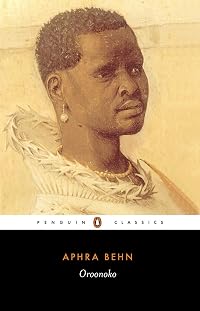
Oroonoko
by Aphra Behn
On This Page
Description
Aphra Behn was one of the first professional English female writers and Oroonoko was one of her earliest works. It is the love story between Oroonoko, the grandson of an African king, and the daughter of that king's general. The king takes the girl into his harem, and when she plans to escape with his grandson, sells her as a slave. When Oroonoko tries to follow her he is caught by an English slave trader and taken to the same West Indian island as his love..
Tags
Recommendations









Member Recommendations
Member Reviews
Aphra Behn's enchanting story of movements, encounters and the uneasy existence of parallel worlds may not be "the first novel in English", but it is haunting and magisterial. The mythic world, the dreamy nobility and nightmarish cruelty of Oroonoko's own, almost entirely fictitious, Africa; the grim politics of put-money-in-thy-purse Europe, ruining everything it touches, and the ignoble Europeans, creatures of vicious cunning; the clear-lit paradise of Suriname, full of doomed children, the natives, and novel little creatures of all sorts that make as good eating for real as the people and their land will in metaphor (meatphor).
Things get out of control when those worlds start bleeding into each other--Oroonoko and Imoinda too noble show more for plantation slavery, the Indians too naive to resist it, the Europeans too venal to do honour to their religious ideals, the remnants of their ancient, noble, savage selves. And the stigmata thereof appear everywhere--on the self-mutilation of the native generals, on the piece of flesh that Oroonoko cuts from his throat and flings at the slavers, but also on the beautiful scarification that his people inflict on one another, that stark and redblooded art. In the deadly vengeance the Europeans take, certainly, but also in the ambiguous fecundity of Imoinda's body, the pregnancy that turns slavery into war and self-destruction, the nobility of cutting off your nose to spite your face. The promise of the future and birth and growth that all these men fight over, the fear of losing possession of it and in it losing oneself. The eternal last word of negative capability, of self-hurt, and the sad nobility therein. We destroy ourselves to show the world who we are.
Certainly not an anti-slavery story as such, then, but an anti-degradation story, anti-besmirching of that delicate inner rightness we call human dignity. Economic systems and political systems have a logic, and it will win out over truth and beauty. But Prince Oroonoko doesn't need to die to prove it any more than Charles I did. It's a story that exalts the aristocrat, but it exalts him as a more fully developed human. And as such, of course, it's unavoidably an anti-slavery story too, whatever Behn would have said. show less
Things get out of control when those worlds start bleeding into each other--Oroonoko and Imoinda too noble show more for plantation slavery, the Indians too naive to resist it, the Europeans too venal to do honour to their religious ideals, the remnants of their ancient, noble, savage selves. And the stigmata thereof appear everywhere--on the self-mutilation of the native generals, on the piece of flesh that Oroonoko cuts from his throat and flings at the slavers, but also on the beautiful scarification that his people inflict on one another, that stark and redblooded art. In the deadly vengeance the Europeans take, certainly, but also in the ambiguous fecundity of Imoinda's body, the pregnancy that turns slavery into war and self-destruction, the nobility of cutting off your nose to spite your face. The promise of the future and birth and growth that all these men fight over, the fear of losing possession of it and in it losing oneself. The eternal last word of negative capability, of self-hurt, and the sad nobility therein. We destroy ourselves to show the world who we are.
Certainly not an anti-slavery story as such, then, but an anti-degradation story, anti-besmirching of that delicate inner rightness we call human dignity. Economic systems and political systems have a logic, and it will win out over truth and beauty. But Prince Oroonoko doesn't need to die to prove it any more than Charles I did. It's a story that exalts the aristocrat, but it exalts him as a more fully developed human. And as such, of course, it's unavoidably an anti-slavery story too, whatever Behn would have said. show less
This book, published in 1688, is brutal, by a woman “often cited as the first known professional female writer.” Prince Oroonoko‘s betrothed is sold into slavery. Then he is tricked by an evil English slave trader and sold into slavery. Shipped to Suriname, he finds his lover owned by the same master. Initially treated well because of his royalty, he is betrayed again. So he kills his love, and himself in the most gruesome of ways. All of this in the summary, so no spoilers. But that‘s the entire story. Beautiful imagery of the country, Behn is a lovely writer. I‘m trying to decide if she was opposed to slavery. Some times she seems to excuse it, but given the brutality of the story I tend to think she very much opposed it. A show more hard but short read. Prepare yourself accordingly if you decide to read it. show less
The immediate reaction to a book that's over 300 years old is typically to dismiss it as being antiquated, hard to read, and almost certainly uninteresting. Fortunately, Aphra Behn's masterpiece Oroonoko is none of those things. Rather, it is a short yet surprisingly enthralling read, with universal themes and a commentary on slavery that was ahead of its time and still prescient to this day.
The short novel (which has no chapters and, at least in my edition, was a mere 78 pages) tells the life of the great Prince Oroonoko, a black man born into great honor and esteem in his African homeland. When his love for the beautiful Imoinda forces the jealous King to exile him, he is deceived by slave-owners and sold into servitude, where his show more demeanor and honor gain him the respect of his fellow slaves and even of the white men. But despite this, his story is at heart a tragic one, and ends in a manner unbecoming and disgraceful to a man so eloquently described.
Behn's sympathies for the slave-prince are what truly drive the narrative. From the start, she eschews many of the stereotypical depictions of African slaves, choosing instead to emphasize his character. In fact, the pureness and boldness of Oroonoko's color is understood by Behn to be a positive trait, one that is not an anomaly in the text. Perhaps driven by the substandard treatment of women in the time, Behn is compassionate towards her black characters, depicting them all as proud in stark contrast to many of the white characters, most of whom are filled with vice. This is a radical technique for the time, and one that has assuredly contributed to the book's long-lasting appeal.
So too is the adventurous and swiftly-moving nature of the plot. While the trajectory of the story is that of a typical tragedy, Behn intersperses her fairly straightforward narrative with moments of extreme excitement and fancy. Particularly in the scenes of shocking violence, Oroonoko is portrayed as legendary and almost superhuman, able to withstand many blows and self-inflicted wounds throughout. The fanciful nature of these acts meshes well with the realism Behn seeks to imbue the novel with, and makes it a fascinating genre study as well as a rip-roaring tale.
Even if you find the older-style language too much to appreciate fully, the brevity and power of this story make it hard to want to ignore. Ahead of its time in so many ways, it's easy to see why Oroonoko is as relevant in the twenty-first century as it was in the seventeenth. show less
The short novel (which has no chapters and, at least in my edition, was a mere 78 pages) tells the life of the great Prince Oroonoko, a black man born into great honor and esteem in his African homeland. When his love for the beautiful Imoinda forces the jealous King to exile him, he is deceived by slave-owners and sold into servitude, where his show more demeanor and honor gain him the respect of his fellow slaves and even of the white men. But despite this, his story is at heart a tragic one, and ends in a manner unbecoming and disgraceful to a man so eloquently described.
Behn's sympathies for the slave-prince are what truly drive the narrative. From the start, she eschews many of the stereotypical depictions of African slaves, choosing instead to emphasize his character. In fact, the pureness and boldness of Oroonoko's color is understood by Behn to be a positive trait, one that is not an anomaly in the text. Perhaps driven by the substandard treatment of women in the time, Behn is compassionate towards her black characters, depicting them all as proud in stark contrast to many of the white characters, most of whom are filled with vice. This is a radical technique for the time, and one that has assuredly contributed to the book's long-lasting appeal.
So too is the adventurous and swiftly-moving nature of the plot. While the trajectory of the story is that of a typical tragedy, Behn intersperses her fairly straightforward narrative with moments of extreme excitement and fancy. Particularly in the scenes of shocking violence, Oroonoko is portrayed as legendary and almost superhuman, able to withstand many blows and self-inflicted wounds throughout. The fanciful nature of these acts meshes well with the realism Behn seeks to imbue the novel with, and makes it a fascinating genre study as well as a rip-roaring tale.
Even if you find the older-style language too much to appreciate fully, the brevity and power of this story make it hard to want to ignore. Ahead of its time in so many ways, it's easy to see why Oroonoko is as relevant in the twenty-first century as it was in the seventeenth. show less
"Shall we render Obedience to such a degenerate Race...Will you, I say, suffer the Lash from such Hands?",, February 11, 2015
This review is from: Oroonoko (Penguin Classics) (Paperback)
As one of the earliest novels in English, it's interesting to see what fiction was like in the 1680s.
This is the tale of Prince Orinooko, only surviving grandson of the rather despotic 100-year old king of 'Coramantien' in Africa. He falls in love with local beauty, Imoinda, but she has caught the eye of his grandfather too, who makes her part of his harem. The first part of the novel, the description of the royal court and related adventures was quite interesting (a rather 'English' imagining of the place, I think, with its French tutor and European show more courtly ideals: "refined Notions of true Honour, that absolute Generosity, and that Softness, that was capable of the highest Passions of Love and Gallantry.")
Then the two lovers are separately sold into slavery and here one must suspend disbelief, as our hero's new owner in Surinam, aware of his slave's qualities, "began to conceive so vast an Esteem for him, that he ever after lov'd him as his dearest Brother" and "he was received more like a Governor than a Slave." However, that doesn't mean life is going to be easy, as Orinooko comes to the belief that "there was no Faith in the White men or the Gods they ador'd...a Man ought to be eternally on his Guard and never to eat or drink with Christians, without his Weapon."
How Orinooko's observations cause him to act forms the concluding part of the tale.
Despite being 330 years old, this is perfectly readable, though I have to say it didn't exactly 'grab' me as a read .
However from an historical point of view, it's of interest both to see the development of the novel, and to observe how the Black race was portrayed as against Victorian opponents to slavery like Harriet Beecher Stowe. While the latter gains her readers' sympathies by focussing on Uncle Tom's Christianity and long-suffering, and creates a rather child-like character, Aphra Behn shows a man who repudiates all Christianity stands for and who is 'all man' in his fearlessness - "a Prince, whose Valour and Magnanimity deserved the Empire of the World" and "Who struck an Awe and Reverence." show less
This review is from: Oroonoko (Penguin Classics) (Paperback)
As one of the earliest novels in English, it's interesting to see what fiction was like in the 1680s.
This is the tale of Prince Orinooko, only surviving grandson of the rather despotic 100-year old king of 'Coramantien' in Africa. He falls in love with local beauty, Imoinda, but she has caught the eye of his grandfather too, who makes her part of his harem. The first part of the novel, the description of the royal court and related adventures was quite interesting (a rather 'English' imagining of the place, I think, with its French tutor and European show more courtly ideals: "refined Notions of true Honour, that absolute Generosity, and that Softness, that was capable of the highest Passions of Love and Gallantry.")
Then the two lovers are separately sold into slavery and here one must suspend disbelief, as our hero's new owner in Surinam, aware of his slave's qualities, "began to conceive so vast an Esteem for him, that he ever after lov'd him as his dearest Brother" and "he was received more like a Governor than a Slave." However, that doesn't mean life is going to be easy, as Orinooko comes to the belief that "there was no Faith in the White men or the Gods they ador'd...a Man ought to be eternally on his Guard and never to eat or drink with Christians, without his Weapon."
How Orinooko's observations cause him to act forms the concluding part of the tale.
Despite being 330 years old, this is perfectly readable, though I have to say it didn't exactly 'grab' me as a read .
However from an historical point of view, it's of interest both to see the development of the novel, and to observe how the Black race was portrayed as against Victorian opponents to slavery like Harriet Beecher Stowe. While the latter gains her readers' sympathies by focussing on Uncle Tom's Christianity and long-suffering, and creates a rather child-like character, Aphra Behn shows a man who repudiates all Christianity stands for and who is 'all man' in his fearlessness - "a Prince, whose Valour and Magnanimity deserved the Empire of the World" and "Who struck an Awe and Reverence." show less
So its kind of like 'Amistad' mixed with 'Braveheart' :) . Short tale of an african prince who finds himself on a slave plantation. Reminded me of a shakespearean tragedy at times too. Has the feel of non-fiction in parts, those odd inconsistencies which tend to denote real events.
Its narrative structure is unusual in that about half is from the title characters point of view and the rest from the authors.
While i thought it was fine until about half-way i was still expecting to give it 2 stars but it finishes strongly.
Its narrative structure is unusual in that about half is from the title characters point of view and the rest from the authors.
While i thought it was fine until about half-way i was still expecting to give it 2 stars but it finishes strongly.
Urgh! I seriously struggled with this - for a start all the nouns have capital letters, which yes, I know, was the style at the time, but I just found it distracting. Secondly I honestly had read about a quarter of it thinking it was just an introduction before I realised that actually I was reading the story. Of course, had it been a real book and not the kindle version I wouldn't have fallen into that trap. I kept looking forward to see when it would actually start. I found this dull and overly descriptive- did Behn REALLY need to tell us who everyone was related to? All it really achieved was a sense of confusion - and totally distracted from the story, which actually could have been quite good, although unbelievable. I nearly gave show more up on many occasions and it's taken me nearly two months to read. Unless you are a glutton for punishment I wouldn't go near it!! show less
The story of Oroonoko, a prince, and his wife, Imoinda. Imoinda is a beauty and Oroonoko's grandfather, the king, wishes to have her for his own. Both Imoinda and Oroonoko are subsequently enslaved. Inspired by a trip to Surinam, Aphra Behn's view of slaves is very much of her time--a sort of mingling of the noble savage, fierce warrior myth and the born to serve myth.
I think this is worthwhile as a measure of how early the use of slave labor was recognized as being immoral in truth. Written in the 1600's there can be no doubt that Behn was bothered by the institution as it existed. There is a morbid fascination you feel while reading it. I wanted to put it aside, and yet I wanted to finish to the bitter end.
I think this is worthwhile as a measure of how early the use of slave labor was recognized as being immoral in truth. Written in the 1600's there can be no doubt that Behn was bothered by the institution as it existed. There is a morbid fascination you feel while reading it. I wanted to put it aside, and yet I wanted to finish to the bitter end.
Members
- Recently Added By
Lists

1001 Books You Must Read Before You Die
1,448 works; 1,137 members

The Guardian's 1000 Novels Everyone Must Read
1,005 works; 552 members

100 Books to Read in a Lifetime (That Are Older Than 200 Years)
415 works; 176 members

Women's reading list
50 works; 7 members

1,001 BYMRBYD Concensus
723 works; 27 members

A Novel Cure
742 works; 23 members

Books Read in 2022
5,226 works; 115 members

Literary Works Read in College
316 works; 15 members

My TBR
371 works; 3 members

Fières de lettres
85 works; 1 member

DigitalDreamDoor top 300
300 works; 4 members
Reading LIst
648 works; 1 member

el
1,139 works; 1 member

In Our Time books
4,934 works; 2 members
Best of British Literature
226 works; 41 members
Author Information

104+ Works 4,119 Members
Aphra Behn is often considered the first Englishwoman to support herself as a writer. She was unquestionably the leading woman playwright of the Restoration period. Behn is also notable for her poetry and fiction. While still in her twenties, she traveled with her family to Surinam, in South America, where she witnessed a slave insurrection, much show more like the rebellion that figures prominently in her novel Oroonoko (1688), a work that introduced the character of the noble savage. Behn was well connected at court and for a brief time was sent to Antwerp as a spy. Around 1670, with the help of John Dryden, she established a career in the theater, and, during the following two decades, rarely was her work absent from the London stage. Among the comedies that bear the special stamp of her libertine, feminist, and Tory political views are The Dutch Lover (1673), The Feign'd Curtezans (1679), and her best-known works, The Rover (1677) and The Rover, Part II (1681). Readers seeking an introduction to the skill and sensibility of Aphra Behn will do well to look into her lyric poetry, which is often represented in recent anthologies of women writers. (Bowker Author Biography) show less
Awards and Honors
Notable Lists
Series
Belongs to Publisher Series
Work Relationships
Is contained in
Has the adaptation
Has as a student's study guide
Common Knowledge
- Canonical title
- Oroonoko
- Original title
- Oroonoko
- Original publication date
- 1688
- People/Characters
- Oroonoko (Ceasar); Imoinda (Clemene); Onahal; Aboan; Harry Martin; Mr. Martin (show all 10); Byam; Mr. Trefry; Colonel Martin; Tuscan
- Important places
- Africa; Surinam; London, England, UK; United Kingdom
- First words
- I do not pretend, in giving you the history of this Royal Slave, to entertain my reader with adventures of a feigned hero, whose life and fortunes fancy may manage at the poet's pleasure; nor in relating the truth, design to ... (show all)adorn it with any accidents but such as arrived in earnest to him.
- Last words
- (Click to show. Warning: May contain spoilers.)Thus died this great man, worthy of a better fate, and a more sublime wit than mine to write his praise: yet, I hope, the reputation of my pen is considerable enough to make his glorious name to survive all the ages, with that of the brave, the beautiful, and the constant Imoinda.
- Original language
- English
Classifications
Statistics
- Members
- 1,312
- Popularity
- 18,516
- Reviews
- 31
- Rating
- (3.02)
- Languages
- 8 — Czech, Dutch, English, Estonian, French, German, Multiple languages, Portuguese
- Media
- Paper, Audiobook, Ebook
- ISBNs
- 72
- UPCs
- 2
- ASINs
- 21