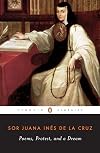
Poems, Protest, and a Dream: Selected Writings
by Sor Juana Inés de la Cruz
On This Page
Description
"This en face annotated edition of selected writings of the Mexican poet includes the Respuesta to the Bishop of Puebla (1691) and a broad selection of her poetry and dramatic texts: nine love sonnets; segments from Primero sueño, Villancico VI to Saint Catherine, and Loa para el auto sacramental de el divino Narciso; and Leonor's speech from the play Los empeños de una casa. Peden's 'Translator's Note' explains her translation strategy of 'moving backwards' towards the poet's place and show more time, which skillfully captures the full flavor of the baroque past. Stavans' extensive 'Introduction' and 'Suggestions for Further Reading' provide orientation to Sor Juana's masterpieces and their social and intellectual contexts. Highly recommended for classroom and general use"--Handbook of Latin American Studies, v. 58. show lessTags
Recommendations























Member Reviews
Sor Juana Ines de la Cruz is perhaps Latin American literature's (as well as Spanish-language literature's) best kept secret. This is the nun who does it all, and this is the collection that demonstrates it. Included is Sor Juana's "Response to the Most Illustrious Poetess Sor Filotea de la Cruz," which ably argues why women have a right to education. It's an impressive essay, part autobiography and part defense, that is all the more notable when one considers how it was written well before Virginia Woolf ever started hanging out in a room of her own.
This collection also features Sor Juana's "First I Dream" (elsewhere known as "First Dream"). If you can get through it, supposedly it's Sor Juana's masterpiece. I didn't understand a line show more of it, so you'll have to take the professional critics' word for it. More accessible are her numerous romances, decimas, sonnets, and more. Many of these are pleasingly secular works that resonate to a surprising degree even today.
One can only hope that Sor Juana's popularity will pick up amongst English speakers. Her work makes an invaluable contribution to feminist literature as well as to lesbian literature, though many critics seem to shy away from this latter point. Regardless of Sor Juana's own sexual awareness, her love poems are undoubtedly Sapphic in nature and deserve study from this perspective.
No matter what the perspective, though, one also hopes that an increased interest in Sor Juana will bring about a full translation of her obras completas. In the meantime, Margaret Sayers Peden offers what she aptly calls an "approximation" of Sor Juana's poetry. If in translating poetry one has to choose between preserving the meaning of the poem versus preserving the rhythm, Peden definitely seems to err toward the side of protecting the rhythm. (But my Spanish is patchy, so in this I could be wrong.) This edition includes the original Spanish on one side and Peden's English translation on the opposite face, so one is free to compare and infer the literal meaning in Spanish from the one side while appreciating its poetic musicality in English on the other. Now matter how you approach this amazing work though, Sor Juana will not disappoint. show less
This collection also features Sor Juana's "First I Dream" (elsewhere known as "First Dream"). If you can get through it, supposedly it's Sor Juana's masterpiece. I didn't understand a line show more of it, so you'll have to take the professional critics' word for it. More accessible are her numerous romances, decimas, sonnets, and more. Many of these are pleasingly secular works that resonate to a surprising degree even today.
One can only hope that Sor Juana's popularity will pick up amongst English speakers. Her work makes an invaluable contribution to feminist literature as well as to lesbian literature, though many critics seem to shy away from this latter point. Regardless of Sor Juana's own sexual awareness, her love poems are undoubtedly Sapphic in nature and deserve study from this perspective.
No matter what the perspective, though, one also hopes that an increased interest in Sor Juana will bring about a full translation of her obras completas. In the meantime, Margaret Sayers Peden offers what she aptly calls an "approximation" of Sor Juana's poetry. If in translating poetry one has to choose between preserving the meaning of the poem versus preserving the rhythm, Peden definitely seems to err toward the side of protecting the rhythm. (But my Spanish is patchy, so in this I could be wrong.) This edition includes the original Spanish on one side and Peden's English translation on the opposite face, so one is free to compare and infer the literal meaning in Spanish from the one side while appreciating its poetic musicality in English on the other. Now matter how you approach this amazing work though, Sor Juana will not disappoint. show less
Lesbian feminists like to fantasize about this lady because she wanted to dress like a boy to get into what was then a men-only university. Then she started her own personal library that ended up bigger than the university at that time, which is why she's now the symbolic muse of my own library. And she's on the front of the Mexican 100 peso note too. She was a plucky and spirited lady that genuinely had some insight into dreams as well but the baroque poetry in this book translated from Spanish isn't really my thing.
A wonderful, brilliant look into a woman’s struggle to pursue her intellectual endeavors. This collection of prose predates many of the most famous works that deal with women’s educations and their position in society.
Ratings
Members
- Recently Added By
Lists

To read 2025
5 works; 1 member
Author Information

162+ Works 1,565 Members
Born Juana de Asbaje in a small town, this Mexican author became a nun in 1669, probably because her illegitimate birth removed her from consideration for marriage to someone worthy of her. A misfit in a restrictive colonial society that mistrusted such intense intellectual curiosity in a woman, Asbaje was the finest lyric poet and one of the most show more interesting dramatists of the Spanish American colonial period. Despite the opposition of the ecclesiastical hierarchy, she carried out scientific experiments and became the confidante of nobility and a correspondent of intellectuals throughout Spanish America. A Woman of Genius (Respuesta a Sor Filotea) is an extraordinary document of the intellectual history of a woman who would not be defeated by her circumstances. Ultimately, she sold her books and devoted herself to caring for the sick and poor; she died of an illness contracted while nursing during an outbreak of the plague. (Bowker Author Biography) show less
Some Editions
Series
Belongs to Publisher Series
Work Relationships
Common Knowledge
- Canonical title
- Poems, Protest, and a Dream: Selected Writings
- Original publication date
- 1997
Classifications
Statistics
- Members
- 286
- Popularity
- 112,460
- Reviews
- 3
- Rating
- (3.43)
- Languages
- English
- Media
- Paper
- ISBNs
- 2
- ASINs
- 1