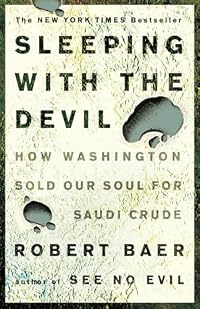
Sleeping with the Devil: How Washington Sold Our Soul for Saudi Crude
by Robert Baer
On This Page
Description
"Saudi Arabia is more and more an irrational state--a place that spawns global terrorism even as it succumbs to an ancient and deeply seated isolationism, a kingdom led by a royal family that can't get out of the way of its own greed. Is this the fulcrum we want the global economy to balance on?" In his explosive New York Times bestseller, See No Evil, former CIA operative Robert Baer exposed how Washington politics drastically compromised the CIA's efforts to fight global terrorism. Now in show more his powerful new book, Sleeping with the Devil, Baer turns his attention to Saudi Arabia, revealing how our government's cynical relationship with our Middle Eastern ally and America' s dependence on Saudi oil make us increasingly vulnerable to economic disaster and put us at risk for further acts of terrorism. For decades, the United States and Saudi Arabia have been locked in a "harmony of interests." America counted on the Saudis for cheap oil, political stability in the Middle East, and lucrative business relationships for the United States, while providing a voracious market for the kingdom' s vast oil reserves. With money and oil flowing freely between Washington and Riyadh, the United States has felt secure in its relationship with the Saudis and the ruling Al Sa'ud family. But the rot at the core of our "friendship" with the Saudis was dramatically revealed when it became apparent that fifteen of the nineteen September 11 hijackers proved to be Saudi citizens. In Sleeping with the Devil, Baer documents with chilling clarity how our addiction to cheap oil and Saudi petrodollars caused us to turn a blind eye to the Al Sa'ud's culture of bribery, its abysmal human rights record, and its financial support of fundamentalist Islamic groups that have been directly linked to international acts of terror, including those against the United States. Drawing on his experience as a field operative who was on the ground in the Middle East for much of his twenty years with the agency, as well as the large network of sources he has cultivated in the region and in the U.S. intelligence community, Baer vividly portrays our decades-old relationship with the increasingly dysfunctional and corrupt Al Sa'ud family, the fierce anti-Western sentiment that is sweeping the kingdom, and the desperate link between the two. In hopes of saving its own neck, the royal family has been shoveling money as fast as it can to mosque schools that preach hatred of America and to militant fundamentalist groups--an end game just waiting to play out. Baer not only reveals the outrageous excesses of a Saudi royal family completely out of touch with the people of its kingdom, he also takes readers on a highly personal search for the deeper roots of modern terrorism, a journey that returns time again and again to Saudi Arabia: to the Wahhabis, the powerful Islamic sect that rules the Saudi street; to the Taliban and al Qaeda, both of which Saudi Arabia helped to underwrite; and to the Muslim Brotherhood, one of the most active and effective terrorist groups in existence, which the Al Sa'ud have sheltered and funded. The money and arms that we send to Saudi Arabia are, in effect, being used to cut our own throat, Baer writes, but America might have only itself to blame. So long as we continue to encourage the highly volatile Saudi state to bank our oil under its sand--and so long as we continue to grab at the Al Sa'ud's money--we are laying the groundwork for a potential global economic catastrophe. show lessTags
Recommendations













Member Reviews
Provocative and even frightening account of our relationship with the Saudis by former CIA operative Robert Baer in a book dedicated to the memory of Daniel Pearl. The text includes blacked-out passages from the CIA Publications Review Board. Baer begins by delineating the specifics of the oil industry in which Arab sheikhdoms own sixty percent of the world's reserves. He describes the prolifigate and corrupt lifestyle of the house of Al Sa'ud and the allure of all of their oil money to Washington lobbyists and politicians. He made this wry observation when he moved back to D.C. from the Middle East in 1994 and observed the official treatment of Prince Bandar, the Saudi ambassador to the U.S.:
"Bandar's convoy, his sprawling house, the show more special access, the no-limits lifestyle: They were all a constant reminder of the way Washington really ran. Forget the crap about democracy, about the capital of the free world. Washington was a company town, and Bandar had a seat on the board." He not only reminds us of how many of the Bush II Administration are associated with the oil industry, but also goes into some detail about the Carlyle Group, the private global investment firm that provides lots of wealth to Republicans as they leave the Administration, and very close ties to, and lucrative deals with, Saudi businesses as well.
Baer recounts the Saudi role in funding terrorism over the years, charging "For American arms makers [who have made fortunes off of deals to the Saudis], Saudi Arabia is an industry subsector all its own, with its own peculiar rules. We buy oil from Saudi Arabia, refine it, and put it in our automobiles, and a certain small percentage of what we pay for it ends up funding terrorist acts against America and American institutions at home and abroad."
Baer gives a history of the Muslim Brotherhood, founded in 1928 by the Egyptian Hassan al-Banna, and also some background about the the influence of the 13th century Syrian cleric Ibn Taymiyah and the most extremist of the Muslim Brothers, Sayyid Qutb. As Baer notes "Egypt executed Sayyid in 1966, but his doctrine [of jihad against "infidels"] lived on."
The Saudis need to support the Muslim Brotherhood and its hatred of America and Israel, Baer asserts, in order to redirect resentment and aggression against its own corruption and greed. If Islamic militarism is now out of control, neither the Saudis nor the Americans care to admit the extent of the role played by the Saudis.
Baer concludes: "Was it all inevitable? No.... Washington made us lie down with the devil. It made the bed, pulled back the covers, and invited the devil in. We whispered in his ear and told him we loved him. When things went a little wrong, Washington held his hand and said it was all right. And all that time we had our eye on his bulging wallet, lit by the moonlight on the dresser."
In a way, the book serves as the footnotes to Michael Moore's "Farenheit 9/11." It's a short book, and has an informal tone that of necessity lacks footnotes, but is well worth the little time it will take to read.
(JAF) show less
"Bandar's convoy, his sprawling house, the show more special access, the no-limits lifestyle: They were all a constant reminder of the way Washington really ran. Forget the crap about democracy, about the capital of the free world. Washington was a company town, and Bandar had a seat on the board." He not only reminds us of how many of the Bush II Administration are associated with the oil industry, but also goes into some detail about the Carlyle Group, the private global investment firm that provides lots of wealth to Republicans as they leave the Administration, and very close ties to, and lucrative deals with, Saudi businesses as well.
Baer recounts the Saudi role in funding terrorism over the years, charging "For American arms makers [who have made fortunes off of deals to the Saudis], Saudi Arabia is an industry subsector all its own, with its own peculiar rules. We buy oil from Saudi Arabia, refine it, and put it in our automobiles, and a certain small percentage of what we pay for it ends up funding terrorist acts against America and American institutions at home and abroad."
Baer gives a history of the Muslim Brotherhood, founded in 1928 by the Egyptian Hassan al-Banna, and also some background about the the influence of the 13th century Syrian cleric Ibn Taymiyah and the most extremist of the Muslim Brothers, Sayyid Qutb. As Baer notes "Egypt executed Sayyid in 1966, but his doctrine [of jihad against "infidels"] lived on."
The Saudis need to support the Muslim Brotherhood and its hatred of America and Israel, Baer asserts, in order to redirect resentment and aggression against its own corruption and greed. If Islamic militarism is now out of control, neither the Saudis nor the Americans care to admit the extent of the role played by the Saudis.
Baer concludes: "Was it all inevitable? No.... Washington made us lie down with the devil. It made the bed, pulled back the covers, and invited the devil in. We whispered in his ear and told him we loved him. When things went a little wrong, Washington held his hand and said it was all right. And all that time we had our eye on his bulging wallet, lit by the moonlight on the dresser."
In a way, the book serves as the footnotes to Michael Moore's "Farenheit 9/11." It's a short book, and has an informal tone that of necessity lacks footnotes, but is well worth the little time it will take to read.
(JAF) show less
Very interesting book on a subject that seems to be a taboo in certain political and economic circles. It is a sad thing that some people present their money hoarding as national interest. Even sadder is the fact that their action in turn motivates majority of people to actually give their lives believing they are doing it for the patriotic reasons.
Dont get me wrong, this is nothing new and it was happenning from dawn of mankind. But saying that it is nothing new is like saying "theft - what about it, its been around for ages". Whenever possible this way of profiteering needs to be made public.
Very disturbing book about a country that is trying to find its way - I might even say its public identity. Is it capable of doing it? Maybe. show more But it is more than clear that its inability to find path it will thread on brings the balance of everything else in question.
Recommended - it might even help reader to put in context all events that took place in last few years in that troubled region of the world. show less
Dont get me wrong, this is nothing new and it was happenning from dawn of mankind. But saying that it is nothing new is like saying "theft - what about it, its been around for ages". Whenever possible this way of profiteering needs to be made public.
Very disturbing book about a country that is trying to find its way - I might even say its public identity. Is it capable of doing it? Maybe. show more But it is more than clear that its inability to find path it will thread on brings the balance of everything else in question.
Recommended - it might even help reader to put in context all events that took place in last few years in that troubled region of the world. show less
As you can guess from the title, neither the US government or the Saudis come out looking good in this. Baer is a former CIA case officer, one of his later books was turned into the movie Syriana, it was very loosely adapted. I heard Baer speak once and he said he didn't even understand the movie. Baer maintains that the Saudis are much more involved in terrorism then they have been letting on and no one in Washington will call them on it because no one wants to upset the flow of cheap oil (the book was written in 2003 when there was cheap oil) or the chance of a Saudi funded job when they leave office. If you believe him, we're screwed. His ideas blend well with Michael Scheuer's in his book Osama Bin Laden, in that Scheuer credits the show more Saudis with "creating" bin Laden, while Baer explains why they did it. A little dated but a interesting book, not as good as his others though. show less
The book "Sleeping with the Devil" discusses the flawed and corrupt nature of the US political system, intelligence and counterintelligence apparatus, defense industry, energy economy, and policy towards the Middle East. The author, a former intelligence officer, asserts that wealthy Arab officials have made large defense contracts with the US and have manipulated oil prices to stay in power, while also funding terrorists and taking bribes to maintain a lavish lifestyle. The US has inserted its military into the region to maintain this status quo and has used agencies like the FBI to cover up corruption and impropriety in both the US and Arabia. The book suggests self-reform by politicians and corporate elites and the invasion of a show more 400-mile stretch of oil-rich territory including Qatar, Kuwait, and Saudi Arabia as potential solutions. However, the invasion is now impossible as it would incite further anger and opposition from Muslims, and the politicians do not have the incentive to reform. The author predicts that the House of Saud will eventually fall, leading to a rise in oil prices and a decline in the US economy. show less
Know all those things that terrify you about the Middle East? In Sleeping with the Devil, former CIA case officer Robert Baer explains why you don't know the half of it.
A decade later, Sleeping with the Devil is as timely as ever, making it one of the best books I've read not just on the Middle East, but on foreign policy. Definitely a must-read.
A decade later, Sleeping with the Devil is as timely as ever, making it one of the best books I've read not just on the Middle East, but on foreign policy. Definitely a must-read.
Good round up of the pungent and incestuous relationship between the US Govt and the House of Saud. I wish Baer would have done infinitely more work citing sources and facts, as you can't help but read it and wonder what is factual based and what is simply word of mouth statements from his sources. He makes the case at one point that the House of Saud has over one trillion (with a T) invested in the US Stock Market and the same amount stored in US banks per a deal with the govt. An amazing statement thats just left on its own at the end of a chapter. Not that I couldn't believe that the financing statement was true, but the complete lack of backing makes it a tad hard to swallow. For me - much of the history section was on the boring show more side - but I did my history thesis in college on Ibn Saud and his descendants so if you are unfamiliar this book is as good as any to bring yourself up to date. He also repeats himself quite a bit - making me wonder if the book was written over a long period of time and didn't have a thorough editor to clean that up.
You'll also notice many of the themes & scenes in the movie Syriana were ripped directly from the 1st chapter in the book titled "The Doomsday Scenario". show less
You'll also notice many of the themes & scenes in the movie Syriana were ripped directly from the 1st chapter in the book titled "The Doomsday Scenario". show less
Holy cow, this is an interesting book, even if Baer is not as much at the center of the action as he thinks he is.
Members
- Recently Added By
Lists

Saudi Arabia
5 works; 1 member
Author Information

13 Works 2,759 Members
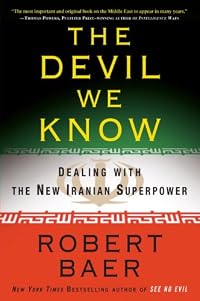
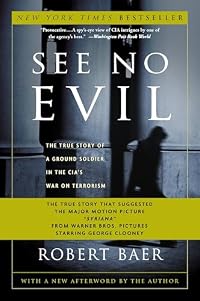
Robert Baer was born in Los Angeles, California on July 1, 1952. He graduated from the Georgetown University School of Foreign Service and in 1976, decided to join the CIA's Directorate of Operations. He worked for the CIA for 20 years as a case officer assigned to the Middle East. He has written several books including Sleeping with the Devil: show more How Washington Sold Our Soul for Saudi Crude, The Devil We Know: Dealing with the New Iranian Superpower, and The Company We Keep: A Husband-and-Wife True-Life Spy Story. His book See No Evil: The True Story of a Ground Soldier in the CIA's War on Terrorism was the basis for the acclaimed film Syriana. He writes regularly for Time.com and has contributed to Vanity Fair, the Wall Street Journal, and the Washington Post. (Bowker Author Biography) show less
Some Editions
Awards and Honors
Distinctions
Series
Belongs to Publisher Series
Common Knowledge
- Canonical title*
- Or noir et Maison-Blanche. Comment l'Amérique a vendu son âme pour le pétrole saoudien
- Original title
- Sleeping with the Devil: How Washington Sold Our Soul for Saudi Crude
- Original publication date
- 2003
- Important places*
- Arabie Saoudite
- Original language*
- Anglais (Etats-Unis) (Etats-Unis)
*Some information comes from Common Knowledge in other languages. Click "Edit" for more information.
Classifications
- Genres
- Nonfiction, General Nonfiction, History, Politics and Government, Religion & Spirituality
- DDC/MDS
- 953.8053 — History & geography History of Asia West Asian; Yemen, Kuwait, Saudi Arabia Saudi Arabia 1926-
- LCC
- HD9576 .S33 .B34 — Social sciences Industries. Land use. Labor Industries. Land use. Labor Special industries and trades Mineral industries. Metal trade
- BISAC
Statistics
- Members
- 575
- Popularity
- 50,711
- Reviews
- 13
- Rating
- (3.81)
- Languages
- English, French, German, Italian
- Media
- Paper, Audiobook, Ebook
- ISBNs
- 14
- ASINs
- 4