On This Page
Description
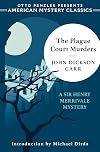
Plague Court is old and crumbling, long neglected after its lord, hangman's assistant Louis Playge, fell victim to the black death hundreds of years before. Famously haunted by Playge's ghost, the property finally has a new owner and banishing the spirit is the first order of business. And when the medium employed with this task is found stabbed to death in a locked stone hut on the grounds, surrounded by an untouched circle of mud, the other guests at Plague Court have every reason to fear show more an act of supernatural violence-for who among them would be diabolical and calculating enough to orchestrate such an impossible execution? Enter Sir Henry Merrivale, an amateur sleuth of many talents with deductive powers strong enough to unspool even the most baffling crimes. But in the creepy, atmospheric setting of Plague Court, where every indication suggests intervention from the afterlife, he encounters a seemingly-illogical murder scene unlike anything he's ever encountered for the first time in thirty years, The Plague Court Murders is the first novel in the Sir Henry Merrivale series. Originally published under the name Carter Dickson, it is a masterful example of the "impossible crime" novel for which John Dickson Carr is known. show lessTags
Recommendations


















Member Reviews
A Paranormal Locked Room
Review of the American Mystery Classics paperback (February 2, 2021) of the William Morrow & Company hardcover original (1934)
Despite an intriguing start, this started dragging for me quite early. I even resorted to mementoizing* it, although that attempt proved to be so confusing show more that I had to go back and persevere in chronological order. The first 40% just felt like an overextended prelude where the investigators (but not the main one), the suspects and the victim are introduced. Then it did start to get more interesting as the actual suspect interviews begin. Finally at the 60% point, Sir Henry Merrivale (the series lead) is introduced and the gradual solution to the case begins to coalesce.
Plague Court is the ancestral home of the Playge family, one of whom was an assistant executioner during the years of the Great Plague in 17th Century London, England. Now in 1930's London, the house is reputed to be haunted, but a spiritualist vows that he will exorcise the ghost. Various witnesses and authorities (including Ken Blake, the "Watson" of the case) appear on the scene to view the event. The spiritualist is instead found dead from several stab wounds (apparently from Playge's own awl-like knife which had been stolen from a museum shortly before) inside a locked and bolted stone building inside the courtyard of Plague Court. Though the yard is wet and muddy no footsteps to or from the building can be found.
That introduction overstayed its welcome, but the case starts to have some momentum when the eccentric Sir Henry Merrivale is brought in to consult on the matter. Merrivale was a Chief of Intelligence in the World War (1914-1918) and still maintains an office in Whitehall. He brings the case to a dramatic conclusion and the investigators adjourn for punch back at his office where he explains it all. As it is for all locked room mysteries, the solution is pretty far-fetched.
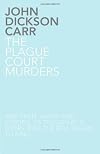
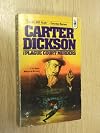
See front cover at https://images-na.ssl-images-amazon.com/images/S/compressed.photo.goodreads.com/...
The front cover of the original 1934 William Morrow & Company hardcover when the book was first issued under the penname of Carter Dickson. Image sourced from Goodreads.
On Berengaria's Ease of Solving Scale® I would rate this as a 10 out of 10, i.e. "impossible to solve." In hindsight one might say that clues were provided, but the culprit was hidden from view for so long that it all came out as a twist in the end which was impossible to foresee.
Footnote
Trivia and Links
John Dickson Carr (1906-1977) is one of the 99 authors listed in The Book of Forgotten Authors (2017) by Christopher Fowler. He is No. 20 in the alphabetical listing which you can see towards the bottom of my review here.
This edition of The Plague Court Murders is part of the Otto Penzler American Mystery Classics series (2018-ongoing). There is a related Goodreads Listopia here with 55 books listed as of early January 2024. There are currently 68 titles listed at the Mysterious Press online bookshop. The official website for the series at Penzler Publishers seems to show only the most recent and upcoming titles. show less
Review of the American Mystery Classics paperback (February 2, 2021) of the William Morrow & Company hardcover original (1934)
“Wait Blake. Wait a bit. Before I tell you about it, let me ask you whether you’re willing to give me a hand in what you’ll probably call an idiotic business. I want you to …”
“Go on.”
“To spend the night in a haunted house,” said Halliday.
“What’s idiotic about that?” I asked, trying to conceal the fact that my boredom had begun to disappear; I felt an anticipatory pleasure, and my companion seemed to notice it.
Despite an intriguing start, this started dragging for me quite early. I even resorted to mementoizing* it, although that attempt proved to be so confusing show more that I had to go back and persevere in chronological order. The first 40% just felt like an overextended prelude where the investigators (but not the main one), the suspects and the victim are introduced. Then it did start to get more interesting as the actual suspect interviews begin. Finally at the 60% point, Sir Henry Merrivale (the series lead) is introduced and the gradual solution to the case begins to coalesce.
Plague Court is the ancestral home of the Playge family, one of whom was an assistant executioner during the years of the Great Plague in 17th Century London, England. Now in 1930's London, the house is reputed to be haunted, but a spiritualist vows that he will exorcise the ghost. Various witnesses and authorities (including Ken Blake, the "Watson" of the case) appear on the scene to view the event. The spiritualist is instead found dead from several stab wounds (apparently from Playge's own awl-like knife which had been stolen from a museum shortly before) inside a locked and bolted stone building inside the courtyard of Plague Court. Though the yard is wet and muddy no footsteps to or from the building can be found.
That introduction overstayed its welcome, but the case starts to have some momentum when the eccentric Sir Henry Merrivale is brought in to consult on the matter. Merrivale was a Chief of Intelligence in the World War (1914-1918) and still maintains an office in Whitehall. He brings the case to a dramatic conclusion and the investigators adjourn for punch back at his office where he explains it all. As it is for all locked room mysteries, the solution is pretty far-fetched.
See front cover at https://images-na.ssl-images-amazon.com/images/S/compressed.photo.goodreads.com/...
The front cover of the original 1934 William Morrow & Company hardcover when the book was first issued under the penname of Carter Dickson. Image sourced from Goodreads.
On Berengaria's Ease of Solving Scale® I would rate this as a 10 out of 10, i.e. "impossible to solve." In hindsight one might say that clues were provided, but the culprit was hidden from view for so long that it all came out as a twist in the end which was impossible to foresee.
Footnote
*mementoize
məˈmenˌtōˈīz/
verb / neologism
Definitions:
• 1. to tell a story in reverse order, as in the film Memento (2000) by director Christopher Nolan.
“Christopher Nolan didn’t invent reverse chronology story telling, but his film title Memento is the easiest to make into a verb: mementoize."
• 2. to read a book in reverse order to finish it, especially when reading it in forward order is not very interesting or compelling.
“The book was so dull I had to mementoize it in order to get through it."
• 3. a fictitious word invented for book reviews by The Lone Librarian™.
Trivia and Links
John Dickson Carr (1906-1977) is one of the 99 authors listed in The Book of Forgotten Authors (2017) by Christopher Fowler. He is No. 20 in the alphabetical listing which you can see towards the bottom of my review here.
This edition of The Plague Court Murders is part of the Otto Penzler American Mystery Classics series (2018-ongoing). There is a related Goodreads Listopia here with 55 books listed as of early January 2024. There are currently 68 titles listed at the Mysterious Press online bookshop. The official website for the series at Penzler Publishers seems to show only the most recent and upcoming titles. show less
A fine example of a locked-room mystery by John Dickson Carr. This had a properly spooky atmosphere—so spooky I had to read this in daylight—and felt pretty plausible as far as locked-room mysteries go. I also really liked the letter that Blake reads toward the beginning of the book; the style is very much like The Devil in Velvet, which is my favourite JDC novel.
In terms of JDC’s protagonists, Merrivale is less annoying than M. Bencolin, but Gideon Fell is my favourite. I did not like how Merrivale was perving on the ladies and trying to pass it off as a personality trait.
This American Mystery Classics edition of the book is comfortable to read, but it had some weird typos that made me think that the text was drawn from an OCR of show more an older copy. Was also puzzled to see “reënforcing”—was the New Yorker’s copyediting team on the case?! Also, at one point the book quoted from a French newspaper and it said “une” problème when it is “un” problème.
I would certainly recommend this if you’re looking to try John Dickson Carr or locked-room mysteries, because it’s not too ridiculous, and it’s a nice spooky story. show less
In terms of JDC’s protagonists, Merrivale is less annoying than M. Bencolin, but Gideon Fell is my favourite. I did not like how Merrivale was perving on the ladies and trying to pass it off as a personality trait.
This American Mystery Classics edition of the book is comfortable to read, but it had some weird typos that made me think that the text was drawn from an OCR of show more an older copy. Was also puzzled to see “reënforcing”—was the New Yorker’s copyediting team on the case?! Also, at one point the book quoted from a French newspaper and it said “une” problème when it is “un” problème.
I would certainly recommend this if you’re looking to try John Dickson Carr or locked-room mysteries, because it’s not too ridiculous, and it’s a nice spooky story. show less
The Plague Court Murders, first published in 1934, has a high reputation as a "locked-door" mystery. Members of a nutty family want to exorcise an ancestor from London's Plague Years from a decrepit, unoccupied property. The central event is to be a confrontation between an ancestral (meaning long dead) boogieman, Louis Playge, and a controversial psychic, Roger Darworth. Not everyone in the family approves of the plan. Dean Halliday, who owns the property, doesn't believe in ghosts or spirits. His imperious aunt, Lady Benning, is implacable in her belief in the spirits. She consults regularly with Darworth, and she has set this exorcism in motion. Dean invites the narrator, Ken Blake, a former investigator, to "spend the night in a show more haunted house." Blake in turn invites current Scotland Yard Detective-Inspector Masters.
Darworth proposes to lock himself inside a small stone building in the property's courtyard overnight and have it out with the evil spirit. A kind of a seance. It's a quintessential locked room: masonry walls and floor, ancient oak roof, only the tiniest of windows, sealed behind sturdy grilles. Of course Darworth dies (no story if he doesn't). When the door is rammed open, his lacerated body lies in a pond of blood.
As the plot has it, two policemen are on hand, taking names and statements of those present through the night. Many clues, opinions, statements, and possibilities are collected, but until the entry of Sir Henry Merrivale halfway through the story no one can sort the genuine from the bogus. Sir Henry is another obese, cranky but brilliant observer and thinker that John Dickson Carr created to crack these impossible cases. The book was written in 1934, so the misogynistic attitude of the crime-solver isn't surprising.
The plot is convoluted in the extreme, and the exposition struck me as overlong. I'd rate it on the minus side of Very Good. show less
Darworth proposes to lock himself inside a small stone building in the property's courtyard overnight and have it out with the evil spirit. A kind of a seance. It's a quintessential locked room: masonry walls and floor, ancient oak roof, only the tiniest of windows, sealed behind sturdy grilles. Of course Darworth dies (no story if he doesn't). When the door is rammed open, his lacerated body lies in a pond of blood.
As the plot has it, two policemen are on hand, taking names and statements of those present through the night. Many clues, opinions, statements, and possibilities are collected, but until the entry of Sir Henry Merrivale halfway through the story no one can sort the genuine from the bogus. Sir Henry is another obese, cranky but brilliant observer and thinker that John Dickson Carr created to crack these impossible cases. The book was written in 1934, so the misogynistic attitude of the crime-solver isn't surprising.
The plot is convoluted in the extreme, and the exposition struck me as overlong. I'd rate it on the minus side of Very Good. show less
The Plague Court Murders is the first in a series featuring Sir Henry Merrivale, noted expert on crime, barrister, physician and all around smart guy when it comes to solving the unsolvable. Carter Dickson is one of the pseudonyms of Golden-Age mystery writer John Dickson Carr, and this book definitely falls within at category. The reader is presented with an impossible crime, with several suspects and a number of red herrings. In the introduction to this edition, it is noted that Carr was a fan of the great Houdini, as well as spiritualism and haunted-house stories; he combined elements of all three in putting together this story.
As it begins, a Mr. Dean Halliday is explaining to Ken Blake that his family home, called Plague Court, is show more supposedly haunted, and he invites Blake and another friend, Inspector Masters, to go with him that very night to attend a seance. Masters is interested because the seance will be handled by Roger Darworth, who is a subject under surveillance by the police, along with his medium, Joseph. But during the seance something goes terribly wrong, and Darworth, who is alone, and locked in to a small stone building on the property, ends up murdered. The police are totally baffled by this impossible crime, and turn to Sir Henry Merrivale (often called "Mycroft") for help.
Like a lot of Carr's work, this one is a bit long, and the prose a bit stilted and sometimes archaic. The language may try the patience of modern mystery readers (it was written in the 1930s), and also, we don't really meet Sir Henry until late in the game. The story just kind of drags until after Darworth's murder, when it begins only then to pick up some speed. And, while the core mystery is well plotted, I wasn't overwhelmed by the solution. I will say that it was fun watching things unravel, and I was definitely wrong in my choice of murderer.
As noted, modern mystery readers may be a bit put off by the language and the slowness of the story at times, but those readers who are fans of books written during the Golden Age of Mystery will probably enjoy it. show less
As it begins, a Mr. Dean Halliday is explaining to Ken Blake that his family home, called Plague Court, is show more supposedly haunted, and he invites Blake and another friend, Inspector Masters, to go with him that very night to attend a seance. Masters is interested because the seance will be handled by Roger Darworth, who is a subject under surveillance by the police, along with his medium, Joseph. But during the seance something goes terribly wrong, and Darworth, who is alone, and locked in to a small stone building on the property, ends up murdered. The police are totally baffled by this impossible crime, and turn to Sir Henry Merrivale (often called "Mycroft") for help.
Like a lot of Carr's work, this one is a bit long, and the prose a bit stilted and sometimes archaic. The language may try the patience of modern mystery readers (it was written in the 1930s), and also, we don't really meet Sir Henry until late in the game. The story just kind of drags until after Darworth's murder, when it begins only then to pick up some speed. And, while the core mystery is well plotted, I wasn't overwhelmed by the solution. I will say that it was fun watching things unravel, and I was definitely wrong in my choice of murderer.
As noted, modern mystery readers may be a bit put off by the language and the slowness of the story at times, but those readers who are fans of books written during the Golden Age of Mystery will probably enjoy it. show less
It was a dark and stormy night. Ha ha.
He went too far with the haunted house atmospherics in this one. This was early in his career and he got much better.
He went too far with the haunted house atmospherics in this one. This was early in his career and he got much better.
Enjoyed the first half of this much more than latter. So much explaining.
1930. Dean Halliwell invited Ken Blake and D.I. Masters to his house, Plague Court, at night to debunk supernatural activities. But not long after they arrive, and finding various people in attendance, Roger Darworth, spiritualist, who aimed to exorcise the evil at Plague Court is found dead in a sealed chamber, stabbed multiple times. Masters with D.S. Bert McDonnell investigate but find that they need the help of Sir Henry Merrivale.
An entertaining historical locked room mystery.
An ARC was provided by the publisher via Netgalley in exchange for an honest review.
Originally published in 1934
An entertaining historical locked room mystery.
An ARC was provided by the publisher via Netgalley in exchange for an honest review.
Originally published in 1934
Members
- Recently Added By
Lists

Must Read Detective Stories (Nick Fuller)
278 works; 2 members
A Locked Room Library
71 works; 1 member
Author Information

230+ Works 18,990 Members
John Dickson Carr, the master of locked room mysteries, was born in Uniontown, Pennsylvania, in 1906. He was educated at Haverford College and the Sorbonne in Paris. Carr is a prolific writer with more than 80 novels and collections of short stories to his credit. He began his writing career at the age of 26 with his first published novel, It show more Walks At Night. Some of his most popular works are The Three Coffins (1935), The Burning Coat (1937), and The Bride of Newgate (1951). Carr also collaborated with Adrian Doyle, the son of Sir Arthur Conan Doyle in The Exploits of Sherlock Holmes (1954). Carr met his wife in 1932 and settled in England in 1933. He was drafted by the United States military in World War II, and was ordered to remain in England and work with the BBC. He lived in many cities throughout the world until 1967, when he permanently moved to Greenville, South Carolina. John Dickson Carr also wrote mystery novels under the name Carter Dickson. He died in Greenville in 1977. (Bowker Author Biography) show less
Some Editions
Series

Belongs to Publisher Series
Work Relationships
Common Knowledge
- Canonical title*
- Pyövelin tikari
- Original title
- The Plague Court Murders
- Original publication date
- 1934
- People/Characters
- Sir Henry Merrivale; Kenwood Blake; Humphrey Masters (Chief Inspector); Dean Halliday; Lady Benning; Marion Latimer (show all 16); Ted Latimer; Major Featherton; Joseph Dennis; Roger Darworth; Detective-Sergeant McDonnell; Lollypop; Mrs. Sweeney; Glenda Darworth; Louis Playge; James Halliday
- Important places
- London, England, UK; Plague Court
- First words
- Old Merrivale, that astute and garrulous lump who sits with his feet on the desk at the War Office, has been growling again for somebody to write the story of the Plague Court murders; chiefly, it is believed, to glorify hims... (show all)elf.
- Last words
- (Click to show. Warning: May contain spoilers.)'She died in the right place, son. She and Louis Playge - they both belong there.'
*Some information comes from Common Knowledge in other languages. Click "Edit" for more information.
Classifications
Statistics
- Members
- 281
- Popularity
- 114,779
- Reviews
- 12
- Rating
- (3.62)
- Languages
- 6 — English, Finnish, French, Italian, Russian, Spanish
- Media
- Paper, Ebook
- ISBNs
- 11
- ASINs
- 12