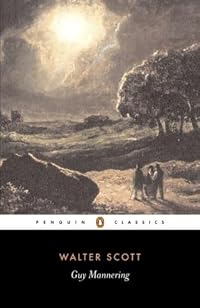
On This Page
Description
Guy Mannering believes in the ability of patriarchal power and social position to sort out social confusion, but has to learn the limits of authority in a society that is no longer a single hierarchy. Scott's second novel, it was first published in 1815.Tags
Recommendations


















Member Reviews
Prodigious! The author had an uphill battle to make me want to finish this book. It is a very physically large book (hard for me to hold) and very small print (though plenty of space between words and on the margins) and the notes are in an even finer print (had to get the magnifying glass out several times). The writing is from the early 1800s; a careful, slow build up, meandering at times. The scene is in Scotland, somewhere near the border of England, much of it in the country with the farming folk; so there is a LOT of Scottish dialog. Made me laugh, because Scott would make a note of the meaning of words that were not that obscure, but the broad dialect often went unnoted. I found that if I read it aloud very quickly, I could show more usually get the sense of it. Those are the reasons this was a difficult pull.
Here is why I read every page and longed for more. Scott was writing about ten years before Jane Austen, although this book is set in the 1750s. I found similarities. The slow build up to the characters, who they were and what they were really like. The sly and subtle humor about human nature. About when that became tedious, he romped off on an adventure which kept me on the edge of my seat, Robert Louis Stevenson style. At times the dialect and discussions of certain characters made me laugh, as when reading Anthony Trollope. And when I would feel that this was too much for my eyes (they get tired quickly when reading), and was it really worth the effort? I would start one more chapter and Scott would pull me right back in. At one point, I even skimmed the last chapter to make sure I wouldn't be disappointed; I was not, and when I finally got there the normal route, I read the chapter again and enjoyed every word.
A word about the illustrations. There were seven illustrators for this novel. A picture at every chapter heading, some decorations and at least one full page picture in each chapter. They are line drawings, or cross-hatch, I'm not up on the technical descriptions for illustrations, but I will say that I don't remember when I've read a book where the illustrations were more apt. They were a nice relief from the small print. My version was printed in 1911 by Ward, Lock and Co.
Scott gives many of the real life inspirations for this story, and in a very funny end note, gives the standard disclaimer about all characters being fictional but that nobody will believe him. Very much worth reading, because you get at least two more stories in it. That's the thing, you will want to read every word in this book, because to skip any of it means missing out on his lovely wit.
A couple of my favorite bits. At one point in the story, when it seemed that it would become a dreary tale, the next chapter jumped us 17 years into the future. We are brought up to speed by a stranger entering an inn and the inhabitants tell him their various versions (both fanciful and erroneous) of what has happened since he has been there last. It is charming, funny and a delightful way to catch up.
The reaction of Dominie Sampson (one of the comic reliefs of the novel) when he is told he will be in charge of a "Prodigious" (his favorite word) library of books to be sorted and cataloged. Priceless.
I suppose that if one had to find the over-arching theme of this novel, it might be how the same actions could be interpreted so differently, depending on whether you were "high-born" or "low-born." What in the nobility is considered as courage and high blood, for others is considered presumption.
You will note that I haven't told you much about what happens in the story. Well, I won't. You must read it yourselves, if you enjoy writing from the early nineteenth century, and find out. show less
Here is why I read every page and longed for more. Scott was writing about ten years before Jane Austen, although this book is set in the 1750s. I found similarities. The slow build up to the characters, who they were and what they were really like. The sly and subtle humor about human nature. About when that became tedious, he romped off on an adventure which kept me on the edge of my seat, Robert Louis Stevenson style. At times the dialect and discussions of certain characters made me laugh, as when reading Anthony Trollope. And when I would feel that this was too much for my eyes (they get tired quickly when reading), and was it really worth the effort? I would start one more chapter and Scott would pull me right back in. At one point, I even skimmed the last chapter to make sure I wouldn't be disappointed; I was not, and when I finally got there the normal route, I read the chapter again and enjoyed every word.
A word about the illustrations. There were seven illustrators for this novel. A picture at every chapter heading, some decorations and at least one full page picture in each chapter. They are line drawings, or cross-hatch, I'm not up on the technical descriptions for illustrations, but I will say that I don't remember when I've read a book where the illustrations were more apt. They were a nice relief from the small print. My version was printed in 1911 by Ward, Lock and Co.
Scott gives many of the real life inspirations for this story, and in a very funny end note, gives the standard disclaimer about all characters being fictional but that nobody will believe him. Very much worth reading, because you get at least two more stories in it. That's the thing, you will want to read every word in this book, because to skip any of it means missing out on his lovely wit.
A couple of my favorite bits. At one point in the story, when it seemed that it would become a dreary tale, the next chapter jumped us 17 years into the future. We are brought up to speed by a stranger entering an inn and the inhabitants tell him their various versions (both fanciful and erroneous) of what has happened since he has been there last. It is charming, funny and a delightful way to catch up.
The reaction of Dominie Sampson (one of the comic reliefs of the novel) when he is told he will be in charge of a "Prodigious" (his favorite word) library of books to be sorted and cataloged. Priceless.
I suppose that if one had to find the over-arching theme of this novel, it might be how the same actions could be interpreted so differently, depending on whether you were "high-born" or "low-born." What in the nobility is considered as courage and high blood, for others is considered presumption.
You will note that I haven't told you much about what happens in the story. Well, I won't. You must read it yourselves, if you enjoy writing from the early nineteenth century, and find out. show less
Like The Bride of Lammermoor, this is a novel worth reading in spite of a totally preposterous storyline, simply because of the quality of Scott's writing. Just let all that business of astrologers, missing heirs and mysterious gypsy women drift by you and enjoy the magnificent detailing, the Galloway scenery, the incomparable Border farmer Dandie Dinmont, and a brilliant thumbnail sketch of Enlightenment Edinburgh.
(I read this a few years ago, but forgot to catalogue it at the time)
(I read this a few years ago, but forgot to catalogue it at the time)
A bit difficult to read, like most of Walter Scott's novels, but an interesting story nonetheless, filled with memorable characters and the unique mood and flavor of old Scotland. The storyline of the long-lost heir was perhaps a bit too melodramatic (but that's half the fun of Walter Scott's novels).
It was also fascinating to read about what daily life was like before the legal and technical innovations of the 19th century, and how many groups with contrasting lifestyles and beliefs - gypsies, farmers, tinkers, smugglers, soldiers, thieves, and gentry landowners - managed to live side by side in the same countryside. Most of these characters are also surprisingly likable, apart from the few major villains.
It was also fascinating to read about what daily life was like before the legal and technical innovations of the 19th century, and how many groups with contrasting lifestyles and beliefs - gypsies, farmers, tinkers, smugglers, soldiers, thieves, and gentry landowners - managed to live side by side in the same countryside. Most of these characters are also surprisingly likable, apart from the few major villains.
This is the second novel written by Walter Scott, and arguably better than his first one Waverley.
Set mainly in the rural Galloway region of Scotland in the late 1700s, Guy Mannering tells us a story of Gipsies, smugglers, kidnap, lost identity, love interests, a dispossed Laird and his lost heir. The cast of characters is one of the best in any novel. For example the Gipsy woman Meg Merrilies carries such a strong personality and image that she has achieved immortality beyond these pages in the popular imagination. Keats also wrote a poem based on her. Likewise, the smuggler Dirk Hatteraick is archetypal in his role of desparate incorrigible rogue. Scott even manages to make memorable characters out of the eccentric and socially show more awkward chaplain, and the lawyer.
Though the plot is somewhat predictable in its overall arch, it is still a tense tale in its scenes and happenings, with enough clever interweavings and twists that it doesn't get boring. As a romantic tale of picturesque quality, it would be a great introduction to Scott's novels. show less
Set mainly in the rural Galloway region of Scotland in the late 1700s, Guy Mannering tells us a story of Gipsies, smugglers, kidnap, lost identity, love interests, a dispossed Laird and his lost heir. The cast of characters is one of the best in any novel. For example the Gipsy woman Meg Merrilies carries such a strong personality and image that she has achieved immortality beyond these pages in the popular imagination. Keats also wrote a poem based on her. Likewise, the smuggler Dirk Hatteraick is archetypal in his role of desparate incorrigible rogue. Scott even manages to make memorable characters out of the eccentric and socially show more awkward chaplain, and the lawyer.
Though the plot is somewhat predictable in its overall arch, it is still a tense tale in its scenes and happenings, with enough clever interweavings and twists that it doesn't get boring. As a romantic tale of picturesque quality, it would be a great introduction to Scott's novels. show less
The second published novel of Walter Scott. Apparently written in 6 weeks when Scott needed to raise funds urgently when in a financial crisis, the book holds together remarkably well.
The plot is of its era, and slightly unrealistic - the heir, kidnapped as a child, returns as a man, not knowing his heritage, and rights the wrongs. But there are a couple of interesting features: although the book is subtitled "The Astrologer", astrology is not given much credence; and the "Gypsy queen" is given a generous treatment in the plot.
A rollickingly good yarn, more complex and nuanced that expected from a rushed production.
The plot is of its era, and slightly unrealistic - the heir, kidnapped as a child, returns as a man, not knowing his heritage, and rights the wrongs. But there are a couple of interesting features: although the book is subtitled "The Astrologer", astrology is not given much credence; and the "Gypsy queen" is given a generous treatment in the plot.
A rollickingly good yarn, more complex and nuanced that expected from a rushed production.
The setting is the latter 18th century (post- '45). Mannering, an Oxford student, arrives in Scotland. He has been expertly tutored in astrology, a subject in which he only half believes. He is given hospitality at an old family seat, now in decline, and has the opportunity to predict events affecting the heir who is born on the day of his arrival. The book recounts those events.
The story is very engaging and I was sorry to finish it. It is not as moving as Heart of Midlothian or as historically charged as most of Scott's Scottish novels, but it has some of Scott's best characters: Paulus Pleydell, an advocate who is introduced to us in a tavern engaged in a drinking game ('Such, O Themis, were anciently the sports of thy Scottish show more children!'); Dandie Dinmont; who breeds terriers, all of whom are named either Pepper or Mustard; Dominie Sampson, an eccentric tutor (the reunion with his charge is not to be missed); and my personal favourite, Sir Robert Hazlewood, a pompous landowner who speaks in heavy, legal redundancies.
Scott's talent and resources as a writer are bottomless: that's the impression I took from this book. show less
The story is very engaging and I was sorry to finish it. It is not as moving as Heart of Midlothian or as historically charged as most of Scott's Scottish novels, but it has some of Scott's best characters: Paulus Pleydell, an advocate who is introduced to us in a tavern engaged in a drinking game ('Such, O Themis, were anciently the sports of thy Scottish show more children!'); Dandie Dinmont; who breeds terriers, all of whom are named either Pepper or Mustard; Dominie Sampson, an eccentric tutor (the reunion with his charge is not to be missed); and my personal favourite, Sir Robert Hazlewood, a pompous landowner who speaks in heavy, legal redundancies.
Scott's talent and resources as a writer are bottomless: that's the impression I took from this book. show less
Not the adventuresome type of novel one usually associates with Scott, the era of castles and pitched battles is long past and the hero is bedeviled by smugglers and gypsies rather than religious fanatics or enemy knights. I enjoyed it.
Members
- Recently Added By
Lists

F. B. Perkins' List of 100 Best Fiction
100 works; 5 members
150 Best Novels Selected by Brander Matthews (1883)
150 works; 7 members

Book Titles Mentioned In Newberry Medal And Honor Books
884 works; 3 members
Author Information

1,004+ Works 40,580 Members
Some Editions
Awards and Honors
Series


Belongs to Publisher Series
Work Relationships
Common Knowledge
- Canonical title
- Guy Mannering
- Original publication date
- 1815
- People/Characters
- Guy Mannering; Mrs Mannering; Julia Mannering; Lieutenant Archer; Godfrey Bertram; Margaret Bertram (show all 28); Vanbeest Brown (Harry Bertram); Harry Bertram (Vanbeest Brown); Lucy Bertram; Charles Hazlewood; Dominie Sampson; Meg Merrilies; Gilbert Glossin; Scrow; Dirk Hatteraick; Frank Kennedy; Mr MacMorlan; Mrs MacMorlan; Mr Mervyn; Mrs Mervyn; Dandie Dinmont; Mrs MacCandlish; Brown; Deacon Bearscliff; Tib Mumps; MacGuffog; Tod Gabriel; Paulus Plevdell
- Important places
- Scotland, UK; Cumberland, England, UK; The Netherlands (as Holland); India; Cumbria, England, UK
- Epigraph
- 'Tis said that words and signs have power
O'er sprites in planetary hour;
But scarce I praise their venturous part,
Who tamper with such dangerous art.
Lay of the Last Minstrel - First words
- It was in the beginning of the month of November, 17--, when a young English gentleman, who had just left the University of Oxford, made use of the liberty afforded him to visit some parts of the north of England; and curiosi... (show all)ty extended his tour into the adjacent frontier of the sister country.
- Last words
- (Click to show. Warning: May contain spoilers.)"Here ends THE ASTROLOGER."
Classifications
Statistics
- Members
- 643
- Popularity
- 44,875
- Reviews
- 13
- Rating
- (3.75)
- Languages
- 5 — Czech, English, French, German, Russian
- Media
- Paper, Ebook
- ISBNs
- 80
- ASINs
- 57