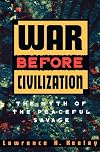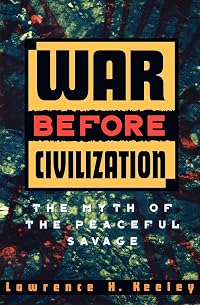
War Before Civilization: The Myth of the Peaceful Savage
by Lawrence H. Keeley
On This Page
Description
The myth of the peace-loving ""noble savage"" is persistent and pernicious. Indeed, for the last fifty years, most popular and scholarly works have agreed that prehistoric warfare was rare, harmless, unimportant, and, like smallpox, a disease of civilized societies alone. Prehistoric warfare, according to this view, was little more than a ritualized game, where casualties were limited and the effects of aggression relatively mild. Lawrence Keeley's groundbreaking War Before Civilization show more offers a devastating rebuttal to such comfortable myths and debunks the notion that warfare was introduced t show lessTags
Recommendations
















Member Reviews
I thought the book was rather good. It covered material which by and large I am not familiar. The argument, which I buy, is that primitive cultures were in fact warlike and not peaceful. That instinct was born out by the book.
I gave the book three stars for two reasons; repetition and some inaccurate facts. The latter involved an area that I know something about, Canada. The book was way too generous with Canada's treatment of the First Nations, as they are called there. The book totally omits any mention of the hanging of Louis Riel.
One of the more fascinating points didn't directly concern ancient history but related to modern history. The author discusses the discomfort Westerners have with combating guerilla war tactics, in modern show more times called terrorism, with similar tactics. Daily the headlines blare about terror attacks by modern tribal warriors, i.e. Arabs migrating to Western societies. The fact is we are more comfortable with candlelight vigils than really fighting back.
Other than that I enjoyed reading the book. show less
I gave the book three stars for two reasons; repetition and some inaccurate facts. The latter involved an area that I know something about, Canada. The book was way too generous with Canada's treatment of the First Nations, as they are called there. The book totally omits any mention of the hanging of Louis Riel.
One of the more fascinating points didn't directly concern ancient history but related to modern history. The author discusses the discomfort Westerners have with combating guerilla war tactics, in modern show more times called terrorism, with similar tactics. Daily the headlines blare about terror attacks by modern tribal warriors, i.e. Arabs migrating to Western societies. The fact is we are more comfortable with candlelight vigils than really fighting back.
Other than that I enjoyed reading the book. show less
Excellent book on a very interesting subject. Author writes in a very clean and scientific way (as it is possible when book is aiming to general public) and points out to very complex social interactions and the way conflict - either raiding or full scale warfare - comes into life. Author aims at explaining that simple views are not a way to explain anything let alone causes of war (or peace). Final words, discussion and conclusions are one of the best topic-closures in any scientific book I have read.
There are an awful lot of myths out there about primitive societies -- ranging from "they don't fight" to "they can't fight." Keeley gives a comprehensive picture of "War Before Civilization," showing that primitive peoples tend to see a lot more warfare than more advanced ones, and moreover, that they're good at what they do. When a civilization defeats a tribe (especially now, in the 19th and 20th centuries, after technology has tilted so far away from the intimidated mass and towards the brave, disciplined individual fighter), it's a matter of throwing more troops at them than they can hope to defeat, or perhaps hiring and arming other primitives to beat them. And the cutting edge of modern war is learning how to fight in tiny units show more of concealed skirmishers again (although the modern style involves assaulting much more often than primitives normally have stomach, for -- and in fairness, many primitive wars _are_ fought in a manner that the 18th century would recognize, just with less talent and discipline. The Apaches won for the longest time -- but the Igbo lost). show less
Obra de referencia sobre la violencia y la guerra en sociedades pre-estatales.
Apr 8, 2008Spanish
Ratings
Members
- Recently Added By
Author Information

2 Works 352 Members
Awards and Honors
Awards
Common Knowledge
- Original publication date
- 1997-12-18
Classifications
- Genres
- Anthropology, Nonfiction, History, General Nonfiction, Science & Nature
- DDC/MDS
- 355.009 — Society, government, & culture Public administration & military science The Military - Land, Air & Sea / Warfare Biography And History
- LCC
- GN799 .W26 .K44 — Geography, Anthropology and Recreation Anthropology Anthropology Prehistoric archaeology
- BISAC
Statistics
- Members
- 330
- Popularity
- 95,989
- Reviews
- 4
- Rating
- (3.96)
- Languages
- English, French, Portuguese
- Media
- Paper, Ebook
- ISBNs
- 9
- ASINs
- 1