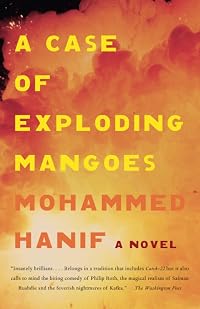
A Case of Exploding Mangoes
by Mohammed Hanif
On This Page
Description
Ali Shigri, Pakistan Air Force pilot and Silent Drill Commander of Fury Squadron, is determined to understand what or who pushed his father to commit suicide--and to avenge his death. His father, one of Zia ul-Haq's colonels, may or may not have been involved in the conspiracies and coincidences leading to the mysterious 1988 plane crash that killed Pakistan's dictator General Zia ul-Haq. His search immerses him in a snarl of events: Americans in Pakistan, Soviets in Afghanistan, dollars in show more every hand. show lessTags
Recommendations
















Member Recommendations
by anonymous user

by tandah
Member Reviews
This biting satire is a novel constructed around real events: the death of Pakistani President Zia ul-haq, together with an American diplomat and several members of his administration, in a mysterious plane crash in 1988. Through his protagonist, Under Officer Ali Shigri, Hanif satirizes militarism, Islamism, power, and those who try to subvert power, with delicious zeal. Shigri is convinced that his father, the late Colonel Shigri, was murdered on Zia's orders, and is trying to launch a plot to kill Zia in revenge—but are there other people out there with the same idea? There were points at which I felt he could have used a stricter editing eye for his prose—he's very fond of lists of things in order to create a scene, which does show more grow wearisome at times—but overall this is a smart, darkly funny book. show less
Im August 1988 explodierte kurz nach dem Start das Flugzeug des pakistanischen Militärdiktators Zia ul-Haq, wobei er sowie einige seiner Generäle und der amerikanische Botschafter ums Leben kamen. Bis heute sind die Ursachen, die zu diesem Unglück führten, nicht bekannt. In dem Buch mit diesem ungewöhnlichen Titel stellt der Autor Mohammed Hanif seine eigene Sicht der Dinge dar - und das in einer eher ungewöhnlichen Form.
Stets kapitelweise wechselnd erfolgt ein Bericht der Hauptfigur, des jungen Luftwaffenkadetten Ali Shigri und (zumeist) ein zeitgleicher Abschnitt aus dem Leben Zia al-Haqs. Während Shigri einen zu Beginn mysteriösen Plan zu verfolgen scheint, der ihn in eine ausgesprochen schwierige Situation bringt, fühlt show more sich der Diktator von allen Seiten bedroht - nicht immer zu Recht. Auch die Sichtweisen anderer Personen spielen in den Kapiteln eine Rolle, denn irgendwie haben diese alle ihren Anteil an dem zu Beginn genannten Unglück.
Was sich nun vielleicht eher wie eine kriminalistische Aufklärungsgeschichte anhören mag, ist jedoch eine herrliche Satire auf die Situation in den Herrschaftsverhältnissen dieser Militärdiktatur. Zia ul-Haq wird als ein sehr gläubiger Moslem dargestellt, überaus eitel und voller Paranoia vor möglichen Attentätern. Selbst der Generalsekretär der Straßenfegergewerkschaft sitzt deswegen im Kerker. Doch die Ängste des Diktators entbehren nicht ganz jeglicher Grundlage: Seine Führungsriegen sind ausschließlich auf ihren eigenen Vorteil bedacht und jeder katzbuckelt und intrigiert so gut und viel wie möglich. Shigris Kapitel dagegen beschreiben die Wilkür und Gewalt, der im Prinzip jeder (nicht nur Soldat) ausgesetzt sind. Doch sein Tonfall ist dabei so wunderbar trocken, dass ich beispielsweise selbst bei der Beschreibung der unschönen Unterbringung in der Folterkammer lachen musste (schon mal was von 'Do-it-yourself-Folter' gehört?).
Ein witziges Buch mit einem ernsten Hintergrund, das nicht immer ganz einfach zu lesen ist, da die häufigen Zeitsprünge gelegentlich irritierend wirken. show less
Stets kapitelweise wechselnd erfolgt ein Bericht der Hauptfigur, des jungen Luftwaffenkadetten Ali Shigri und (zumeist) ein zeitgleicher Abschnitt aus dem Leben Zia al-Haqs. Während Shigri einen zu Beginn mysteriösen Plan zu verfolgen scheint, der ihn in eine ausgesprochen schwierige Situation bringt, fühlt show more sich der Diktator von allen Seiten bedroht - nicht immer zu Recht. Auch die Sichtweisen anderer Personen spielen in den Kapiteln eine Rolle, denn irgendwie haben diese alle ihren Anteil an dem zu Beginn genannten Unglück.
Was sich nun vielleicht eher wie eine kriminalistische Aufklärungsgeschichte anhören mag, ist jedoch eine herrliche Satire auf die Situation in den Herrschaftsverhältnissen dieser Militärdiktatur. Zia ul-Haq wird als ein sehr gläubiger Moslem dargestellt, überaus eitel und voller Paranoia vor möglichen Attentätern. Selbst der Generalsekretär der Straßenfegergewerkschaft sitzt deswegen im Kerker. Doch die Ängste des Diktators entbehren nicht ganz jeglicher Grundlage: Seine Führungsriegen sind ausschließlich auf ihren eigenen Vorteil bedacht und jeder katzbuckelt und intrigiert so gut und viel wie möglich. Shigris Kapitel dagegen beschreiben die Wilkür und Gewalt, der im Prinzip jeder (nicht nur Soldat) ausgesetzt sind. Doch sein Tonfall ist dabei so wunderbar trocken, dass ich beispielsweise selbst bei der Beschreibung der unschönen Unterbringung in der Folterkammer lachen musste (schon mal was von 'Do-it-yourself-Folter' gehört?).
Ein witziges Buch mit einem ernsten Hintergrund, das nicht immer ganz einfach zu lesen ist, da die häufigen Zeitsprünge gelegentlich irritierend wirken. show less
While it might help, you don’t really need to know about Pakistan’s history to really enjoy this book. Mohammed Hanif has the ability to make you care about varied characters, even the purported villains.
Ali Shigri is the main character, but the book is written from the points of view of multiple characters, which removes it from a narrow tale about revenge, into a much broader story encompassing as many concerns as there are characters.
I found that I was eager to get to each chapter to see what new layer would be revealed about the story. Additionally, Hanif’s sardonic humor actually had me laughing out loud. I am generally not fond of political novels, but if more were as well written as this, I’d probably have to change my show more mind. show less
Ali Shigri is the main character, but the book is written from the points of view of multiple characters, which removes it from a narrow tale about revenge, into a much broader story encompassing as many concerns as there are characters.
I found that I was eager to get to each chapter to see what new layer would be revealed about the story. Additionally, Hanif’s sardonic humor actually had me laughing out loud. I am generally not fond of political novels, but if more were as well written as this, I’d probably have to change my show more mind. show less
Imagine sipping a perfect cup of tea while listening to a friend of yours who is busy telling you the juiciest gossips about a person who is always selling himself as the most respectable person that there is. And you laugh and giggle and sometimes your jaw drops, "No! Really! You are kidding me!" and you giggle and are thoroughly amused. Sometimes, you think you shouldn't listen to your friend but you just can't stop because the gossiping is so god damn funny and irresistible. So you keep on sipping tea, you keep on giggling and you keep listening. This is how I felt while reading this book.
It made me laugh out loud several times. Often, I felt that I am becoming a part of an inside joke that only the author and I know. It's a funny show more feeling!
However, the book has a very good structure, a story that keeps on moving and characters that keep surprising you. The first half is funny, the second half sometimes hit you in the guts. When I finished reading this book, I put it aside and stared at the wall. It made me feel sad for certain people that I never paid attention to before.
Highly recommended! show less
It made me laugh out loud several times. Often, I felt that I am becoming a part of an inside joke that only the author and I know. It's a funny show more feeling!
However, the book has a very good structure, a story that keeps on moving and characters that keep surprising you. The first half is funny, the second half sometimes hit you in the guts. When I finished reading this book, I put it aside and stared at the wall. It made me feel sad for certain people that I never paid attention to before.
Highly recommended! show less
This is a great book. Part political thriller and part satire (though satire that often cuts far too close to home at times). It is a fictionalized account of the death of the Pakistani dictator Zia ul Haq, killed in an air crash along with a bevy of his top generals and the US ambassador, Arnold Raphael in 1988 just as they were beginning to celebrate their victory over the Soviets in the Afghanistan War.
The title of the book is a play on words, referring to both the mystery behind what caused the crash (there are a number of different theories that lay the blame at the feet of a number of different suspects), as well as the popular suspicion that the plane was blown up by a bomb planted in a crate of mangoes that was loaded on the show more plane in Bahawalpur.
Knowing anything about the actual history is not necessary to enjoy this novel as I believe Hanif sets the scene very well, but one's appreciation only increases of the way he weaves the various theories surrounding the crash into one narrative. For example, there is a subplot about the blind girl Zainab who is imprisoned for fornication after being gangraped (Zia did introduce a law which automatically made female rape victims criminals if they could not produce eyewitnesses to testify that they were raped). After a human rights demonstrator breaches his security cordon, Zia orders Zainab to essentially be 'disappeared' into the Pakistani version of Guantanamo Bay. There she curses her tormentor, and according to folklore, crows carry the curse of wronged women to their recipients. One of the theories about the plane crash is that it was the result of mechanical failure after a crow was sucked into one of its engines.
Mohammed Hanif deftly weaves together a variety of subplots - the main one following an airforce cadet (as he himself once was) who gets caught up in an investigation after his roommate goes AWOL. Other POVs include Zia himself, his wife, his long time ally and chief of the ISI, General Akhtar his bodyguard and the suave torturer, Major Kiyani.
All this sounds like dour, heavy going, but Hanif's writing is generally warm, accessible and lightly humorous. Much of the humour is earthy, ribald even, but rings true to the time and setting. Hanif pokes fun at a whole bevy of sacred cows, terrorism, fundamentalism, the Pakistani army, the ISI, the CIA, the Mujahideen (an awkward gentleman named OBL who runs a construction company shows up at a large 4th of July BBQ held at the American ambassador's residence at one point!) All in all, this makes for an entertaining read, but above all, what one finds most compelling is the mystery of how, ultimately, Zia met his end. show less
The title of the book is a play on words, referring to both the mystery behind what caused the crash (there are a number of different theories that lay the blame at the feet of a number of different suspects), as well as the popular suspicion that the plane was blown up by a bomb planted in a crate of mangoes that was loaded on the show more plane in Bahawalpur.
Knowing anything about the actual history is not necessary to enjoy this novel as I believe Hanif sets the scene very well, but one's appreciation only increases of the way he weaves the various theories surrounding the crash into one narrative. For example, there is a subplot about the blind girl Zainab who is imprisoned for fornication after being gangraped (Zia did introduce a law which automatically made female rape victims criminals if they could not produce eyewitnesses to testify that they were raped). After a human rights demonstrator breaches his security cordon, Zia orders Zainab to essentially be 'disappeared' into the Pakistani version of Guantanamo Bay. There she curses her tormentor, and according to folklore, crows carry the curse of wronged women to their recipients. One of the theories about the plane crash is that it was the result of mechanical failure after a crow was sucked into one of its engines.
Mohammed Hanif deftly weaves together a variety of subplots - the main one following an airforce cadet (as he himself once was) who gets caught up in an investigation after his roommate goes AWOL. Other POVs include Zia himself, his wife, his long time ally and chief of the ISI, General Akhtar his bodyguard and the suave torturer, Major Kiyani.
All this sounds like dour, heavy going, but Hanif's writing is generally warm, accessible and lightly humorous. Much of the humour is earthy, ribald even, but rings true to the time and setting. Hanif pokes fun at a whole bevy of sacred cows, terrorism, fundamentalism, the Pakistani army, the ISI, the CIA, the Mujahideen (an awkward gentleman named OBL who runs a construction company shows up at a large 4th of July BBQ held at the American ambassador's residence at one point!) All in all, this makes for an entertaining read, but above all, what one finds most compelling is the mystery of how, ultimately, Zia met his end. show less
First, a personal confession: The cover of this book seduced me during a recent furtive prowl through the bookstore, and for once I'm NOT sorry I bought this impulsive read. Guiltily, I let it jump the queue of to-be-read titles and dived right in… I didn't have any knowledge of the history behind the novel, but without thinking twice entered the world of Pakistan's political intrigue.
It was like sneaking off from school to watch a great movie.
While it is a fact that Pakistan's military dictator, General Zia ul-Haq died in an apparent accidental crash moments after takeoff of a Hercules C130 cargo plane in 1988, the cause of the crash has never been 100% explained. Despite the C130's reputation as a robust machine, there is strong show more indication of possible mechanical failure. There is also a long list of people who wanted Zia out of the picture, including several who died on the same plane. There is no shortage of speculation as to how any single murderous act, or murderers in various combinations may have been able to make a plane crash look accidental.
Add to this a rich supply of religious contention, local superstition, and scriptural overtones, and author Mohammed Hanif pulls all the possibilities into a provocative novel. The result is a sardonic, sarcastic, sometimes satirical mocking of the despotism of the military, the cynical involvement of the United States behind-the-scenes manipulation, and the exploitation of the general population. There is plenty of irony and black humor as well, and the novel is a portrait of political instability in a crucial part of the world.
Five stars for this marvelously entertaining whodunnit of Pakistani military politics. Not only was this a great read, but it motivates me to read more from Pakistani writers. show less
It was like sneaking off from school to watch a great movie.
While it is a fact that Pakistan's military dictator, General Zia ul-Haq died in an apparent accidental crash moments after takeoff of a Hercules C130 cargo plane in 1988, the cause of the crash has never been 100% explained. Despite the C130's reputation as a robust machine, there is strong show more indication of possible mechanical failure. There is also a long list of people who wanted Zia out of the picture, including several who died on the same plane. There is no shortage of speculation as to how any single murderous act, or murderers in various combinations may have been able to make a plane crash look accidental.
Add to this a rich supply of religious contention, local superstition, and scriptural overtones, and author Mohammed Hanif pulls all the possibilities into a provocative novel. The result is a sardonic, sarcastic, sometimes satirical mocking of the despotism of the military, the cynical involvement of the United States behind-the-scenes manipulation, and the exploitation of the general population. There is plenty of irony and black humor as well, and the novel is a portrait of political instability in a crucial part of the world.
Five stars for this marvelously entertaining whodunnit of Pakistani military politics. Not only was this a great read, but it motivates me to read more from Pakistani writers. show less
The best book I read in 2009 by some distance. Imaginative in the Marquez fashion and honest about the debt owned to Marquez - one of the characters, whose death is foretold, is appropriately reading "Chronicle of a Death Foretold" - but there's bits of "The General in his Labyrinth" and Vargas Llosa's "Feast of the Goat" in there as well and probably its these obvious references that prevented it making serious progress in any of the literary prizes.
But is also very funny in a James Thurber-esque manner - particularly in its description of the crow, and its role in Zia's fate - and politically astute, giving the Pakistani and American militaries a well merited kicking. The references to Catch 22 are apporpriate too....the concept of show more silent drill is so wonderfully absurd, that surely it must genuinely exist? If not, someone wil have to invent it. Highly recommended show less
But is also very funny in a James Thurber-esque manner - particularly in its description of the crow, and its role in Zia's fate - and politically astute, giving the Pakistani and American militaries a well merited kicking. The references to Catch 22 are apporpriate too....the concept of show more silent drill is so wonderfully absurd, that surely it must genuinely exist? If not, someone wil have to invent it. Highly recommended show less
Members
- Recently Added By
Lists

Favourite Booker Prize contenders
73 works; 21 members

Top Five Books of 2013
1,562 works; 715 members

Best of World Literature
434 works; 52 members
Booker Prize
491 works; 62 members

Literature by People of Color
81 works; 9 members

Man Booker Prize Longlist 2008
13 works; 2 members

First Novels
373 works; 17 members

Not the NYT list of top 100 21st century books
100 works; 6 members
Author Information

7+ Works 1,698 Members
Some Editions
Awards and Honors
Awards
Notable Lists
Series
Belongs to Publisher Series
Common Knowledge
- Canonical title*
- A Case of Exploding Mangoes
- Original title
- A Case of Exploding Mangoes
- Original publication date
- 2008
- People/Characters
- Ali Shigri; General Zia ul-Haq; Obaid-ul-llah; General Akhtar; Major Kiyani
- Important places
- Pakistan
- Important events*
- Aircrash and death of General Zia ul Haq
- Dedication
- For Fatima, Razia, Nimra & Channan
- First words
- You might have seen me on TV after the crash.
- Last words
- (Click to show. Warning: May contain spoilers.)Before he kisses the Quran and closes it carefully, he reads the verse on the page that is open in front of him and tries to recall a half-remembered story about an ancient prophet.
- Blurbers
- Hamid, Mohsin; Haddon, Mark; le Carré, John
- Original language
- English
*Some information comes from Common Knowledge in other languages. Click "Edit" for more information.
Classifications
Statistics
- Members
- 1,284
- Popularity
- 18,972
- Reviews
- 53
- Rating
- (3.66)
- Languages
- 9 — Dutch, English, French, German, Italian, Polish, Portuguese, Spanish, Swedish
- Media
- Paper, Audiobook, Ebook
- ISBNs
- 39
- ASINs
- 13