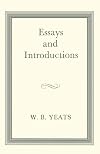
Essays & Introductions
by W. B. Yeats
On This Page
Tags
Recommendations


















Member Reviews
Like T.S. Eliot's "The Sacred Wood" (1920), W.B. Yeats's "General Introduction for All my Work" (1937) remains essential reading. (Curious both are bi-initialed names; can't do this with the two prior famous Williams, WW and Shake, neither sporting a middle name.) Want an introduction to Dante? Read T.S. To Spenser? Read W.B.
"I tried to make the language of poetry coincide with that of passionate, normal speech" and in this English poetry has followed him, he asserts (521). "It was a long time before I had made a language to my liking" but about 1917 he discovered he needed, not as Wordsworth, words in common use, but "a powerful and passionate syntax." "I would have poetry turn its back on all that modish curiosity, psychology.." show more (530).
Love his quoting Lady Gregory's rejection of a play in the modern manner sent to the Abbey Theatre,"'Tragedy must be a joy to the man who dies.' neither scholars nor the populace have sung or read anything generation after generation because of its pain." Marvelously appropriate to plays in our time (2005-2017), so often deliberately depressing. Lady Gregory and Yeats support the Shakespeare scholar Hugh Richmond who questions new plays and old tragedies that are performed to depress, and not exhilarate (Intro to Shakespeare's Tragedies Reviewed 2015).
Wonderful essays on Spenser, Shelley (especially the philosophy imbedded in his poetry--Yeats arguing that to last, philosophy must be embedded in poetry), and Berkeley--whose attempt to establish a Trinity College mission in Bermuda, a college for Native Americans, impinges on my residence, since I live about 20 miles from Berkeley's saltbox house near Newport, RI. Yeats notes Berkeley's Bermuda project had "a learned city so carefully mapped out, a steeple in the centre"; as for the Indian students, "He that cannot live must dream. Did tar-water, a cure-all learnt from American Indians, suggest though he could not quiet men's minds he might give their bodies respite…"(399). From this I learned the Native source of the tar shampoo my dermatologist recommended for me. show less
"I tried to make the language of poetry coincide with that of passionate, normal speech" and in this English poetry has followed him, he asserts (521). "It was a long time before I had made a language to my liking" but about 1917 he discovered he needed, not as Wordsworth, words in common use, but "a powerful and passionate syntax." "I would have poetry turn its back on all that modish curiosity, psychology.." show more (530).
Love his quoting Lady Gregory's rejection of a play in the modern manner sent to the Abbey Theatre,"'Tragedy must be a joy to the man who dies.' neither scholars nor the populace have sung or read anything generation after generation because of its pain." Marvelously appropriate to plays in our time (2005-2017), so often deliberately depressing. Lady Gregory and Yeats support the Shakespeare scholar Hugh Richmond who questions new plays and old tragedies that are performed to depress, and not exhilarate (Intro to Shakespeare's Tragedies Reviewed 2015).
Wonderful essays on Spenser, Shelley (especially the philosophy imbedded in his poetry--Yeats arguing that to last, philosophy must be embedded in poetry), and Berkeley--whose attempt to establish a Trinity College mission in Bermuda, a college for Native Americans, impinges on my residence, since I live about 20 miles from Berkeley's saltbox house near Newport, RI. Yeats notes Berkeley's Bermuda project had "a learned city so carefully mapped out, a steeple in the centre"; as for the Indian students, "He that cannot live must dream. Did tar-water, a cure-all learnt from American Indians, suggest though he could not quiet men's minds he might give their bodies respite…"(399). From this I learned the Native source of the tar shampoo my dermatologist recommended for me. show less
Ratings
Members
- Recently Added By
Author Information

829+ Works 25,466 Members
William Butler Yeats was born in Dublin, Ireland on June 13, 1865. He was a driving force behind the Irish Literary Revival and, along with Lady Gregory, Edward Martyn, and others, founded the Abbey Theatre, where he served as its chief playwright until the movement was joined by John Synge. Yeats' plays included The Countess Cathleen, The Land of show more Heart's Desire, Cathleen ni Houlihan, The King's Threshold, and Deirdre. Although a convinced patriot, Yeats deplored the hatred and the bigotry of the Nationalist movement, and his poetry is full of moving protests against it. He was appointed to the Irish Senate in 1922. He was awarded the Nobel Prize in Literature in 1923 for what the Nobel Committee described as "inspired poetry, which in a highly artistic form gives expression to the spirit of a whole nation." He is one of the few writers who completed their greatest works after being awarded the Nobel Prize. His poetry collections include The Wild Swans at Coole, Michael Robartes and the Dancer, The Tower, The Winding Stair and Other Poems, and Last Poems and Plays. He died on January 28, 1939 at the age of 73. (Bowker Author Biography) show less

William Butler Yeats has a Legacy Library. Legacy libraries are the personal libraries of famous readers, entered by LibraryThing members from the Legacy Libraries group.
Classifications
- Genres
- Nonfiction, Literature Studies and Criticism, Fiction and Literature
- DDC/MDS
- 824.912 — Literature & rhetoric English & Old English literatures English essays Modern Period 20th Century 1901-1945
- LCC
- PR5900 .A5 — Language and Literature English English Literature 19th century , 1770/1800-1890/1900
- BISAC
Statistics
- Members
- 171
- Popularity
- 192,594
- Reviews
- 1
- Rating
- (4.22)
- Languages
- English, French
- Media
- Paper, Ebook
- ISBNs
- 5
- ASINs
- 6