On This Page
Description
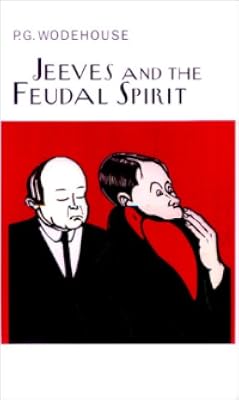
When Bertie Wooster goes to stay with his Aunt Dahlia at Brinkley Court and unexpectedly becomes engaged to the imperious Lady Florence Craye, disaster threatens from all sides.While Florence tries to cultivate Bertie's mind, her former fiancé, hefty ex-policeman "Stilton" Cheesewright, threatens to beat his body to a pulp, and her new admirer, the bleating poet Percy Gorringe, tries to borrow a thousand pounds.To cap it all, there's a jewelry heist; plus, Bertie has incurred the show more disapproval of Jeeves by growing a mustache. All in all, it's a classic Wodehouse farce. show lessTags
Recommendations

















Member Reviews
No one can touch P. G. Wodehouse for absolute hilarity. Nor can Jonathan Cecil be touched, tickled, or otherwise approached for humorous narration. When the twain meet, it's an audiobook recorded in heaven. Such is Jeeves and the Feudal Spirit, published in 1954 and featuring that iconic comic pairing, Bertram Wooster and his superb valet Jeeves. I reviewed this title a few years ago, but that was the print version and anyways I've read so much Wodehouse that they all blend together after awhile. Not that I mind, of course.
In this installment Bertie and Jeeves are at odds again, this time over Bertie's mustache. The mustache is, as Aunt Dahlia puts it, "an offense against God and man" that "takes one into a new and dreadful world," but show more Bertie believes it gives him a dashing, debonair look. Unfortunately, the formidable Florence Craye feels the same and it isn't long before Bertie finds himself once more engaged to the young authoress. Dodging her former fiancé, mucking about with pearl necklaces (genuine and otherwise), assisting the aged relative in her own peccadilloes, and readying himself for the Drones' annual dart tournament keep Bertie more than busy at Totleigh Towers. But of course, it takes Jeeves's nick-of-time intervention to save the day. And to reward that brainiest of brains, Bertie decides to shave the mustache. It is, he reflects, rather dangerous to be too fascinating. Better to be a weedy butterfly that is able to flit lightly out of various matrimonial nooses!
Wodehousian similes never fail to amuse (Aunt Dahlia's face shines "like the seat of a bus driver's trousers"). The literary references are masterful in their juxtaposition with such a character as Bertram Wooster (especially when you know the source material—haha!). I listened to this during my commute home for a week and it never failed to get me laughing, even after a rough day. Is it possible to consume Wodehousian products delivered by J. Cecil and not feel the effects? It's delightful absurdity as only these two masters can produce it—simply ripping.
If, of course, that's the word I want... show less
In this installment Bertie and Jeeves are at odds again, this time over Bertie's mustache. The mustache is, as Aunt Dahlia puts it, "an offense against God and man" that "takes one into a new and dreadful world," but show more Bertie believes it gives him a dashing, debonair look. Unfortunately, the formidable Florence Craye feels the same and it isn't long before Bertie finds himself once more engaged to the young authoress. Dodging her former fiancé, mucking about with pearl necklaces (genuine and otherwise), assisting the aged relative in her own peccadilloes, and readying himself for the Drones' annual dart tournament keep Bertie more than busy at Totleigh Towers. But of course, it takes Jeeves's nick-of-time intervention to save the day. And to reward that brainiest of brains, Bertie decides to shave the mustache. It is, he reflects, rather dangerous to be too fascinating. Better to be a weedy butterfly that is able to flit lightly out of various matrimonial nooses!
Wodehousian similes never fail to amuse (Aunt Dahlia's face shines "like the seat of a bus driver's trousers"). The literary references are masterful in their juxtaposition with such a character as Bertram Wooster (especially when you know the source material—haha!). I listened to this during my commute home for a week and it never failed to get me laughing, even after a rough day. Is it possible to consume Wodehousian products delivered by J. Cecil and not feel the effects? It's delightful absurdity as only these two masters can produce it—simply ripping.
If, of course, that's the word I want... show less
Anyone the slightest bit familiar with Wodehouse knows that his brand of humor is simply inimitable. What I am learning as I read more of his works is that it is relentless. From the very first page of this book, Wodehouse had me in stitches. And the first page was just the beginning of the dedication! (You really must read this dedication. It articulates the funny side of dedications in a way you've probably never imagined before — and it was even funnier to me because I've recently finished Shakespeare's sonnets, which were prefaced with the kind of dedication that a fellow would use who was expecting to really "clean up." LOL!)
In this story, Bertie Wooster is again in danger of leading his cousin Lady Florence to the altar... again show more he is mistaken for a thief, all in the service of an aunt... and again he dares to trifle with Jeeves' good taste when he tries to grow a mustache. That mustache had me rolling. Everyone who saw it (with one important exception) said that it was an offense against God and man, that they had never seen anything so obscene outside of a nightmare, it was horribly frightful, etc. Through it all Bertie preserves his unshaken belief that it really was rather becoming to him, don't you know. Imperturbably hilarious!
Much of Wodehouse's humor lies in Bertie's narration. Cheesewright calls him a nasty name, and Bertie says something like, "Now I'm a rather astute chap, and words of this kind really seemed to me to be the opposite of undying friendship. To ascertain the truth of this assumption, I ventured what might be called a very skillful riposte, in the words: 'Oh, you think that of me, do you?' " I think this kind of humor works because we recognize that happy self-delusion in ourselves at times.
I was laughing aloud throughout this book, and I think it's true what one critic says, that it's impossible to be unhappy when reading Wodehouse. His delightfully clueless characters and brilliant British humor just don't get old. In the end, after several madcap reversals and very near escapes, all is settled satisfactorily and Bertie even shaves his moustache, after sober consideration of the havoc it has wreaked. I am sure Jeeves was unutterably relieved — and so are we the readers, who have been trying this whole time to imagine a moustache that would provoke such strong language as Bertie's did. Highly recommended! show less
In this story, Bertie Wooster is again in danger of leading his cousin Lady Florence to the altar... again show more he is mistaken for a thief, all in the service of an aunt... and again he dares to trifle with Jeeves' good taste when he tries to grow a mustache. That mustache had me rolling. Everyone who saw it (with one important exception) said that it was an offense against God and man, that they had never seen anything so obscene outside of a nightmare, it was horribly frightful, etc. Through it all Bertie preserves his unshaken belief that it really was rather becoming to him, don't you know. Imperturbably hilarious!
Much of Wodehouse's humor lies in Bertie's narration. Cheesewright calls him a nasty name, and Bertie says something like, "Now I'm a rather astute chap, and words of this kind really seemed to me to be the opposite of undying friendship. To ascertain the truth of this assumption, I ventured what might be called a very skillful riposte, in the words: 'Oh, you think that of me, do you?' " I think this kind of humor works because we recognize that happy self-delusion in ourselves at times.
I was laughing aloud throughout this book, and I think it's true what one critic says, that it's impossible to be unhappy when reading Wodehouse. His delightfully clueless characters and brilliant British humor just don't get old. In the end, after several madcap reversals and very near escapes, all is settled satisfactorily and Bertie even shaves his moustache, after sober consideration of the havoc it has wreaked. I am sure Jeeves was unutterably relieved — and so are we the readers, who have been trying this whole time to imagine a moustache that would provoke such strong language as Bertie's did. Highly recommended! show less
Jeeves and the Feudal Spirit is P.G. Wodehouse at the top of his writing game! It’s one ridiculous scenario after another, and I couldn’t stop laughing the whole way through. An all time favorite book!
What great fun.
Wodehouse is an absolute master of the English language. He is also very clever at plot, weaving many threads together in artful ways. And very good at character. And at dialogue.
I'll just let the book speak for itself with a few phrases that tickled me:
Here Stilton … snorted in his uncouth way. There are two things I particularly dislike about G. D'Arcy Cheesewright -- one, his habit of saying "Ho!" the other his tendency, when moved, to make a sound like a buffalo pulling its foot out of a swamp.
"…I would like the strength of this whisky-and-soda to be as that of ten."
Aunt Dahlia, upon seeing Bertie's moustache for the first time:
"Was this the face that stopped a thousand clocks?"
…one ought never to underestimate show more a man simply because he devotes his life to shoving oars into rivers and pulling them out again, this being about as silly a way of passing time as could be hit upon. show less
Wodehouse is an absolute master of the English language. He is also very clever at plot, weaving many threads together in artful ways. And very good at character. And at dialogue.
I'll just let the book speak for itself with a few phrases that tickled me:
Here Stilton … snorted in his uncouth way. There are two things I particularly dislike about G. D'Arcy Cheesewright -- one, his habit of saying "Ho!" the other his tendency, when moved, to make a sound like a buffalo pulling its foot out of a swamp.
"…I would like the strength of this whisky-and-soda to be as that of ten."
Aunt Dahlia, upon seeing Bertie's moustache for the first time:
"Was this the face that stopped a thousand clocks?"
…one ought never to underestimate show more a man simply because he devotes his life to shoving oars into rivers and pulling them out again, this being about as silly a way of passing time as could be hit upon. show less
This time it's Bertie's new moustache that Jeeves disapproves of and Florence Craye whom Bertie is in danger of marrying if she and "Stilton" Cheesewright decide to call it quits because she believes that Bertie is hopelessly in love with her and he is too gallant to tell her how wrong she is. (Alpine hats and dinner jackets that waiters might wear and Madeline Bassett and Gussy Fink-Nottle are in other books.) The action takes place at Aunt Dahlia's place, Brinkley Court (and not, say, Totleigh Towers). There is a pearl necklace or two that are a source of trouble. And the usual wonderful writing. And a typical description of Bertie:
"... But then everybody says that though you have a brain like a peahen, you're the soul of kindness and show more generosity." [p. 55] show less
"... But then everybody says that though you have a brain like a peahen, you're the soul of kindness and show more generosity." [p. 55] show less
The valet Jeeves is horrified to find that Bertie Wooster has grown a moustache. But he rises above any hints of revenge, and solves a series of problems.
Much of the action takes place at Brinkley Hall, the stately home belonging to Bertie’s favourite Aunt Dahlia and her somewhat pernickety husband Tom. As, as ever with Wodehouse, there are many characters involved in a complex dance of relationship. There's the author Florence, the playwright Percy, the policeman with a bad temper, Stilton Cheesewright... and two pearl necklaces.
The humour is gentle satire, which I appreciate. Literary references abound, and Bertie’s general ignorance would be irritating if it weren’t for his generosity and kindness.
An enjoyable story which show more would make a good introduction to PG Wodehouse. show less
Much of the action takes place at Brinkley Hall, the stately home belonging to Bertie’s favourite Aunt Dahlia and her somewhat pernickety husband Tom. As, as ever with Wodehouse, there are many characters involved in a complex dance of relationship. There's the author Florence, the playwright Percy, the policeman with a bad temper, Stilton Cheesewright... and two pearl necklaces.
The humour is gentle satire, which I appreciate. Literary references abound, and Bertie’s general ignorance would be irritating if it weren’t for his generosity and kindness.
An enjoyable story which show more would make a good introduction to PG Wodehouse. show less
An especially delightful edition in the Bertie and Jeeves cannon. I especially loved the subplot of the moustache because that is a frequent subplot in my marriage (consider me Jeeves on this issue).
Members
- Recently Added By
Lists

20th Century Literature
1,161 works; 55 members

Top Five Books of 2014
1,064 works; 397 members

Books Read in 2013
1,630 works; 51 members

Books Read in 2011
684 works; 19 members
Author Information

657+ Works 110,817 Members
P. G. Wodehouse was born in Guildford, United Kingdom on October 15, 1881. After completing school, he spent two years as a banker at the Hong Kong and Shanghai Bank in London and then took a job as a sports reporter and columnist for the Globe newspaper. His first novel, The Pothunters, was published in 1902. He wrote over 100 novels and short show more story collections during his lifetime including A Perfect Uncle, Love Among the Chickens, The Swoop, P. Smith in the City, Meet Mr. Milliner, Doctor Sally, Quick Service, The Old Reliable, Uneasy Money, A Damsel in Distress, Jill the Reckless, The Adventures of Sally, A Pelican at Blandings, The Girl in Blue, and Aunts Aren't Gentlemen. His most famous characters, Bertie Wooster and his manservant, Jeeves, appeared in books such as Much Obliged, Jeeves. He also wrote lyrics for musical comedies and worked as screenwriter in Hollywood in the 1930s. In 1939, he bought a villa in Le Touquet on the coast of France. He remained there when World War II started in 1939. The following year, the Germans appropriated the villa, confiscated property, and arrested him. He was detained in various German camps for almost one year before being released in 1941. He went to Berlin and spoke of his experience in five radio talks to be broadcast to America and England. The talks themselves were completely innocuous, but he was charged with treason in England. He was cleared, but settled permanently in the United States. He became a citizen in 1955. He was made a Knight Commander of the Order of the British Empire in 1975. He died from a heart attack after a long illness on February 14, 1975 at the age of 93. (Bowker Author Biography) show less
Some Editions
Series

Belongs to Publisher Series
Work Relationships
Is contained in
Common Knowledge
- Canonical title
- Jeeves and the Feudal Spirit
- Original title
- Jeeves and the Feudal Spirit
- Alternate titles
- Bertie Wooster Sees It Through
- Original publication date
- 1954
- People/Characters
- Reginald Jeeves; Bertram Wilberforce Wooster (Bertie); Florence Craye; G. D'Arcy "Stilton" Cheesewright; Dahlia Travers; L.G. Trotter (show all 11); Mrs. Trotter; Percy Gorringe; Tom Travers; Lord Sidcup (Sir Roderick Spode); Daphne Delores Morehead
- Important places
- England, UK; Brinkely Court
- First words
- As I sat in the bath-tub, soaping a meditative foot and singing, if I remember correctly, 'Pale Hands I Loved Beside the Shalimar', it would be deceiving my public to say that I was feeling boomps-a-daisy.
- Last words
- (Click to show. Warning: May contain spoilers.)'Thank you very much, sir,' he said.
- Original language*
- englanti
- Disambiguation notice
- UK title 'Jeeves and the Feudal Spirit', US title 'Bertie Wooster Sees It Through'
*Some information comes from Common Knowledge in other languages. Click "Edit" for more information.
Classifications
Statistics
- Members
- 1,928
- Popularity
- 11,078
- Reviews
- 30
- Rating
- (4.28)
- Languages
- 9 — Dutch, English, Finnish, French, German, Hungarian, Italian, Spanish, Swedish
- Media
- Paper, Audiobook, Ebook
- ISBNs
- 56
- UPCs
- 5
- ASINs
- 22