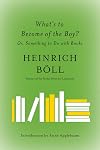
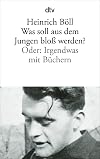
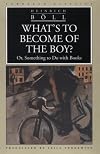
What's to Become of the Boy? Or, Something to Do with Books
by Heinrich Böll
On This Page
Description
A vivid account of growing up poor, rebellious, and anti-Fascist in Nazi Germany What's to Become of the Boy' is a spirited, insightful, and wonderfully sympathetic memoir about life during wartime written with the characteristic brilliance by one of the 20th-century's most celebrated authors. It is both an essential autobiography of the Nobel Prizewinning author and a compelling memoir of being young and idealistic during an age of hardship and war. From the Trade Paperback edition.Tags
Recommendations




















Member Reviews
Known for his more famous titles Billiards at Half-Past Nine, The Clown, and Group Portrait with Lady, among others, Heinrich Böll details his high school years set against the impending backdrop of Nazism in this short memoir. Böll came from a family that though not Jewish, was a feverishly anti-Nazi one living on the cusp of the party’s full power. Living in poverty as a consequence of rejecting the political enthusiasm sweeping Germany, Böll’s family lived dangerously on the edge, splurging on books and other luxuries while struggling to make ends meet. “We were crazy enough to buy books and to read them”, he humorously writes, reminiscing the teenage years when he quite literally ducked Hitler’s campaigns with his show more education (86).
What’s to Become of the Boy? is a most peculiar memoir — extremely short and witty, it articulates the necessity of “ordinary writing” as a form of literature amongst history books and war memoirs. Böll’s attitude against Nazism is unapologetic; a fact that remains even when his memory fail him, for he admits to writing from pure memory, having “no notes or jottings to resort to”, forty years after the fact (13). Weaving crisp humor — “was [the sinus condition] really Nazi-induced? It may well have been, for I was also allergic to the Nazis” — with self-reflection, Böll offers a modest and surprisingly unruffled memoir of a teenager living his days in a Germany that had Nazism at its heels (65). show less
What’s to Become of the Boy? is a most peculiar memoir — extremely short and witty, it articulates the necessity of “ordinary writing” as a form of literature amongst history books and war memoirs. Böll’s attitude against Nazism is unapologetic; a fact that remains even when his memory fail him, for he admits to writing from pure memory, having “no notes or jottings to resort to”, forty years after the fact (13). Weaving crisp humor — “was [the sinus condition] really Nazi-induced? It may well have been, for I was also allergic to the Nazis” — with self-reflection, Böll offers a modest and surprisingly unruffled memoir of a teenager living his days in a Germany that had Nazism at its heels (65). show less
Another book I bought for myself on Mother's Day, from a little shop in Ann Arbor specializing in well-preserved first editions. I picked this up hoping for hints on how to live in a time when all around you seem consumed by power and hate and scapegoating. What I got was a somewhat disjointed memoir of a man looking back at his teen years from many years distant. It was as much of a memoir of the ways memory deceives and disorders and lumps impossible things together as it was a memoir of coming of age during the rise of the Nazi party.
It's very stream-of-consciousness and rambly. And while that did often leave me wishing for more context or thoroughness, it did pretty effectively convey that for the most part, life just goes on. It's show more hard to see the context when you're living that context every day. How much time can you spend wondering what's to become of the country, or the world, when the question of "What's to become of you?" is so uncertain.
But this book isn't going to connect the dots for you. If you want to derive any meaning from it, you're going to have to do the work. show less
It's very stream-of-consciousness and rambly. And while that did often leave me wishing for more context or thoroughness, it did pretty effectively convey that for the most part, life just goes on. It's show more hard to see the context when you're living that context every day. How much time can you spend wondering what's to become of the country, or the world, when the question of "What's to become of you?" is so uncertain.
But this book isn't going to connect the dots for you. If you want to derive any meaning from it, you're going to have to do the work. show less
Heinrich Boll's Memoir is a short review of his life between 1933 (when he was 15) and 1937: the period when the Nazis began to establish, and then exert, the demands that touched everyone within German society and forced everyone to find a place on the continuum from opposition through acquiescence to support to rabid loyalty. Boll grew up in a Catholic family that, like many Germans, thought the Nazis would not last and were appalled to see the consolidation of power and how the Nazis began to break society on the Procrustean bed of Nazi ideology. Boll's family was poor, often moved to break a cycle of creditors, but never relinquished its beliefs. His family was, "that explosive mixture of petty-bourgeois vestiges, Bohemian traits, show more and proletarian pride, not truly belonging to any class, yet arrogant rather than humble, in other words almost "class-conscious" again. And of course, of course, in spite of everything, Catholic, Catholic, Catholic". Although Boll himself did not share the family faith in faith.
Boll's family was convinced of the inevitability of war as soon as the Nazis took power, and Boll comments on the responsibility of the ‘ordinary' person in that, "in the final analysis, the fatal role played by those highly educated, unquestionably decent German high school teachers led to Stalingrad and made Auschwitz possible: that Hindenberg blindness." Boll was determined not to "learn for dying" which he describes as "for many if not all German high school graduates had been preached as the highest goal in life." He skipped as much school as he could but also read and studied the things he liked as much as he could, to the point where his parents wondered, "what's to become of the boy?", although they knew it would somehow have to involve books.
Interesting that Boll says he preferred Barbusse to Remarque; a view that I would share. show less
Boll's family was convinced of the inevitability of war as soon as the Nazis took power, and Boll comments on the responsibility of the ‘ordinary' person in that, "in the final analysis, the fatal role played by those highly educated, unquestionably decent German high school teachers led to Stalingrad and made Auschwitz possible: that Hindenberg blindness." Boll was determined not to "learn for dying" which he describes as "for many if not all German high school graduates had been preached as the highest goal in life." He skipped as much school as he could but also read and studied the things he liked as much as he could, to the point where his parents wondered, "what's to become of the boy?", although they knew it would somehow have to involve books.
Interesting that Boll says he preferred Barbusse to Remarque; a view that I would share. show less
Heinrich Böll beschreibt in diesen Erinnerungen skizzenhaft seine letzten Schuljahre in der Zeit zwischen 1933 und 1937 unter den Nationalsozialisten. Weder wird dabei eine umfassende Darstellung der Verhältnisse gegeben noch Objektivität oder Repräsentativität vorgegaukelt. Stattdessen steht bewusst Subjektives im Vordergrund. Da geht es nicht nur um Nazis, sondern auch um Dostojewski. Die Klarheit über den kommenden Krieg mischt sich mit der Unklarheit über die eigene Zukunft. Vieles wird nur angedeutet, manches künstlerisch zugespitzt. Hier hat nicht irgendjemand seine Erinnerungen an Nazideutschland zu Papier gebracht hat, sondern ein Literat. Seiner Ablehnung der nationalsozialistischen Ideologie fügt Böll den show more sprachlichen Widerwillen gegen Hitlers Mein Kampf hinzu. Der Autor hat den Humor nicht gescheut bei der Beschreibung einer Zeit, die üblicherweise mit betroffener Miene kommentiert wird. Das Ergebnis wirkt sehr aufrichtig. show less
Nov 13, 2012German
libro autobiografico che abbraccia anche il periodo della scuola; ritratto dell'autore da ragazzo che ricorda sia il personaggio di Casa senza custode, sia quello di Opinioni di un clown; l'ingombro del cattolicesimo come un'ossessione mentre il nazismo prende il potere, prepara la guerra e mette su tutto l'apparato di condizionamento e propaganda. i personaggi hanno forse poco spessore, non sono sufficientemente delineati; ma amche il protagonista risulta schiacciato dentro il racconto e questo ne esalta la gravità
Oct 8, 2017Italian
libro rescata los años en que Boll asistio al colegio bajo el régimen nazi.
Apr 17, 2013Spanish
Ratings
Members
- Recently Added By
Lists

German Literature
518 works; 52 members
Author Information

Heinrich Böll was born in Cologne, Germany on December 21, 1917. He studied German at the University of Cologne. He was drafted into military service in 1938 shortly after he finished his schooling and served several years in the infantry before his demobilization in 1945. His first novel, Der Zug war pünktlich (The Train Was on Time), was show more published in 1949. His other works include Billiards at Half-Past Nine, The Clown, Absent without Leave, Enter and Exit, and The Lost Honor of Katharina Blum. He received numerous awards including the Georg Büchner Prize in 1967 and the Nobel Prize for Literature in 1972. He died on July 16, 1985 at the age of 67. (Bowker Author Biography) show less
All Editions
Some Editions
Series
Belongs to Publisher Series
Common Knowledge
- Canonical title
- What's to Become of the Boy? Or, Something to Do with Books
- Original title
- Was soll aus dem Jungen bloß werden? Oder: Irgendwas mit Büchern
- Original publication date
- 1981 (German edition) (German edition); 1984 (English translation) (English translation)
- Dedication
- For Samay, Sara, and Boris
- Original language*
- Duits
*Some information comes from Common Knowledge in other languages. Click "Edit" for more information.
Classifications
- Genres
- Biography & Memoir, Fiction and Literature
- DDC/MDS
- 833.914 — Literature & rhetoric German & related literatures German fiction 1900- 1900-1990 1945-1990
- LCC
- PT2603 .O394 .Z47613 — Language and Literature German, Dutch and Scandinavian literatures German literature Individual authors or works 1860/70-1960
- BISAC
Statistics
- Members
- 215
- Popularity
- 152,489
- Reviews
- 6
- Rating
- (3.32)
- Languages
- 14 — Danish, Dutch, English, Finnish, French, German, Hungarian, Italian, Norwegian (Bokmål), Polish, Portuguese, Slovenian, Spanish, Swedish
- Media
- Paper, Ebook
- ISBNs
- 23
- ASINs
- 2