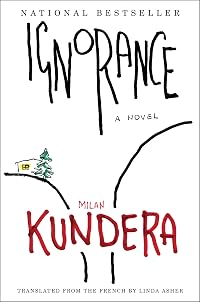
Ignorance
by Milan Kundera
On This Page
Description
A man and a woman meet by chance while returning to their homeland, which they had abandoned 20 years earlier when they chose to become exiles. Will they manage to pick up the thread of their strange love story, interrupted almost as soon as it began and then lost in the tides of history?Tags
Recommendations







Member Reviews
April 1 was Milan Kundera’s 81st birthday. In his honor I read his latest book, from 2000, “Ignorance.” While reading the book I didn’t really understand the title. I kept believing that it should have been “Nostalgia” as that’s the main topic of the book. The author uses razor sharps observations for analyzing the various moods and emotions surrounding nostalgia. His observations revealed that there are many types of nostalgia. He started off with its etymological origins and then went on to contrasting it with homesickness. The rest of the book is made up with evolving examples of nostalgia from the perspectives of the immigrants who can and who cannot return, but also from the perspective of those who stayed home.
But show more titles of the book do not necessarily need to reflect their main topics. In this case the title helps us to realize that nostalgia often originates and ends up in ignorance. We long for a state of affairs that no longer exists it and maybe it never did. Thus we are ignorant of the past. When we attempt to return to this imagined location, family, situation… of the past we may encounter events and feeling we were not prepared for and face our ignorance of the present. That’s exactly what happened to the woman who returned to Bohemia after spending 20 years mostly in Paris and to her fleeting love interest who returned from Denmark. Their stories and their loved ones’ provide the prism that breaks down the gray of ignorance and nostalgia into a colorful and painful rainbow.
Another interesting aspect of the book is the comparative analysis of Homer’s Odysseus. It is not a literary analysis, but a motivational one. While telling the stories of 20th century immigrants Kundera wonders what made Odysseus and Penelope tick, what kind of feeling they must have had cope with. By reaching to the classic tale, he managed to create and even more timelessness feeling for the whole book. The emotions described and analyzed are proven to be eternal.
As an immigrant this is one of the most important books I read. It helped me think about my own nostalgia and discover in what aspects I am similar to the book’s heroes and what aspects I am not. Thank you Mr. Kundera and happy birthday. show less
But show more titles of the book do not necessarily need to reflect their main topics. In this case the title helps us to realize that nostalgia often originates and ends up in ignorance. We long for a state of affairs that no longer exists it and maybe it never did. Thus we are ignorant of the past. When we attempt to return to this imagined location, family, situation… of the past we may encounter events and feeling we were not prepared for and face our ignorance of the present. That’s exactly what happened to the woman who returned to Bohemia after spending 20 years mostly in Paris and to her fleeting love interest who returned from Denmark. Their stories and their loved ones’ provide the prism that breaks down the gray of ignorance and nostalgia into a colorful and painful rainbow.
Another interesting aspect of the book is the comparative analysis of Homer’s Odysseus. It is not a literary analysis, but a motivational one. While telling the stories of 20th century immigrants Kundera wonders what made Odysseus and Penelope tick, what kind of feeling they must have had cope with. By reaching to the classic tale, he managed to create and even more timelessness feeling for the whole book. The emotions described and analyzed are proven to be eternal.
As an immigrant this is one of the most important books I read. It helped me think about my own nostalgia and discover in what aspects I am similar to the book’s heroes and what aspects I am not. Thank you Mr. Kundera and happy birthday. show less
When Odysseus returned to Ithaka after twenty years of travel and travail he was welcomed home; but was his return to the place he remembered and to the wife that he remembered? With Ignorance Milan Kundera gives the reader a meditation on this theme and others. Ignorance raises the question of where home is anymore in the modern world, not only for émigrés but for anyone who moves around. The place of one’s birth no longer seems to qualify, as one grows away from it, moves to more attractive places, or becomes cosmopolitan in tastes. For people in and from formerly communist countries, sudden opportunities to travel and migrate, after decades of restricted opportunities, seem to have raised the question afresh.
Irena, the novel’s show more main character, who lives in Paris, has enjoyed the status of émigré for two decades: Parisians feel sorry for the poor Czech woman and after the fall of Czech communism in 1989, they begin to wonder why she is not hurrying back home to help out. Her Parisian friends seem to consider it her patriotic duty. Yet Irena has worked hard to become settled in Paris, where she buried her Czech husband and raised their two daughters, who for all practical matters are French. Now Irena has a job, an apartment, and a boyfriend in Paris, not a bad city in which to make one’s home. Only a visit from her mother, who still lives in Prague, persuades Irena to make a return visit to the city of her birth.
Josef, the novel’s other main character, likewise fled Czechoslovakia in 1969. He settled in Denmark, where he married a Danish woman, and they lived happily together until she died. Josef, still mourning her death and attached to their home in Denmark, where he keeps everything just as it was when she was alive, is also very slow to return to the land of his birth. Now he is returning for a visit only because he had promised his dying wife that he would.
On their way to Czechoslovakia, Irena and Josef meet by chance in the Paris airport. Irena remembers Josef from another chance encounter many years before in Prague, before she married. There had been some chemistry between the two, but after their meeting they had never seen each other again: “Their love story stopped before it could start.” Now Irena introduces herself again, and they agree to get together in Prague. Actually, Josef cannot remember her, but now he sees no reason to turn down an opportunity for friendship with a warm, good-looking woman.
Before they rendezvous in Prague, they both have certain rounds to make and this is where Kundera begins to raise doubts about the idea of the Great Return. Both Irena and Josef are struck by the strangeness of the spoken Czech language, which seems to have developed an ugly nasal drawl since their departure. They also both notice the hometown diminution effect: Landscapes and city scenes that once seemed impressive have shrunk into insignificance, if they have not disappeared altogether. Worst of all, the whole country has been inundated by tasteless popular culture and crass commercialism; for example, the music on the radio is described as “noise” and “sewage-water music,” and the tubercular face of writer Franz Kafka adorns a T-shirt for tourists.
Both Irena and Josef get a glimpse of what they might have become if they had stayed in Czechoslovakia. When the weather turns hot, Irena buys a dowdy Czech dress that makes her look “naïve, provincial, inelegant” and “pitiable, poor, weak, downtrodden.” In his high school diary that his brother had saved for him, Josef is able to contemplate the “little snot” he used to be, back in the days of his virginity, when he obsessed about girls but could express his feelings only by torturing his girlfriends emotionally. Both Irena and Josef also get an eyeful of their potential selves in the friends and relatives that they meet, who form a kind of gauntlet for the two visitors but who otherwise have not missed them for twenty years.
Irena tries to socialize with some Prague friends, but after an awkward moment, her friends declare their “plain-and-simple” preference for beer rather than the wine she offers them. Then, beer in hand, they stand around chatting to each other about local matters, pretty much ignoring Irena. They are totally uninterested in what she has been doing during the twenty years she was away. Irena realizes that they have “amputated twenty years from her life” and no longer have much in common with her. She already misses her Parisian friend Sylvie.
In the provincial hometown that he visits, Josef has to run an even worse gauntlet formed by his sister-in-law, his Czech former wife (to whom he was married for only a few months), and his stepdaughter. Josef’s brother is happy enough to see him again, though the brother is somewhat embarrassed because he has taken over the family home and Josef’s old belongings. Although she also enjoys his goods, Josef’s sister-in-law has not forgiven him for running off and causing them to suffer under the Communist regime. Worse, she calls up his former wife and tells her he is in town. Then his stepdaughter calls him to say she has to see him right away to discuss certain important matters that she cannot talk about on the phone, but when he calls back to break their appointment, the stepdaughter says her mother warned her about what “a filthy little egotist” he is.
By the time Irena and Josef meet in Prague, they are ready for some relief and consolation. They share each other’s stories over lunch and wine, then head up to his hotel room. Before long, they are making love, but it does not end well and he leaves to catch his plane back to Denmark.
Thus, the ending of the novel is immensely sad. For both Irena and Josef, the Great Return to their homeland fizzles out and so does their brief romance. Even though Josef realizes that Irena is in love with him, he is still emotionally committed to his dead wife. Irena and Josef have crossed paths again, but again their paths do not match. Another possibility, however, is that Irena will find the encounter with Josef liberating. Until this encounter, Irena has tended to be dependent in her relationships with other people—first with her mother, then with her husband, Martin, and even with her married boyfriend, Gustaf.
Throughout the novel, Kundera also draws parallels to and meditates on the ur-myth of the Great Return—the story of Homer’s Odyssey (c. 725 b.c.e.), which is at the center of Ignorance just as the story of Oedipus’s sense of moral responsibility is at the center of The Unbearable Lightness of Being. Here Kundera seems to draw on the myth of Odysseus’s return primarily to show that it no longer applies to the modern world but is a romantic hangover from another time. For Odysseus, the return had tremendous validity, as he struggled to get back to his beloved homeland and wife. Around the time of the Victorian poet Alfred, Lord Tennyson, who wrote a stirring poem about Odysseus’s restlessness after his return, the myth started going downhill. Now the myth seems totally meaningless.
Where is home anymore? Where is love? In Ignorance Kundera seems to say that in the modern world neither of these is easy to find. Kundera destroys the idea that the place of one’s birth has any special significance. Instead, life is full of possibilities. Home and love are out there somewhere, but they have to be compatible with one’s identity, which in the modern world is a shifting, developing concept, dependent not just on one’s origins but on one’s experiences, memories, ideals, and ignorance. show less
Irena, the novel’s show more main character, who lives in Paris, has enjoyed the status of émigré for two decades: Parisians feel sorry for the poor Czech woman and after the fall of Czech communism in 1989, they begin to wonder why she is not hurrying back home to help out. Her Parisian friends seem to consider it her patriotic duty. Yet Irena has worked hard to become settled in Paris, where she buried her Czech husband and raised their two daughters, who for all practical matters are French. Now Irena has a job, an apartment, and a boyfriend in Paris, not a bad city in which to make one’s home. Only a visit from her mother, who still lives in Prague, persuades Irena to make a return visit to the city of her birth.
Josef, the novel’s other main character, likewise fled Czechoslovakia in 1969. He settled in Denmark, where he married a Danish woman, and they lived happily together until she died. Josef, still mourning her death and attached to their home in Denmark, where he keeps everything just as it was when she was alive, is also very slow to return to the land of his birth. Now he is returning for a visit only because he had promised his dying wife that he would.
On their way to Czechoslovakia, Irena and Josef meet by chance in the Paris airport. Irena remembers Josef from another chance encounter many years before in Prague, before she married. There had been some chemistry between the two, but after their meeting they had never seen each other again: “Their love story stopped before it could start.” Now Irena introduces herself again, and they agree to get together in Prague. Actually, Josef cannot remember her, but now he sees no reason to turn down an opportunity for friendship with a warm, good-looking woman.
Before they rendezvous in Prague, they both have certain rounds to make and this is where Kundera begins to raise doubts about the idea of the Great Return. Both Irena and Josef are struck by the strangeness of the spoken Czech language, which seems to have developed an ugly nasal drawl since their departure. They also both notice the hometown diminution effect: Landscapes and city scenes that once seemed impressive have shrunk into insignificance, if they have not disappeared altogether. Worst of all, the whole country has been inundated by tasteless popular culture and crass commercialism; for example, the music on the radio is described as “noise” and “sewage-water music,” and the tubercular face of writer Franz Kafka adorns a T-shirt for tourists.
Both Irena and Josef get a glimpse of what they might have become if they had stayed in Czechoslovakia. When the weather turns hot, Irena buys a dowdy Czech dress that makes her look “naïve, provincial, inelegant” and “pitiable, poor, weak, downtrodden.” In his high school diary that his brother had saved for him, Josef is able to contemplate the “little snot” he used to be, back in the days of his virginity, when he obsessed about girls but could express his feelings only by torturing his girlfriends emotionally. Both Irena and Josef also get an eyeful of their potential selves in the friends and relatives that they meet, who form a kind of gauntlet for the two visitors but who otherwise have not missed them for twenty years.
Irena tries to socialize with some Prague friends, but after an awkward moment, her friends declare their “plain-and-simple” preference for beer rather than the wine she offers them. Then, beer in hand, they stand around chatting to each other about local matters, pretty much ignoring Irena. They are totally uninterested in what she has been doing during the twenty years she was away. Irena realizes that they have “amputated twenty years from her life” and no longer have much in common with her. She already misses her Parisian friend Sylvie.
In the provincial hometown that he visits, Josef has to run an even worse gauntlet formed by his sister-in-law, his Czech former wife (to whom he was married for only a few months), and his stepdaughter. Josef’s brother is happy enough to see him again, though the brother is somewhat embarrassed because he has taken over the family home and Josef’s old belongings. Although she also enjoys his goods, Josef’s sister-in-law has not forgiven him for running off and causing them to suffer under the Communist regime. Worse, she calls up his former wife and tells her he is in town. Then his stepdaughter calls him to say she has to see him right away to discuss certain important matters that she cannot talk about on the phone, but when he calls back to break their appointment, the stepdaughter says her mother warned her about what “a filthy little egotist” he is.
By the time Irena and Josef meet in Prague, they are ready for some relief and consolation. They share each other’s stories over lunch and wine, then head up to his hotel room. Before long, they are making love, but it does not end well and he leaves to catch his plane back to Denmark.
Thus, the ending of the novel is immensely sad. For both Irena and Josef, the Great Return to their homeland fizzles out and so does their brief romance. Even though Josef realizes that Irena is in love with him, he is still emotionally committed to his dead wife. Irena and Josef have crossed paths again, but again their paths do not match. Another possibility, however, is that Irena will find the encounter with Josef liberating. Until this encounter, Irena has tended to be dependent in her relationships with other people—first with her mother, then with her husband, Martin, and even with her married boyfriend, Gustaf.
Throughout the novel, Kundera also draws parallels to and meditates on the ur-myth of the Great Return—the story of Homer’s Odyssey (c. 725 b.c.e.), which is at the center of Ignorance just as the story of Oedipus’s sense of moral responsibility is at the center of The Unbearable Lightness of Being. Here Kundera seems to draw on the myth of Odysseus’s return primarily to show that it no longer applies to the modern world but is a romantic hangover from another time. For Odysseus, the return had tremendous validity, as he struggled to get back to his beloved homeland and wife. Around the time of the Victorian poet Alfred, Lord Tennyson, who wrote a stirring poem about Odysseus’s restlessness after his return, the myth started going downhill. Now the myth seems totally meaningless.
Where is home anymore? Where is love? In Ignorance Kundera seems to say that in the modern world neither of these is easy to find. Kundera destroys the idea that the place of one’s birth has any special significance. Instead, life is full of possibilities. Home and love are out there somewhere, but they have to be compatible with one’s identity, which in the modern world is a shifting, developing concept, dependent not just on one’s origins but on one’s experiences, memories, ideals, and ignorance. show less
I picked this book on Hoopla because I was looking for an Eastern European book for July Read the World 21. I read Kundera's The Joke many years ago, and remember nothing about it. This book is quite short, so I check it out.
And this is a very bittersweet read. Kundera wrote this in French, when he had already been living in Paris for decades. And the two main characters in this book are both Czech emigrees--one to Denmark, one to Paris. They have been away for 20 years. They are both widowed. Both have family and friends ask them when they will "return to their country", and neither has ever wanted to. Yet they both do, and run into each other in the airport, after having met some 25 years before, in Czechoslovakia.
This book isn't show more about their emigration, or their return. It is really about memory, interpretation, misunderstanding, and how different people can remember the same event differently--or not at all. A defining event in one person's life--a breakup--is just one of many to the other person involved. Family members remember events differently. And who is right? Is anyone right? How does this happen? So not only do these two people not feel like they fit into Czech life and culture any more, they don't have any Czech memories from the last 20 years to share with friends, and they and their friends all remember their past interactions so differently. Where do they fit? Where do they want to be? Why did they really leave in the first place? Who do they want to be near? Who do they feel like now? After 2o years away there is so much more to "your country" and "your language". show less
And this is a very bittersweet read. Kundera wrote this in French, when he had already been living in Paris for decades. And the two main characters in this book are both Czech emigrees--one to Denmark, one to Paris. They have been away for 20 years. They are both widowed. Both have family and friends ask them when they will "return to their country", and neither has ever wanted to. Yet they both do, and run into each other in the airport, after having met some 25 years before, in Czechoslovakia.
This book isn't show more about their emigration, or their return. It is really about memory, interpretation, misunderstanding, and how different people can remember the same event differently--or not at all. A defining event in one person's life--a breakup--is just one of many to the other person involved. Family members remember events differently. And who is right? Is anyone right? How does this happen? So not only do these two people not feel like they fit into Czech life and culture any more, they don't have any Czech memories from the last 20 years to share with friends, and they and their friends all remember their past interactions so differently. Where do they fit? Where do they want to be? Why did they really leave in the first place? Who do they want to be near? Who do they feel like now? After 2o years away there is so much more to "your country" and "your language". show less
I was thinking while reading this book about the rating I'll give it… I was going to give it a 4-star rating wishing it could it be 4.5 stars. But while reading the last 50 pages, I definitely knew I was going to give it a 5, and quite easily, too. The ideas represented about art, history, music, writing, and philosophy in this book are probably more worthy of attention and reading than the main story. And the main story got amazingly better near the end which made me wish the story would go on; nevertheless, the ending was perfect even though it doesn't give closure. I LOVED reading the book and at a point, I wished it was longer. Yes. That almost never happens.
The story is about two people - separate stories at first - who decide to show more return to their home, Prague after living abroad for about two decades during the Russian invasion, and then they meet by coincidence on their way home. I loved LOVED loved how the author reworked bits of Homer's Odyssey in the story with astute comparisons to ponder upon even though I hadn't had the slightest idea what the Odyssey was about (but now I do, thanks to Kundera's brilliant writing and story-telling.)
Really beautifully written. And a recommended read. Note that this is not a popular novel of his but it is the latest one. Therefore, it might be a better idea to start with something known and lovable, such as The Unbearable Lightness of Being or The Joke (I haven't ready any yet.)
I added quotes I found interesting to this page from the book: http://www.goodreads.com/work/quotes/3424606
Now, excuse me while I go buy the rest of Kundera's books. show less
The story is about two people - separate stories at first - who decide to show more return to their home, Prague after living abroad for about two decades during the Russian invasion, and then they meet by coincidence on their way home. I loved LOVED loved how the author reworked bits of Homer's Odyssey in the story with astute comparisons to ponder upon even though I hadn't had the slightest idea what the Odyssey was about (but now I do, thanks to Kundera's brilliant writing and story-telling.)
Really beautifully written. And a recommended read. Note that this is not a popular novel of his but it is the latest one. Therefore, it might be a better idea to start with something known and lovable, such as The Unbearable Lightness of Being or The Joke (I haven't ready any yet.)
I added quotes I found interesting to this page from the book: http://www.goodreads.com/work/quotes/3424606
Now, excuse me while I go buy the rest of Kundera's books. show less
Kundera is a master of many languages. He's a Czech who writes in French. He's also an émigré. This book explores the feelings that emigres have for the land and people they left behind. A subject of which he has firsthand knowledge. I had read Thomas Wolfe's "You Can't Go Home Again" and came away very disappointed as Wolfe doesn't do justice to a very interesting question. Kundera goes there. He pulls it apart from many perspectives. Skip the Wolfe, Read Kundera.
Kundera explores the meaning of nostalgia. He compares how it is used in various languages with emphasis on different aspects of the apparently similar phenomenon. I'm astounded at how different people focused on different aspects. Kundera also uses The Odyssey to illustrate show more how the hero Odysseus was impacted by nostalgia.
Communism had a lot to do with Kundera's leaving Czechoslovakia. And with the fall of the Soviet Union, he was under great pressure to return. Many assumed he would want to get back "home" as soon as it was possible. But Kundera sees Paris as his home now and has no interest in returning to Prague. In "Ignorance", Kundera shows many reasons why emigres don't return when they can.
On returning, they, like the main character, Irena, may be faced with an unpleasant situation like becoming the daughter of the dominating or at least unsympathetic mother. In Paris, she was at least her own person who didn't need to defend her position all the time. Or, like Joseph, whose family suffered because of his emigrating, he had his own life. Some regimes looked very negatively on the rejection inherent in emigrating. And families who were left behind let the émigré that the émigré was the cause of their problems with guilt tripping of various forms. And then there's the property and or rights the émigré abandoned. Returning means facing what happened while they were gone. While some issues can be rectified when parties can agree, many fester and leave enduring resentment.
Needless to say, returning is not as pleasant as many imagine. Yet those around them, in their new "home", expect the émigré to look longingly upon their chance to return. They don't understand the situation and all that it entails.
And then there's the one they fell in love with before they knew anything about life. They were cruel, and even though we want to think of them differently, as if they changed, we are faced with their cruelty once again. Kundera finally lets us know where the title comes from. He tells us that we were ignorant when we were young, but that was the time when we chose our first mate, our career, and where we went to escape. show less
Kundera explores the meaning of nostalgia. He compares how it is used in various languages with emphasis on different aspects of the apparently similar phenomenon. I'm astounded at how different people focused on different aspects. Kundera also uses The Odyssey to illustrate show more how the hero Odysseus was impacted by nostalgia.
Communism had a lot to do with Kundera's leaving Czechoslovakia. And with the fall of the Soviet Union, he was under great pressure to return. Many assumed he would want to get back "home" as soon as it was possible. But Kundera sees Paris as his home now and has no interest in returning to Prague. In "Ignorance", Kundera shows many reasons why emigres don't return when they can.
On returning, they, like the main character, Irena, may be faced with an unpleasant situation like becoming the daughter of the dominating or at least unsympathetic mother. In Paris, she was at least her own person who didn't need to defend her position all the time. Or, like Joseph, whose family suffered because of his emigrating, he had his own life. Some regimes looked very negatively on the rejection inherent in emigrating. And families who were left behind let the émigré that the émigré was the cause of their problems with guilt tripping of various forms. And then there's the property and or rights the émigré abandoned. Returning means facing what happened while they were gone. While some issues can be rectified when parties can agree, many fester and leave enduring resentment.
Needless to say, returning is not as pleasant as many imagine. Yet those around them, in their new "home", expect the émigré to look longingly upon their chance to return. They don't understand the situation and all that it entails.
And then there's the one they fell in love with before they knew anything about life. They were cruel, and even though we want to think of them differently, as if they changed, we are faced with their cruelty once again. Kundera finally lets us know where the title comes from. He tells us that we were ignorant when we were young, but that was the time when we chose our first mate, our career, and where we went to escape. show less
Ignorance is a novel that exposes the weakness and fallibility of our memory. Milan Kundera evokes the question to what extent our poor memory renders us ignorant.
Irena and Josef chanced to encounter one another at Paris airport while returning to their homeland, which they had pertinaciously abandoned twenty years ago during the Russian invasion. Both of them chose to be unlawful exiles with whom families dare not to keep in contact. Irena, then pregnant with her second child, fled with her husband Martin to Paris and soon led a poverty-stricken life as a widow until she became Gustaf's mistress. Irena instantly recognized Josef at the first sight of him: they had met at a friend's party in Prague some 20 years ago. She had regretted show more parting with him after the party and was stricken with a wound that never healed.
Josef fled the country when he was a medical student in veterinary medicine. Unlike his brother who succumbed to the Communist reign and denied his own convictions to demonstrate support, Josef could not bear to see his country enslaved and humiliated. He settled down in Copenhagen, got married, became a vet. Not a day passed without Josef's reminiscing his deceased wife. He loved her even more, in a melancholy and memorial way, and respected all her customs, such as taking care every chair, vase, and lamp was where she had liked it.
While our protagonists sighed at the drastic changes of their once-familiar homeland and the wiping out of landmarks, a more subtle but inevitable issue emerged. Their rueful recollections and nostalgia caught up with them, in fragments, fear, and regret. However obdurately and diligently they tried to shield off past memories and put off paltry values of the past lives, the pang of regret and sense of loneliness never spared them. Irena always felt emigration was an irreparable mistake she had committed at the age of ignorance. It was out of her own will, freedom, decision and fate. Josef was always seized with the pain and guilt of his sadistic love toward his teenage girlfriend, whom he never sought over after she attempted suicide.
This book trims to the bone the inescapable issue of lost time and forgotten memories. Our protagonists were despondent at the fact that their compatriots, after some twenty years of separations, bore no interest in the exiles' lives. Why do sad memories always seem to linger around? Why do we remember this one fragment but not the other bit? Why do we often remember the faces but befuddle with names? In each of us the choice seems to occur mysteriously outside our will and our interests. Far as this book concerns, friends do not always hold the same degree of significance for each other and thus the texture, perspicuity, and depth of recollections disparate. When recollections are not evolved in a recurring manner (i.e. in conversations with friends and family), ignorance reign.
The premise of the book is tantalizing and moving though the abrupt (rather unexpected and somewhat lewd) turn of the events and the ending left me fish-mouthed (careful reader will see to the twist). I was left with the impression that the whole thing was a mere illusion. Whatever the case Kundera intended it to be, Ignorance is no less mesmerizing than his best known The Unbearable Lightness of Being. This is the kind of book that does not insatiate you with complex philospohical overtones and mind-boggling prose but at the same time challenges the simple thoughts of life. The book addresses the very simple matter of life--its memory, how we have lived life and how we go about remembering life. show less
Irena and Josef chanced to encounter one another at Paris airport while returning to their homeland, which they had pertinaciously abandoned twenty years ago during the Russian invasion. Both of them chose to be unlawful exiles with whom families dare not to keep in contact. Irena, then pregnant with her second child, fled with her husband Martin to Paris and soon led a poverty-stricken life as a widow until she became Gustaf's mistress. Irena instantly recognized Josef at the first sight of him: they had met at a friend's party in Prague some 20 years ago. She had regretted show more parting with him after the party and was stricken with a wound that never healed.
Josef fled the country when he was a medical student in veterinary medicine. Unlike his brother who succumbed to the Communist reign and denied his own convictions to demonstrate support, Josef could not bear to see his country enslaved and humiliated. He settled down in Copenhagen, got married, became a vet. Not a day passed without Josef's reminiscing his deceased wife. He loved her even more, in a melancholy and memorial way, and respected all her customs, such as taking care every chair, vase, and lamp was where she had liked it.
While our protagonists sighed at the drastic changes of their once-familiar homeland and the wiping out of landmarks, a more subtle but inevitable issue emerged. Their rueful recollections and nostalgia caught up with them, in fragments, fear, and regret. However obdurately and diligently they tried to shield off past memories and put off paltry values of the past lives, the pang of regret and sense of loneliness never spared them. Irena always felt emigration was an irreparable mistake she had committed at the age of ignorance. It was out of her own will, freedom, decision and fate. Josef was always seized with the pain and guilt of his sadistic love toward his teenage girlfriend, whom he never sought over after she attempted suicide.
This book trims to the bone the inescapable issue of lost time and forgotten memories. Our protagonists were despondent at the fact that their compatriots, after some twenty years of separations, bore no interest in the exiles' lives. Why do sad memories always seem to linger around? Why do we remember this one fragment but not the other bit? Why do we often remember the faces but befuddle with names? In each of us the choice seems to occur mysteriously outside our will and our interests. Far as this book concerns, friends do not always hold the same degree of significance for each other and thus the texture, perspicuity, and depth of recollections disparate. When recollections are not evolved in a recurring manner (i.e. in conversations with friends and family), ignorance reign.
The premise of the book is tantalizing and moving though the abrupt (rather unexpected and somewhat lewd) turn of the events and the ending left me fish-mouthed (careful reader will see to the twist). I was left with the impression that the whole thing was a mere illusion. Whatever the case Kundera intended it to be, Ignorance is no less mesmerizing than his best known The Unbearable Lightness of Being. This is the kind of book that does not insatiate you with complex philospohical overtones and mind-boggling prose but at the same time challenges the simple thoughts of life. The book addresses the very simple matter of life--its memory, how we have lived life and how we go about remembering life. show less
روايات كونديرا تشبه جولة بالسيارة في يوم يكاد يخنقه الضجر ! ، نفس الشعور الذي ينتابني بعد رحلة من هذا النوع والعودة للمنزل ، الخروج من رأسك قليلاً ، النظر للكون بأكمله في شوارع المدينة والعودة من جديد لحياتك . نفس الشعور يولد مع روايات كونديرا .
الفكرة الرئيسية هنا هي النوستالجيا ، وأي شيء يحكي عن الحنين يعجبني ! فكرة الغياب ثمّ العودة ، فكرة الوقوف على عتبات الذاكرة التي وُزّعت على مدننا التي تركناها خلفنا. show more
وهذه المدن قد تكون حقيقية فيزيائياً، أو فكرة معنوية ابتعدنا عنها ، نشاهد انفسنا في أعين الآخرين ، الذين تركناهم هناك ، نستنكر ، أو نتذكر بشيء من الاجلال والامتنان .
القراءة لكونديرا تمنحك أيام من التأمل، فجأة يصبح عقلك نشطاً، تجعلك تتحول إلى فيلسوف - ما يزعج الاخرين الذين وباضطرار يستمعون لتحليلاتك لحياتهم بالمقارنة بقصص كونديرا - .
رواية صغيرة من ١٣٠ صفحة ، اخرجوا في جولة السيارة الجميلة قريبا واستمتعوا . show less
الفكرة الرئيسية هنا هي النوستالجيا ، وأي شيء يحكي عن الحنين يعجبني ! فكرة الغياب ثمّ العودة ، فكرة الوقوف على عتبات الذاكرة التي وُزّعت على مدننا التي تركناها خلفنا. show more
وهذه المدن قد تكون حقيقية فيزيائياً، أو فكرة معنوية ابتعدنا عنها ، نشاهد انفسنا في أعين الآخرين ، الذين تركناهم هناك ، نستنكر ، أو نتذكر بشيء من الاجلال والامتنان .
القراءة لكونديرا تمنحك أيام من التأمل، فجأة يصبح عقلك نشطاً، تجعلك تتحول إلى فيلسوف - ما يزعج الاخرين الذين وباضطرار يستمعون لتحليلاتك لحياتهم بالمقارنة بقصص كونديرا - .
رواية صغيرة من ١٣٠ صفحة ، اخرجوا في جولة السيارة الجميلة قريبا واستمتعوا . show less
Members
- Recently Added By
Published Reviews
ThingScore 100
Bei Kundera sind alle Figuren Opfer des Schicksals, Getriebene der Umstände, gefangen im Netz der Zeitläufte, hilflose Akteure im Leben. Die individuelle Geschichte einer Person spiegelt sich in der Weltgeschichte, und alle Figuren sind Spiegel und Brennpunkt dessen, was sie umgreift und übersteigt.
Insofern ist "Die Unwissenheit" ein großer, ja großartiger Roman. Ein Werk über Erinnern, show more Gedächtnis und Vergessen, das an Intensität und Tiefe, an Leichtigkeit und Eleganz nahtlos an den Erfolg der "Unerträglichen Leichtigkeit" anschließen könnte. In Josef portraitiert sich Kundera wohl zum Teil selbst: Ob dieser Autor wohl immer da am stärksten ist, wo er verborgen in einer anderen Figur, einer anderen Haut vom Eigenen spricht? "Die Unwissenheit" liefert für diese Vermutung den allerschönsten Beleg. show less
Insofern ist "Die Unwissenheit" ein großer, ja großartiger Roman. Ein Werk über Erinnern, show more Gedächtnis und Vergessen, das an Intensität und Tiefe, an Leichtigkeit und Eleganz nahtlos an den Erfolg der "Unerträglichen Leichtigkeit" anschließen könnte. In Josef portraitiert sich Kundera wohl zum Teil selbst: Ob dieser Autor wohl immer da am stärksten ist, wo er verborgen in einer anderen Figur, einer anderen Haut vom Eigenen spricht? "Die Unwissenheit" liefert für diese Vermutung den allerschönsten Beleg. show less
added by Indy133
Lists

1001 Books You Must Read Before You Die
1,448 works; 1,134 members

Books Read in 2019
4,052 works; 108 members
Author Information

53+ Works 61,356 Members
One of the foremost contemporary Czech writers, Kundera is a novelist, poet, and playwright. His play The Keeper of the Keys, produced in Czechoslovakia in 1962, has long been performed in a dozen countries. His first novel, The Joke (1967), is a biting satire on the political atmosphere in Czechoslovakia in the 1950s. It tells the story of a show more young Communist whose life is ruined because of a minor indiscretion: writing a postcard to his girlfriend in which he mocks her political fervor.The Joke has been translated into a dozen languages and was made into a film, which Kundera wrote and directed. His novel Life Is Elsewhere won the 1973 Prix de Medicis for the best foreign novel. Kundera has been living in France since 1975. His books, for a long time suppressed in his native country, are once again published.The Unbearable Lightness of Being (1984), won him international fame and was a successful English-language film. In this work Kundera moves toward more universal and philosophically tinged themes, thus transforming himself from a political dissident into a writer of international significance. (Bowker Author Biography) show less
Some Editions
Awards and Honors
Series
Belongs to Publisher Series
Work Relationships
Is contained in
Has as a commentary on the text
Common Knowledge
- Canonical title
- Ignorance
- Original title
- L'ignorance
- Alternate titles
- La Ignorancia
- Original publication date
- 2000-04 (1e traduction du française et édition en espagnol, Tusquets Editores, Barcelone) (1e traduction du française et édition en espagnol, Tusquets Editores, Barcelone); 2003-04-03 (1e édition originale française, Blanche, Gallimard) (1e édition originale française, Blanche, Gallimard); 2005-02-10 (Réédition française, Folio, 4155, Gallimard) (Réédition française, Folio, 4155, Gallimard)
- People/Characters
- Irena; Josef; Martin
- Important places
- Prague, Czech Republic; Czechoslovakia
- Epigraph
- /
- Dedication
- /
- First words
- 1
« Qu'est-ce que tu fais encore ici ! » Sa voix n'était pas méchante, mais elle n'était pas gentille non plus ; Sylvie se fâchait.
« Et où devrais-je être ? demanda Irena.
[...] - Last words
- (Click to show. Warning: May contain spoilers.)Through the porthole he saw, far off in the sky, a low wooden fence and a brick house with a slender fir tree like a lifted arm before it.
- Original language
- Français
Classifications
- Genres
- General Fiction, Fiction and Literature
- DDC/MDS
- 891.86354 — Literature & rhetoric Literatures of other languages East Indo-European and Celtic literatures West and South Slavic languages (Bulgarian, Slovene, Polish, Czech, Slovak, Serbo-Croatian, and Macedonian) Czech Czech fiction 1900–1989 Late 20th century 1945–1989
- LCC
- PQ2671 .U47 .I3613 — Language and Literature French, Italian, Spanish and Portuguese literatures French literature Modern literature 1961-2000
- BISAC
Statistics
- Members
- 2,583
- Popularity
- 7,335
- Reviews
- 40
- Rating
- (3.69)
- Languages
- 27 — Arabic, Catalan, Chinese, Czech, Danish, Dutch, English, Estonian, Finnish, French, German, Greek, Hebrew, Hungarian, Icelandic, Italian, Korean, Lithuanian, Norwegian (Bokmål), Farsi/Persian, Polish, Romanian, Russian, Spanish, Swedish, Turkish, Portuguese (Portugal)
- Media
- Paper, Audiobook, Ebook
- ISBNs
- 85
- ASINs
- 13