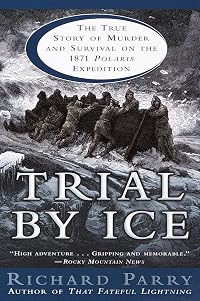
Trial by Ice: The True Story of Murder and Survival on the 1871 Polaris Expedition
by Richard Parry
On This Page
Description
“An extraordinary real-life adventure of men battling the elements and themselves, told with ice-cold precision.” –Kirkus Reviews (starred review) In the dark years following the Civil War, America’s foremost Arctic explorer, Charles Francis Hall, became a figure of national pride when he embarked on a harrowing, landmark expedition. With financial backing from Congress and the personal support of President Grant, Captain Hall and his crew boarded the Polaris, a steam schooner show more carefully refitted for its rigorous journey, and began their quest to be the first men to reach the North Pole. Neither the ship nor its captain would ever return. What transpired was a tragic death and whispers of murder, as well as a horrifying ordeal through the heart of an Arctic winter, when men fought starvation, madness, and each other upon the ever-shifting ice. Trial by Ice is an incredible adventure that pits men against the natural elements and their own fragile human nature. In this powerful true story of death and survival, courage and intrigue aboard a doomed ship, Richard Parry chronicles one of the most astonishing, little known tragedies at sea in American history. “ABSORBING . . . Suspense builds as Parry describes the events leading up to Hall’s ‘murder,’ then climaxes in horrifying detail.” –Publishers Weekly “RIVETING.” –Library Journal show lessTags
Recommendations






































Member Recommendations

Member Reviews
I am not sure I have ever read a book so deserving both of one star and of five stars.
Five stars, because it is a vivid, dramatic telling of the voyage and destruction of the U.S.S. Polaris, and the death -- probably the murder -- of the voyage's commander Charles Francis Hall. One star, because there are so many casual errors of fact that, in the early pages at least, I was constantly cringing. It was so bad that I very nearly stopped reading.
Charles Francis Hall was a self-taught religious fanatic who had involved himself in the hunt for the lost Franklin Expedition to find the Northwest Passage. He made some mildly useful discoveries, came to know the Inuit, and became obsessed with the Arctic. His earlier expeditions had been show more private, but in 1871 he convinced the U. S. government to fund an expedition to the North Pole. Unfortunately, Hall was not a sailor or a scientist, so he needed others to manage the ship, and the government chose scientists to go with the expedition. And most of the experts chosen for the voyage were not very competent or cooperative, and Hall did not have the force of personality to control him. And then... Hall got sick. After struggling for life for a few days, and showing signs of improvement, he relapsed and died. There is good reason to think it was murder; a century later, his body was autopsied and was found to be heavily laden with arsenic.
Hall hadn't been a great commander, but his death made things far worse. The remaining officers quarreled, got drunk, mismanaged everything. The Polaris was mishandled and suffered progressive damage. Without going into too many details, about half the survivors ended up trapped on an iceberg; the other half grounded their ship on an arctic island with no good way to escape. Incredibly, everyone except Hall survived, but most came within a few days of starvation or death by freezing, and most of the scientific data was lost, and they never made it anywhere near the North Pole.
It was a fiasco that was eventually hushed up because the Powers That Be had little interest in finding the truth.
This tale author Parry tells very well. If what he tells you is true.
Well, most of it is true, or at least is what was reported at the time. But I cannot stress enough how many small errors there are, I spotted more in the early pages, where I know the material, than in the late, but the rate is incredibly high. Examples:
- Parry repeatedly refers to sledges as "sleds." Yes, there are mechanical similarities, but you don't use a sled in the Arctic for carrying provisions; you use a sledge.
- On page 21 and other places, he confuses the explorers John Ross and James Clark Ross -- uncle and nephew, but the former was an erratic failure and the latter the greatest explorer of his age.
- On page 11 he refers to the "considerable fortune" of Jane Franklin, the wife of John Franklin. Jane Franklin had inherited enough money that she could have been comfortable, but she was middle class, not wealthy.
- On p. 23, he says that, in Through the Looking Glass, the White Queen races as fast as she can to stay in one place. It is the Red Queen who did so, as in the common phrase "Red Queen's Race."
- On p. 31 he treats scientific arctic expeditions as exceptional, but all the nineteenth century Northwest Passage expeditions were basically scientific, and their leaders usually ended up as members of the Royal Society
- On p. 45 he implies that keeping journals on those expeditions was a special burden, but all officers on all the expeditions were expected to keep journals, which were often published (e.g. Franklin had published the journal of his first voyage).
- On p. 50 he says of St. John's, Newfoundland that "in 1870... [it] existed for one reason only." That one reason is cod. And, yes, Newfoundland was founded to fish for cod. But by 1870, the sealing industry had arisen, and there was some whaling, and a small timber industry,
- On several places, the first one on p. 72, he states that there are people who doubt that Robert Peary reached the North Pole. There are two classes of people: Those who know that Peary didn't reach the Pole and those who haven't studied the evidence. I won't discuss that -- that's another book -- but the fact that Parry accepts Peary's claims shows that he hasn't studied the record.
- On p. 126 he states "Forced to drink a mix of lime juice and sauerkraut, the British tar...." British sailors drank lemon juice, called "lime" to make it sound better; it was the Germans who used sauerkraut to avoid scurvy.
I could go on. I could also point to the "Select Bibliography," which has only six items, five of them from before 1900 and one from 1971. You just can't trust this book. It is extremely frustrating for someone who wants facts. Don't quote this thing.
But if you want a great story, or at least a story of a lot of people struggling intensely to survive in the High North, you can hardly do better. show less
Five stars, because it is a vivid, dramatic telling of the voyage and destruction of the U.S.S. Polaris, and the death -- probably the murder -- of the voyage's commander Charles Francis Hall. One star, because there are so many casual errors of fact that, in the early pages at least, I was constantly cringing. It was so bad that I very nearly stopped reading.
Charles Francis Hall was a self-taught religious fanatic who had involved himself in the hunt for the lost Franklin Expedition to find the Northwest Passage. He made some mildly useful discoveries, came to know the Inuit, and became obsessed with the Arctic. His earlier expeditions had been show more private, but in 1871 he convinced the U. S. government to fund an expedition to the North Pole. Unfortunately, Hall was not a sailor or a scientist, so he needed others to manage the ship, and the government chose scientists to go with the expedition. And most of the experts chosen for the voyage were not very competent or cooperative, and Hall did not have the force of personality to control him. And then... Hall got sick. After struggling for life for a few days, and showing signs of improvement, he relapsed and died. There is good reason to think it was murder; a century later, his body was autopsied and was found to be heavily laden with arsenic.
Hall hadn't been a great commander, but his death made things far worse. The remaining officers quarreled, got drunk, mismanaged everything. The Polaris was mishandled and suffered progressive damage. Without going into too many details, about half the survivors ended up trapped on an iceberg; the other half grounded their ship on an arctic island with no good way to escape. Incredibly, everyone except Hall survived, but most came within a few days of starvation or death by freezing, and most of the scientific data was lost, and they never made it anywhere near the North Pole.
It was a fiasco that was eventually hushed up because the Powers That Be had little interest in finding the truth.
This tale author Parry tells very well. If what he tells you is true.
Well, most of it is true, or at least is what was reported at the time. But I cannot stress enough how many small errors there are, I spotted more in the early pages, where I know the material, than in the late, but the rate is incredibly high. Examples:
- Parry repeatedly refers to sledges as "sleds." Yes, there are mechanical similarities, but you don't use a sled in the Arctic for carrying provisions; you use a sledge.
- On page 21 and other places, he confuses the explorers John Ross and James Clark Ross -- uncle and nephew, but the former was an erratic failure and the latter the greatest explorer of his age.
- On page 11 he refers to the "considerable fortune" of Jane Franklin, the wife of John Franklin. Jane Franklin had inherited enough money that she could have been comfortable, but she was middle class, not wealthy.
- On p. 23, he says that, in Through the Looking Glass, the White Queen races as fast as she can to stay in one place. It is the Red Queen who did so, as in the common phrase "Red Queen's Race."
- On p. 31 he treats scientific arctic expeditions as exceptional, but all the nineteenth century Northwest Passage expeditions were basically scientific, and their leaders usually ended up as members of the Royal Society
- On p. 45 he implies that keeping journals on those expeditions was a special burden, but all officers on all the expeditions were expected to keep journals, which were often published (e.g. Franklin had published the journal of his first voyage).
- On p. 50 he says of St. John's, Newfoundland that "in 1870... [it] existed for one reason only." That one reason is cod. And, yes, Newfoundland was founded to fish for cod. But by 1870, the sealing industry had arisen, and there was some whaling, and a small timber industry,
- On several places, the first one on p. 72, he states that there are people who doubt that Robert Peary reached the North Pole. There are two classes of people: Those who know that Peary didn't reach the Pole and those who haven't studied the evidence. I won't discuss that -- that's another book -- but the fact that Parry accepts Peary's claims shows that he hasn't studied the record.
- On p. 126 he states "Forced to drink a mix of lime juice and sauerkraut, the British tar...." British sailors drank lemon juice, called "lime" to make it sound better; it was the Germans who used sauerkraut to avoid scurvy.
I could go on. I could also point to the "Select Bibliography," which has only six items, five of them from before 1900 and one from 1971. You just can't trust this book. It is extremely frustrating for someone who wants facts. Don't quote this thing.
But if you want a great story, or at least a story of a lot of people struggling intensely to survive in the High North, you can hardly do better. show less
This tells the story of the American Polaris expedition to the north pole in 1871.
The expedition was a total failure, and it was really doomed from the start because of poorly defined responsibilities, and rivalry between the crew members.
The most gripping part is the story of the voyage home after they had given up on reaching the pole. In particular, the survival of Tyson's group on the ice floe is both harrowing and remarkable. If it wasn't for the Inuit with them on the ice, they would surely have died.
When you read the list of disasters caused by bad decisions, stupidity and bad luck, it's surprising that only one person died.
No one comes out of this looking good. There's no glory and no heroes.
The expedition was a total failure, and it was really doomed from the start because of poorly defined responsibilities, and rivalry between the crew members.
The most gripping part is the story of the voyage home after they had given up on reaching the pole. In particular, the survival of Tyson's group on the ice floe is both harrowing and remarkable. If it wasn't for the Inuit with them on the ice, they would surely have died.
When you read the list of disasters caused by bad decisions, stupidity and bad luck, it's surprising that only one person died.
No one comes out of this looking good. There's no glory and no heroes.
Highly recommend this book as an accompaniment to the "Kingdom of Ice".
Trial by Ice is an incredible adventure that pits men against the natural elements and their own fragile human nature. Beyond this, it is also an authentic murder mystery that, in its time, led to accusations of foul play and a dramatic, unresolved investigation. Now, more than a century after the crime was committed, the author draws on recent evidence to recount the amazing story of the killer who boarded the Polaris–and got away with murder.
Ratings
Members
- Recently Added By
Lists

Polar exploration
54 works; 4 members
Author Information
7 Works 280 Members
Richard Parry is a retired surgeon whose practice was based in Fairbanks, Alaska.
Common Knowledge
- Original title
- Trial by Ice. The True Story of Murder and Survival on the 1871 Polaris Expedition
- Original publication date
- 2001
- People/Characters
- Charles Francis Hall; Emil Bessels; R. W. D. Bryan; Sidney Buddington; Hubbard Chester; Ebierbing (show all 12); Elisha Kent Kane; Joseph Mauch; Frederick Meyer; Emil Schuman; Tookoolito; George Tyson
- Important places
- North Pole; Arctic; Ellesmere Island, Canada; Greenland; Kennedy Channel, Arctic
- Important events
- Polaris Expedition
- Dedication
- To my wife, Kathie,
Just keep reminding me that
over the next hill lies a new adventure.
And to my sons, David and Matthew,
For making me proud of them. . . - First words
- November 10, 1871. The black sky leaned heavily upon the land.
Classifications
- Genres
- Nonfiction, History, Travel, General Nonfiction
- DDC/MDS
- 919.804 — History & geography Geography & travel Geography of and travel in Australasia, Pacific Ocean islands, Atlantic Ocean islands, Arctic islands, Antarctica and on extraterrestrial worlds Polar regions
- LCC
- G670 — Geography, Anthropology and Recreation Geography (General) Arctic and Antarctic regions
- BISAC
Statistics
- Members
- 206
- Popularity
- 158,596
- Reviews
- 4
- Rating
- (3.92)
- Languages
- English, German, Portuguese (Portugal)
- Media
- Paper, Ebook
- ISBNs
- 10
- UPCs
- 1
- ASINs
- 1