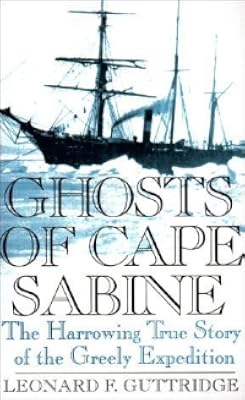
Ghosts of Cape Sabine: The Harrowing True Story of the Greely Expedition
by Leonard F. Guttridge
On This Page
Description
Journal entries, letters, diaries, and other documentary material help reconstruct the experiences of the twenty-five men who attempted to establish a scientific base in the Arctic region of Lady Franklin Bay in July of 1881.Tags
Recommendations
















Member Recommendations

Member Reviews
Usually I dislike the phrases "ill-fated" or "destined to fail" in my nonfiction, because hindsight is always 20/20. But in the case of the Lady Franklin Bay Expedition, the description could not be more apt. The expedition's failure is a lesson in leadership on and off the ice. Adolphus Greely had neither the inspiring optimism of Franklin or unwavering camaraderie of De Long. The expedition was begrudgingly funded by the U.S. Army, NOT the Navy, with all the characteristic beaucracy of a post-Civil War America. The Jeannette (from "Kingdom of Ice") had gone missing, and the mission was to not only look for De Long and his crew, but to establish a permanent scientific base in Cape Sabine, and to outdo Britain by reaching farthest show more North. From the outset, the crew chafes at Greely's uncompromising attitude, and morale quickly spirals after the resupply ship, the Proteus, fails to emerge on the horizon. While the Proteus has its own desperate tale of survival, the expedition is forced to abandon the site and trek to Littleton Island in the hopes that someone will come for them.
I think this one might be one of the most well-researched, certainly the densest! It's "harrowing" for sure, but Guttridge could've easily trimmed some fat off the D.C. chapters to make room for lesser crew members. It's guilty of unnecessary name-dropping. Also, Guttridge consistently uses the term "Eskimo" to describe two of the crew members, instead of Kalaallit Inuit or simply Inuit. "Eskimo" is an inexcusable term for a book published in 2000. Still it's unlike any other expedition that I've read about this year! show less
I think this one might be one of the most well-researched, certainly the densest! It's "harrowing" for sure, but Guttridge could've easily trimmed some fat off the D.C. chapters to make room for lesser crew members. It's guilty of unnecessary name-dropping. Also, Guttridge consistently uses the term "Eskimo" to describe two of the crew members, instead of Kalaallit Inuit or simply Inuit. "Eskimo" is an inexcusable term for a book published in 2000. Still it's unlike any other expedition that I've read about this year! show less
Whom the Arctic destroys, it first drives mad.
That is the sad truth of nineteenth and early twentieth century Arctic exploration. From John Ross's sighting of the non-existent "Croker Mountains" to the crew of the Karluk a century later, the tales of officers making absurd decisions, of sailors out of control, of choices made for no known reason are endless. There are a lot of reasons. Scurvy leads the list. Seasonal affective disorder certainly doesn't help. Other dietary problems may contribute.
Sometimes, the problems began before the expedition even sailed. The Greeley expedition to Ellesmere Island in 1881, one of the more ambitious attempts to reach the high arctic, is a case in point. The planning was simply fuddled. This left the show more members of the expedition with no means of survival and little hope of timely rescue. As a result, the majority died, miserably, and charges of cannibalism flew.
The tale is certainly dramatic, needing only a good telling.
This telling is, well, fair. It was simply too easy to get lost. Two or three times it seemed as if everybody was about to die and we must be at the end of the actual expedition. Then -- surprise! -- everybody goes on doing whatever they were doing. People died, periodically, but it seems as if the narrative bounces back and forth from the end to somewhere in the middle. It may be strictly chronological, but if so, it loses the thread of the chronology.
This probably still qualifies as the best popular account of one of the disastrous miscalculations that have so marred Arctic explorations. But you might want to take notes as you read it. It's too easy to get lost otherwise. show less
That is the sad truth of nineteenth and early twentieth century Arctic exploration. From John Ross's sighting of the non-existent "Croker Mountains" to the crew of the Karluk a century later, the tales of officers making absurd decisions, of sailors out of control, of choices made for no known reason are endless. There are a lot of reasons. Scurvy leads the list. Seasonal affective disorder certainly doesn't help. Other dietary problems may contribute.
Sometimes, the problems began before the expedition even sailed. The Greeley expedition to Ellesmere Island in 1881, one of the more ambitious attempts to reach the high arctic, is a case in point. The planning was simply fuddled. This left the show more members of the expedition with no means of survival and little hope of timely rescue. As a result, the majority died, miserably, and charges of cannibalism flew.
The tale is certainly dramatic, needing only a good telling.
This telling is, well, fair. It was simply too easy to get lost. Two or three times it seemed as if everybody was about to die and we must be at the end of the actual expedition. Then -- surprise! -- everybody goes on doing whatever they were doing. People died, periodically, but it seems as if the narrative bounces back and forth from the end to somewhere in the middle. It may be strictly chronological, but if so, it loses the thread of the chronology.
This probably still qualifies as the best popular account of one of the disastrous miscalculations that have so marred Arctic explorations. But you might want to take notes as you read it. It's too easy to get lost otherwise. show less
The annotation of this book promises "a nonfiction narrative that reads like a novel." That statement more aptly describes "Iceblink" or "Trial by Ice" than "Ghosts of Cape Sabine", however.
That is not to say that it did not have its own points of interests. The diary excerpts were interesting, as they tell of the several different points of view, as well as show how one can choose to remain in the dark about something obvious to everyone around them.
As stated much in the book, Greely may have been a good commander for the most part, but not on this particular expedition. Even though "the expedition, after a retreating voyage of 500 miles, landed as its assigned rendezvous with every man in health, all records intact, all scientific show more instruments preserved", it does not mean that he could not have handled his people better. How often had he threatened to demote or arrest men over trivial matters? Moreover, what of his insane dislike of other explorers such as Nansen & Peary? Not to mention his harsh opinion of Garlington. Garlington & his group could just as easily have suffered the same fate if the Yantic had not changed her course to rescue them. show less
That is not to say that it did not have its own points of interests. The diary excerpts were interesting, as they tell of the several different points of view, as well as show how one can choose to remain in the dark about something obvious to everyone around them.
As stated much in the book, Greely may have been a good commander for the most part, but not on this particular expedition. Even though "the expedition, after a retreating voyage of 500 miles, landed as its assigned rendezvous with every man in health, all records intact, all scientific show more instruments preserved", it does not mean that he could not have handled his people better. How often had he threatened to demote or arrest men over trivial matters? Moreover, what of his insane dislike of other explorers such as Nansen & Peary? Not to mention his harsh opinion of Garlington. Garlington & his group could just as easily have suffered the same fate if the Yantic had not changed her course to rescue them. show less
Unfortunately, I found Leonard F. Guttridge's "Ghosts of Cape Sabine" too poorly written to enjoy. This should have been a great, epic tale of the Greeley expedition's misfortunes while spending years exploring the arctic. The story itself is fairly dramatic and interesting-- there is plenty of source material to make this a story worth telling.
Under Guttridge's pen, the story is extremely difficult to follow and unskillfully woven. (I defy you to find a paragraph in this book that does not mention at least three different people... it just becomes a confusing jumble of names all to frequently.) I found myself skimming and skipping page after boring page before I finally put down the book for good.
I love a good arctic (or antarctic) show more exploration story... there are tons of great books out there focused on the trials and tribulations of different expeditions. Unfortunately, this is not one of them. show less
Under Guttridge's pen, the story is extremely difficult to follow and unskillfully woven. (I defy you to find a paragraph in this book that does not mention at least three different people... it just becomes a confusing jumble of names all to frequently.) I found myself skimming and skipping page after boring page before I finally put down the book for good.
I love a good arctic (or antarctic) show more exploration story... there are tons of great books out there focused on the trials and tribulations of different expeditions. Unfortunately, this is not one of them. show less
Interesting story, poorly told. I feel like this is one that could have benefited from a solid editor with a timeline.
Last year I read North by Roger Hubank, a fictional account of the Greely expedition. Afterwards, I wanted to read an historical account of the Greeley expedition. In this book, I learned more about problems with the first two relief attempts. I liked Guttridge's detailed end notes describing the sources from institutions such as the National Archives and the Library of Congress.
Ratings
Members
- Recently Added By
Author Information

7 Works 568 Members
Common Knowledge
- Original title
- Ghosts of Cape Sabine: the harrowing true story of the Greely Expedition
- Original publication date
- 2000
- People/Characters
- William M. Beebe, Jr.; Jacob Bender; Henry Biederbeck; David L. Brainerd; Louis V. Caziarc; William E. Chandler (show all 21); Thorlip Frederick Christiansen; John C. Colwell; Maurice Connell; William H. Cross; Joseph Elison; Julius Frederick; Ernest A. Garlington; Adolphus W. Greeley; William Babcock Hazen; William Henry Howgate; Octave Pavy; Richard Pike; George W. Rice; Roderick Schneider; Frank Wildes
- Important places
- Arctic; Lady Franklin Bay; Ellesmere Island; Kane Basin; Cape Sabine; Smith Sound (show all 10); Baffin Bay; Fort Conger; St. John's, Newfoundland, Canada; Upernavik, Greenland
- Important events
- Greeley Arctic Expedition (1881)
- Dedication
- For Jean
WITH LOVE AND GRATITUDE - First words
- PROLOGUE
"Most of us are out of our right minds. I fear for the future."
-- LIEUTENANT ADOLPHUS GREELY
It was 18 September, 1883. Twenty-give men huddled in their sleeping bags out on an ice floe grinding... (show all) erratically through the shifting ice and swirling contents of the Arctic's Kane Basin.
Classifications
- Genres
- Nonfiction, History, General Nonfiction, Travel, Biography & Memoir
- DDC/MDS
- 919.804 — History & geography Geography & travel Geography of and travel in Australasia, Pacific Ocean islands, Atlantic Ocean islands, Arctic islands, Antarctica and on extraterrestrial worlds Polar regions
- LCC
- G670 — Geography, Anthropology and Recreation Geography (General) Arctic and Antarctic regions
- BISAC
Statistics
- Members
- 251
- Popularity
- 129,207
- Reviews
- 6
- Rating
- (3.82)
- Languages
- English, German
- Media
- Paper
- ISBNs
- 6
- ASINs
- 3