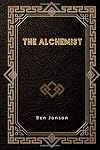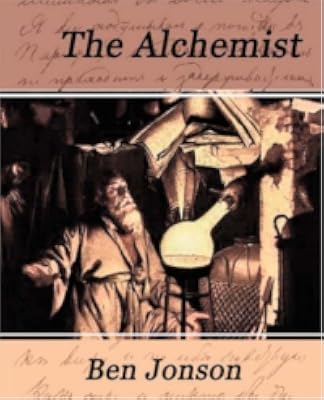
The Alchemist
by Ben Jonson
On This Page
Description
Samuel Taylor Coleridge said of Ben Jonson's The Alchemist that it had one out of the three most perfect plots in literature. This play, with its sharp portrayal of human folly, is considered by many to be Jonson's best comedy. First performed 1610, its popularity has endured to this day.Tags
Recommendations


















Member Reviews
Despite the title and subject matter, there's nothing much of esoteric interest in this play. (Well, if you take Face as Yesod, Subtle as Hod, and Dol as Netzach ... but, no.) It is a fairly fascinating Elizabethan satire, though. It would be great fun to see it staged, though I can't recall having noted any productions in recent memory. It's probably confined to academic stages these days.
This edition features notes and glosses by English professor John McCollum, who reliably explains the obvious, and leaves the obscure unremarked. Alchemical jargon is called out as "alchemical jargon," without any effort to clarify what it might actually mean in an alchemical context. McCollum also provides some useful biographical notes on Jonson.
This edition features notes and glosses by English professor John McCollum, who reliably explains the obvious, and leaves the obscure unremarked. Alchemical jargon is called out as "alchemical jargon," without any effort to clarify what it might actually mean in an alchemical context. McCollum also provides some useful biographical notes on Jonson.
The general gist of this play among commentators on Goodreads is that much of the humour is dated which is why they don't think the play works all that well. It is not so much that people seem to hate the play, but rather feel that the content belongs to the past. That, and the fact that Johnson is overshadowed by Shakespeare, though I would suggest that Johnson wrote in the generation after Shakespeare, meaning that while he was a contemporary, it seems that his career is mostly post-Shakespeare, and Johnson probably wrote up to the time when the Puritans closed down all of the theatres in England. In any case it is always going to be difficult to write plays that last when you are up against a behemoth like Shakespeare, since show more Shakespeare was always going to attract most of the attention, and most of your work is going to be left to those who what to explore the literature that existed around his time (much like me). In a way it is sort of like competing with a reviewer like Manny on Goodreads, who has such a huge following that pretty much the rest of us pail in comparison.
What attracted me to this play though was that it seemed to deal with ordinary people. Okay, Shakespeare had ordinary people in his plays as well, such as the soldiers in Henry V and Falstaff and company in the two Henry IV plays. However, the main focus of his plays tended to be on the princes and kings (with maybe the exception of Henry IV where Prince Harry spends a lot of time mingling with the commoners). I remember one of the things that came out of history when I was in university was that there was the development of an interest in the lives of the commoners. In a way, history was moving away from being little more than dates and dead people, and beginning to be a sociological examination of the lives of people at the time. For instance I remember that in high school and university, the lecturer would give us a lecture on the common feudal village that existed at the time. However, with me, being young, impressionable, and into Dungeons and Dragons, when I did history all I wanted to learn about wars and heroes, not about how peasant kids would be beaten by their fathers in the paddock so that they would know where to grow their crops.
However, as I grew up I come to understand that there is more to history than simply heroes and wars, and that the voice and life of the common people are actually quite silent. This changes as more people became literate and the ability to write developed, however back in Shakespeare's time the little people, namely the illiterate ones, would simply remain hidden from our eyes, and when they appeared, they would appear as the laughing stock, the comic relief, and the foil in the plans of the hero. We see this in Henry IV and we see this here, where the actual lives of the commoners are hidden behind a farcial display of comedy and tomfoolery.
The other thing that I wish to raise with regards to this play is that question of making mockery of alchemy. The idea behind alchemy may be dated, but the idea of mocking it is not. Take for instance the Big Bang Theory (that is the television show). Okay, this may not necessarily be what we have in the Alchemist (particularly since those guys are not a bunch of commoners that are trying to make money off of conning people into thinking that they can cure diseases and turn lead into gold) but it does show how playwrights and producers bring science, and even psuedo-science, into the world of comedy. In fact, much of what those guys (Sheldon et al) are studying could actually be considered psuedo-science since much of it is based upon mathematical assumptions and hypothesis, and in many cases these theories are little more than educated guesses. For instance, Einstein's theory of relativity is actually still just that, a theory. show less
What attracted me to this play though was that it seemed to deal with ordinary people. Okay, Shakespeare had ordinary people in his plays as well, such as the soldiers in Henry V and Falstaff and company in the two Henry IV plays. However, the main focus of his plays tended to be on the princes and kings (with maybe the exception of Henry IV where Prince Harry spends a lot of time mingling with the commoners). I remember one of the things that came out of history when I was in university was that there was the development of an interest in the lives of the commoners. In a way, history was moving away from being little more than dates and dead people, and beginning to be a sociological examination of the lives of people at the time. For instance I remember that in high school and university, the lecturer would give us a lecture on the common feudal village that existed at the time. However, with me, being young, impressionable, and into Dungeons and Dragons, when I did history all I wanted to learn about wars and heroes, not about how peasant kids would be beaten by their fathers in the paddock so that they would know where to grow their crops.
However, as I grew up I come to understand that there is more to history than simply heroes and wars, and that the voice and life of the common people are actually quite silent. This changes as more people became literate and the ability to write developed, however back in Shakespeare's time the little people, namely the illiterate ones, would simply remain hidden from our eyes, and when they appeared, they would appear as the laughing stock, the comic relief, and the foil in the plans of the hero. We see this in Henry IV and we see this here, where the actual lives of the commoners are hidden behind a farcial display of comedy and tomfoolery.
The other thing that I wish to raise with regards to this play is that question of making mockery of alchemy. The idea behind alchemy may be dated, but the idea of mocking it is not. Take for instance the Big Bang Theory (that is the television show). Okay, this may not necessarily be what we have in the Alchemist (particularly since those guys are not a bunch of commoners that are trying to make money off of conning people into thinking that they can cure diseases and turn lead into gold) but it does show how playwrights and producers bring science, and even psuedo-science, into the world of comedy. In fact, much of what those guys (Sheldon et al) are studying could actually be considered psuedo-science since much of it is based upon mathematical assumptions and hypothesis, and in many cases these theories are little more than educated guesses. For instance, Einstein's theory of relativity is actually still just that, a theory. show less
This was an underwhelming play. While it started well, the play did not continue in that fashion. For the amount of effort that is required to read a play that is this old, I do not think it is worth the effort for most readers-- just my opinion.
After many years I've just re-read this lovely play. I'd forgotten most of the trickery and comedy. Loved it.
There's just really not much to say about The Alchemist.
It has the one-dimensional characters of a morality play. The language is uninteresting; the wordplay is not clever enough to have an enduring quality. The plot is barely worth mentioning: an academic, a bawd, and a butler perpetrate a series of frauds based around the claim they can produce The Philosopher's Stone.
Clearly a base crowd-pleaser that hasn't aged well. Jonson can do so much better.
It has the one-dimensional characters of a morality play. The language is uninteresting; the wordplay is not clever enough to have an enduring quality. The plot is barely worth mentioning: an academic, a bawd, and a butler perpetrate a series of frauds based around the claim they can produce The Philosopher's Stone.
Clearly a base crowd-pleaser that hasn't aged well. Jonson can do so much better.
Clever play, unsatisfying ending
Ellis Quint cutting off horses hocks
Members
- Recently Added By
Lists

Best Early Modern Plays Not By Shakespeare
78 works; 8 members

Early Modern (Shakesperean)
64 works; 2 members

Greatest Books, allegedly
484 works; 9 members

Recommended Reading : 600 Classics Reviewed, Editors of Salem Press, 2015
634 works; 6 members
My Play Collection
769 works; 3 members
Author Information

267+ Works 5,653 Members
Born in 1572, Ben Jonson rejected his father's bricklaying trade and ran away from his apprenticeship to join the army. He returned to England in 1592, working as an actor and playwright. In 1598, he was tried for murder after killing another actor in a duel, and was briefly imprisoned. One of his first plays, Every Man Out of His Humor (1599) had show more fellow playwright William Shakespeare as a cast member. His success grew with such works as Volpone (1605) and The Alchemist (1610) and he was popular at court, frequently writing the Christmas masque. He is considered a very fine Elizabethan poet. In some anti-Stratfordian circles he is proposed as the true author of Shakespeare's plays, though this view is not widely accepted. Jonson was appointed London historian in 1628, but that same year, his life took a downward turn. He suffered a paralyzing stroke and lost favor at court after an argument with architect Inigo Jones and the death of King James I. Ben Jonson died on August 6, 1637. (Bowker Author Biography) show less
Some Editions
Awards and Honors
Notable Lists
Series
Belongs to Publisher Series
Work Relationships
Is contained in
Contains
Has as a supplement
Has as a commentary on the text
Common Knowledge
- Original title
- The Alchemist
- Original publication date
- 1610 (first performance) (first performance)
- People/Characters
- Ben Jonson
- Original language
- English
Classifications
Statistics
- Members
- 533
- Popularity
- 55,956
- Reviews
- 8
- Rating
- (3.61)
- Languages
- 5 — Dutch, English, French, Italian, Spanish
- Media
- Paper, Audiobook, Ebook
- ISBNs
- 95
- ASINs
- 22