On This Page
Description
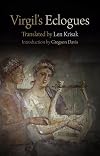
Publius Vergilius Maro (70-19 B.C.), known in English as Virgil, was perhaps the single greatest poet of the Roman empire-a friend to the emperor Augustus and the beneficiary of wealthy and powerful patrons. Most famous for his epic of the founding of Rome, the Aeneid, he wrote two other collections of poems: the Georgics and the Bucolics, or Eclogues.The Eclogues were Virgil's first published poems. Ancient sources say that he spent three years composing and revising them at about the age show more of thirty. Though these poems begin a sequence that continues with the Georgics and culminates in the Aeneid, they are no less elegant in style or less profound in insight than the later, more extensive works. These intricate and highly polished variations on the idea of the pastoral poem, as practiced by earlier Greek poets, mix political, social, historical, artistic, and moral commentary in musical Latin that exerted a profound influence on subsequent Western poetry.Poet Len Krisak's vibrant metric translation captures the music of Virgil's richly textured verse by employing rhyme and other sonic devices. The result is English poetry rather than translated prose. Presenting the English on facing pages with the original Latin, Virgil's Eclogues also features an introduction by scholar Gregson Davis that situates the poems in the time in which they were created. show lessTags
Recommendations












Member Recommendations
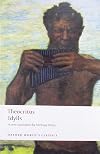
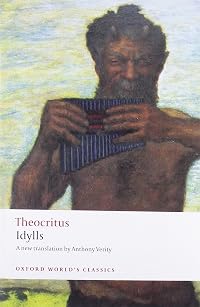
Idylls by Theocritus
dirkjohnson This is the foundation work of the genre in which the Bucolics are placed. Virgil largely copied several of his poems from the Greek of Theocritus.
Member Reviews
These poems provide the foundation for a definition of pastoral. Virgil's book contains ten pieces, each called not an idyll but an eclogue, populated by and large with herdsmen imagined conversing and singing in largely rural settings, whether suffering or embracing revolutionary change or happy or unhappy love. They are inviting and easy to like, both attractive and intelligent. This was from early in Virgil's career and he is already an accomplished poet. The eclogues, written under the patronage of Maecenas, are called the Bucolics or country poems even though they are really highly civilized set pieces. Like much of Roman literature they look back to Greek examples, in this case that of Theocritus, the Greek poet of the third show more century B.C.
They highlight individual characters like Meliboeus and Tityrus in Eclogue 1. Here Virgil uses the two herdsmen to convey issues of power and its opposite. In Eclogue 2 Corydon and Alexis demonstrate the power of passion. Corydon coaxes Alexis saying, "O come and live with me in the countryside among the humble farms." (p 13) Virgil is able to consider the result of erotic passion with some detachment through his use of homosexual passion in this country setting. Perhaps the best known of the Eclogues is number four which foretells of a son to be born to Antony and Octavia. Alas this event was not fated to happen and the birth prophesied would later be interpreted as one of a completely different boy, one who would have a career that outlived both the poet Virgil and Rome's empire if not her culture.
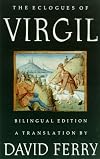
Through the eclogues as a whole there is the exploration of the idea of the nature of the pastoral, its innocence and seeming edenic being in comparison with the urban life of Virgil and most of his audience. In David Ferry's beautiful translation these verses come alive in a contemporary idiom. As Michael Dirda has said, this is a "volume to buy, read , and treasure." show less
They highlight individual characters like Meliboeus and Tityrus in Eclogue 1. Here Virgil uses the two herdsmen to convey issues of power and its opposite. In Eclogue 2 Corydon and Alexis demonstrate the power of passion. Corydon coaxes Alexis saying, "O come and live with me in the countryside among the humble farms." (p 13) Virgil is able to consider the result of erotic passion with some detachment through his use of homosexual passion in this country setting. Perhaps the best known of the Eclogues is number four which foretells of a son to be born to Antony and Octavia. Alas this event was not fated to happen and the birth prophesied would later be interpreted as one of a completely different boy, one who would have a career that outlived both the poet Virgil and Rome's empire if not her culture.
Through the eclogues as a whole there is the exploration of the idea of the nature of the pastoral, its innocence and seeming edenic being in comparison with the urban life of Virgil and most of his audience. In David Ferry's beautiful translation these verses come alive in a contemporary idiom. As Michael Dirda has said, this is a "volume to buy, read , and treasure." show less
Meant to be wonderful, but sorry I just can't see it.
"[So much] has my relish for poetry deserted me that at present I cannot read Virgil with pleasure." - Thomas Jefferson to John Daly Burk, 21 Jun. 1801 [PTJ 34:400-401]
"your Latin & Greek should be kept up assiduously by reading at spare hours: and, discontinuing the desultory reading of the schools. I would advise you to undertake a regular course of history & poetry in both languages ... in Latin read Livy, Caesar, Sallust Tacitus, Cicero’s Philosophies, and some of his Orations, in prose; and Virgil, Ovid’s Metamorphoses, Horace, Terence & Juvenal for poetry." - Thomas Jefferson to Francis Eppes, 6 Oct. 1820
"your Latin & Greek should be kept up assiduously by reading at spare hours: and, discontinuing the desultory reading of the schools. I would advise you to undertake a regular course of history & poetry in both languages ... in Latin read Livy, Caesar, Sallust Tacitus, Cicero’s Philosophies, and some of his Orations, in prose; and Virgil, Ovid’s Metamorphoses, Horace, Terence & Juvenal for poetry." - Thomas Jefferson to Francis Eppes, 6 Oct. 1820
A dual-language version. Gave this to Kelsey, Latin fan.
this casme in by error, I haven't seen it yet, and this record doesn't tell us much.
Edition: // Descr: xxviii, 154 p. : ill. 15 cm. // Series: Elementary Classics Call No. { 873 V81 4 c. #3. } Edited, with Notes & Vocabualry, for the Use of Schools by T.E. Page. // //
2016 (very brief review can be found at the link - which is a LibraryThing page)
https://www.librarything.com/topic/226898#5820620
https://www.librarything.com/topic/226898#5820620
Members
- Recently Added By
Author Information

544+ Works 38,753 Members
Virgil was born on October 15, 70 B.C.E., in Northern Italy in a small village near Mantua. He attended school at Cremona and Mediolanum (Milan), then went to Rome, where he studied mathematics, medicine and rhetoric, and finally completed his studies in Naples. He entered literary circles as an "Alexandrian," the name given to a group of poets show more who sought inspiration in the sophisticated work of third-century Greek poets, also known as Alexandrians. In 49 BC Virgil became a Roman citizen. After his studies in Rome, Vergil is believed to have lived with his father for about 10 years, engaged in farm work, study, and writing poetry. After the battle of Philippi in 42 B.C.E. Virgil¿s property in Cisalpine Gaul, was confiscated for veterans. In the following years Virgil spent most of his time in Campania and Sicily, but he also had a house in Rome. During the reign of emperor Augustus, Virgil became a member of his court circle and was advanced by a minister, Maecenas, patron of the arts and close friend to the poet Horace. He gave Virgil a house near Naples. Between 42 and 37 B.C.E. Virgil composed pastoral poems known as Bucolic or Eclogues and spent years on the Georgics. The rest of his life, from 30 to 19 B.C., Virgil devoted to The Aeneid, the national epic of Rome, and the glory of the Empire. Although ambitious, Virgil was never really happy about the task. Virgil died in 19 B. C. (Bowker Author Biography) show less
Some Editions
Series

Belongs to Publisher Series
Work Relationships
Is contained in
Is an adaptation of
Common Knowledge
- Canonical title
- The Eclogues or Bucolics (translations) (translations)
- Original title
- Eclogae
- Alternate titles
- The Pastoral Poems; The Bucolics
- Original publication date
- ca. 37 BCE
- First words
- Stretched in the shadow of the broad beech, thou rehearsest, Tityrus, on the slender pipe thy woodland music. (Calverley trans.)
Tityrus, lying back beneath wide beechen cover,
you meditate the woodland muse on slender oat. (Lee trans.) - Last words
- (Click to show. Warning: May contain spoilers.)Go -- the star of morning breaks -- go home, my full-fed sheep. (Calverley trans.)
Classifications
- Genres
- Poetry, Fiction and Literature
- DDC/MDS
- 871.01 — Literature & rhetoric Latin & Italic literatures Latin poetry Latin poets Classical period to 500CE
- LCC
- PA6807 .B7 — Language and Literature Greek language and literature. Latin language and literature Roman literature Individual authors Vergilius Maro, Publius (Virgil)
- BISAC
Statistics
- Members
- 920
- Popularity
- 29,228
- Reviews
- 11
- Rating
- (3.55)
- Languages
- 15 — Basque, Catalan, Czech, Dutch, English, Estonian, Finnish, French, German, Italian, Latin, Multiple languages, Portuguese, Spanish, Turkish
- Media
- Paper, Audiobook, Ebook
- ISBNs
- 97
- ASINs
- 46