The Savage
by David Almond
On This Page
Description
A boy tells about a story he wrote when dealing with his father's death about a savage kid living in a ruined chapel in the woods--and the tale about the savage kid coming to life in the real world.Tags
Recommendations

Member Recommendations
Member Reviews
I have always enjoyed the metaphysical nature of David Almond's books, this one included.
Blue is a boy whose dad recently passed away, giving the local bully, Hopper, even more reasons to target Blue. When his guidance counselor suggests writing as a way to deal with his grief, Blue finds that writing a story about "Savage" and drawing him does help. The story of Savage, as written & illustrated by Blue, is included within the now-older-narrator-Blue's story. When Savage comes to life and goes to Hopper's house in the night, intending to kill him, but only beating him up, readers are left wondering...
Is Savage Blue's alter-ego? Is Savage the dark-side of Blue and only in his imagination? Are Blue and Savage the same person - two sides show more of one coin? The questions resonate with readers and we are left thinking...and thinking some more.
To me, the hallmark of a great book is this quality - does it make me THINK and does it stay with me and continue to make me THINK. has done this for me.
Geared toward middle readers, the graphic novel format, the story-within-a-story mode, and the real topics of grief and bullying are a well-done combo. show less
Blue is a boy whose dad recently passed away, giving the local bully, Hopper, even more reasons to target Blue. When his guidance counselor suggests writing as a way to deal with his grief, Blue finds that writing a story about "Savage" and drawing him does help. The story of Savage, as written & illustrated by Blue, is included within the now-older-narrator-Blue's story. When Savage comes to life and goes to Hopper's house in the night, intending to kill him, but only beating him up, readers are left wondering...
Is Savage Blue's alter-ego? Is Savage the dark-side of Blue and only in his imagination? Are Blue and Savage the same person - two sides show more of one coin? The questions resonate with readers and we are left thinking...and thinking some more.
To me, the hallmark of a great book is this quality - does it make me THINK and does it stay with me and continue to make me THINK. has done this for me.
Geared toward middle readers, the graphic novel format, the story-within-a-story mode, and the real topics of grief and bullying are a well-done combo. show less
 This review was written for LibraryThing Early Reviewers.
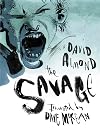
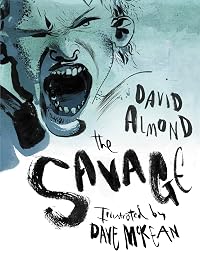
This story by David Almond and illustrated by Dave McKean is a beautiful telling of a story of grief and reconciliation. Having loved Skellig, I was also prepared for something unusual because the cover shows a child yelling—in pain? In a manical attack? The story and the illustrations seem to be seamless, conjoining of written word and picture, each complementing the other. Blue’s father has died and the school counselor advises Blue to write out his feelings. Blue is sharing the book he wrote, complete with spelling and other errors, with the reader. Blue eventually writes about a wild boy who lives in the nearby woods and who has adventures but is also capable of facing down the local bully. At some point for Blue, the difference show more between his reality and the story he’s writing begin to blur, and Blue realizes there is some interaction between his creation and himself. In one sense, this is similar to classic (and I mean the non-politically correct) fairy stories which were meant to scare and teach. Blue’s creation is scary, but he helps Blue make sense of his world, and Blue to help his mother and sister. This is not a book for small children, but for tweeners and older, especially those having some issue in life, this might be an excellent choice. show less
The Savage written by David Almond and illustrated by Dave McKean is a gripping hybrid novel that mixes story, art, and emotion in a really powerful way.
The author employs a shifting point of view, switching back and forth from our protagonist Blue’s real world to the Savage’s fictional world of Blue’s creation, until the two finally blend into one. Blue’s story is told in first person—with Blue speaking directly to the reader about losing his dad and trying to deal with all the anger and sadness that came after—while the Savage’s story is told in third person.
The author uses childlike misspellings, mixed-media illustrations with watercolor, gouache, and ink sketches, as well as changing fonts to help tell the story. In show more Blue’s real world, the font is neat and controlled, but when it switches to the Savage’s story, the font gets messy, uneven, and even backwards sometimes. The artwork and rough style highlight the dark, emotional tone of Blue’s writing/emotions.
The Savage himself serves as symbolism for Blue’s feelings of loss, grief, rage, and being so changed by his loss that he doesn’t relate to other people anymore. The violence of the Savage shows the rage and sorrow that Blue doesn’t know how to express otherwise. The softness that the Savage shows towards Blue and his family represents Blue’s own desire to tame his anger and sadness and find that feeling of belonging again.
Blue’s character development is important, because it shows how creativity and storytelling can help process pain in a way that confronting it directly sometimes can’t. When his counselor suggests he try writing down his feelings, Blue doesn’t think that works at all. However, through the story of the Savage, Blue starts to face his grief and understand himself better—even if he doesn’t realize it right away.
The Savage left me speechless. It’s a deeply human tale of love, loss, and healing, that anyone that has grappled with close personal loss will find moving and relatable. show less
The author employs a shifting point of view, switching back and forth from our protagonist Blue’s real world to the Savage’s fictional world of Blue’s creation, until the two finally blend into one. Blue’s story is told in first person—with Blue speaking directly to the reader about losing his dad and trying to deal with all the anger and sadness that came after—while the Savage’s story is told in third person.
The author uses childlike misspellings, mixed-media illustrations with watercolor, gouache, and ink sketches, as well as changing fonts to help tell the story. In show more Blue’s real world, the font is neat and controlled, but when it switches to the Savage’s story, the font gets messy, uneven, and even backwards sometimes. The artwork and rough style highlight the dark, emotional tone of Blue’s writing/emotions.
The Savage himself serves as symbolism for Blue’s feelings of loss, grief, rage, and being so changed by his loss that he doesn’t relate to other people anymore. The violence of the Savage shows the rage and sorrow that Blue doesn’t know how to express otherwise. The softness that the Savage shows towards Blue and his family represents Blue’s own desire to tame his anger and sadness and find that feeling of belonging again.
Blue’s character development is important, because it shows how creativity and storytelling can help process pain in a way that confronting it directly sometimes can’t. When his counselor suggests he try writing down his feelings, Blue doesn’t think that works at all. However, through the story of the Savage, Blue starts to face his grief and understand himself better—even if he doesn’t realize it right away.
The Savage left me speechless. It’s a deeply human tale of love, loss, and healing, that anyone that has grappled with close personal loss will find moving and relatable. show less
THE SAVAGE is a story about storytelling, its magic, and its redemptive power. The illustrations by Dave McKean are both haunting and laugh-out-loud funny. The text is mesmerizing. Clearly, others disagree, but I found it a realistic depiction of a child and his relationship with violence. Pure magic.
This graphic novel far exceeded my expectations. The book addresses many topics which young readers can relate with or have experienced, such as confusion, frustration, loneliness, or misunderstanding. This book teaches about feeling "sad, small, frightened, furious, bitter, lost, and lonely," (50) but it ultimately expresses the importance of choosing tenderness, compassion, and care over violence or revenge. The book contains important messages about bullying, justice, and emotional regulation. It also addresses death, the grieving process, and finding reconciliation with the past through healing. The narrator states "Somehow I knew my wounds would heal, that my sadness would start to fade." (76) It celebrates the triumph of choosing show more and gravitating towards "good," while steering clear and away from "bad." The story ends with the strong message that love is eternal and continues forever, even past our own lifetimes. This book is truly phenomenal, and I highly recommend it as a graphic novel for young adults or more mature children. show less
I picked this up because I love Dave McKean's art, and I've enjoyed the books he's made in collaboration with Neil Gaiman. His art here is wonderfully surreal and dark, with lovely layers of atmospheric ink wash and strong black brushstrokes. His characters have faces that sometimes look like tribal masks from Africa or the Inuit. I loved looking at it and trying to pick apart how he drew each page.
This book is an interesting intersection of feral child stories and childrens' monster myths, combined with a compelling story about coping with the rage and frustration of being bullied. It touches on violence and cannibalism that might startle some straitlaced parents (also true of a lot of kid-generated content) and I don't think show more middle-school readers will feel pandered to, or as if they're subject to an author trying to teach them An Important Lesson. show less
This book is an interesting intersection of feral child stories and childrens' monster myths, combined with a compelling story about coping with the rage and frustration of being bullied. It touches on violence and cannibalism that might startle some straitlaced parents (also true of a lot of kid-generated content) and I don't think show more middle-school readers will feel pandered to, or as if they're subject to an author trying to teach them An Important Lesson. show less
Another exceptional and quietly moving work of lyrical prose by David Almond, this time enhanced by the graphic illustrations of Dave McKean. Narrated by Blue, a boy mourning the sudden death of his father, this short graphic novel is a story within a story, as Blue writes his own tale about the Savage, a feral boy he imagines lives in his town. In the hands of a lesser author, the narrative might have become a muddled mess, but from Almond's pen, the result is a superb blend of fantasy and truth in which young Blue discovers that he and the Savage have more in common than he realized. The work's one shortcoming - and the reason it doesn't merit a 5-star rating - is the inconsistency of the ink-and Photoshop illustrations, which are show more occasionally nondescript and add little to the story, though Almond's effortless skill carries it all. show less
This review was written for LibraryThing Early Reviewers.Members
- Recently Added By
Author Information

60+ Works 10,746 Members
David Almond was born on May 15, 1951 in the United Kingdom. He writes novels for children and young adults including The Savage, Slog's Dad, My Name Is Mina, The Boy Who Swam with Piranhas, and The Tightrope Walkers. He has received numerous awards including the Carnegie Medal for Skellig, two Whitbread Awards, the Michael L. Printz Award for show more young-adult books for Kit's Wilderness, the Smarties Prize and the Boston Globe Horn Book Award for The Fire-Eaters, the 2015 Guardian Children's Fiction Prize for A Song for Ella Grey, and the Hans Christian Andersen Award. (Bowker Author Biography) show less
Awards and Honors
Awards
Distinctions
Common Knowledge
- First words
- You won't believe this but it's true. I wrote a story called "The Savage" about a savage kid that lived under the ruined chapel in Burgess Woods, and the kid that came to life in the real world.
Classifications
- Genres
- Tween, Fiction and Literature, Graphic Novels & Comics
- DDC/MDS
- 823.914 — Literature & rhetoric English & Old English literatures English fiction 1900- 1901-1999 1945-1999
- LCC
- PZ7 .A448 .S — Language and Literature Fiction and juvenile belles lettres Fiction and juvenile belles lettres Juvenile belles lettres
- BISAC
Statistics
- Members
- 362
- Popularity
- 86,752
- Reviews
- 34
- Rating
- (3.69)
- Languages
- English, French, Italian, Spanish
- Media
- Paper, Audiobook
- ISBNs
- 11
- ASINs
- 2