On This Page
Description
In 1852, forced by the United States government to leave their beloved Island of the Golden Breasted Woodpecker, fourteen-year-old Omokayas and her Ojibwe family travel in search of a new home.Tags
Recommendations










Member Reviews
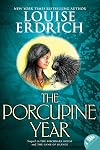
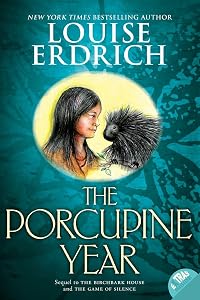
The Porcupine Year, sequel to The Birchbark House and The Game of Silence, continues the adventures of an Anishinabe, or Ojibwe girl, Omakayas (Little Frog). In The Porcupine Year, so named for the porcupine “medicine animal” that befriends Omakayas’ brother, Omakayas is now twelve years old and is traveling with her family in 1852. The U.S. government is moving the native people ever westward, and Omakayas’ family hopes to join their relatives somewhere northwest of their homeland in current-day Minnesota.
In third person narration, The Porcupine Year recounts a year in the lives of the Anishinabe family. True to the Native American view of life as a circle, the book begins in spring and ends full-circle in the following spring. show more During that time, Omakaya’s annoying younger brother, Pinch, matures into a resourceful boy named Quill, Omakayas herself, earns a new name, Leading Thunderbird Woman, and the family endures hardship and adventure on the trail west. Native American culture is woven seamlessly into the story, and is experienced through context, rather than explanation. When Omakayas and Pinch narrowly survive a trip through dangerous rapids, the reader completely understands the symbolism behind Omakayas’ decision to leave her precious red beads on a rock by the river as a gesture of thankfulness. Native words are sprinkled liberally throughout the story, but few will send readers to the included glossary,
“’We should continue north, giiwedin,’ said Old Tallow. ‘Few chimookomanag have made their homes in the great woods and lakes. We don’t want them to kick us out again!’
‘I still think that my brother might come through this way,’ said Deydey. ‘This is our old stomping ground. We hunted here long ago, But now…’
‘Game is getting scarce.’
‘There is always good fishing on this lake. But I think we are camped close to the big path of our enemies, the Bwaanag. If their warriors come across us on their way back to their homes, after a raid – mad that they got nothing, howah! – we’d be in big trouble.’”
Native culture is also evident in the respect that Omakayas and the other children have for their elders. The Porcupine Year, is not, however, a novel that merely glorifies the Indian way of life and excoriates the Whites. Rather, Porcupine Year is an honest novel that treats each person individually. Although the whites are understandably blamed for the Anishinabe’s forced migration, the family readily takes in two white children that have been left homeless orphans after a fire. Omakayas’ father is half-white himself. Later, it is a relative from their own tribe that steals from Little Frog’s family, and members of the fierce Bwaanag tribe that kidnap members of the family. As in all cultures, there are good and evil people, and Erdrich does not shy from presenting both types.
Overall, however, The Porcupine Year is not a Native American story, it is the story of a girl…
a girl with a darling baby brother, a girl in a budding romance with a local boy, a girl seeking the approval of her father, a girl with a stern but loving mother, a pesky younger brother, a doting grandmother and a mean-spirited cousin. In short, a girl like any other girl - a girl that readers will understand.
The Porcupine Year is not as deep and soul-searching as the multiple award-winning, Birchbark House, but its faster pace and shorter length (193 pages) makes it more accessible to younger or less-avid readers. The Porcupine Year can easily be read on its own, without its prequels. Some Native American legends are included as stories within the story; a glossary of Ojibwe words and author’s notes conclude the book. Pencil illustrations are by the author. Highly recommended for fans of adventure, historical fiction, coming-of-age, and Native American books. Grades 5 and up. show less
In third person narration, The Porcupine Year recounts a year in the lives of the Anishinabe family. True to the Native American view of life as a circle, the book begins in spring and ends full-circle in the following spring. show more During that time, Omakaya’s annoying younger brother, Pinch, matures into a resourceful boy named Quill, Omakayas herself, earns a new name, Leading Thunderbird Woman, and the family endures hardship and adventure on the trail west. Native American culture is woven seamlessly into the story, and is experienced through context, rather than explanation. When Omakayas and Pinch narrowly survive a trip through dangerous rapids, the reader completely understands the symbolism behind Omakayas’ decision to leave her precious red beads on a rock by the river as a gesture of thankfulness. Native words are sprinkled liberally throughout the story, but few will send readers to the included glossary,
“’We should continue north, giiwedin,’ said Old Tallow. ‘Few chimookomanag have made their homes in the great woods and lakes. We don’t want them to kick us out again!’
‘I still think that my brother might come through this way,’ said Deydey. ‘This is our old stomping ground. We hunted here long ago, But now…’
‘Game is getting scarce.’
‘There is always good fishing on this lake. But I think we are camped close to the big path of our enemies, the Bwaanag. If their warriors come across us on their way back to their homes, after a raid – mad that they got nothing, howah! – we’d be in big trouble.’”
Native culture is also evident in the respect that Omakayas and the other children have for their elders. The Porcupine Year, is not, however, a novel that merely glorifies the Indian way of life and excoriates the Whites. Rather, Porcupine Year is an honest novel that treats each person individually. Although the whites are understandably blamed for the Anishinabe’s forced migration, the family readily takes in two white children that have been left homeless orphans after a fire. Omakayas’ father is half-white himself. Later, it is a relative from their own tribe that steals from Little Frog’s family, and members of the fierce Bwaanag tribe that kidnap members of the family. As in all cultures, there are good and evil people, and Erdrich does not shy from presenting both types.
Overall, however, The Porcupine Year is not a Native American story, it is the story of a girl…
a girl with a darling baby brother, a girl in a budding romance with a local boy, a girl seeking the approval of her father, a girl with a stern but loving mother, a pesky younger brother, a doting grandmother and a mean-spirited cousin. In short, a girl like any other girl - a girl that readers will understand.
The Porcupine Year is not as deep and soul-searching as the multiple award-winning, Birchbark House, but its faster pace and shorter length (193 pages) makes it more accessible to younger or less-avid readers. The Porcupine Year can easily be read on its own, without its prequels. Some Native American legends are included as stories within the story; a glossary of Ojibwe words and author’s notes conclude the book. Pencil illustrations are by the author. Highly recommended for fans of adventure, historical fiction, coming-of-age, and Native American books. Grades 5 and up. show less
A beautiful, engrossing coming-of-age story, which casually treads the line between myth and realism. Omakayas and her family are each interesting, unpredictable, and worth spending time with.
My 9-year-old daughter loves this book. I just listened to it with my 11-year-old son, and we enjoyed it quite a bit also. I hadn't realized until now that it was part of a series; I'll definitely seek out the others.
My 9-year-old daughter loves this book. I just listened to it with my 11-year-old son, and we enjoyed it quite a bit also. I hadn't realized until now that it was part of a series; I'll definitely seek out the others.
1852 - “… a year of flight and adventure, pain and joy…” for Omakayas and her family. Beautiful map on the inside cover details their journey! And another beautiful story to read in this series, even with all of the sadness and hardships. And amongst those, Omakayas starts dating, wherein the quote below made me laugh, as I am a father:
“As long as we hear that flute, she’s safe! But the minute he stops, go and find my daughter.” Said every father ever!
“…remembering all that happened in that year of danger and love, sacrifice and surprise - that porcupine year.” The year Omakayas became a healer and a woman. The year Pinch gets a new name and a pet! The year famine gets a member of their family. A beautiful and a show more terrible year. Can't wait for the next book! show less
“As long as we hear that flute, she’s safe! But the minute he stops, go and find my daughter.” Said every father ever!
“…remembering all that happened in that year of danger and love, sacrifice and surprise - that porcupine year.” The year Omakayas became a healer and a woman. The year Pinch gets a new name and a pet! The year famine gets a member of their family. A beautiful and a show more terrible year. Can't wait for the next book! show less
Very well done chronicle of Ojibwe life as the tribes were being displaced during the colonization of America. Good story, in the way that Little House and Bo at Ballard Creek and Dancing at the Odinochka are good stories -- daily life historical fiction is always appealing to me.
A continuation of two other books to start this series, also a children’s book, set in the mid-1800s, focusing on a young Anishinaabe/Ojibwe girl, Omakayas (Little Frog). This follows another year in her life. Initially she and her younger brother get caught up in some rapids in their canoe and are not sure where they’ve ended up. They do find their way back to their family (who has found some beads belonging to Omakayas and fear the two have died!), along with a pet baby porcupine! Other happenings include coming across a wildfire (as they travel toward more family living elsewhere) and “adopting” two white children. Later on the group is ambushed and robbed, leaving them to struggle to survive.
I didn’t like this one as much show more as the first two, though that little porcupine was cute!I hate that had to leave the little guy behind at one point while he slept. *sniff *sniff. . I’m not sure why this one didn’t hold my interest as well as the first two in the series, but I did lose focus a few times. (Note: I was not listening to an audio, so can’t blame it on that.) I will continue the series, however. show less
I didn’t like this one as much show more as the first two, though that little porcupine was cute!
(#6 in the 2009 Book Challenge)
Lovely, lovely story about an Ojibwe family living in the mid-19th century who are migrating westward as American settlers are slowing encroaching on traditional native lands. This is the third in a series. They're compared a lot to the Little House books, and there is something satisfying about seeing roughly the same era from the point of view of Native people. The illustrations even have a Garth Williams feel to them. Most of the action is from the view of 12 year old Omakayas, and includes fun and light-hearted moments as well as the more serious hardships faced by the Ojibwe. Even though there is a lot of good and interesting information about how this particular Indian tribe lived, it always feels show more easy to relate Omakayas's experiences to things that might happen in any family. After reading this book, I was so attached to the porcupine that I'm now having separation anxiety. There was one small detail that is simply nagging at me though, and it says more about me than the book I'm sure ... but at one point Omakayas is holding her baby brother and he is described as limp like a noodle. Would an Ojibwe person in 1850 have any experience with noodles? Enough to use them in a simile? This seriously kept me up at night.
Grade: A-
Recommended: To fans of the Little House books and people who like American historical fiction. I would say that people who like Erdrich's adult literature would enjoy seeing what she does with a children's series. show less
Lovely, lovely story about an Ojibwe family living in the mid-19th century who are migrating westward as American settlers are slowing encroaching on traditional native lands. This is the third in a series. They're compared a lot to the Little House books, and there is something satisfying about seeing roughly the same era from the point of view of Native people. The illustrations even have a Garth Williams feel to them. Most of the action is from the view of 12 year old Omakayas, and includes fun and light-hearted moments as well as the more serious hardships faced by the Ojibwe. Even though there is a lot of good and interesting information about how this particular Indian tribe lived, it always feels show more easy to relate Omakayas's experiences to things that might happen in any family. After reading this book, I was so attached to the porcupine that I'm now having separation anxiety. There was one small detail that is simply nagging at me though, and it says more about me than the book I'm sure ... but at one point Omakayas is holding her baby brother and he is described as limp like a noodle. Would an Ojibwe person in 1850 have any experience with noodles? Enough to use them in a simile? This seriously kept me up at night.
Grade: A-
Recommended: To fans of the Little House books and people who like American historical fiction. I would say that people who like Erdrich's adult literature would enjoy seeing what she does with a children's series. show less
An American Indian family goes through many trials as they most move to a new home in the mid-1800s.
I picked this title up because I've enjoyed Erdrich's books for adults in the past and wanted to try one of her books for children. Somehow I missed the obvious note on the cover that this was part of a series. However, like with her books for adults, this book stood alone just fine; I did not feel like I was missing out by not having read the previous two books.
Some time has passed between when I finished reading this book and now that I'm finally sitting down to write a review. My memory is terrible for the details, but I recall that I quite enjoyed the book and read it pretty quickly. The main characters -- a sister and brother -- are show more quite likable, indeed even lovable. You root for them and their family as they try to resettle in a new land. Some moments are comic while others are dramatic; Erdrich writes them all so beautifully that they are quite touching.
Black-and-white drawings are scattered throughout the book. These are not strictly necessary, but children might enjoy how they break up the text occasionally. show less
I picked this title up because I've enjoyed Erdrich's books for adults in the past and wanted to try one of her books for children. Somehow I missed the obvious note on the cover that this was part of a series. However, like with her books for adults, this book stood alone just fine; I did not feel like I was missing out by not having read the previous two books.
Some time has passed between when I finished reading this book and now that I'm finally sitting down to write a review. My memory is terrible for the details, but I recall that I quite enjoyed the book and read it pretty quickly. The main characters -- a sister and brother -- are show more quite likable, indeed even lovable. You root for them and their family as they try to resettle in a new land. Some moments are comic while others are dramatic; Erdrich writes them all so beautifully that they are quite touching.
Black-and-white drawings are scattered throughout the book. These are not strictly necessary, but children might enjoy how they break up the text occasionally. show less
Members
- Recently Added By
Lists

Books for An American Girl Readers
58 works; 1 member
Author Information

71+ Works 45,380 Members
Karen Louise Erdrich was born on June 7, 1954 in Little Falls, Minnesota. Erdrich grew up in Wahpeton, North Dakota, where both of her parents were employed by the Bureau of Indian Affairs. She is a member of the Turtle Mountain Band of Chippewa. Erdrich graduated from Dartmouth College in 1976 with an AB degree, and she received a Master of Arts show more in creative writing from Johns Hopkins University in 1979. Erdrich published a number of poems and short stories from 1978 to 1982. In 1981 she married author and anthropologist Michael Dorris, and together they published The World's Greatest Fisherman, which won the Nelson Algren Award in 1982. In 1984 she won the National Book Critics Circle Award for Love Medicine, which is an expansion of a story that she had co-written with Dorris. Love Medicine was also awarded the Virginia McCormick Scully Prize (1984), the Sue Kaufman Prize (1985) and the Los Angeles Times Award for best novel (1985). In addition to her prose, Erdrich has written several volumes of poetry, a textbook, children's books, and short stories and essays for popular magazines. She has been the recipient of numerous awards for professional excellence, including the National Magazine Fiction Award in 1983 and a first-prize O. Henry Award in 1987. Erdrich has also received the Pushcart Prize in Poetry, the Western Literacy Association Award, the 1999 World Fantasy Award, and the Scott O'Dell Award for Historical Fiction in 2006. In 2007 she refused to accept an honorary doctorate from the University of North Dakota in protest of its use of the "Fighting Sioux" name and logo. Erdrich's novel The Round House made the New York Times bestseller list in 2013. Her other New York Times bestsellers include Future Home of the Living God (2017). (Bowker Author Biography) show less
Awards and Honors
Awards
Distinctions
Notable Lists
Series

Common Knowledge
- Original title
- The Porcupine Year
- Original publication date
- 2008
- People/Characters
- Omakayas; Quill (Pinch); Old Tallow; Nokomis
- Important places
- Madeline Island, Wisconsin, USA; Lake Superior; Minnesota, USA
- Dedication
- For Nenaa'ikiizhikok
Kiizh, my little blue - First words
- Here follows the story of a most extraordinary year in the life of an Ojibwe family and of a girl named Omakakiins, or "Omakayas," Little Frog, who lived a year of flight and adventure, pain and joy, in 1852, when the uncut f... (show all)orests of Minnesota still stretched, full and deep, west from the shores of Lake Superior.
- Last words
- (Click to show. Warning: May contain spoilers.)Omakayas had promised to make something for him, and now she smiled thoughtfully as she sorted the quills, remembering all that had happened in that year of danger and love, sacrifice and surprise—that porcupine year.
Classifications
- Genres
- Kids, Tween, Fiction and Literature, Children's Books
- DDC/MDS
- 813.54 — Literature & rhetoric American literature in English American fiction in English 1900-1999 1945-1999
- LCC
- PZ7 .E72554 .P — Language and Literature Fiction and juvenile belles lettres Fiction and juvenile belles lettres Juvenile belles lettres
- BISAC
Statistics
- Members
- 494
- Popularity
- 61,154
- Reviews
- 23
- Rating
- (4.02)
- Languages
- English
- Media
- Paper, Audiobook, Ebook
- ISBNs
- 18
- ASINs
- 2