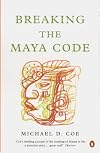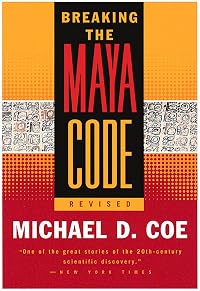
Breaking the Maya Code
by Michael D. Coe
On This Page
Description
The inside story of one of the major intellectual breakthroughs of our time - the last great decipherment of an ancient script. It will fascinate anyone interested in decipherment and puzzles as well as scholars of Maya civilization. The book has been revised and updated with the latest discoveries.Tags
Recommendations
















Member Reviews
"When Charlemagne was crowned Emperor by the Pope in St. Peter's in Rome, on Christmas Day in the year 800, Maya civilization was it its height: scattered throughout the jungle-covered lowlands of the Yucatán Peninsula were more than a dozen brilliant city-states, with huge populations, towering temple-pyramids and sophisticated royal courts. The arts, scientific learning, and, above all, writing flourished under royal patronage. Maya mathematicians and astronomers scanned the heavens, and tracked the planets as they moved across the background of the stars in the tropical night. Royal scribes --devotees of the twin Monkey-Man Gods -- wrote all this down in their bark-paper books, and inscribed the deeds of their kings, queens, and show more princes on stone monuments and the walls of their temples and palaces.
Even the mightiest empires have their day and finally crumble, awaiting resurrection by the archaeologist's spade. It was not long after 800 that things began to fall apart for the ancient Maya, who had enjoyed six centuries of prosperity during Europe's Dark Age, and city after city was abandoned to the encroaching forest. Then there was a final brief renaissance of lowland culture in northern Yucatán, to be followed by the final cataclysm brought about at the hands of the white foreigners from across the sea." pp. 48-49
I start with this long excerpt because it sets the stage for Michael Coe's story of how Maya writing was deciphered and because it shows his readable but scholarly approach. I picked up this book, which has sat on my TBR since October 17, 1992, according to the sales slip still inside it, because I recently enjoyed Margalit Fox's The Riddle of the Labyrinth about deciphering Linear B.
The central questions posed by this book are why it took so long to "break" the Maya code and what understanding their writing tells us about the Maya and their lives and preoccupations. In large part, this is an intellectual history of the people who tried to decipher the writing, and one of the enjoyable aspects of the book is the way Coe gently but pointedly describes where they went wrong, as when he remarks, about an extremely influential researcher in the field, "It as though someone were pursing a career in evolutionary biology, and decided to ignore Darwin."
The story of decoding Maya writing is at once a comedy of errors, a tale of opportunities missed and what Coe calls "stumbling blocks," a story of chance serendipities, and a look at the hard work of anthropologists and linguists. Writing can be logographic (using symbols for words or the smallest parts of words, called morphemes), syllabic (with symbols for consonant-vowel combinations), or alphabetic (like ours). At first, Mayan writing was thought to be logographic, although a 16th century Spanish priest, Bishop Landa, wrote down syllabic and alphabetic sounds associated with different glyphs and images; his work was lost for centuries but proved helpful much later in confirming interpretations arrived at using other methods.
By the time Coe, a Yale anthropology professor, wrote this book in 1992, researchers had finally broken the code, learning that although there are glyphs that represent individual people and other words, most of them are syllabic and used in combinations. They were finally able to read the inscriptions on monuments, and thus learned that they were neither all dates (the Mayans had an amazing obsession with dates) or all astronomical observations (ditto), as had been previously hypothesized, but detailed the accession of rulers to power, their genealogical heritage, their capture of prisoners, their somewhat bloody rituals, and more. I have no doubt that in the 20+ years since, much more has been discovered, but this is a fascinating tale of real people and real research, as well as a portrait of very real people who lived more than a thousand years ago. One of the interesting findings to come out of this new understanding is the prestige associated with being a scribe, and their artistic leanings. As Coe writes:
"Now, the ancient Maya scribes could have written everything expressed in their language using only the syllabic signary -- but they did not, any more than did the Japanese with their kana signs, or the Sumerians and Hittites with their syllabaries, or the Egyptians with their stock of consonantal signs. The logograms just had too much prestige to abolish. And why should they have done so? 'One picture is worth a thousand words,' as the saying goes, and Maya logograms, like their Egyptian equivalents, are often remarkably pictorial and thus more immediately informative than a series of abstract phonetic signs: for example, the Maya could, and sometimes did, write out balam, "jaguar," syllabically as ba-la-m(a), but by using a jaguar's head for balam, the scribe could get his word across in a more dramatic fashion. p. 264
Coe lived through a dramatic breakthrough in understanding a fascinating culture and people. This book tells how it happened. show less
Even the mightiest empires have their day and finally crumble, awaiting resurrection by the archaeologist's spade. It was not long after 800 that things began to fall apart for the ancient Maya, who had enjoyed six centuries of prosperity during Europe's Dark Age, and city after city was abandoned to the encroaching forest. Then there was a final brief renaissance of lowland culture in northern Yucatán, to be followed by the final cataclysm brought about at the hands of the white foreigners from across the sea." pp. 48-49
I start with this long excerpt because it sets the stage for Michael Coe's story of how Maya writing was deciphered and because it shows his readable but scholarly approach. I picked up this book, which has sat on my TBR since October 17, 1992, according to the sales slip still inside it, because I recently enjoyed Margalit Fox's The Riddle of the Labyrinth about deciphering Linear B.
The central questions posed by this book are why it took so long to "break" the Maya code and what understanding their writing tells us about the Maya and their lives and preoccupations. In large part, this is an intellectual history of the people who tried to decipher the writing, and one of the enjoyable aspects of the book is the way Coe gently but pointedly describes where they went wrong, as when he remarks, about an extremely influential researcher in the field, "It as though someone were pursing a career in evolutionary biology, and decided to ignore Darwin."
The story of decoding Maya writing is at once a comedy of errors, a tale of opportunities missed and what Coe calls "stumbling blocks," a story of chance serendipities, and a look at the hard work of anthropologists and linguists. Writing can be logographic (using symbols for words or the smallest parts of words, called morphemes), syllabic (with symbols for consonant-vowel combinations), or alphabetic (like ours). At first, Mayan writing was thought to be logographic, although a 16th century Spanish priest, Bishop Landa, wrote down syllabic and alphabetic sounds associated with different glyphs and images; his work was lost for centuries but proved helpful much later in confirming interpretations arrived at using other methods.
By the time Coe, a Yale anthropology professor, wrote this book in 1992, researchers had finally broken the code, learning that although there are glyphs that represent individual people and other words, most of them are syllabic and used in combinations. They were finally able to read the inscriptions on monuments, and thus learned that they were neither all dates (the Mayans had an amazing obsession with dates) or all astronomical observations (ditto), as had been previously hypothesized, but detailed the accession of rulers to power, their genealogical heritage, their capture of prisoners, their somewhat bloody rituals, and more. I have no doubt that in the 20+ years since, much more has been discovered, but this is a fascinating tale of real people and real research, as well as a portrait of very real people who lived more than a thousand years ago. One of the interesting findings to come out of this new understanding is the prestige associated with being a scribe, and their artistic leanings. As Coe writes:
"Now, the ancient Maya scribes could have written everything expressed in their language using only the syllabic signary -- but they did not, any more than did the Japanese with their kana signs, or the Sumerians and Hittites with their syllabaries, or the Egyptians with their stock of consonantal signs. The logograms just had too much prestige to abolish. And why should they have done so? 'One picture is worth a thousand words,' as the saying goes, and Maya logograms, like their Egyptian equivalents, are often remarkably pictorial and thus more immediately informative than a series of abstract phonetic signs: for example, the Maya could, and sometimes did, write out balam, "jaguar," syllabically as ba-la-m(a), but by using a jaguar's head for balam, the scribe could get his word across in a more dramatic fashion. p. 264
Coe lived through a dramatic breakthrough in understanding a fascinating culture and people. This book tells how it happened. show less
Wow. This has to be one of the most readable academic volumes I have ever encountered. Coe's writing style is friendly, engaging, and even humorous at times. He provides a very thorough and well organized history of the decipherment of the Mayan glyphs. Part history, part biography (of many, many - maybe all individuals involved in the subject), and part scuttlebutt - Coe walks us through the key events and persons involved in the lengthy and distributed efforts to decipher the glyphs.
This volume is worth reading for anyone with even the remotest interest in language, archeology or epigraphy - it is just so engaging!
This volume is worth reading for anyone seriously interested in the topic of Mayan glyphs due to its extensive bibliograpy show more and references. show less
This volume is worth reading for anyone with even the remotest interest in language, archeology or epigraphy - it is just so engaging!
This volume is worth reading for anyone seriously interested in the topic of Mayan glyphs due to its extensive bibliograpy show more and references. show less
This is certainly not a book for casual reading for it is the story of the several people behind the ultimate decipherment of Mayan writing. Detailed and chronological, the author tells of the collegiality and animosity among the deciphers who singularly and separately gathered the myriad knowledge needed to break the Mayan code. The author has great admiration for the Mayan for they were the first to create a written language in North America.
The author is quite clear that all ancient writing systems rely on a complex combination of phonetic and semantic signs while there are three great classes of writing systems: logographic, syllabic, alphabetic. The pillars for decipherment are:
1. The database must be large enough, with many texts show more of adequate length.
2. The language must be known, or at least a reconstructed, ancestral version, in vocabulary, grammar, and syntax; at the very minimum, the linguistic family to which the language of the script belongs should be known.
3. There should be a bilingual inscription of some sort, one member of which is a known writing system.
4. The cultural context of the script should be known, above all traditions and histories giving place names, royal name and title, and so forth.
5. For logographic scripts, there should be pictorial reference, either pictures that accompany the text, or pictorially derived logographic signs.
Both Mayan and its grammar are unlike any other language Westerners learned for there was no Rosetta Stone, no point #3 to light the way to decipherment.
The author does not whitewash Mayan history; “Notwithstanding the pious claims of a past generation of archaeologists, blood and gore were the rule not the exception among the city states of the lowlands…. favourite themes of Classic Maya reliefs are the stripping, binding, trampling, torture, and decapitation of captives.”
I was hoping the book would be along the lines of The Writing of the Gods: The Race to Decode the Rosetta Stone by Edward Dolnick with more pictures of word and sentence composition but on the whole, the book was a fine read. show less
The author is quite clear that all ancient writing systems rely on a complex combination of phonetic and semantic signs while there are three great classes of writing systems: logographic, syllabic, alphabetic. The pillars for decipherment are:
1. The database must be large enough, with many texts show more of adequate length.
2. The language must be known, or at least a reconstructed, ancestral version, in vocabulary, grammar, and syntax; at the very minimum, the linguistic family to which the language of the script belongs should be known.
3. There should be a bilingual inscription of some sort, one member of which is a known writing system.
4. The cultural context of the script should be known, above all traditions and histories giving place names, royal name and title, and so forth.
5. For logographic scripts, there should be pictorial reference, either pictures that accompany the text, or pictorially derived logographic signs.
Both Mayan and its grammar are unlike any other language Westerners learned for there was no Rosetta Stone, no point #3 to light the way to decipherment.
The author does not whitewash Mayan history; “Notwithstanding the pious claims of a past generation of archaeologists, blood and gore were the rule not the exception among the city states of the lowlands…. favourite themes of Classic Maya reliefs are the stripping, binding, trampling, torture, and decapitation of captives.”
I was hoping the book would be along the lines of The Writing of the Gods: The Race to Decode the Rosetta Stone by Edward Dolnick with more pictures of word and sentence composition but on the whole, the book was a fine read. show less
it lost its way in the middle of the book, throwing names and dates around like the worst high school history book. The last third, which focused on a few researches in a short span of time, was much easier to read and more enjoyable. One does get tired of constant bashing of the book's villain, Eric Thompson, who if you take the author's word for it, was the most racist (ancient Americans could never have developed writing! ) and near sighted (why learn the language of a culture you are studying? ) scholar to have existed. ..
Despite these shortcoming, the author's enthusiasm for the subject shines through, and in the end it truly is a fascinating topic and story.
Despite these shortcoming, the author's enthusiasm for the subject shines through, and in the end it truly is a fascinating topic and story.
Excellent and interesting. At the time I read this, I was all set to learn Mayan hieroglyphs. Then I realized that I would have to learn Mayan. Eesh. Chan Balam - Sky Jaguar. That's about as far as I got in my notebook I was keeping. Then I adopted an iguana and suddenly got very, very busy. The book however - it was great. Love reading about ancient languages and translations of ancient scripts.
Very interesting! Particularly in the later sections as you find out more about the Maya - for instance the fact that they seemed to love 'tagging' everything with their names. 'His cup, his bowl', fine, but also 'his bone' (inscribed on a bit of bone in a tomb) and so on.
Now I want to read the updated version to find out what the research in this area since 1994 has revealed.
Now I want to read the updated version to find out what the research in this area since 1994 has revealed.
Interesting, but complicated, subject matter. This is not the simplified story that was shown on the PBS special.
I enjoyed it, but it might not be that great for someone without an interest in linguistics or language. Its major flaw, I think, is that the author has tried to find a middle ground between being too technical and being too vague, and has ended up with something that can be both. It's not textbook rigorous, but it might be a little too complicated for someone without any linguistic background. Despite his attempts to explain all the concepts, they are pretty complicated and come at you fast.
I enjoyed it, but it might not be that great for someone without an interest in linguistics or language. Its major flaw, I think, is that the author has tried to find a middle ground between being too technical and being too vague, and has ended up with something that can be both. It's not textbook rigorous, but it might be a little too complicated for someone without any linguistic background. Despite his attempts to explain all the concepts, they are pretty complicated and come at you fast.
Members
- Recently Added By
Lists

r/AskHistorians' Recommended Books
1,068 works; 18 members

In Our Time books
4,934 works; 2 members
Author Information

44+ Works 4,063 Members
Michael D. Coe is Professor Emeritus of Anthropology and Curator Emeritus in the Peabody Museum of Natural History at Yale University. His many other books include The Maya, Mexico, and The True History of Chocolate (with Sophie D. Coe), all published by Thames Hudson.
Some Editions
Awards and Honors
Awards
Notable Lists
Common Knowledge
- Canonical title
- Breaking the Maya Code
- Alternate titles
- Breaking the Maya Code
- Original publication date
- 1992
- People/Characters
- Yuri Valentinovich Knorosov; Linda Schele; David Stuart; Tatiana Proskouriakoff
- Important places
- Mexico
- Dedication
- To the memory of Yuri Valentinovich Knorosov
ah bobat, ah miatz, etail - First words
- It was 12 cycles, 18 katuns, 16 tuns, 0 uinals, and 16 kins since the beginning of the Great Cycle.
- Last words
- (Click to show. Warning: May contain spoilers.)After over four centuries of suppression and repression, the Maya people are learning to write in the ancient script that their own ancestors had invented.
Classifications
- Genres
- Anthropology, Nonfiction, History, General Nonfiction
- DDC/MDS
- 972 — History & geography History of North America Mexico, Central America, West Indies, Bermuda
- LCC
- F1435.3 .W75 .C64 — Local History of the United States, Canada and Latin America Latin America. Spanish America Central America Mayas
- BISAC
Statistics
- Members
- 761
- Popularity
- 36,781
- Reviews
- 9
- Rating
- (3.90)
- Languages
- English, German, Italian, Spanish
- Media
- Paper, Ebook
- ISBNs
- 14
- ASINs
- 8