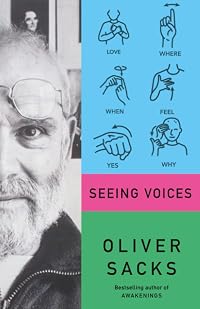
Seeing Voices
by Oliver Sacks
On This Page
Description
A neurologist investigates the world of the deaf, examining their past and present treatment at the hands of society, and assesses the value and significance of sign language.Tags
Recommendations





Member Recommendations

Member Reviews
My American Sign Language teacher recommended the class read Seeing Voices by Oliver Sacks, so I decided to read it during our break between terms. I quickly found myself immersed in a world within the world in which we live. Sacks, a hearing man, explores the Deaf world and Deaf Culture in a way that brings clarity to something that feels impossible to understand. Sacks provides a glimpse into the history of deaf people and their interactions with the world. His observations are compassionate but never pitying. At times I found myself wincing at the cruelty people are capable of inflicting on one another as I read his descriptions of the attitudes toward deaf people throughout history. In his discussion on communication among the Deaf show more and between Deaf and hearing people, I felt a sense of the urgency all living beings feel to communicate. His examination of deaf people's attempts to communicate and how often hearing people force their communication on other people as if its the only way to communicate left me heartsick but more aware of my own tendencies. I felt incredibly aware of how often I take hearing for granted and how often it serves me without me giving it a second thought. Sacks also pushed me to think about how "normal" doesn't mean the same thing to everyone, something I know but sometimes forget. Seeing Voices is about more than Deaf Culture and deaf people, it's a book about how society functions and normalizes and fears and creates and destroys and changes. Seeing Voices screams for us to open our world and see beyond the limitations we place on ourselves and others based on misconception and lack of communication... show less
Here I am listening to Beethoven on my bed, piano arpeggios mingling with the keyboard clicks, someone's footsteps on the stairway, and beyond that this newly consoling silence just floating in the night. I finished this book in a loud pizza shop and had to put earphones in (no music) to focus. At once it is commentary on the density of the prose and research and my chronic inability to focus, especially given how readily available sound and music and hubbub is in my life and in our society.
I don't Sign, but now I want to be introduced to the wholly novel way of thinking and framing that Sign facilitates. I am reminded of the Master of None scene where the soundtrack evaporates and the deaf character begins to express herself, to show more seemingly vibrate with life off the screen, her facial expressions and gestural emotiveness leaping onto a whole new linguistic dimension. My favorite parts of this book were the times Sacks conveys this admiration for Sign, as well as his admiration for language in general. Sign in this book is a channel by which Sacks navigates the anatomical, developmental, cultural, and aesthetic structures and textures of language.
It took me a while to get through this short book, though. Mostly because it is dense. show less
I don't Sign, but now I want to be introduced to the wholly novel way of thinking and framing that Sign facilitates. I am reminded of the Master of None scene where the soundtrack evaporates and the deaf character begins to express herself, to show more seemingly vibrate with life off the screen, her facial expressions and gestural emotiveness leaping onto a whole new linguistic dimension. My favorite parts of this book were the times Sacks conveys this admiration for Sign, as well as his admiration for language in general. Sign in this book is a channel by which Sacks navigates the anatomical, developmental, cultural, and aesthetic structures and textures of language.
It took me a while to get through this short book, though. Mostly because it is dense. show less
This book is pretty old at this point, there are newer books with newer science in them re: the neuroscience of language and sign language in particular. And there was a lot of blah blah about how what the mother does or doesn't do for their infant can make or break them, as if fathers do not a thing to influence child development. But, I like Sacks' style, and I really liked the third part of the book where he describes being on the Gallaudet campus for the Deaf president protests. A great moment in history.
First of all I have to mention the footnotes. They are extensive and take up half the page in some instances. This was very distracting, and I felt almost as if I were reading two books at once.
There were several things here that struck me. I picked up the book as sign language has always interested me, more so after working my last job, where some of the children were not able to hear, and some unable to speak in other ways. This book was interesting and informative and a very quick read.
There was mention early on how one young man, who had lost his hearing after seven years. He would hear the voice of his mother in his head even after his hearing was gone. This made me think of how I and possibly you, do this with books. I hear the show more voices of well known and loved characters in my head as I read. This was defined by the author as an "illusory" type of hearing.
This book explores the options given to the patents of non hearing children as far as signing and lip reading are concerned. There is mention of how som who live in the deaf community choose to Live without trying any extreme measures to give them at least some hearing. I think this is a perfectly good choice for an adult to make.
For an adult to make it for a child, at least as far as not exposing them to different learning settings and options, is in my opinion a mistake. All of us have ways of learning that suit us better than others, and when it comes to parents of a child who faces difficulty from the outset, the choices must be quite stressful. Finding what works best for your child can be difficult without any added obstacles.
We have all heard the horror stories from the past where of children grew to adulthood having been labeled as "slow" or "feeble minded" or worse, when their only issue was lack of hearing, and thus lack of ability to communicate. I have no reason to believe that things have changed enough over the years to keep this from happening now.
My reason for reading this book is that there was a girl I will call V in the classroom where I worked. She was brought in as a 4 year old who had not had any prior intervention, aside from the implantation of a cochlear implant. There was little training for her after the initial few weeks, as she didn't seem to like having the magnet near her head. I believe that if she had been sent to an appropriate school where profoundly deaf children were top priority and the the staff was trained and equipped for that particular challenge, her chances of acieving some learning would have been much better.
At one point she was taken out of school for three years, with no intervention or teaching at all, and then sent back to the same place. By that time she was an adolescent trapped in a world of silence and low vision. I read this book because of her and because I always believed that she would have been capable of so much more, were she given the chance. What I read affirmed that belief for me. show less
There were several things here that struck me. I picked up the book as sign language has always interested me, more so after working my last job, where some of the children were not able to hear, and some unable to speak in other ways. This book was interesting and informative and a very quick read.
There was mention early on how one young man, who had lost his hearing after seven years. He would hear the voice of his mother in his head even after his hearing was gone. This made me think of how I and possibly you, do this with books. I hear the show more voices of well known and loved characters in my head as I read. This was defined by the author as an "illusory" type of hearing.
This book explores the options given to the patents of non hearing children as far as signing and lip reading are concerned. There is mention of how som who live in the deaf community choose to Live without trying any extreme measures to give them at least some hearing. I think this is a perfectly good choice for an adult to make.
For an adult to make it for a child, at least as far as not exposing them to different learning settings and options, is in my opinion a mistake. All of us have ways of learning that suit us better than others, and when it comes to parents of a child who faces difficulty from the outset, the choices must be quite stressful. Finding what works best for your child can be difficult without any added obstacles.
We have all heard the horror stories from the past where of children grew to adulthood having been labeled as "slow" or "feeble minded" or worse, when their only issue was lack of hearing, and thus lack of ability to communicate. I have no reason to believe that things have changed enough over the years to keep this from happening now.
My reason for reading this book is that there was a girl I will call V in the classroom where I worked. She was brought in as a 4 year old who had not had any prior intervention, aside from the implantation of a cochlear implant. There was little training for her after the initial few weeks, as she didn't seem to like having the magnet near her head. I believe that if she had been sent to an appropriate school where profoundly deaf children were top priority and the the staff was trained and equipped for that particular challenge, her chances of acieving some learning would have been much better.
At one point she was taken out of school for three years, with no intervention or teaching at all, and then sent back to the same place. By that time she was an adolescent trapped in a world of silence and low vision. I read this book because of her and because I always believed that she would have been capable of so much more, were she given the chance. What I read affirmed that belief for me. show less
An engaging and thoughtful (though perhaps slightly wide-eyed) overview of deafness and Deafness. Having read two of his books so far, I think Sacks is an academic and writer who treats his subject with a lot of care and is great at communicating what he knows and has learnt in a very accessible and compelling way to the reader.
Lost all the great quotes I'd saved in my notes, except for this eloquent revelation:
It is often not deafness that disables, but rather lack of language, lack of access, lack of understanding.
So much awe and respect for the Deaf community and their culture.
P.S.: The only copy of Seeing Voices I could get my hands on was the audiobook version; irony notwithstanding, it was fairly enjoyable and I do want to try more audiobooks in the future. show less
Lost all the great quotes I'd saved in my notes, except for this eloquent revelation:
And to be defective in language, for a human being, is one of the most desperate of calamities, for it is only through language that we enter fully into our human estate and culture, communicate freely with our fellows, acquire and share information. If we cannot do this, we will be bizarrely disabled and cut off—whatever ourshow more
desires or endeavours, or native capacities.
It is often not deafness that disables, but rather lack of language, lack of access, lack of understanding.
So much awe and respect for the Deaf community and their culture.
P.S.: The only copy of Seeing Voices I could get my hands on was the audiobook version; irony notwithstanding, it was fairly enjoyable and I do want to try more audiobooks in the future. show less
Vendo Vozes é um livro por um lado datado. Foi escrito nos anos 80 e revisado nos anos 90. Um período pré internet que fica evidente ao longo da leitura. São três livros em um e acabam se repetindo um pouco. Diferente de outros livros do mesmo autor, Vendo Vozes tem em alguns momentos uma estrutura de ensaio sobre a importância da linguagem no desenvolvimento da inteligência e do indivíduo. Claro que ele não se restringe à lingua falada, mas principalmente pelo estudo de casos de surdez ele explora o impacto que o desenvolvimento da linguagem afeta a vida daqueles que não escutam. O ponto principal que o autor quer provar é que a linguagem de sinais é rica e complexa o suficiente para desenvolver todo o potencial cognitivo show more que qualquer outra linguagem falada promove. Procura remover o preconceito que se tem em relação a linguagem de sinais como sendo pobre, ou que ela promova um isolamento de quem a usa e dificulta a integração na sociedade. O autor mostra claramente nos seus estudos e casos que a lingua de sinais é a melhor forma de integrar o deficiente auditivo na sociedade, principalmente quando a surdez se instala muito cedo, antes da aquisição de outra linguagem. O livro mostra a história das escolas para surdos, como elas começaram, seus pioneiros, e como um século de desenvolvimento foi retrocedido quando os legisladores ouvintes proibiram às escolas de ensinar a língua de sinais obrigando o ensino da linguagem oral, desenvolvida com muito esforço por aqueles que não escutam. O livro passeia pela história, pelo ensaio linguístico, pelas memórias e experiências do autor. Certamente é um livro importante para quem se interessa por linguagem e pelo mundo dos deficiente auditivos. Pela quantidade de comentários em notas de rodapé, o livro as vezes se torna cansativo, pois algumas notas chegam a ocupar mais da metade da página e cobrir várias folhas. show less
Oliver Sacks has this unfortunate habit of puting 1/4-1/3 of the content of his books into footnotes. Lengthy footnotes, which provide almost a parallel narrative, are interesting in the postmodern sense, but I don't think that's what he's aiming for.
Members
- Recently Added By
Lists

Great Books About Language
73 works; 45 members
Author Information

68+ Works 43,783 Members
Oliver Sacks was born in London, England on July 9, 1933. He received a medical degree from Queen's College, Oxford University and performed his internship at Middlesex Hospital in London and Mount Zion Hospital in San Francisco. He completed his residency at UCLA. In 1965, he became a clinical neurologist to the Little Sisters of the Poor and show more Beth Abraham Hospital. His work in a Bronx charity hospital led him to write the book Awakenings in 1973. The book inspired a play by Harold Pinter and became a film starring Robert De Niro and Robin Williams. His other works included An Anthropologist on Mars, The Mind's Eye, The Man Who Mistook His Wife for a Hat, Uncle Tungsten, Musicophilia, A Leg to Stand On, On the Move: A Life, and Gratitude. In 2007, he ended his 42-year relationship with the Albert Einstein College of Medicine to accept an interdisciplinary teaching position at Columbia. In 2012, he returned to the New York University School of Medicine as a professor of neurology. He died of cancer on August 30, 2015 at the age of 82. (Bowker Author Biography) show less
Some Editions
Series
Belongs to Publisher Series
Proa Butxaca (12)
Work Relationships
Common Knowledge
- Canonical title*
- Vedere voci: un viaggio nel mondo dei sordi
- Original title
- Seeing Voices: A Journey into the World of the Deaf
- Original publication date
- 1989
- Epigraph
- [Sign language] is, in the hands of its masters, a most beautiful and expressive language, for which, in their intercourse with each other and as a means of easily and quickly reaching the minds of the deaf, neither nature no... (show all)r art has given them a satisfactory substitute.
It is impossible for those who do not understand it to comprehend its possibilities with the deaf, its powerful influence on the moral and social happiness of those deprived of hearing, and its wonderful power of carrying thought to intellects which would otherwise be in perpetual darkness. Nor can they appreciate the hold it has upon the deaf. So long as there are two deaf people upon the face of the earth and they get together, so long will signs be in use.
--J. Schuyler Long
Head teacher, Iowa School for the Deaf
The Sign Language (1910) - Dedication
- For Isabelle Rapin, Bob Johnson, Bob Silvers, and Kate Edgar
- First words
- We are remarkably ignorant about deafness, which Dr. Johnson called "one of the most desperate of human calamities"--much more ignorant than an educated man would have been in 1886, or 1786.
- Last words
- (Click to show. Warning: May contain spoilers.)One hopes the events at Gallaudet will be but the beginning.
- Original language
- English
*Some information comes from Common Knowledge in other languages. Click "Edit" for more information.
Classifications
- Genres
- Nonfiction, General Nonfiction, Science & Nature
- DDC/MDS
- 305.908162 — Society, government, & culture Social sciences, sociology & anthropology Social group - Age, Gender, Ethnicity People by occupation and miscellaneous social statuses The Intelligent And Other Disadvanted Groups Disability
- LCC
- HV2370 .S23 — Social sciences Social pathology. Social and public welfare. Criminology Social pathology. Social and public welfare. Protection, assistance and relief Special classes People with disabilities
- BISAC
Statistics
- Members
- 1,799
- Popularity
- 12,225
- Reviews
- 35
- Rating
- (3.73)
- Languages
- 13 — Catalan, Dutch, English, Finnish, French, German, Greek, Italian, Polish, Spanish, Swedish, Turkish, Portuguese (Portugal)
- Media
- Paper, Audiobook, Ebook
- ISBNs
- 50
- ASINs
- 19