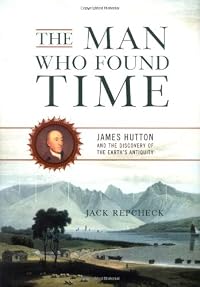
The Man Who Found Time: James Hutton And The Discovery Of Earth's Antiquity
by Jack Repcheck
On This Page
Description
There are three men whose life's work helped free science from the strait-jacket of religion. Two of the three?Nicolaus Copernicus and Charles Darwin?are widely heralded for their breakthroughs. The third, James Hutton, is comparatively unknown, yet he profoundly changed our understanding of the earth, its age, and its dynamic forces.A Scottish gentleman farmer, Hutton's observations on his small tract of land led him to a theory that directly contradicted biblical claims that the Earth was show more only 6,000 years old. This expertly crafted narrative tells the story not only of Hutton, but al show lessTags
Recommendations


















Member Reviews
Through much of the 1700s and before, two assumptions dominated perspectives on history of the earth, due to the pervasive effects of Christian ideology. The first is that the earth is less than 6000 years old, and the second, that Noah's flood accounts for fossils as well as the deposition of layers of rock.
The visionary James Hutton (1726- 1797) was the first to put forward both facts and a detailed theory that challenged this perspective. Three principles can be attributed to Hutton: (a) the earth is very old, almost unimaginably so; (b) current geological processes are no different from those occurring in the past; and (c) "subterranean heat" has been an important causal agent in formation of the earth's crust. With these ideas and show more the evidence for them, Hutton laid the groundwork for the nascent science of geology.
This concise biography offers a readable and informative account of Hutton's life, work, and lasting influence. In the words of Walter Alvarez, it is a "beautifully written and irresistable little book". Part of its value is that it places Hutton in the context of his times. Thus, one early chapter traces the history of biblical chronometry, another describes Edinburgh, where Hutton received his education (known as "Auld Reekie" for the pervasive odor of raw sewage on the sidewalks). Yet another chapter discusses the Scottish Enlightenment, the remarkable period during which Edinburgh flourished as a center of intellectual activity; this was the milieu that fostered the development and reception of Hutton's ideas. Chapters on Hutton's life focus on his education and intellectual influences; his 13 year career as a farmer (during which he made observations that led to his ideas on the long term effects of erosion); and his move back to Edinburgh, where he helped oversee construction of a canal, and stayed to develop and publish his great geological work, his two volume The Theory of the Earth (published in 1795).
Hutton's work did not have immediate influence, and Repcheck explores several reasons why -- that it was poorly written, that it was very technical, and that it was published at a time of political ferment. More plausible than these reasons is the fact that Hutton's ideas were strongly resisted by both scientific and religious orthodoxy. The contemporary biblical geology of Abraham Werner was vastly influential, and his followers made special effort to refute Hutton's claims and interpretations. The accuracy and significance of Hutton's views were not recognized until Charles Lyell (1797-1875) publicized and expanded on them in his (1830-1833) Principles of Geology. Hutton's ideas (through Lyell's work) greatly influenced Charles Darwin, as he began making his own geological observations and formulating his new theory of descent with modification.
Repcheck makes a case that James Hutton stands with Copernicus, Galileo, and Darwin as visionaries who helped to free science from the religious orthodoxies of their times. Hutton's name is barely known outside of the field of geology. However, Repcheck's book contributes to an appreciation of a historical figure who contributed mightily to our understanding of the natural forces that have shaped our earth over the past 4.6 billion years. show less
The visionary James Hutton (1726- 1797) was the first to put forward both facts and a detailed theory that challenged this perspective. Three principles can be attributed to Hutton: (a) the earth is very old, almost unimaginably so; (b) current geological processes are no different from those occurring in the past; and (c) "subterranean heat" has been an important causal agent in formation of the earth's crust. With these ideas and show more the evidence for them, Hutton laid the groundwork for the nascent science of geology.
This concise biography offers a readable and informative account of Hutton's life, work, and lasting influence. In the words of Walter Alvarez, it is a "beautifully written and irresistable little book". Part of its value is that it places Hutton in the context of his times. Thus, one early chapter traces the history of biblical chronometry, another describes Edinburgh, where Hutton received his education (known as "Auld Reekie" for the pervasive odor of raw sewage on the sidewalks). Yet another chapter discusses the Scottish Enlightenment, the remarkable period during which Edinburgh flourished as a center of intellectual activity; this was the milieu that fostered the development and reception of Hutton's ideas. Chapters on Hutton's life focus on his education and intellectual influences; his 13 year career as a farmer (during which he made observations that led to his ideas on the long term effects of erosion); and his move back to Edinburgh, where he helped oversee construction of a canal, and stayed to develop and publish his great geological work, his two volume The Theory of the Earth (published in 1795).
Hutton's work did not have immediate influence, and Repcheck explores several reasons why -- that it was poorly written, that it was very technical, and that it was published at a time of political ferment. More plausible than these reasons is the fact that Hutton's ideas were strongly resisted by both scientific and religious orthodoxy. The contemporary biblical geology of Abraham Werner was vastly influential, and his followers made special effort to refute Hutton's claims and interpretations. The accuracy and significance of Hutton's views were not recognized until Charles Lyell (1797-1875) publicized and expanded on them in his (1830-1833) Principles of Geology. Hutton's ideas (through Lyell's work) greatly influenced Charles Darwin, as he began making his own geological observations and formulating his new theory of descent with modification.
Repcheck makes a case that James Hutton stands with Copernicus, Galileo, and Darwin as visionaries who helped to free science from the religious orthodoxies of their times. Hutton's name is barely known outside of the field of geology. However, Repcheck's book contributes to an appreciation of a historical figure who contributed mightily to our understanding of the natural forces that have shaped our earth over the past 4.6 billion years. show less
This is a fine book about not only James Hutton, but the Scottish Enlightenment of the Late 18th century as well. Most people have never heard of such a social movement, but the University of Edinborough put forth a long list of major figures, like David Hume and Adam Smith, to name a few more widely known figures. Hutton is remembered for codifying some of the fundamental principles of geology (see #40 above), and should be remembered as a revolutionary figure in science in the same breath as Galileo, Newton and Darwin. It is clear and takes the time to explain any technical terms that come up. One of those cross-platform (so to speak) histories, like [The Calculus Wars], which covers an array of levels of history in an effort to show more highlight a particular stratum.
Hutton was the first 'scientist' to challenge the accepted Biblical age of the earth and his theories were highly controversial in his time. Add that to the fact that his book was rushed to completion while he was literally dying of kidney failure, which compromised its quality, and that it was published in London during the American Revolution, it was basically ignored by the general population. A few esteemed professors throughout Europe fought against it bitterly, having their own competing theories that pounded the round peg of fact into the square hole of Biblical chronology. The winner of the two views was Hutton's, which has been supported over and over again by many avenues of experiments and observation. A view that all rocks were created either at the Creation with a capitol C or precipitated into their current form by Noah's Flood, and any evidence to the contrary had been deemed heretical until Hutton's ideas were accepted. show less
Hutton was the first 'scientist' to challenge the accepted Biblical age of the earth and his theories were highly controversial in his time. Add that to the fact that his book was rushed to completion while he was literally dying of kidney failure, which compromised its quality, and that it was published in London during the American Revolution, it was basically ignored by the general population. A few esteemed professors throughout Europe fought against it bitterly, having their own competing theories that pounded the round peg of fact into the square hole of Biblical chronology. The winner of the two views was Hutton's, which has been supported over and over again by many avenues of experiments and observation. A view that all rocks were created either at the Creation with a capitol C or precipitated into their current form by Noah's Flood, and any evidence to the contrary had been deemed heretical until Hutton's ideas were accepted. show less
This is a short book, not much over 200 pages, whose purpose is to make James Hutton (1726-1797) known to the general public. In this it is successful; I had not previously heard of the man. The author is an editor, not a geologist, and it shows; the book reads very much as a secondary source, with information from here and there pieced together. It includes exactly one map, of the UK, with most of the mentioned locations marked, enough to get by, but it is utterly lacking in illustrations of geological features (though it does have a glossary), so the interested but ignorant layperson such as myself must resort to google, which is annoying. The personal information is extracted primarily from a biography of James Hutton by his friend show more John Playfair, and alas not a great deal is known. Also alas, James Hutton wrote his magnum opus as he was dying and in significant pain, and it is apparently less coherent than he was in real life, and fell into obscurity. His work was rediscovered decades later by Charles Lyell, who gave him credit, but who became the famous one, an influence on Charles Darwin. This book is not profound, but it is useful. It presents a sketch of political and intellectual developments during the Scottish Enlightenment. James Hutton lived in and near Edinburgh, and overlapped with David Hume and Adam Smith and James Watt, and Joseph Black, an unfamiliar name to me, but he was a physician and scientist, and social liaison for the others. James Hutton was up against two forces: biblical chronologies, and Abraham Werner's theory of earth formation. A chapter is dedicated to biblical chronologies. At the Council of Nicaea in AD 325, the emperor Constantine was so impressed by the systematic chronology of Eusebius, who had compiled it from multiple sources, that he ordered it to be published and circulated. This served as the basis for subsequent chronologies, all of which predicted the Second Coming of Jesus Christ not too far in the future when the earth would be 6000 years old. Bishop Ussher, whose chronology got into the King James Bible, was toward the end of a long line. Geology then, was a matter of fitting reality into this chronology, and where there was conflict, traditional interpretation of scripture won. Abraham Werner was a generation younger than James Hutton, but a published mineralogist and professor, so in a position of influence. His theory was a synthesis of others, essentially a hot earth gradually cooled by a universal ocean that had evaporated to reveal land; he deliberately did not specify age. Succinctly, James Hutton entered the University of Edinburgh at age 14 (not unusual), studied medicine there and elsewhere, partnered in a chemical factory that generated an income for the rest of his life, inherited land not far from Edinburgh and became a farmer, returned to Edinburgh and joined a committee to construct a canal. At the university, he was influenced by professor Colin Maclaurin, who had worked with Isaac Newton and was intent on spreading the scientific method. As a farmer, he was technologically inventive, and had ample opportunity to observe and extrapolate from natural processes, notably that erosion of surfaces and composition of rocks form a cycle. John Playfair wrote: "They were neither of them, even at that time, entirely new propositions, though in the conduct of the investigation, and in the use made of them, a great deal of originality was displayed." With this as the essential insight, James Hutton searched for supporting evidence, refined his theory, and presented it to the Royal Society of Edinburgh in 1785. He realized that the earth must be far older than generally supposed, but had no means of determining how old. This is the gist, fleshed out with investigative excursions around Scotland and England and Wales, other prominent theories, subsequent discoveries, and current status. I am insufficiently educated in the basics to absorb many details, so for me the relative brevity of the book was just about right, and despite the flaws I would recommend it.
(read 11 Sep 2011) show less
(read 11 Sep 2011) show less
Short and easy to read, but mainly demonstrates how little is actually known about Hutton. Gives nice digestible passages about the Scottish Enlightenment and scientific ideas of the time. Intriguing is that Hutton's grasp of geology came literally from hands-on engagement, namely his work with the soil of his own farm. My interest partly sparked by a visit to Siccar Point, which gets only a passing mention in the main text but the writer returns to it in a postscript where he tells of his field encounter with a herd of scary cows - they scared me too!
Dr. James Hutton is now considered the "Father of Modern Geology" but this was not always the case. Scientists, up until relatively recently, had to contend with Mother Church and its interpretations of the age of the Earth based on the Bible. Hutton was no exception to this.
Repcheck is able to blend the life of Dr. James Hutton with the events around him in Scotland, England and the Continent into a fabulous story. By giving the reader a fantastic glimpse into eighteenth-century Edinburgh society, we can truly begin to understand the Scottish Enlightenment and its profound impact on the rest of the world.
As Repcheck points out, Dr. James Hutton is not a household name while Charles Lyell is when it comes to the history of geology. I show more have to admit that I had never heard of Hutton and I took a number of geology classes in university. Now that I have read this book, I have a greater appreciation for Lyell because some of his ideas derived from Hutton's theory.
If you have any general interest in sciences and their development in the seventeenth, eighteenth or nineteenth centuries, then this book can and will give you a great introduction to the Scottish Enlightenment and the works of this particular individual and the field of geology.
Happy Reading, show less
Repcheck is able to blend the life of Dr. James Hutton with the events around him in Scotland, England and the Continent into a fabulous story. By giving the reader a fantastic glimpse into eighteenth-century Edinburgh society, we can truly begin to understand the Scottish Enlightenment and its profound impact on the rest of the world.
As Repcheck points out, Dr. James Hutton is not a household name while Charles Lyell is when it comes to the history of geology. I show more have to admit that I had never heard of Hutton and I took a number of geology classes in university. Now that I have read this book, I have a greater appreciation for Lyell because some of his ideas derived from Hutton's theory.
If you have any general interest in sciences and their development in the seventeenth, eighteenth or nineteenth centuries, then this book can and will give you a great introduction to the Scottish Enlightenment and the works of this particular individual and the field of geology.
Happy Reading, show less
This book was really interesting. It covered a person I had heard of before, but not directly. As this book states, James Hutton postulated that the Earth was actually older than the Bible would have us believe. Some other people came up with theories for that too, but they didn't have satisfactory evidence to back up their claims. So Dr. Hutton goes out and finds proof of all of his theories, but there are detractors of course. Most people were wedded to the idea of the Biblical creation for many years after Hutton died, but then Charles Lyell comes along and rediscovers Hutton's theory.
I thought the book was well written. It established the culture of the times, how Newton had been a believer in the Biblical Creation and the history show more of trying to count years from the bible. That in itself was really fascinating. I knew they could count off years that were given, but I didn't know the precise way it was done. It turns out that they tried to predict the Second Coming, and flubbed the numbers to make sure it happened after they were dead. So then finally someone came up with the precise date of Creation as being October 23, 4004 BC at Noon. This undoubtedly held back progress for years, but whatever.
Back to the book itself though. It covers the years that Hutton had lived and touches upon some of the years of the Scottish Enlightenment. It talks about the luminaries of those times and lists Hutton as someone deserving of as much praise as Galileo, Newton, and Copernicus. This is something that I can agree with in the sense that Hutton turned a preconceived notion on it's head, and demanded hard facts. show less
I thought the book was well written. It established the culture of the times, how Newton had been a believer in the Biblical Creation and the history show more of trying to count years from the bible. That in itself was really fascinating. I knew they could count off years that were given, but I didn't know the precise way it was done. It turns out that they tried to predict the Second Coming, and flubbed the numbers to make sure it happened after they were dead. So then finally someone came up with the precise date of Creation as being October 23, 4004 BC at Noon. This undoubtedly held back progress for years, but whatever.
Back to the book itself though. It covers the years that Hutton had lived and touches upon some of the years of the Scottish Enlightenment. It talks about the luminaries of those times and lists Hutton as someone deserving of as much praise as Galileo, Newton, and Copernicus. This is something that I can agree with in the sense that Hutton turned a preconceived notion on it's head, and demanded hard facts. show less
THE MAN WHO FOUND TIME was highly recommended in recently published THE GEOGRAPHY OF GENIUS.
Heading south on the North Sea along with two friends who would become his champions,
James Hutton found the shale and sandstone outcrop/unconformity at Siccar Point that would prove
his erosion-sedimentation-uplift theory.
His logic and reasoning took him to the next step of the origin and timeline of the earth,
with journeys to Arthur's Seat and Glen Tilt.
Not sure that readers need so much extra information on The Bonnie Prince and the history of The Church.
It may be enough to know that not much has changed in Church intelligence since Copernicus and Galileo.
Just a modern mental IInquisition.
More maps (Edinburgh!) and photos or drawings of geology show more formations would enhance the tale.
As well, the author offers great build-ups to the Eureka locations, yet delivery feels anti-climactic. show less
Heading south on the North Sea along with two friends who would become his champions,
James Hutton found the shale and sandstone outcrop/unconformity at Siccar Point that would prove
his erosion-sedimentation-uplift theory.
His logic and reasoning took him to the next step of the origin and timeline of the earth,
with journeys to Arthur's Seat and Glen Tilt.
Not sure that readers need so much extra information on The Bonnie Prince and the history of The Church.
It may be enough to know that not much has changed in Church intelligence since Copernicus and Galileo.
Just a modern mental IInquisition.
More maps (Edinburgh!) and photos or drawings of geology show more formations would enhance the tale.
As well, the author offers great build-ups to the Eureka locations, yet delivery feels anti-climactic. show less
Members
- Recently Added By
Lists

History of Geology
6 works; 1 member
Author Information

3 Works 519 Members
Jack Repcheck is an editor at W. W. Norton Company. His previous book was the critically acclaimed The Man Who Found Time: James Hutton and the Discovery of the Earth's Antiquity
Awards and Honors
Awards
Common Knowledge
- People/Characters
- James Hutton
- Important places
- Edinburgh, Scotland, UK
Classifications
- Genres
- Science & Nature, Nonfiction, History, Biography & Memoir, General Nonfiction
- DDC/MDS
- 551.092 — Natural sciences & mathematics Earth sciences; geology Geology, hydrology, meteorology {geology limited to properties and phenomena of the solid earth} standard subdivisions History, geographic treatment, biography Biography
- LCC
- QE22 .H9 .R47 — Science Geology Geology General
- BISAC
Statistics
- Members
- 350
- Popularity
- 89,682
- Reviews
- 13
- Rating
- (3.68)
- Languages
- English, German
- Media
- Paper, Ebook
- ISBNs
- 9
- ASINs
- 2