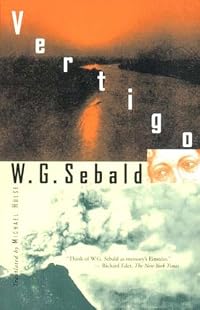
Vertigo
by W. G. Sebald 
On This Page
Description
A unnamed narrator, beset by nervous ailments, is again the readers' guide on a hair-raising journey through the past and across Europe, amid the restless literary ghosts of Kafka, Stendhal, and Casanova. In four dizzying sections, Sebald, one of the most acclaimed European writers of our time, plunges the reader into vertigo, into that "swimming of the head" as Webster defines it.Tags
Recommendations




























Member Reviews
If you want to confuse someone, ask them to explain the plot of a Sebald novel. Better yet, ask them if his novels actually are novels. Because I’m not entirely sure they are – and yet I’m pretty sure they’re fictional. Vertigo describes the arrival in Italy of Stendahl in the early 1800s as part of Napoleon’s army, and then covers his life somewhat swiftly. The next section recounts two visits by the narrator to Venice, and other towns in Italy, as in 1987 he retraces some of his travels of 1980. The third section describes an incident during Franz Kafka’s life, when he was supposed to give a talk in an Italian town in his professional capacity. In the final section, the narrator returns to his childhood village and notes show more the changes since he left decades before. It’s clear the narrator is Sebald himself, but not clear how much of what he recounts is invention. Certainly Venice, which he visits, is a real place, and the places he mentions in the city are real and the histories he gives them are real; but is the village of W., where the narrator spent his childhood, an actual place? Does it matter? I am, as should be clear from my own writing, interested in that liminal area between true fact and invented fiction – that is, essentially, what the glossary to Adrift on the Sea of Rains is. (And I admit it, Sebald’s Austerlitz was one of the inspirations behind my novella.) Reading Sebald is unlike reading any other author, and it’s for that reason – and the sheer quality of his prose – that I treasure his books. I plan to work my way through his entire oeuvre. show less
Science tries to tell us what we can know; literature now has the unenviable task of telling us what we can’t. Ever since the beginning of the 20th century, this has been the mission of just about all the writers acknowledged to be our greatest, and, in fact, how many of them defined their own project.
Sebald is one of the later masters of this art. In this earlier book, all the elements that will define his work are present, and if they haven't reached their apotheosis, it doesn't matter, because he will always give you those fractal moments, wherein the whole seems to be contained in a single, perfectly realized sequence. And at the same time, you know you can't just read any part, or any one book. To have read Sebald truly you will show more have to push on and read everything by him, even though at the end of this process you also know you will find no revelation, no epiphany, no sense of culmination--just the melancholy and pleasurable job of starting again. show less
Sebald is one of the later masters of this art. In this earlier book, all the elements that will define his work are present, and if they haven't reached their apotheosis, it doesn't matter, because he will always give you those fractal moments, wherein the whole seems to be contained in a single, perfectly realized sequence. And at the same time, you know you can't just read any part, or any one book. To have read Sebald truly you will show more have to push on and read everything by him, even though at the end of this process you also know you will find no revelation, no epiphany, no sense of culmination--just the melancholy and pleasurable job of starting again. show less
Throughout Vertigo, W.G. Sebald, through deceptively clear prose and photographs, creates a disorienting waking dream for his readers. The novel is divided into four sections, and while there is not a straightforward plot or clear storyline, Sebald weaves thematic connections as well as specific details revisited from different perspectives to hold the novel together. Some sections read as biographies of historical figures, while others are written from the perspective of neurotic characters, traveling in Venice, Vienna, and the Tyrolean Mountains in dreamlike states.
Nothing is stable in Sebald's world. Although maps, atlases, and sketches of terrain appear throughout the book, discrepancies between these guides and the actual sites, show more changed by time, development, or the gap between the ideal and reality, make these worlds difficult for the characters to navigate. Sebald uses water as another device to convey the dream-like vertigo suffered by his characters. Waves roll, vaporetti rock on the canals of Venice, the lapping of water acts as a lullaby. Buildings and works of art molder and decay. Characters attempt to find something concrete to hold onto - friends, people on the streets, a walking routine, scraps of paper to decipher - but in the end their dream-states always prevail.
Since finishing Vertigo, I can't shake off the disorienting sense that I was dreaming along with the characters. This novel is recommended for people who don't require traditional plots, but who are interested in traveling with Sebald, witnessing his blurring of genres, and sharing in the disconcerting experience of life with his characters. show less
Nothing is stable in Sebald's world. Although maps, atlases, and sketches of terrain appear throughout the book, discrepancies between these guides and the actual sites, show more changed by time, development, or the gap between the ideal and reality, make these worlds difficult for the characters to navigate. Sebald uses water as another device to convey the dream-like vertigo suffered by his characters. Waves roll, vaporetti rock on the canals of Venice, the lapping of water acts as a lullaby. Buildings and works of art molder and decay. Characters attempt to find something concrete to hold onto - friends, people on the streets, a walking routine, scraps of paper to decipher - but in the end their dream-states always prevail.
Since finishing Vertigo, I can't shake off the disorienting sense that I was dreaming along with the characters. This novel is recommended for people who don't require traditional plots, but who are interested in traveling with Sebald, witnessing his blurring of genres, and sharing in the disconcerting experience of life with his characters. show less
It seemed remarkable to me the ease in which I sped through this book. Not that I understood it all, I did not. Even though the translation I read was in English, the writing still felt foreign to me. The words for people and places, and even things, were unfamiliar, and from time to time I would skip back a few pages to see if I had missed something important in my understanding of this dream. Reading this felt like a dream. And often I would find myself pages ahead to somewhere I failed to understand how I could have gotten to. There have been enough moments in my life on the road when I have felt the same way. The many miles I drove each day found me in places I knew I needed to be but hadn't a memory of getting there. It was if the show more car had driven itself. My mind would wander. The experience was similar to reading Max Sebald's Vertigo.
Others have claimed the same dream-experience regarding this book. It could go without saying that I will read this book again, most likely after I have read all four of the major Sebald works. It is comforting to me, the manner in which he writes. The way in which Sebald introduces something almost nonchalantly and then offers a treatise on the subject. But not exactly, because as soon as you get comfortable in this new direction his text has taken he swerves off the road again naturally, as if he meant to, and with such great skill the move feels not frightening at all.
I am envious of the way in which Sebald records his memories. The grace in his athleticism on the page is nothing short of astounding. He is so coordinated in these actions. And the photographs add so much even if they are blurred and out of focus, tired and crumbling from years of being stored on dusty shelves in boxes tied in knots of twine and wire gauged in oil and overuse. A language foreign, but lined in memory, familiar but uncanny, and sounding out the truth he makes believable in my own world today, rife with its own skeptical and judgmental versions of a country's patriotic morals and delusional beliefs of superiority. Sebald instead adds to the growing number of this member group of like-minds against, but holds dear his own position of autonomy. And though the leaders of this memory-movement are mostly all dead, their numbers are expanding, daily, and with a fervor, in my mind, bordering on nothing short of something quite delightful. The insanity of made-time. show less
Others have claimed the same dream-experience regarding this book. It could go without saying that I will read this book again, most likely after I have read all four of the major Sebald works. It is comforting to me, the manner in which he writes. The way in which Sebald introduces something almost nonchalantly and then offers a treatise on the subject. But not exactly, because as soon as you get comfortable in this new direction his text has taken he swerves off the road again naturally, as if he meant to, and with such great skill the move feels not frightening at all.
I am envious of the way in which Sebald records his memories. The grace in his athleticism on the page is nothing short of astounding. He is so coordinated in these actions. And the photographs add so much even if they are blurred and out of focus, tired and crumbling from years of being stored on dusty shelves in boxes tied in knots of twine and wire gauged in oil and overuse. A language foreign, but lined in memory, familiar but uncanny, and sounding out the truth he makes believable in my own world today, rife with its own skeptical and judgmental versions of a country's patriotic morals and delusional beliefs of superiority. Sebald instead adds to the growing number of this member group of like-minds against, but holds dear his own position of autonomy. And though the leaders of this memory-movement are mostly all dead, their numbers are expanding, daily, and with a fervor, in my mind, bordering on nothing short of something quite delightful. The insanity of made-time. show less
It's rare that I encounter an author that makes me want to read and read and read because the way they write is so perfect. This is the first W G Sebald book I've read and I will be reading more. Everything about this book is perfect, from its surreal interludes and quirky uncaptioned images to its reflections on memory and the past. Read it.
"He had no answers, but believed the questions were quite sufficient" (p. 62)
Now I have read all of Sebald's four major "novels". I feel, as I often do after reading Sebald, unable to say anything meaningful about his work, even though I was deeply moved while reading him. It seems funny to me, in retrospect, that I didn't especially like Rings of Saturn, the first book of his I read. I'm sure if I return to it now I will love it. His writing goes to the edge of so many things that it is easy to imagine one not liking it if they just aren't in the mood for this type of stuff, though lately I have been all about this type of stuff.
Since I am again unable to say anything meaningful, I wanted to transcribe what I wrote about Sebald in my show more notebook while sitting in the park a few weeks ago:
The problem with most writing is that it tries to do so much and what it tries to do is so predictable and in the same mode. I want a literature that is not trying to say anything, not the intention constantly hounding at every word. How to write for the barely visible? How to make it not seem significant, at least not in the normal ways? Approaching BOREDOM that is the goal. Even achieving boredom, which is a task--boredom that is not the result of boring writing--boredom which is carefully manufactured boredom in the reader which is a kind of constant attentiveness--a state of unease where the reader is potentially responsible for everything.
Deliberately slowing down the pace, not deliberately beautiful, as if an accident. Signifiers not bundled together like a thesis--a sort of rambling that defies easy 'purpose', allowing the person speaking to be the only common element, that voice and his concerns which is larger than the piece of writing, that goes on afterward and was going on before, that the writing becomes a sort of artifact of his thinking & materializing perspective without DEFINING him, without concluding anything without easyness of "saying".
It is not that it lacked significance, it's that the words did not create that significance. The words were like a rag, already soaked in whatever mysterious significance it needed--so that the words themselves didn't have to try to convey anything. The attention is focused back to the basic attention of the sentence, its parts taken simply which becomes a feat astounding by itself. To read every sentence as if it were the only sentence in the English language. To make a reader read it that way. How?
I'd like to append that I do not completely stand behind all these thoughts, they are just jottings I made without time to revise or think through. Nonetheless, Sebald was on my mind when I was thinking about these subjects. Also interesting is this article I read about Sebald, in which I quote:
It is clear that his work was as unfinished as it was original. And odd. It was work of high seriousness without pretension. That is, it engaged with many of the great themes of the literature and art of the past: war, peace, life, death, art itself, memory, absence, omission. But almost as prominent was—for a writer with such high regard for the history of individuals—the almost total absence of such concerns as love, sex, family, children; or of such ordinary (and powerful) emotions as jealousy, hatred, love (again) or greed.
It is interesting that I never thought about what was omitted in his writings, which are very familiar themes in other writer's works. I would also add that "love" in that quote above should probably be amended to "romantic love", since he does convey a lot of friendship and deep connections between (usually neglected) people, as well as familial love. And also absent is humor, though there are glimpses where you can tell he was highly attuned to humor, but that his main concern, at least in his writings, lay elsewhere.
I would like to say something about his technique of embedding images within his narrative, but I fear I have not thought it through enough to say anything interesting yet. Perhaps that will be something I can think about on a re-read, which I plan to do very soon, starting with Rings of Saturn.
One last thing that I wanted to mention, and this is going out on a limb, is that it would be interesting to study the parallels between Sebald and Bolano. From the limited Bolano that I've read, I feel like they are approaching the same subjects and big questions from completely different angles and writing styles. Which means I should probably read more Bolano, since I also did not love the first (and only) Bolano I've read (2666). I will end with a quote from the book itself, since I have already rambled on long enough:
"The more images I gathered from the past, I said, the more unlikely it seemed to me that the past had actually happened in this or that way, for nothing about it could be called normal: most of it was absurd, and if not absurd, then appalling." (p. 212)show less
Stendhal e Kafka, ma anche Pisanello e Giotto. Questi i compagni dei viaggi - reali, immaginati, ricostruiti - qui descritti da Sebald, in peregrinazioni incentrate soprattutto sull'Italia e sull'inseguimento di un senso di vertigine che dà il titolo al libro, suo primo romanzo e già capolavoro. Fra le quattro parti del libro, All'estero è quella che prediligo, per via dell'affascinante equilibrio fra progetto e imprevisto, non senza momenti di ironia.
Members
- Recently Added By
Published Reviews
ThingScore 100
The time has come to say something about this writer's extraordinary prose, without which his rambling plots and ruminations would be merely clever and unsettling. Like the coincidences he speaks of, it is a style that recovers, devours, and displaces the past. He has Bernhard's love of the alarming superlative, the tendency to describe states of the most devastating confusion with great show more precision and control. But the touch is much lighter than Bernhard's, the instrument more flexible. Kafka is present here too, perhaps from time to time Robert Walser, and no doubt others as well. But all these predecessors have been completely digested, destroyed, and remade in Sebald and above all in his magnificent descriptions, which mediate so effectively between casual incident and grand reflection. show less
added by jburlinson
Lists

German Literature
514 works; 50 members

20th Century Literature
1,161 works; 55 members

1,001 BYMRBYD Concensus
723 works; 27 members

Books Read in 2020
4,379 works; 124 members
Author Information

32+ Works 16,911 Members
He studied German language and literature in Freiburg, Switzerland and Manchester. He has taught at the University of East Anglia in Norwich, England since 1970. He became a professor of European literature in 1987. From 1989 to 1994 was the first director of the British Centre for Literary Translation. He was born in Wertach in Allgau, Germany in show more 1944. (Bowker Author Biography) show less
W. G. Sebald has a Legacy Library. Legacy libraries are the personal libraries of famous readers, entered by LibraryThing members from the Legacy Libraries group.
Some Editions
Awards and Honors
Series
Belongs to Publisher Series
Work Relationships
Common Knowledge
- Canonical title*
- Duizelingen
- Original title
- Schwindel. Gefühle.
- Alternate titles*
- Melancholische dwaalwegen : roman
- Original publication date
- 1990 (German edition) (German edition)
- People/Characters
- Stendhal; Franz Kafka; Elizabeth of Bohemia; W.G. Sebald; Giacomo Casanova
- Important places
- London, England, UK; Vienna, Austria; Lake Garda, Italy; Milan, Lombardy, Italy; Venice, Veneto, Italy; Verona, Veneto, Italy
- First words
- In mid-May of the year 1800 Napoleon and a force of 36,000 men crossed the Great St Bernard pass, an undertaking that had been regarded until that time as next to impossible.
- Last words
- (Click to show. Warning: May contain spoilers.)And, the day after, a silent rain of ashes, westward, as far as Windsor Park.
- Original language*
- Duits
*Some information comes from Common Knowledge in other languages. Click "Edit" for more information.
Classifications
- Genres
- Fiction and Literature, General Fiction
- DDC/MDS
- 833.914 — Literature & rhetoric German & related literatures German fiction 1900- 1900-1990 1945-1990
- LCC
- PT2681 .E18 .S313 — Language and Literature German, Dutch and Scandinavian literatures German literature Individual authors or works 1961-2000
- BISAC
Statistics
- Members
- 1,850
- Popularity
- 11,609
- Reviews
- 27
- Rating
- (3.95)
- Languages
- 18 — Chinese, Czech, Danish, Dutch, English, Estonian, Finnish, French, German, Hungarian, Italian, Japanese, Norwegian (Bokmål), Polish, Portuguese, Spanish, Swedish, Turkish
- Media
- Paper, Ebook
- ISBNs
- 45
- ASINs
- 9