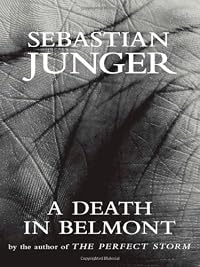
A Death in Belmont
by Sebastian Junger
On This Page
Description
In the spring of 1963, the quiet suburb of Belmont, Massachusetts, is rocked by a shocking sex murder that exactly fits the pattern of the Boston Strangler. Sensing a break in the case that has paralyzed the city of Boston, the police track down a black man, Roy Smith, who cleaned the victim's house that day and left a receipt with his name on the kitchen counter. Smith is hastily convicted of the Belmont murder, but the terror of the Strangler continues. On the day of the murder, Albert show more DeSalvo--the man who would eventually confess in lurid detail to the Strangler's crimes--is also in Belmont, working as a carpenter at the Jungers' home. In this spare, powerful narrative, Sebastian Junger chronicles three lives that collide--and ultimately are destroyed--in the vortex of one of the first and most controversial serial murder cases in America.--From publisher description. show lessTags
Recommendations




Member Reviews
This is a meticulously researched true crime novel that was born out of a family legend. The tale goes that the man who would eventually confess to being the Boston Strangler worked a construction job at the author's house when he was a child. 'Al' as he was know locally, once tried to lure the author's mother into the basement on a flimsy pretext. The incident bothered her, but she never told anyone until after he was in jail.
Later, a woman was murdered right there in his sleepy hometown of Belmont. A black man was arrested - he was only in town for a cleaning job at the murdered woman's house. The family story was that the man was completely innocent. Local cops just picked up the black man in town - a stranger - and charged him show more because of racism. As the author investigates, this traditional lore is challenged. The case is not as cut and dry as he originally imagined.
This book is heavily laden with history, interrogation transcripts, and courtroom speeches. The author's careful handling of the case does a great job of conveying the complexity of criminal proceedings and the difficulty of ever really knowing the truth. show less
Later, a woman was murdered right there in his sleepy hometown of Belmont. A black man was arrested - he was only in town for a cleaning job at the murdered woman's house. The family story was that the man was completely innocent. Local cops just picked up the black man in town - a stranger - and charged him show more because of racism. As the author investigates, this traditional lore is challenged. The case is not as cut and dry as he originally imagined.
This book is heavily laden with history, interrogation transcripts, and courtroom speeches. The author's careful handling of the case does a great job of conveying the complexity of criminal proceedings and the difficulty of ever really knowing the truth. show less
This is much more than a "true crime" book about a murder. This book is a compelling chunk of American history.
For much of U.S. history -- and all too often, even in these more enlightened times -- justice has failed to be blind, as advertised, when it comes to the color of a person's skin. In 1963, while Boston was gripped by terror over the "Boston Strangler" murders, a killing took place in the quiet, lily-white suburban Boston town of Belmont, Massachusetts. In many ways, it fit the M.O. of the Strangler killings. It was all-too-easily blamed on an African-American workman, Roy Smith who had been hired to clean the victim's house that day.
That same day, less than two miles away, a workman was putting the finishing touches on a new show more addition to the home of Sebastian Junger's family. (Sebastian was just a baby at the time.) The worker's name was Albert DeSalvo.
Over the course of the next few years, Roy Smith was convicted of the Belmont killing; the Boston Strangler killings continued; and then, eventually, Albert DeSalvo was arrested and confessed to most of the Strangler killings (but not the one which had been "solved" in Belmont) and then the killings stopped.
These are the basic facts around which this story is spun. But it is a tale of complexity and depth. Smith was no angel, and DeSalvo's identity as the Strangler has been questioned many times. But the presence of DeSalvo so close to the crime scene that day obviously raises some significant questions. While ultimately forming his own opinions, Junger fairly acknowledges the ambiguities of the situation, while reminding us of basic legal principles such as "reasonable doubt."
As background, Junger takes us into the questionable history of American juris(im)prudence -- both official (2-minute jury deliberations) and unofficial (lychings) -- where alleged crimes by persons of color against whites are concerned. We're introduced to a Mississippi prison that probably killed more African American prisoners with hard labor than the death penalty ever did. We learn about the history of serial killer investigations and the origins of criminal profiling. We even re-live that pivotal event of 1963 -- the Kennedy assasination -- and see its impact on the wheels of American justice. All of this is framed against the backdrop of our changing society, as America moved into and through the tumultuous 1960's.
I found this book almost impossible to put down; it was read in one sitting with only minimal pauses. show less
For much of U.S. history -- and all too often, even in these more enlightened times -- justice has failed to be blind, as advertised, when it comes to the color of a person's skin. In 1963, while Boston was gripped by terror over the "Boston Strangler" murders, a killing took place in the quiet, lily-white suburban Boston town of Belmont, Massachusetts. In many ways, it fit the M.O. of the Strangler killings. It was all-too-easily blamed on an African-American workman, Roy Smith who had been hired to clean the victim's house that day.
That same day, less than two miles away, a workman was putting the finishing touches on a new show more addition to the home of Sebastian Junger's family. (Sebastian was just a baby at the time.) The worker's name was Albert DeSalvo.
Over the course of the next few years, Roy Smith was convicted of the Belmont killing; the Boston Strangler killings continued; and then, eventually, Albert DeSalvo was arrested and confessed to most of the Strangler killings (but not the one which had been "solved" in Belmont) and then the killings stopped.
These are the basic facts around which this story is spun. But it is a tale of complexity and depth. Smith was no angel, and DeSalvo's identity as the Strangler has been questioned many times. But the presence of DeSalvo so close to the crime scene that day obviously raises some significant questions. While ultimately forming his own opinions, Junger fairly acknowledges the ambiguities of the situation, while reminding us of basic legal principles such as "reasonable doubt."
As background, Junger takes us into the questionable history of American juris(im)prudence -- both official (2-minute jury deliberations) and unofficial (lychings) -- where alleged crimes by persons of color against whites are concerned. We're introduced to a Mississippi prison that probably killed more African American prisoners with hard labor than the death penalty ever did. We learn about the history of serial killer investigations and the origins of criminal profiling. We even re-live that pivotal event of 1963 -- the Kennedy assasination -- and see its impact on the wheels of American justice. All of this is framed against the backdrop of our changing society, as America moved into and through the tumultuous 1960's.
I found this book almost impossible to put down; it was read in one sitting with only minimal pauses. show less
Junger wrote one of my favorite books, The Perfect Storm. (Made into a mediocre film, but that shouldn't be held against it.) I can't rate this book quite as high--that book had some absolutely awesome, spine-tingling moments I'll never forget, and this book doesn't match it. I also wouldn't agree with the blurb inside that called it reminiscent of Capote's In Cold Blood, which I read only a few days ago. It might similarly be about a gruesome murder, but their virtues are quite opposite. Capote claimed to have invented a new from, the "non-fiction novel." As a novel I'd rate it highly--the writing is first-rate and worthy of being called literature. But as non-fiction I consider it unreliable for a number of reasons. With Junger's A show more Death in Belmont, I'm not particularly impressed with the prose--indeed on that dimension it falls short of The Perfect Storm. But as non-fiction, as a work of journalism, it's first-rate and convincing in ways I feel Capote's classic book is not.
The origins of the book lie in a piece of Junger's family lore summed up in a photograph in the book--of Junger as an infant held by his mother, and caught also in the photograph Albert DeSalvo, the Boston Stranger. While DeSalvo was working for the Jungers in the Spring of 1963, Bessie Goldberg was raped and strangled to death little more than a mile from their home. A black man, Roy Smith, was convicted of her murder. Junger's mother has always believed Smith was innocent and Goldberg another victim of the Boston Stranger. In telling the story of these two men and the crimes of which they were convicted, Junger examines the American justice system and its flaws: "Between 1973 and 200 more than one hundred people have been released from death row--over 3 percent of the current death-row population--because they were later proved to be innocent." He later adds that of those found to be innocent "one out of five confessed to the crime." Those are sobering statistics. Moreover, half-way in the book given the evidence Junger had related, I thought Smith was probably guilty--although I wouldn't have voted for conviction had I been on the jury--by the end of the book Junger convinced me he was probably innocent.
Note the qualification "probably" and one thing Junger wrestles with throughout is the question not simply of guilt and innocence but doubt--particularly that elusive definition of "reasonable doubt" and how society comes to terms with it. For the "ability of citizens to scrutinize the theories insisted on by their government is their only protection against abuse of power and, ultimately, against tyranny." I do like how Junger used the cases involving DeSalvo and Smith to examine that issue. If I have any complaint, it's that I wish Junger had included his sources--there are no notes of them. At one point for instance, he stated that the polygraph has "error rates of 30 percent." I have no problem believing that--polygraphs after all don't really measure truth--only a physiological response. But I'd have liked to have known on what basis that and other claims were made. Definitely an engrossing book that asked questions every citizen that has to sit in a jury box should think about. show less
The origins of the book lie in a piece of Junger's family lore summed up in a photograph in the book--of Junger as an infant held by his mother, and caught also in the photograph Albert DeSalvo, the Boston Stranger. While DeSalvo was working for the Jungers in the Spring of 1963, Bessie Goldberg was raped and strangled to death little more than a mile from their home. A black man, Roy Smith, was convicted of her murder. Junger's mother has always believed Smith was innocent and Goldberg another victim of the Boston Stranger. In telling the story of these two men and the crimes of which they were convicted, Junger examines the American justice system and its flaws: "Between 1973 and 200 more than one hundred people have been released from death row--over 3 percent of the current death-row population--because they were later proved to be innocent." He later adds that of those found to be innocent "one out of five confessed to the crime." Those are sobering statistics. Moreover, half-way in the book given the evidence Junger had related, I thought Smith was probably guilty--although I wouldn't have voted for conviction had I been on the jury--by the end of the book Junger convinced me he was probably innocent.
Note the qualification "probably" and one thing Junger wrestles with throughout is the question not simply of guilt and innocence but doubt--particularly that elusive definition of "reasonable doubt" and how society comes to terms with it. For the "ability of citizens to scrutinize the theories insisted on by their government is their only protection against abuse of power and, ultimately, against tyranny." I do like how Junger used the cases involving DeSalvo and Smith to examine that issue. If I have any complaint, it's that I wish Junger had included his sources--there are no notes of them. At one point for instance, he stated that the polygraph has "error rates of 30 percent." I have no problem believing that--polygraphs after all don't really measure truth--only a physiological response. But I'd have liked to have known on what basis that and other claims were made. Definitely an engrossing book that asked questions every citizen that has to sit in a jury box should think about. show less
(10) Having grown up proximate to the locales discussed in this book likely made it much more enjoyable for me. My hometown was even briefly mentioned. This is Junger 's (journalist who wrote 'the Perfect Storm') recounting of the murder of Bessie Goldberg. She was killed in her home in Belmont and her neck was wrapped with her stocking just like all the murders of the so-called Boston Strangler. This was 1963 and the black man who was hired to clean the house and left a mere 45 minutes before the husband came home and found her was obviously the main suspect and ultimately committed. But did he do it? Who was actually the Boston Strangler? Could it have been the handyman who worked for the Jungers in Belmont? The man who had been alone show more in the house with his own mother on numerous occasions?
I have never read anything about the Boston Strangler case and frankly had been trying to avoid this true crime genre for awhile. It makes me feel unclean and guilty to be interested in others gruesome tragedies, right? So this was an interesting mystery explored journalistically and read like fiction; read like popular fiction. Lots of zingers about society and information was doled out in chunks as the story flipped around in time and to the two different suspects. Ultimately, the truth cannot be known and this is a bit of a let down.
I would recommend this for an engaging book that doesn't require you to think too much. It is easily read and well written (for the masses.) It does a nice job with the historical setting and brings in some interesting commentary regarding the role of juries, prison as rehabilitation, and of course, the ever ubiquitous theme of racial justice. show less
I have never read anything about the Boston Strangler case and frankly had been trying to avoid this true crime genre for awhile. It makes me feel unclean and guilty to be interested in others gruesome tragedies, right? So this was an interesting mystery explored journalistically and read like fiction; read like popular fiction. Lots of zingers about society and information was doled out in chunks as the story flipped around in time and to the two different suspects. Ultimately, the truth cannot be known and this is a bit of a let down.
I would recommend this for an engaging book that doesn't require you to think too much. It is easily read and well written (for the masses.) It does a nice job with the historical setting and brings in some interesting commentary regarding the role of juries, prison as rehabilitation, and of course, the ever ubiquitous theme of racial justice. show less
It was the finding of an odd family photograph that initially led Sebastian Junger to investigate the murder which forms the basis of this extraordinary true story. Actually, it wasn't so much the photograph itself that was strange, but who was photographed with a one-year-old Sebastian and his thirty-four-year-old mother, Ellen. The story behind the taking of this photograph is actually the most horrifying revelation of all, as this information only further highlights just how close the Jungers came to experiencing their own personal tragedy on that particular day in the spring of 1963.
In 1963, residents of the city of Boston were being terrorized by a series of gruesome murders that soon became known as the 'Boston Stranglings'. show more However, the quiet suburb of Belmont had never experienced the same level of fear until the brutal murder of Bessie Goldberg - which happened only a few blocks from the Junger family home. While Bessie Goldberg's murder bore all the hallmarks of being committed by the Strangler, a young black man by the name of Roy Smith - who had just cleaned the victim's house that day - was arrested, tried, and convicted for her murder. And so, the Strangler continued his reign of terror.
Two years later, Albert DeSalvo - a handyman who was working at the Jungers' home on the day of the Belmont murder - confessed in lurid detail to being the Boston Strangler. Much to the horror of the Jungers, this competent, punctual, and unassuming young man had often spent time alone in their home, as well as with Sebastian and his mother. This disturbing revelation, and the chilling photograph that was taken to commemorate the building of a home studio, opens into a electrifying exploration of race and justice in America during the 1960s. This extraordinary narrative chronicles the multiple lives that collide - and are ultimately destroyed - in the vortex of one of the first and most controversial serial murder cases in America.
I must say that I thoroughly enjoyed reading this book. I found it to be very well-written and thought-provoking, if a little slow in certain parts. Although I felt that the story lost some of its momentum, it still picked up appreciably, and I would certainly give this book a strong A! show less
In 1963, residents of the city of Boston were being terrorized by a series of gruesome murders that soon became known as the 'Boston Stranglings'. show more However, the quiet suburb of Belmont had never experienced the same level of fear until the brutal murder of Bessie Goldberg - which happened only a few blocks from the Junger family home. While Bessie Goldberg's murder bore all the hallmarks of being committed by the Strangler, a young black man by the name of Roy Smith - who had just cleaned the victim's house that day - was arrested, tried, and convicted for her murder. And so, the Strangler continued his reign of terror.
Two years later, Albert DeSalvo - a handyman who was working at the Jungers' home on the day of the Belmont murder - confessed in lurid detail to being the Boston Strangler. Much to the horror of the Jungers, this competent, punctual, and unassuming young man had often spent time alone in their home, as well as with Sebastian and his mother. This disturbing revelation, and the chilling photograph that was taken to commemorate the building of a home studio, opens into a electrifying exploration of race and justice in America during the 1960s. This extraordinary narrative chronicles the multiple lives that collide - and are ultimately destroyed - in the vortex of one of the first and most controversial serial murder cases in America.
I must say that I thoroughly enjoyed reading this book. I found it to be very well-written and thought-provoking, if a little slow in certain parts. Although I felt that the story lost some of its momentum, it still picked up appreciably, and I would certainly give this book a strong A! show less
I've had this book on my shelf for ages, and suddenly it was the right time to read it. Junger is tangentially connected to the case of the Boston Strangler, and this is an insightful and somehow inconclusive retelling of the investigation. In so,e ways it reads like a mystery story, where the police are hard pressed to figure out who the murderer is, and the case is not clear even at the end
A compelling look at the "Boston Strangler" case, the US criminal justice system, and race relations in the 1960s. Bessie Goldberg is killed in Belmont, MA -- at the height of the Strangler's reign of terror -- but the main suspect becomes a transient worker --and black-- Roy Smith. Smith is found guilty and sentenced to life in prison. Albert DeSalvo, the "Boston Strangler" never confesses to, nor is accused of, Goldberg's murder. Unger builds a pretty tight case against DeSalvo and adds a personal angle to the story.
Unger, as usual, does a good job of juggling characters, asking the right questions, and building momentum. To his credit, he does not tie up things neatly with pat answers and lets the multi-layered tragedy speak for itself.
Unger, as usual, does a good job of juggling characters, asking the right questions, and building momentum. To his credit, he does not tie up things neatly with pat answers and lets the multi-layered tragedy speak for itself.
Members
- Recently Added By
Lists

Non-Fiction Worth Reading
1,015 works; 254 members

True Crime
216 works; 16 members

Books Read in 2023
5,547 works; 145 members

Books Set in Boston
5 works; 3 members
Author Information

17+ Works 13,304 Members
Sebastian Junger was born in 1962 in Belmont, Massachusetts. He received his BA degree from Wesleyan University in Cultural Anthropology in 1984. He is a freelance journalist who writes for numerous magazines, including Outside, American Heritage, Men's Journal, and the New York Times Magazine. As an underemployed journalist who assigned himself show more stories and worked as a stringer for the Associated Press in Bosnia, Junger was fascinated by the dangers that people face regularly while doing ordinary jobs. Junger was working as a climber for a tree removal service when the storm occurred that provided the inspiration for his first book. The Perfect Storm (1997) is a carefully researched account of the wreck of the swordfishing boat Andrea Gail, The wreck took place during what one meteorologist called a "perfect storm"--a storm with the worst possible conditions. In order to relate the story of a disaster that left no survivors and had no eyewitnesses, Junger used a combination of sound research, technical detail, and personal insight to reconstruct the final hours. After the publication of this book he was nicknamed the new Hemingway. In 2000, this book was made into a film starring George Clooney and Mark Wahlberg. He wrote several books such as War which is about his time spent with a U.S. Army platoon in Afghanistan. At the Sundance Film Festival in 2010 his documentary Restrepo won Grand Jury Prize for a domestic documentary. Junger's book, Tribe, made the New York Times Bestseller list in 2016. (Bowker Author Biography) show less
Awards and Honors
Awards
Distinctions
Common Knowledge
- Canonical title
- A Death in Belmont
- Alternate titles
- A Death in Belmont
- Original publication date
- 2006
- People/Characters
- Albert Henry DeSalvo; Bessie Goldberg; Roy Smith; Boston Strangler; Israel Goldberg; Ellen Junger (show all 28); Floyd Wiggins; Russ Blomerth; Leah Goldberg; Beryl Cohen; Richard Kelley; Charles Bolster; Jim Bird; John F. Kennedy; Lyndon Baines Johnson; Martin Luther King, Jr.; Malcom X; George Wallace; Dorothy Hunt; Ronnie Clark; Ronnie Walcott; Joann Graff; Sophie Clark; John Bottomly; Mary Sullivan; John Donovan; Marcella Lulka; Erica Wilsing
- Important places
- Belmont, Massachusetts, USA; Chelsea, Massachusetts, USA; Boston, Massachusetts, USA; Fort Dix, New Jersey, USA
- Important events
- Assassination of John F. Kennedy
- Epigraph
- And they said to the Prophet, "How may we stop our ears to the rant of the fool and yet show him charity?"
And he answered, "You show yourselves charity by opening wide your ears to him. The fool in the midst of his babb... (show all)le shall speak truths which the minds of the wise cannot perceive." -- unattributed quote pinned to the office wall of a Massachusetts appellate lawyer. - Dedication
- For my mother, Ellen Sinclair Junger
- First words
- One morning in the fall of 1962, when I was not yet one year old, my mother, Ellen, looked out the window and saw two men in our front yard. One was in his thirties and the other was at least twice that, and they were both d... (show all)ressed in work clothes and seemed very interested in the place where we lived. My mother picked me up and walked outside to see what they wanted.
- Last words
- (Click to show. Warning: May contain spoilers.)Well? Is that conceivably something you might do?
Classifications
- Genres
- General Nonfiction, Nonfiction, Biography & Memoir
- DDC/MDS
- 364.1523097444 — Society, Government, and Culture Social problems and social services Crime Criminal offenses Offenses against the person Homicide Murder History, geographic treatment, biography North America
- LCC
- HV6534 .B43 .J86 — Social sciences Social pathology. Social and public welfare. Criminology Social pathology. Social and public welfare. Criminology Crimes and offenses
- BISAC
Statistics
- Members
- 1,207
- Popularity
- 20,458
- Reviews
- 43
- Rating
- (3.48)
- Languages
- English, German
- Media
- Paper, Audiobook, Ebook
- ISBNs
- 20
- ASINs
- 11