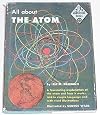
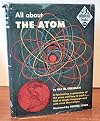
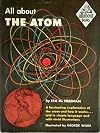
All About the Atom
by Ira Maximilian Freeman
On This Page
Tags
Recommendations





















Member Reviews
1955 Fun with radioactivity!
Published for middle-grade to high-school aged readers, this is an introduction to the history of the science to determine the structure of matter. It begins with the suppositions of the early Greeks, meanders around some, lingers lovingly on the work of John Dalton especially. Then really flies with the advances of Einstein and Fermi, and then tip toes on the A bombs on Japan, the later H bomb tests, and resumes speed with the last chapters of "isn't progress wonderful" with the many uses of isotopes and zapped elements elements mankind has discovered. The gas ethylene + gamma rays of radio cobolt = Polyethylene, hurray!
I can't say that I followed all the science more than superficially Of course not, I'd be show more a nuclear physicist if I could. But sometimes the text made giant scientific leaps in a single bound and I felt extra wobbly and left behind. It was fun, though, how it used clever analogies to put the energy and size of an atom into perspective.
For example, if one atom were blown up to the size of an American football stadium, the atom's nucleus would be the size of a BB pellet on the 50 yard line.
Here was another tidbit that related especially to the industry that dominates my location: oil. Single pipelines carry various oil grades. In 1955, at least, the grades could now be separated by "little squirts" of radioactive oil when the grade changes, which is then detected "by workers" and valves are used to send the new grade to their different storage tanks. I know enough people in the oil industry that I should be able to ask more about this technique and if it is still used. But whether anyone knows, in spite of livelihoods being made, would be interesting in itself.
In the end, I was hurrahing for all the advancements. Yippee! Especially in medicine. And just think how we've had more time to play around with all the wonders (and disasters) for an additional 70 years since this book was published.
I do wonder, though, if there isn't an analogy that could be made of the atom with the value of human knowledge? That, like energy and mass, nothing is ever really made or lost, only changed.
What a book to mark my 200th book read in 2024.
Merged review:
1955 Fun with radioactivity!
Published for middle-grade to high-school aged readers, this is an introduction to the history of the science to determine the structure of matter. It begins with the suppositions of the early Greeks, meanders around some, lingers lovingly on the work of John Dalton especially. Then really flies with the advances of Einstein and Fermi, and then tip toes on the A bombs on Japan, the later H bomb tests, and resumes speed with the last chapters of "isn't progress wonderful" with the many uses of isotopes and zapped elements elements mankind has discovered. The gas ethylene + gamma rays of radio cobolt = Polyethylene, hurray!
I can't say that I followed all the science more than superficially Of course not, I'd be a nuclear physicist if I could. But sometimes the text made giant scientific leaps in a single bound and I felt extra wobbly and left behind. It was fun, though, how it used clever analogies to put the energy and size of an atom into perspective.
For example, if one atom were blown up to the size of an American football stadium, the atom's nucleus would be the size of a BB pellet on the 50 yard line.
Here was another tidbit that related especially to the industry that dominates my location: oil. Single pipelines carry various oil grades. In 1955, at least, the grades could now be separated by "little squirts" of radioactive oil when the grade changes, which is then detected "by workers" and valves are used to send the new grade to their different storage tanks. I know enough people in the oil industry that I should be able to ask more about this technique and if it is still used. But whether anyone knows, in spite of livelihoods being made, would be interesting in itself.
In the end, I was hurrahing for all the advancements. Yippee! Especially in medicine. And just think how we've had more time to play around with all the wonders (and disasters) for an additional 70 years since this book was published.
I do wonder, though, if there isn't an analogy that could be made of the atom with the value of human knowledge? That, like energy and mass, nothing is ever really made or lost, only changed.
What a book to mark my 200th book read in 2024. show less
Published for middle-grade to high-school aged readers, this is an introduction to the history of the science to determine the structure of matter. It begins with the suppositions of the early Greeks, meanders around some, lingers lovingly on the work of John Dalton especially. Then really flies with the advances of Einstein and Fermi, and then tip toes on the A bombs on Japan, the later H bomb tests, and resumes speed with the last chapters of "isn't progress wonderful" with the many uses of isotopes and zapped elements elements mankind has discovered. The gas ethylene + gamma rays of radio cobolt = Polyethylene, hurray!
I can't say that I followed all the science more than superficially Of course not, I'd be show more a nuclear physicist if I could. But sometimes the text made giant scientific leaps in a single bound and I felt extra wobbly and left behind. It was fun, though, how it used clever analogies to put the energy and size of an atom into perspective.
For example, if one atom were blown up to the size of an American football stadium, the atom's nucleus would be the size of a BB pellet on the 50 yard line.
Here was another tidbit that related especially to the industry that dominates my location: oil. Single pipelines carry various oil grades. In 1955, at least, the grades could now be separated by "little squirts" of radioactive oil when the grade changes, which is then detected "by workers" and valves are used to send the new grade to their different storage tanks. I know enough people in the oil industry that I should be able to ask more about this technique and if it is still used. But whether anyone knows, in spite of livelihoods being made, would be interesting in itself.
In the end, I was hurrahing for all the advancements. Yippee! Especially in medicine. And just think how we've had more time to play around with all the wonders (and disasters) for an additional 70 years since this book was published.
I do wonder, though, if there isn't an analogy that could be made of the atom with the value of human knowledge? That, like energy and mass, nothing is ever really made or lost, only changed.
What a book to mark my 200th book read in 2024.
Merged review:
1955 Fun with radioactivity!
Published for middle-grade to high-school aged readers, this is an introduction to the history of the science to determine the structure of matter. It begins with the suppositions of the early Greeks, meanders around some, lingers lovingly on the work of John Dalton especially. Then really flies with the advances of Einstein and Fermi, and then tip toes on the A bombs on Japan, the later H bomb tests, and resumes speed with the last chapters of "isn't progress wonderful" with the many uses of isotopes and zapped elements elements mankind has discovered. The gas ethylene + gamma rays of radio cobolt = Polyethylene, hurray!
I can't say that I followed all the science more than superficially Of course not, I'd be a nuclear physicist if I could. But sometimes the text made giant scientific leaps in a single bound and I felt extra wobbly and left behind. It was fun, though, how it used clever analogies to put the energy and size of an atom into perspective.
For example, if one atom were blown up to the size of an American football stadium, the atom's nucleus would be the size of a BB pellet on the 50 yard line.
Here was another tidbit that related especially to the industry that dominates my location: oil. Single pipelines carry various oil grades. In 1955, at least, the grades could now be separated by "little squirts" of radioactive oil when the grade changes, which is then detected "by workers" and valves are used to send the new grade to their different storage tanks. I know enough people in the oil industry that I should be able to ask more about this technique and if it is still used. But whether anyone knows, in spite of livelihoods being made, would be interesting in itself.
In the end, I was hurrahing for all the advancements. Yippee! Especially in medicine. And just think how we've had more time to play around with all the wonders (and disasters) for an additional 70 years since this book was published.
I do wonder, though, if there isn't an analogy that could be made of the atom with the value of human knowledge? That, like energy and mass, nothing is ever really made or lost, only changed.
What a book to mark my 200th book read in 2024. show less
Very informational on teaching about the atom, and chemistry, and about how it works.
My mother gave me this subscription one year for a Christmas present. This set, togther with the cyclopedia, laid the foundation of my love of science. A huge collection of science, archaeology, history, biography, and anthropology books followed. Unfortunately, most of those were lost as a result of a divorce.
My Childhood collection represents books I remember reading and loving as a young boy. Some are orginal ones I owned, but, unfortunately, most are replacement copies from yard sales, flea markets, and used book stores. I am always on the lookout for a dozen or so, and I am always trying to remember and add new titles. --JJM, 10/15/05
My Childhood collection represents books I remember reading and loving as a young boy. Some are orginal ones I owned, but, unfortunately, most are replacement copies from yard sales, flea markets, and used book stores. I am always on the lookout for a dozen or so, and I am always trying to remember and add new titles. --JJM, 10/15/05
Ratings
Members
- Recently Added By
Author Information
30 Works 1,407 Members
All Editions
Series
Belongs to Publisher Series
AllAbout books (10)
Common Knowledge
- Canonical title
- All About the Atom
- Original publication date
- 1955
Classifications
Statistics
- Members
- 127
- Popularity
- 257,561
- Reviews
- 3
- Rating
- (4.50)
- Languages
- English
- Media
- Paper
- ISBNs
- 2
- ASINs
- 3